Bibliologia
Les folios introductifs de l’Antiphonaire de León (Archivo de la Catedral de León, ms. 8, fol. 1-27)
Étude et édition
L’Antiphonaire de León « joyau des antiphonaires latins » (dom Louis Brou) est le seul complet de l’ancienne liturgie hispanique. Conservé à la cathédrale de León et daté du dixième siècle il est introduit par vingt-sept folios qui appartiennent très certainement au manuscrit originel. Encore largement méconnus malgré leur grande richesse ces folios contiennent des textes littéraires et liturgiques un calendrier des miniatures des tableaux et des roues de comput ainsi qu’un traité de comput. L’édition de ces pièces – à l’exception du traité – et leur analyse pluridisciplinaire (codicologique paléographique iconographique littéraire musicologique liturgique et computistique) permettent d’étudier en profondeur la vie religieuse et la culture de cette époque l’importance de l’héritage wisigothique les influences venues du monde ultra-pyrénéen ainsi que les origines et les remaniements de ce codex. Ces folios introductifs constituent tout à la fois la porte d’entrée et la clef de lecture d’un manuscrit dont l’histoire se trouve au cœur des grands enjeux de son temps : réalisé pour le monastère San Cipriano del Condado il fut vite transféré au monastère Santiago de León puis au chapitre de la cathédrale. Bien que proche des centres de pouvoir – il comporte les seings du roi Ferdinand Ier et de ses fils – il sombra dans l’oubli lorsque son fils Alphonse VI accepta en 1080 de renoncer à la liturgie hispanique et d’adopter à la demande du pape Grégoire VII le rit romain. Cette étude participe à sa redécouverte.
Premodern Jewish Books, their Makers and Readers in an Era of Media Change
This volume brings together studies about books as artefacts within transitional zones. The history of the book from the handwritten to the printed medium is understood as a process marked by innovation and social change but also by disorientation and bewilderment. The journey of a book from production to use was determined by a complex set of factors: communication among authors makers of books patrons and readership; the emergence of publishers; and decisions to be made concerning production and publication. These factors underwent tremendous changes during the fifteenth and sixteenth centuries owing to the spread of printing and the rise of Humanism in Europe. Particular focus is put on the physical evidence of books both handwritten and printed and what it can tell us about a book’s production and its reception.
Late Medieval and Early Modern Libraries
Knowledge Repositories, Guardians of Tradition and Catalysts of Change
Libraries are an important factor in preserving and transmitting knowledge thus contributing to historical continuity. The very concept of simultaneous availability of different texts transmitting possibly contradictory ideas however implies a great potential for engaging readers in new ways of thinking thus promoting change. In addition to transmitting texts historical libraries would often also be perceived as objects of material and spiritual value enhancing the prestige of their owner e.g. contributing to the image-building of the political entities ruled by emperors kings and princes. While the history of individual libraries of the Antiquity the Middle Ages and the Renaissance have been treated in various detail no large-scale study of the impact of Late Medieval and Early Modern libraries as knowledge repositories and guardians of tradition on the one hand and catalysts of change on the other seems to exist. This volume which is inspired by the outcome of the final colloquium of the Lamemoli project held in Siena in March 2022 explores from the book historical point of view a series of both well-known and severely underexplored Late Medieval and Early Modern book collections in existence between c. 1250 and c. 1650 a period of intense mediatic cultural religious and political change in Western Europe. Covering an extensive geographical area from France and Italy to Central and Northern Europe the collections are examined for both their material characteristics and contents and their historical formation in order to assess their roles in preserving and transmitting information as well as generating new ideas.

How the Secularization of Religious Houses Transformed the Libraries of Europe, 16th-19th Centuries
The closure of religious houses in varying circumstances affected all of Europe at some point between the sixteenth and nineteenth century. At different times and in different countries the consequences were widely varied in some cases preserving medieval and early modern collections intact in others abandoning books to their fate or transferring them piecemeal into new ownership to serve different cultural purposes. Integral preservation or dispersal may each be viewed in positive or negative terms. For religious and political history there are many and bigger factors involved and the effects of secularization worked on many things beside libraries and books. None the less by focusing on books and libraries through these changes a particular narrative emerges of great cultural importance. It is the most important book-historical story for the survival and accessibility of Europe's heritage of the written word one that interacts with major historical themes and still connects with future issues for the continuing role of books and libraries in the European heritage.
A conference held in Oxford in 2012 brought together thirty experts in different aspects of this process or with knowledge of its impact in different countries and at different periods. The result was to bring together and share for the first time the similar and different experiences of different European countries from Portugal and Spain in the west to Poland and Ukraine in the east from Finland and Sweden in the north to Naples in the south with ramifications stretching to North and South America. While reading this volume of collected essays the reader may notice a disparity in the evidence that each author has been able to bring to bear upon their subject. Provenance research is well advanced in some territories less so in others. In the decade since the conference and this publication there have been some attempts to bridge certain gaps. But in general there has been little new work in the years since the conference took place. The editors anticipate that this publication will stimulate further research bridging some of the gaps visible in the evidence presented in this volume. Multiple avenues for further investigation open up indeed in historical and cultural studies such as the impact of the secularization on nonreligious libraries and the change in attitude with respect to certain disciplines and even to erudition itself.
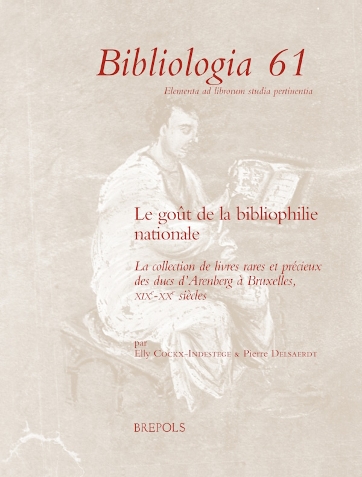
Le goût de la bibliophilie nationale
La collection de livres rares et précieux des ducs d’Arenberg à Bruxelles, xix e-xx e siècles
Dans ce volume les auteurs présentent le résultat de leurs recherches sur la célèbre Collection spéciale du duc Engelbert-Auguste d’Arenberg (1824-1875). Cette bibliothèque de premier plan se trouvait à Bruxelles tout près du Palais d'Egmont où la famille d'Arenberg possédait déjà une importante bibliothèque d'étude et de lecture.
La Collection spéciale était constituée en majeure partie d’imprimés des anciens Pays-Bas datant des xv e et xvi e siècles. Elle s'attacha à illustrer l'histoire des Pays-Bas et l'ancienne littérature en néerlandais et doit donc être comprise comme témoignage de la patrimonialisation du livre au xix e siècle. Il s'agissait d'une collection de tout premier ordre avec bon nombre d'incunables et post-incunables fort rares et même uniques.
Les auteurs situent la Collection spéciale dans le contexte des orientations de la bibliophilie belge au xix e siècle. Ils la reconstituent et en analysent le contenu. Ils décrivent également la façon dont elle fut assemblée puis dispersée. Si la Collection spéciale d'Arenberg parvint à ce degré de perfection c'est entre autres grâce à l'acquisition de nombreux volumes rarissimes et même uniques ayant fait partie de la bibliothèque du bibliophile gantois Constant Philippe Serrure (1805-1872).
Malheureusement la Collection spéciale n'eut pas la vie longue. Au cours des années 1950 elle fut graduellement vendue. Aujourd'hui des volumes ayant fait partie de la Collection spéciale se trouvent dans d'importantes bibliothèques européennes et américaines de Bruxelles à Washington. C'est ce qui fait le prix du catalogue raisonné de la collection riche de 1418 numéros qui sont ici décrits en détail.

Scribes and the Presentation of Texts (from Antiquity to c. 1550)
Proceedings of the 20th Colloquium of the Comité international de paléographie latine
Scribes played complex often overlooked roles in the production of hand-written texts across Antiquity the Middle Ages and the Renaissance. Some scribes simply copied the exemplar; other scribes participated with authors and decorators in establishing the miseen- page and overall appearance of a text. Many decisions needed to be made regarding the selection of text script; the style of rubrication display scripts and initials; the placement and execution of potentially elaborate illuminated images. What was the role of the scribe in contributing to the decision-making process or in determining the final format and material appearance of a document scroll or codex?
This volume explores many of the choices that a single scribe or groups of scribes would need to make when writing and presenting a text whether in a monastic cathedral or lay setting. The articles in the volume range from case studies of a single artifact to the analysis of multiple copies and versions of a particular text.
The authors include eminent specialists in the field of manuscript studies as well as midand early career scholars.
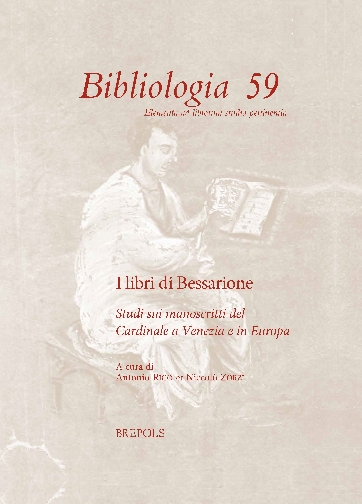
I libri di Bessarione
Studi sui manoscritti del Cardinale a Venezia e in Europa
Thirty years after the conclusion of the cataloguing of the manuscripts kept in the Marciana Library (Venice) due to the the progresses of palaeographic codicological and intellectual studies on Byzantium and Italy in the fifteenth century it is possible to reconsider Bessarion’s library its formation its history its organization and also the activity of the Cardinal (and his collaborators) as a copyist and annotator of manuscripts.
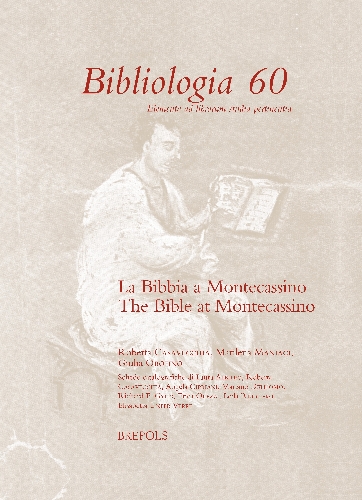
La Bibbia a Montecassino / The Bible at Montecassino
For manuscript historians the Bible in the form of a codex represents a handcrafted object of the utmost importance: it was the sacred text par excellence and served as a vital reference point in the lives of medieval monks. In addition it functioned as an indispensable tool for daily liturgical celebration and as a study text and individual reading book for the purpose of moral edification. The manuscript collection of the Montecassino Abbey presents an exemplary case study both for the total number of biblical manuscripts it preserves (just under a hundred) and for the diversity of types (complete ‘monolithic’ Bibles Old and/ or New Testament sequences of varying size and physiognomy and individual glossed books with commentary beside the text) as well as for the presence of a significant group of codices in Beneventan minuscule produced for internal use within the same Abbey or in its dependencies in a period centered around the eleventh century (with sporadic extensions into the twelfth and thirteenth). The present catalogue aims to deepen our current knowledge of the presence transmission and reception of the Bible in one of the most important and emblematic medieval Benedictine monasteries.
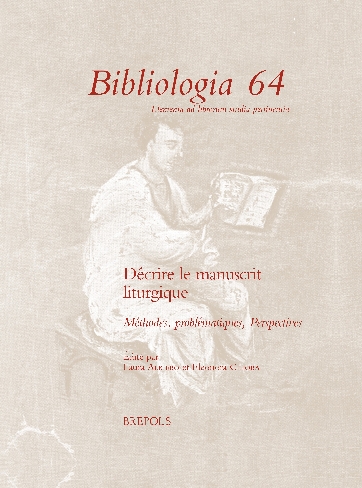
Décrire le manuscrit liturgique
Méthodes, problématiques, perspectives
Objet complexe en raison de sa nature à la fois normative et ‘documentaire’ le livre liturgique offre une diversité de formes qui rend parfois son classement malaisé. Les différents livres destinés au culte sont à considérer non seulement en fonction des textes qu’ils contiennent mais aussi quant à la manière dont les textes sont organisés voire présentés aux aspects codicologiques et surtout aux raisons pour lesquelles ils ont été copiés à savoir les circonstances liturgiques le lieu et / ou le destinataire ultime. Malgré cette approche analytique déjà expérimentée il faut constater une difficulté considérable de la part des chercheurs et conservateurs de bibliothèques à comprendre les manuscrits liturgiques et à en donner une description efficace. Ces aspects ont fait l’objet de deux journées d’étude qui se sont tenues à Paris l’une en 2014 (« Aspiciens a longe. Sources et transmission des livres liturgiques. Répertoires éditions et catalogues ») et l’autre en 2019 (« La description du manuscrit liturgique. Hommage à Victor Leroquais » destinataire de la dotation Hermans). Le présent volume regroupe une grande partie des communications qui offrent des approches différentes et s’avèrent être d’une importance fondamentale pour la compréhension de ce type de sources.
The Angela Burdett-Coutts Collection of Greek Manuscripts
Baroness Angela Burdett-Coutts (1814-1906) descendant of a wealthy and well-known family of bankers inherited quite young through a series of unpredictable circumstances the enormous fortune of Thomas Coutts her maternal grand-father. She spent most of her long life in London where she occupied a prominent position in society becoming well-known not only for her splendid life-style and her important literary and political acquaintances as for instance Charles Dickens and Admiral Nelson but also for her active role as a philanthropist. This book explores a little-known side of her life; although she did not know Greek she became the owner of ca. 100 Greek manuscripts mostly theological datable between the tenth and the sixteenth century a part of which she donated to Highgate School. The manuscripts with all the Baroness's possessions were dispersed at auction in 1921 and in 1987 and are now mainly divided between American and European University Libraries. This book has identified for the first time the Baroness's Greek manuscripts located and described them in detail with special attention to their script style and their origin adding to their description one or two plates of each codex.
Transmission of Knowledge in the Late Middle Ages and the Renaissance
The nineteenth century saw the rapid development of textual criticism for establishing the “best” and “most authentic” forms of both Ancient and Mediaeval texts thanks to the method perfected by Karl Lachmann who based himself on the insights gained during the eighteenth century. Lachmann’s method has been further refined by later philologists with most interestingly the use of computers in establishing the mutual relations of manuscript witnesses since the last decades of the twentieth century. However the interest in what form the texts both Ancient and Mediaeval were actually circulating in the Late Middle Ages and in the Renaissance has been slow to emerge as an area of scholarly interest. In other words: what did the readers actually get in front of their eyes and acted upon as say doctors historians theologians between the thirteenth and sixteenth centuries?
This volume explores the Late Medieval and Renaissance transmission of texts of different genres languages and periods from the book historical point of view taking into consideration not only the textual but also the material aspect of the traditions.
The authors include eminent specialists as well as mid- and early career scholars.
Comment le Livre s'est fait livre. La fabrication des manuscrits bibliques (IVe-XVe siècle)
Bilan, résultats, perspectives de recherche
Dès l’Antiquité et tout au long du Moyen Âge la Bible a été l’un des textes les plus reproduits dans le monde chrétien. Texte sacré par excellence elle a été très largement commentée remaniée utilisée dans des contextes variés et avec des finalités diverses. C’est pourquoi en tout lieu et à toute époque elle constitua l’une des expressions les plus achevées et parfois novatrices du professionnalisme artisanal dans le domaine du livre médiéval. Si le texte de la Bible et sa tradition manuscrite ont depuis longtemps été l’objet d’une attention soutenue de la part des philologues des exégètes et des historiens il en va tout autrement pour ce qui est de son « incarnation » dans un objet matériel.
C’est aux diverses modalités de cette « incarnation » qu’était consacré le colloque international organisé à l’Université de Namur en mai 2012 dont les contributions sont ici réunies. Cette rencontre fut à la fois l’occasion de faire le point sur les connaissances déjà acquises sur la fabrication de la Bible de l’Antiquité tardive au xv e siècle et d’ouvrir de nouvelles pistes de recherche. La perspective adoptée se veut globale et comparative et met en lumière la diversité des solutions retenues pour répondre aux problèmes posés par la réalisation matérielle du texte sacré selon les époques et les contrées des premières bibles pandectes à la diffusion des bibles incunables.
Entre stabilité et itinérance
Livres et culture des ordres mendiants, XIIIe-XVe siècle
Les travaux de ces dernières années confirment que les livres tiennent une place centrale dans l’organisation des couvents mendiants et dans leurs pratiques économiques. Au quotidien les livres font partie intégrante de la vie des couvents comme vecteur de connaissances support d’édification et outil de communication. Les frères les acquièrent pour étudier pour transmettre les savoirs et pour discipliner la société. Les sœurs sont aussi souvent familières de la culture écrite qui peut représenter un lieu de rencontre et de complémentarité entre les communautés masculines et féminines. Les contributions réunies dans ce volume s’attachent à considérer les différentes formes sous lesquelles les uns et les autres ont exprimé leur adhésion à la culture livresque ou leurs éventuelles réserves et reconnaissent dans la tension entre stabilité et itinérance l’un des points essentiels de l’identité culturelle des ordres mendiants. Parmi les aspects étudiés figurent en particulier les réseaux institutionnels et interpersonnels où les échanges de livres ont eu une très grande ampleur à l’humanisme ainsi que les conditions historiques qui marquent le passage du manuscrit à l’imprimé.
Manuscrits hébreux et arabes
Mélanges en l'honneur de Colette Sirat
L'étude des manuscrits hébreux est à juste titre considérée comme le fondement de la recherche en histoire intellectuelle des juifs. C'est sous la plume de Colette Sirat dont les travaux ont profondement marqué aussi bien les études sur la pensée juive et que sur l'histoire de l'écriture que la paléographie hébraïque a acquis une méthodologie rigoureuse un ancrage institutionnel et une série d'ouvrages de référence.
Manuscrits hébreux et arabes est un recueil de mélanges dédiés à Colette Sirat par ses collègues amis et disciples. Les articles portant sur des manuscrits provenant de lieux et périodes différents montrent l'envergure des travaux en paléographie et codicologie hébraïque aujourd'hui.
Medieval Autograph Manuscripts
Proceedings of the XVIIth Colloquium of the Comité International de Paléographie Latine, held in Ljubljana, 7-10 September 2010
What is an autograph? How is it possible to define it? And how can we distinguish the hand of the writer scientist or translator - that is of the learned person setting down his thoughts - from the hand of a pupil or copyist trained in the same style? Autographs have long been an especially challenging area of research into medieval manuscripts for the finished product is intimately linked to both the author’s thought and his hand. Many well-known medieval authors had already been accorded scientific representations and became known as a result of these. They were joined by new names a fact which widens the scope of research in the field of autographs and invites new questions. The XVIIth Colloquium of the Comité International de Paléographie Latine which was held in Ljubljana between 7th and 10th September 2010 was dedicated to autographs. In addition to scientific contributions by established paleographers historians literary and art historians there were also inspiring papers by younger researchers. The colloquium was receptive to the presentation of new methods and processes of research into medieval manuscripts in general. These Proceedings of the XVIIth Colloquium contain 37 scientific papers documented with 239 illustrations as well as with further graphic elements.
Matériaux du livre médiéval
Actes du colloque du Groupement de recherche (GDR) 2836 "Matériaux du livre médiéval", Paris, CNRS, 7-8 novembre 2007
Cet ouvrage présente les résultats des travaux effectués dans le cadre d’un Groupement de recherche (GDR) initié par le CNRS en 2003 pour une durée de quatre ans et portant sur les matériaux du livre médiéval.
Ce groupement de recherche avait pour but de fédérer dans un travail collectif interdisciplinaire et pluridisciplinaire des équipes de recherche en sciences humaines des laboratoires de sciences dites «dures» autrement dit des historiens des paléographes des archivistes-paléographes des chimistes des physiciens des conservateurs de bibliothèques d’archives de musées mais également des enseignants des artisans-papetiers et formaires (les formaires étant des fabricants de formes à faire le papier à la main); participaient aussi au projet parcheminiers enlumineurs calligraphes relieurs etc. ainsi qu’un cinéaste documentariste. L’objectif était de faire progresser la connaissance des matériaux du livre médiéval sur le plan livresque historique expérimental ou analytique en mettant en synergie et en fédérant les approches et les compétences spécifiques des personnels et des laboratoires participant au GDR. Connaissance indispensable pour son apport à l’histoire du livre et capitale pour gérer au mieux les problèmes de la conservation et de la sauvegarde de tout patrimoine.
L’originalité de ce GDR fut d’associer des recherches à la fois très différentes et très complémentaires qui pourraient pour citer T. Delcourt être regroupées en trois grandes catégories: «les recherches techniques sur les supports matériels de l’écrit que sont le papier le parchemin les encres; les recherches sur les différentes étapes intervenant dans la fabrication du livre autour de la reliure mais aussi des ateliers de parcheminiers ou des moulins à papier; enfin des recherches sur le vocabulaire du livre et de l’écrit au Moyen Age si l’on veut comprendre avec un peu de certitude les textes les inventaires ou les recettes qui traitent de la fabrication du livre au Moyen Age.»
Ces travaux ont été exposés au cours d’un colloque qui s’est tenu à Paris en novembre 2007.
The Legacy of Bernard de Montfaucon: Three Hunderd Years of Studies on Greek Handwriting
Proceedings of the Seventh International Colloquium of Greek Palaeography (Madrid-Salamanca, 15-20 September 2008)
In September 2008 the seventh edition of the International Colloquium of Greek Palaeography (Madrid-Salamanca 15-20 September 2008) celebrated the 300th anniversary of the Palaeographia Graeca the pioneer work of the Benedictine Bernard de Montfaucon that established the fundamentals of the discipline. Papers by renowned specialists in the field contributed to the methodology of study and to our knowledge of Greek manuscripts and opened new perspectives for the study of the Greek manuscripts preserved mostly in European libraries taking into account new methodological approaches the possibilities of online resources and the results of ongoing research projects.
The Proceedings published here include contributions by specialists from over ten different countries dealing with palaeographical issues such as ancient capital and lower-case lettering writing and books in the Macedonian Comnenian and Palaeologan periods and Greek scribes and ateliers in the Renaissance (especially in manuscripts from the Iberian Peninsula). Many contributors also take a codicological approach and consider the material aspects of the codex as well as other new research techniques. Finally some papers deal with the book as object and how this relates to its content as well as with the history of texts.
The International Colloquia of Greek Palaeography are organized by the International Committee of Greek Palaeography presided by Prof. Dieter Harlfinger. The seventh edition payed tribute to the memory of the late Jean Irigoin who died in 2006.
Les manuscrits carolingiens
Actes du colloque de Paris, Bibliothèque nationale de France, le 4 mai 2007
À l’occasion de l’exposition «Trésors carolingiens» présentée dans ses salles du 20 mars au 24 juin 2007 la Bibliothèque nationale de France a organisé une journée internationale d’étude autour du livre manuscrit à l’époque en question. L’exceptionnelle richesse du fonds parisien (auquel avaient été adjoints d’incontournables spécimens de certaines bibliothèques régionales françaises) donnait lieu en effet à évoquer pratiquement tous les principaux aspects de la production et du contenu même de ces œuvres ainsi que de leur devenir.
Après une introduction visant à situer le livre carolingien au regard de ses antécédents antiques profanes et païens paléochrétiens et haut-médiévaux (Jean-Pierre Caillet) ce sont les étapes — et les raisons — de l’émergence de l’intérêt pour ces manuscrits et de la constitution de leurs collections qui ont été abordés (Marie-Pierre Laffitte). Il importait d’autre part également de dresser le panorama des grands travaux consacrés à ce domaine de la fin du XIXe siècle à nos jours (Jean Vezin). Le statut privilégié du livre religieux en tant que composante majeure du trésor et tout particulièrement l’assimilation de son contenu à de véritables reliques devaient ensuite être clairement précisés. Naturellement la nature du message iconographique tant à l’égard du texte dont il offre un contrepoint visuel portant ses propres accents que des modèles — anciens ou récents — dont il s’avère tributaire à divers degrés a fourni matière pour de substantielles mises au point (Herbert Kessler Charlotte Denoël Fabrizio Crivello Anne-Orange Poilpré). Les rapports thématiques aussi bien que stylistiques des ivoires de la reliure avec l’imagerie interne du livre ainsi que l’éventuelle diachronie de leur association n’ont pas non plus manqué de susciter un réexamen serré (Lawrence Nees). Par ailleurs les derniers développements d’une investigation de laboratoire sur les pigments utilisés dans l’élaboration des miniatures de certains manuscrits et dont les résultats sont évidemment lourds de conséquences quant aux origines de ceux-ci ont témoigné d’une notable ouverture des perspectives de recherche (Patricia Roger). La conclusion de l’ensemble (Jean-Pierre Caillet) s’attache à souligner l’opportune complémentarité de ces approches; et au-delà des nouveaux acquis ainsi opérés à dégager les orientations encore propres à parfaire la connaissance de ce qui correspond bien à un temps fort de l’évolution culturelle et artistique de l’Occident médiéval.
Early Medieval Palimpsests
Palimpsests are texts from which the primary text has been effaced to make room for fresh writing. The practice was particularly important in the early Middle Ages when numerous often precious books were subjected to this treatment. As a result many ancient texts lay hidden in European libraries for centuries.
Ever since the first palimpsests were discovered in the seventeenth century scholars have been fascinated by the possibility of discovering hitherto unknown texts. For a long time the lower script of palimpsests could only be brought back to the light of day through the use of chemical reagents that proved very detrimental to the manuscripts. The great advance away from these destructive techniques came at the beginning of the twentieth century with the application of ultra-violet photography. Today striking advances in this field are again being made with the development of digital imaging.
The contributions in this volume focus mainly on the cultural evidence offered by palimpsests from the early Middle Ages. Some contributors have examined particular manuscripts in great detail (the London palimpsest of Jerome’s Chronicle or the Munich palimpsest codex from Benediktbeuern); others have looked at specific types of texts that have suffered deletion in this way (liturgical palimpsests Carolingian letters). The volume also contains a handlist of all known palimpsested manuscripts in Beneventan script.