


Comparative Rural History Network- Publications
Making Politics in the European Countryside
1780s-1930s
This book offers a fresh look at the so-called ‘politicisation’ of the European countryside from the late eighteenth century to the 1930s in the context of waning monarchies rising and staggering parliamentary nation states and fascist and communist dictatorships. The concept ‘politicisation’ however is misleading. The book argues that Europe’s rural societies were far from immobile spaces set in routines that had to be politised from outside and against the grain.
The thirteen articles in the volume demonstrate that instead of politicisation from scratch political thinking and acting of country dwellers - from Scandinavia to Spain from Moravia to France - evolved in a constant dialectical relationship with their urban regional and national surroundings: they reacted to wars revolutions and shifting borders their political loyalties changed so did their political agendas their repertoires of collective action and their role in the establishment successes and failures of political parties separate agrarian parties included.
Communities, Environment and Regulation in the Premodern World
Essays in Honour of Peter Hoppenbrouwers
Who had a say in making decisions about the natural world when how and to what end? How were rights to natural resources established? How did communities handle environmental crises? And how did dealing with the environment have an impact on the power relations in communities? This volume explores communities’ relationship with the natural environment in customs and laws ideas practices and memories. Taking a transregional perspective it considers how the availability of natural resources in diverse societies within and outside Europe impacted mobility and gender structures the consolidation of territorial power and property rights. Communities Environment and Regulation in the Premodern World marks Peter Hoppenbrouwers’s career spanning over three decades as a professor of medieval history at Leiden University.
Inequality in rural Europe
(Late Middle Ages – 18th century)
Studies dealing with inequality in European societies have multiplied in recent years. It has now become clear that pressing questions about the historical trends showing both income and wealth inequality as well as the factors leading to an increase or drop of inequality over time could be answered only by taking into account preindustrial times. Therefore this book deals with inequality in the long-run covering and comparing a very long time span starting its investigations in the later middle ages and ending before the nineteenth century the period that marks the beginning of most available studies.
Hitherto urban distribution of income and wealth is much better known than rural inequality. This book intends to reduce this gap in knowledge bringing rural inequality to the fore of research. Since at least until the nineteenth century the majority of people were country men looking at the rural areas is crucial when trying to identify the underlying causes of inequality trends in the long run of history.
The book consists of nine original papers and deals with a variety of topics about inequality covering no less than eight different countries in Europe. The majority of the studies published in this book are the result of teamwork between European universities where a range of research centres are currently exploring different aspects of income and wealth inequality in preindustrial times.
Stocks, seasons and sales
Food supply, storage and markets in Europe and the New World, c. 1600-2000
This book presents ten case-studies by eminent scholars dealing with food supply storage and markets from c. 1600 to c. 2000. Together they present a long-term history of the tools to regulate the rhythms and seasonal patterns of the food production and distribution process. How were the vast flows of staple food needed for metropolitan areas organised? What practical difficulties had to be overcome to preserve this food safely? Did people respond to price patterns in search for profit? Were governments successful in imposing regulation? In dealing with these issues the contributing authors adopt different approaches and investigate cases from England Belgium Germany Austria Italy France and Mexico. The focus on the stocks and flows of grains and other foodstuffs raises new questions combining economic social political and environmental issues in the study of agricultural markets and food policies.
Peasants and their fields
The rationale of open-field agriculture, c. 700-1800
In the Middle Ages and the Early Modern Period open fields could be found in many if not most countries in Europe. They took a wide variety of forms but can in essence be defined as areas of cultivated land in which the intermingled plots of different cultivators without upstanding physical boundaries were subject to some degree of communal management in terms of cropping and grazing. Sometimes such fields occupied a high proportion of the land in a district but often they formed a relatively minor element in landscapes which also contained enclosed fields woodland or expanses of pasture. In some areas open-field agriculture had already been abandoned before the end of the Middle Ages but in others it continued to flourish into the nineteenth or even twentieth centuries.
Although open fields have long been studied by geographers historians and archaeologists much about their origins development and rationale remains contentious. Why across wide areas of Europe did such fields sometimes become central to the experience of so many of our ancestors shaping not only farming practices but also the basic structures of their everyday lives? And why in contrast did they fail to develop or have a less significant role elsewhere?
Over recent decades open fields have been investigated in new interdisciplinary ways and as a Europe-wide phenomenon. In this book more than ever before their development and operation are explained in terms of economic social agrarian and environmental developments which were shared to varying degrees by all parts of the continent. It contains ten new studies from a wide range of regions together with important comparative research from South America and Japan. This collection of essays represents a milestone in the study of open-field agriculture and is a major contribution to the study of the rationale of field systems more generally.
Measuring Agricultural Growth
Land and Labour Productivity in Western Europe from the Middle Ages to the Twentieth Century (England, France and Spain)
This work takes a new look at the question of agricultural production and productivity and reopens the issue of agricultural growth and the questions that still surround its extraordinary impact on European societies. The nine contributions making up the volume set out another approach to this unprecedented shift written from a new angle with new methods and a new way of associating micro and macro analyses.
These chapters also make a break with the illusion of a single and dominant English or Anglo-Dutch model and take a critical look against preconceptions that consist of interpreting everything in terms of advances or delays and of ignoring the context behind the economic decisions made by producers. This collection makes it possible to get away from the eternal confrontation of French and English models and to change the picture by careful consideration of another country with its own very specific natural and institutional conditions: Spain. It sets out to analyse some of the paths taken by farmers to overcome the constraints under which they operated using historical experience and statistical analysis without preconceived ideas.
These papers do not hesitate to cross traditional chronological boundaries and look at different scales of production at different times and in different places. They make incursions into a subject that is still crucial to present-day society at a moment when the future of the food supply on much of the planet is as urgent and acute as ever.
Landscapes or seascapes?
The history of the coastal environment in the North Sea area reconsidered
This volume deals with the geographical evolution of the coastal areas adjacent to the North Sea with a focus upon the last two thousand years. Although many articles are reworked in a fundamental way most of them are the result of a conference which took place in 2010 at Ghent University (Belgium) and which was actually the third in a series of symposiums on the same broad theme. The first took place in 1958 and the second in 1978. Recognized specialists were invited to present their research in a variety of fields relating to the subject. The various disciplines in which the coastal plains are studied too often remain within their own borders and so we have set out to thoroughly interweave them in the hope that this will spur greater interdisciplinary cooperation. This collection of texts is intended to appeal not just to experts in historical geography but to historians and scientists working in any field who wish to gain insights into the present ‘state of play’.
Detailed geological research about many areas provided new data and researchers gradually gained a better understanding of the close relationship between the processes of deposition sea-level change and land formation taking place across multiple regions. In the same time historical and archaeological research also evolved. Most significantly ideas regarding the chronology of human occupation have changed a lot. This scope of the research collected in this volume is important because it has increasingly become evident that land loss and gain were the results of regional factors including and especially human activities. Moreover it is now clear that humans devised survival strategies and thus organized their activities in relation to the environment on a regional basis which means that the causes of local changes must have been both natural and socio-historical. It has now become clearer than ever that there is no single chronological scheme capable of explaining the coastal evolution across the entirety of the North Sea area.
Erik Thoen is professor in rural history and environmental history at Ghent University (B) and co-ordinator of the CORN network.
Guus J. Borger is emeritus professor in historical geography at the University of Amsterdam and the VU University Amsterdam (NL).
Adriaan M.J. de Kraker is senior researcher in historical geography at the VU University Amsterdam (NL).
Tim Soens is professor in rural history and environmental history at the University of Antwerp (B).
Dries Tys is professor at the Brussels Free University (VUB) (B).
Lies Vervaet is assistant specialised in rural history at Ghent University (B).
Henk J.T. Weerts is senior researcher paleogeography at the Cultural Heritage Agency of the Netherlands.

Food supply, demand and trade
Aspects of the economic relationship between town and countryside (Middle Ages – 19th century)
This book is a collection of articles studying various aspects of the relationship between town and countryside during the period from the Middle Ages to the nineteenth century. The focus is on how towns were supplied with basic foodstuffs and especial attention is paid to England and the Low Countries.
Among the articles several deal with the food-provisioning strategies of some of the major cities within that area - Antwerp Ghent and London - and show among other things that large cities were unable to meet their requirements from local supplies and had consequently to access markets further afield. Important matters given substantial elucidation are transport costs and market integration.
In historiography a great deal of attention has been paid to the influence of towns on the countryside and agriculture and particularly to the relationship between the rise of urban markets and the emergence of commercial agriculture but there is still no clarity about how town-countryside relationships influenced economic growth. One of the merits of this book is that it opens up new avenues to an understanding of the complex relationship between urban markets and commercial agriculture. The approach differs from article to article some scholars homing in on the individual strategies of farms others working more in the macroeconomic tradition. In sum the book is a valuable contribution to both rural and urban historiography and can provide a fresh stimulus to the study of economic relationships between town and countryside.
Piet van Cruyningen is senior researcher at the Wageningen University.
Erik Thoen is professor at the University of Ghent.
Exploring the food chain. Food production and food processing in Western Europe, 1850-1990
Until the late 19th century the food industry was restricted to a few activities usually based on small scale industries. The links between agriculture and food processing were very tight. Due to increased purchasing power population growth and urbanisation the demand for food grew substantially. This was not only the case for basis products as corn and potatoes but also and especially for more expensive quality products as meat fish and dairy produce. These developments generated together with the essential technological innovations the creation and development of modern food processing in specialized shops and factories. In only a few decades these industries transformed from an important complement to the primary agricultural production on the farms to a much comprising industrial business. At the end of the 20th century food processing has evolved into a modern high-tech industry dominated by a few large enterprises offering a wide range of products. This volume aims to turn the spotlight on this often neglected but important link in the food chain.
The development of leasehold in northwestern Europe, c. 1200 – 1600
In the twelfth to sixteenth centuries the exploitation of landownership underwent drastic changes in various parts of Northwestern Europe. In these changes the emergence of the lease plays a pivotal role. At the end of the Middle Ages in a number of areas within the North Sea area the greater part of available land was held at lease for relatively short terms. The competitive and contractual nature of such leasing has caused many to associate it with the emergence of capitalism in the countryside seeing its rise as a key element in the transformation of the rural economy and society in the last millennium. In view of this it is surprising that the emergence of leasing has received little systematic attention particularly where its roots its early development its exact arrangements and the social and economic context of its emergence are concerned let alone the regional and chronological differences in these elements. This volume aims to make a first step in exploring these issues.

Credit and the rural economy in North-western Europe, c. 1200-c. 1850
This book retraces the nature and role of credit in the pre-industrial European countryside. As part of an ongoing examination of credit and its provision in European past societies the nine papers collected in this volume offer further insight into the ways in which credit was provided and managed as well as the opportunities which credit may or may not have presented in effecting economic and social change between c. 1200 and c. 1850. In these respects the papers in this volume add to a developing investigation of the history of credit and of indebtedness in northern Europe which also coincides with a continued interest in the structures of credit evident in studies of southern European societies. The present volume also for a broad North Sea region develops a concentration upon the economic and social history of credit from the late medieval period to the early nineteenth century. The themes here are deliberately focused on the nature of credit its form and structure as well as upon the economic and social impact of credit and the changing availability of the same.
Phillipp Schofield is Professor of Medieval History at Aberystwyth University. He has published extensively on the social economic and demographic history of late medieval peasant society in England.
Thijs Lambrecht is postdoctoral researcher with the Research Foundation Flanders and the Department of Early Modern History at Ghent University. His research focuses on rural markets in the Southern Netherlands during the early modern period.
When the Potato Failed. Causes and Effects of the Last European Subsistence Crisis, 1845-1850
The decade that gave rise to the term ‘the Hungry Forties’ in Europe is often regarded and rightly so as one of deprivation unrest and revolution. Two events the Great Irish Famine and the various political events of ‘1848’ stand out. This book is the first to discuss the subsistence crisis of the 1840s in a truly comparative way. This subsistence crisis may be divided into two rather distinct elements. On the one hand the failure of the potato caused by the new unfamiliar fungus phytophthera infestans which first struck Europe in mid-1845 resulted in a catastrophe in Ireland that killed about one million people and radically transformed its landscape and economy. Poor potato crops in 1845 and in the following years also resulted in significant excess mortality elsewhere in Europe. On the other hand this period and 1846 in particular was also one of poor wheat and rye harvests throughout much of Europe. Failure of the grain harvest alone rarely resulted in a subsistence crisis but the combination of poor potato and grain harvests in a single place was a lethal one. Connections between the local and the global between the economic and the political and between the rural and the industrial make the crisis of the late 1840s a multi-layered one.
This book offers a comparative perspective on the causes and the effects of what is sometimes considered as the ‘last’ European subsistence crisis. It begins with an extensive introduction that treats the topic in comparative perspective. The subsistence crisis had its most catastrophic impact in Ireland and three chapters in the current volume are concerned mainly with that country. A fourth chapter uses price data to shed comparative perspective on the crisis while the remaining nine chapters are case studies covering countries ranging from Sweden to Spain and from Scotland to Prussia. Throughout the contributors focus on a range of common themes such as the extent of harvest deficits the functioning of food markets fertility and mortality and public action at local and national levels.
Cormac Ó Gráda is professor of economics at University College Dublin. He has worked extensively on the history of famines in Ireland and worldwide.
Richard Paping teaches economic and social history and economics at University of Groningen. He has done extensive research on developments in standard-of-living economy and demography in the Netherlands.
Eric Vanhaute is professor social and economic history and world history at Ghent University. He has mainly published on the history of the rural society and of labour markets in Flanders and outside.
Table of contents:
Eric Vanhaute Richard Paping and Cormac Ó Gráda The European Subsistence Crisis of 1845-1850: a Comparative Perspective
PART I - The Irish Famine in an International Perspective
Cormac Ó Gráda Ireland’s Great Famine. An overview - Mary E. Daly Something Old and Something New. Recent Research on the Great Irish Famine - Peter M. Solar The Crisis of the Late 1840s. What Can Be Learned From Prices? - Peter Gray The European Food Crisis and the Relief of Irish Famine 1845-1850
PART II - A Potato Famine Outside Ireland?
Tom M. Devine Why the Highlands Did Not Starve. Ireland and Highland Scotland During the Potato Famine - Eric Vanhaute “So Worthy an Example to Ireland”. The Subsistence and Industrial Crisis of 1845-1850 in Flanders - Richard Paping and Vincent Tassenaar The Consequences of the Potato Disease in the Netherlands 1845-1860: a Regional Approach - Hans H. Bass The Crisis in Prussia - Gunter Mahlerwein The Consequences of the Potato Blight in South Germany - Nadine Vivier The Crisis in France. A Memorable Crisis But Not a Potato Crisis - Jean Michel Chevet and Cormac Ó Gráda Crisis: What Crisis? Prices and Mortality in Mid-Nineteenth Century France - Pedro Díaz Marín Subsistence Crisis and Popular Protest in Spain. The Motines of 1847- Ingrid Henriksen A Disaster Seen From the Periphery. The Case of Denmark - Carl-Johan Gadd On the Edge of a Crisis: Sweden in the 1840s

Rural history in the North Sea area. An overview of recent research (Middle Ages - beginning twentieth century)
This volume describes the outlines of the 'state of the art' in the field of rural history for countries such as England the Netherlands Belgium Germany and Northern France. The contributing authors all outstanding specialists in the field present an overview of the most important publications regarding the areas covered. They also point to the most important research topics as well as indicating the most important lacunae in the field of rural history during the last decades. The original texts of this book formed the basis of the international research group CORN which studies the economic development of the Northern European countryside in a comparative way. The regional monographs are preceded by a short methodological introduction concerning the comparative methods used by this network as well as the possible pitfalls and problems.
Land, Shops and Kitchens: Technology and the Food Chain in Twentieth-Century Europe
The book discusses the concept of the food chain from a new perspective emphasising the historical dimension and conflicts. The inclusion of technology as a core element is an original approach to food studies. Thus technology is related to agricultural production packaging transport and storing wholesale and retailing catering and cooking. Also the so-called middle field such as political interference farmers' education and scientific concerns is addressed. This book pays attention to the history of agriculture including such varied themes as water supply fertilisers land use greenhouses and EU policy. It tackles the history of shopping cooking health concerns and fast food eating-places. Technology is not taken for granted but seen as a field of conflict (action reaction and negotiation perhaps best cast with the opposition fast food versus slow food). The concept of the food chain necessitates to consider all these elements as a whole and to present them in one integrated volume.
Landholding and Land Transfer in the North Sea Area (Late Middle Ages - 19th Century)
For a better understanding of medieval and early modern rural society in which land was the principal source of income and investment as well as a most prestigious object of possession and a solid base of power historical questions on landholding and land transfers are highly relevant. This volume aims to clarify some long-standing issues concerning the large variety of land tenure and non-familial transfers of land in the North Sea area by treating them from a regional - if possible comparative - perspective and by linking them to such structural features of preindustrial rural society as shifts in land to labour ratio's; social property relations; commercialisation and the rise of land leasehold and credit markets; the growth of state intervention and the institutional innovation that followed in its wake; the sustained prevalence of local or regional customary law; and the effects of social and cultural values on the demand for land. From viewing the later medieval and early modern period as a whole one has to conclude that the mobility of agricultural land markedly increased. This was due first and foremost to the establishment of clear-cut private property rights to the expansion of land and credit markets and to the spread of short-term leasing. Differences in the pace of capitalist development as well as of state formation were mainly responsible for outspoken regional differences.
The management of common land in north west Europe, c. 1500-1850
Until the 19th century very large areas of Western Europe were subject to some degree to common rights where individual users collectively managed resources such as pasture and wood which were central to the agrarian economy. Much scholarship has focused on the dissolution of these rights and the effects of the enclosure of common land on society and agricultural productivity. In contrast this volume seeks to assess in a comparative framework the long-term management of the common lands and the relative success of strategies in providing the resources sought by the rural population. Chapters covering northern and southern England France the Netherlands Flanders Sweden and northern and southern Germany examine the institutional and legal framework of commoning the resources available and their value the sustainability of practices and policies of inclusion and exclusion among the group of commoners. Building on the theoretical insights of recent works on commonly managed resources this volume the result of an international collaboration in the CORN network provides a series of detailed historical studies and is the first major work to address this central aspect of the agrarian economy in a comparative European context.
Labour and labour markets between town and countryside (Middle Ages — 19th century)
Labour and labour markets in and between town and countryside have been puzzling to economic historians for generations. This book brings together specialists in economic and social history to explore a series of key mechanisms related to the organisation and interdependence of urban and rural labour markets.
A variety of issues such as distribution specialisation and division of tasks economies of urbanisation and (conversely) rural de-localisation (temporary) mobility of labour and commercial links organisation of working time methods of remuneration gendered specialisation of activities are dealt with in this book from the viewpoint of (changing) relationships between rural and urban labour markets.
The renewed interest of social scientists in this research field is reflected by the diversity of the cases analysed according to geographical demographic and economic and political conditions. This book therefore provides interesting opportunities for a comparative reading of the significance of labour in the organisation of societies in the course of the centuries that preceded and led up to the ‘industrial age’ in Western Europe.
Peasants into Farmers?
The Transformation of Rural Economy and Society in the Low Countries (Middle Ages - 19th Century) in Light of the Brenner Debate
Since his pioneering article of 1976 the American historian Robert P. Brenner has tried to come to terms with an issue that has puzzled historians for generations: how can we explain the differences in growth-patterns of North Western European countries in the transition from feudalism to capitalism. In a frontal attack on both the ‘(homeostatic) demographic’ and ‘commercialization’ models Brenner traced the roots of the divergent evolutions back to rural and feudal ‘social-property relations’. In the debate that immediately followed Brenner’s first article and in subsequent exchanges the Low Countries were sorely neglected although areas such as Flanders and Holland played a decisive role in the economic development of Europe. This was partly due to a lack of publications on Dutch rural history in foreign languages. This volume aims to fill this lacuna. It draws upon substantial research and confronts the Brenner thesis with new results and hypotheses; and it contains a powerful and detailed response by Brenner himself.
Land Productivity and Agro-systems in the North Sea Area (Middle Ages - 20th Century). Elements for Comparison
This book deals with land productivity. Agriculture took the largest share of GNP before the mid-19th century and so economic growth must focus on agricultural transformations and measurements of agricultural productivity and its determinants. The 1963 study by B.H. Slicher van Bath on yield ratios across Europe was epoch-making. But more recent studies point to the necessity of placing and analysing land productivity more clearly within agricultural ecological and socio-economic contexts. This publication made by the CORN research team reflects the new developments and findings in this field for the North Sea area from the Middle Ages to the 20th century. The book consists of three sections: the first contains national longterm overviews for each of the North Sea countries; the second part presents several case studies which examine the relationship between land productivity and agro-systems; and the last part consists of general comparative studies. The publication thus hopes to advance our understanding of developments in land productivity and to build the material for further research.
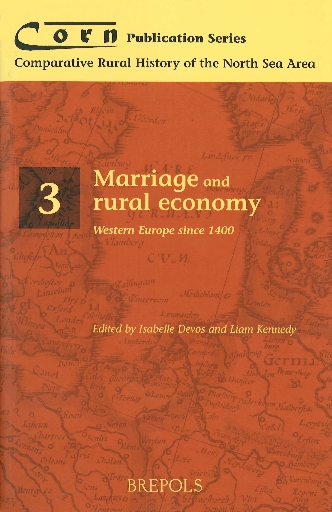
Marriage and Rural Economy. Western Europe since 1400
The history of marriage in Western Europe because of its peculiarities when viewed in a global setting compels attention. This volume examines rural marriage patterns in the long run relating these to changing economic conditions in the North Sea area from c. 1400 to the present. More than thirty years after Hajnal's path-breaking publication it presents a state of the art as regards the study of the European Marriage Pattern in Ireland Scotland England Belgium the Netherlands Germany and Scandinavia. By examining different forms of rural economy such as peasant farming capitalist farming prot-industry and other systems of production with differing implications for marriage and family formation demographic and economic mechanisms emerge more clearly. Turning from description to explanation a complex of interacting factors which regulate the formation of new households is identified and new directions into the research of this phenomenon are promoted. This volume comprises 11 article-chapters and introduction and conclusion and is the result of international collaboration from members of the CORN network. It is a work of richness subtlety and historical depth which makes essential reading for those interested in the evolution of marriage patterns in the distant past and in more recent times.