


Lectio

Le père du siècle: The Early Modern Reception of Jean Gerson (1363–1429)
This volume provides the first wide-ranging investigation of the post-fifteenth-century reception of Jean Gerson (1363-1429) chancellor of the University of Paris guiding light of the Council of Constance and arguably the most influential of late medieval theologians. His impact on early modern movements and thinkers paved the way for many developments still shaping our existence today. Besides his well-known influence in theology and church history the chancellor left a significant impact in jurisprudence human rights art music education literature and even medicine; there is hardly an area of the humanities that did not pay at least some tribute to his authority and there was almost no early modern political or religious movement in the West that neglected his name. Nearly all of the most prominent early modern intellectuals perceived him as an authority and father figure; an illustrious cohort of celebrities including Thomas More Martin Luther King James I Ignatius of Loyola Girolamo Savonarola Christopher Columbus Bartholomew de Las Casas and many others relied on his writings and ideas. The geography of his late-fifteenth- and sixteenth-century reception reflects his pre-eminence reaching from Spain to Scandinavia.

True Warriors? Negotiating Dissent in the Intellectual Debate (c. 1100–1700)
Dissent polemics and rivalry have always been at the centre of intellectual development. The scholarly Streitkultur was given a fresh impetus by the newly founded universities in the High Middle Ages and later turned into a quintessential part of early modern intellectual life with the emergence of the Protestant Reformation creating a new momentum. It was not only mirrored in various well-known intellectual disputations and controversies but also embodied in numerous literary genres and non-literary modes of expression as well as discursive or political strategies. Moreover the harsh debates notwithstanding consensus was also actively searched for both within particular disciplines and within society as a whole.
This volume collects thirteen contributions offering a very rich variety of topics with regard to the negotiation of disagreements from the twelfth till the eighteenth centuries. They reflect inter alia upon the rules and conventions of the intellectual debate upon the media used to negotiate dissent as well as upon the role of formal institutions created to judge and decide in cases of dissent. The contributions are offered by scholars from fields as diverse as history of literature political history history of philosophy history of Church and theology and legal history.

Trilingual Learning
The Study of Greek and Hebrew in a Latin World (1000-1700)
In 1517 the Brabant city of Louvain witnessed the foundation of the Collegium Trilingue (Three Language College). Funded by means of the legacy of the humanist and diplomat Jerome of Busleyden (d. 1517) and steered by guiding spirit Erasmus of Rotterdam this institute offered courses in the three so-called sacred languages Hebrew Greek and Latin which students could attend for free. However this kind of initiative was not unique to Louvain in the early 16th century. In a time span of barely twenty years Greek and Hebrew were also offered in Alcalá de Henares (near Madrid) Wittenberg and Paris among other places. It would not take long before these ‘sacred’ languages were also on the educational agenda at universities throughout the whole of Europe.
The present volume examines the general context in which such polyglot institutes emerged and thrived as well as the learning and teaching practices observed in these institutes and universities. Devoting special attention to the study of the continuity or rather the discontinuity between the 16th-century establishment of language chairs and the late medieval interest in these languages it brings together fifteen selected papers exploring various aspects of these multilingual undertakings focusing on their pedagogical and scholarly dimensions. Most of the contributions were presented at the 2017 LECTIO conference The Impact of Learning Greek Hebrew and ‘Oriental’ Languages on Scholarship Science and Society in the Middle Ages and the Renaissance which was organized at the occasion of the 500th anniversary of the foundation of the Louvain Collegium Trilingue.
Questioning the World
Greek Patristic and Byzantine Question-and-Answer Literature
This volume discusses cosmological issues in Greek Patristic and Byzantine question-and-answer literature. By adopting this focus it yields novel insights into both the (theological / philosophical) content and the (literary) form of the texts under scrutiny. How did Greek Patristic and Byzantine authors understand the cosmos of which they were a part and the world in which they lived? And what literary forms did they use to express their questions and answers on these issues? This collection of studies shows that in order to bring out the important intellectual contribution of the authors under discussion both ‘cosmology’ and ‘question-and-answer literature’ should be defined more broadly than expected. Several papers deal with the crucial corpora by Pseudo-Justin and Maximus the Confessor. Other authors under discussion include Philoponus Pseudo-Caesarius Michael Psellus Severian of Gabala and Nilus Doxopatres. Attention also goes to the critical edition of question-and-answer literature as well as to the Greek Patristic and Byzantine reception of cosmological questions and answers from Antiquity (i.c. Aristotle Philo of Alexandria Plutarch and Iamblichus).
Polemics and Networking in Graeco-Roman Antiquity
Disagreement rivalry and dispute are essential to any intellectual development. This holds true for ancient cultures no less than for us today. From the classical period to the Hellenistic age and to Late Antiquity competition and polemics have shaped the course of intellectual history in Antiquity. Polemical encounters and controversies are often linked to group identities and intellectual networks such as philosophical schools textual traditions artistic circles and religious communities. This collection of studies sprang from the ambition to study the interplay between polemics and intellectual networks from a variety of perspectives and disciplines.
The volume gathers fifteen case studies by leading scholars and young researchers alike. They address a wide range of topics from the Old Academy and the Hellenistic schools to the Neoplatonic commentators of Late Antiquity from biographical literature to literary criticism from artistic manuals to scientific treatises and from pagans to Christians. As multi-sided as the picture that emerges from these case studies may be they all testify to the fact that implicit and explicit polemics are ubiquitous in ancient Greek and Roman literature and have served as triggers of intellectual progress across times and disciplinary boundaries.
Authority Revisited: Towards Thomas More and Erasmus in 1516
In the year 1516 two crucial texts for the cultural history of the West saw the light: Desiderius Erasmus’ Nouum Instrumentum and Thomas More’s Utopia. Both of these works dealt freely with authoritative sources of Western civilization and opened new pathways of thought on the eve of far-reaching religious and political changes.
This book volume deals with aspects of the content reception and influence of Nouum Instrumentum and Utopia in the (Early) Modern Era while also focusing upon the sources they used and critically adopted. The overall approach is that both texts have contributed dramatically to the rise of (early) modern Western thought and have influenced the next generations in their literary philosophical and theological works. This volume multidisciplinary in scope brings together contributions from the fields of bible exegesis theology philosophy philology and history.
Sicut dicit: Editing Ancient and Medieval Commentaries on Authoritative Texts
Commentaries on authoritative texts from Antiquity and the Middle Ages are increasingly being recognized as witnesses to a rich tradition of cultural reception and intellectual engagement. This renewed interest goes hand-in-hand with an increased demand for critical editions of the texts in question. However the genre of the commentary presents a number of specific challenges to the editor challenges related to the textual dynamic the presentation on the page and the intertwined transmission history of the commentary and the authoritative text that forms its subject. This volume brings together twelve case studies on texts written in Greek and Latin which range from Antiquity to the Late Middle Ages. Touching upon a variety of fields including literature theology philosophy medicine and law these case studies offer an interdisciplinary perspective on commentaries on authoritative texts and the editors’ challenging work to accurately reconstruct and present them.
Falsifications and Authority in Antiquity, the Middle Ages and the Renaissance
Confronted with the shifting idea of the authority of a text and its transmission and reception in a variety of genres settings and contexts this collective volume envisages to enlarge and deepen our understanding of these notions by tangling literary forgery and emulation. Authority and authoritative literary productions provoke all kinds of interest and emulation. Hermeneutical techniques detailed exegesis and historical critique are invoked to put authority and indeed also possible falsifications to the test. Scholars from various disciplines working on texts either authoritative or forged and stemming from different periods of time reflect on these topics on a methodological basis and from a hermeneutical entrance. In doing so a threefold axis for questioning the phenomenon is proposed namely the motif of falsification the mechanism or technique applied and the direct or indirect effect of this fraud.
Concepts of Ideal Rulership from Antiquity to the Renaissance
Ancient works On Kingship have received a lot of attention in recent scholarship where the main focus is usually on classic works such as Seneca’s On Clemency Isocrates’ Cyprian Orations or Dio of Prusa’s Kingship Orations. In this volume we deliberately turn to the periphery to the grey zone where matters usually prove more complicated. This volume focuses on authors who deal with analogous problems and raise similar questions in other contexts authors who also address powerful rulers or develop ideals of right rulership but who choose very different literary genres to do so or works on kingship that have almost been forgotten. Departing from well-trodden paths we hope to contribute to the scholarly debate by bringing in new relevant material and confront it with well-known and oft-discussed classics. This confrontation even throws a new light upon the very notion of ‘mirrors for princes’. Moreover the selection of peripheral texts from Antiquity to the Renaissance reveals several patterns in the evolution of the tradition over a longer period of time.
Outsiders and Forerunners
Modern Reason and Historiographical Births of Medieval Philosophy
This book focuses on the emergence and development of philosophical historiography as a university discipline in the 18th and 19th centuries. During that period historians of philosophy evaluated medieval philosophical theories through the lenses of modern leitmotifs and assigned to medieval thinkers positions within an imaginary map of cultural identities based on the juxtaposition of ‘self ’ and ‘other’. Some medieval philosophers were regarded as ‘forerunners’ who had constructively paved the way for modern rationality; whereas others viewed as ‘outsiders’ had contributed to the same effect by way of their struggle against established forms of philosophy. The contributions gathered in this volume each deal with the creative reception of a particular figure in modern history of philosophy. From the 9th century with al-Fārābī to the 16th century these philosophers belong to four historical worlds which have been characterized by European cultural history or have defined themselves as such: the (Jewish-)Arabic world (al-Fārābī Avicenna Maimonides) Latin scholasticism (Roger Bacon Henry of Ghent William of Ockham Marsilius of Padua) medieval lay philosophy (Ramon Lull Petrarch) and Humanism in a broader sense (Nicholas of Cusa Petrus Ramus Andrea Cesalpino).
Towards the Authority of Vesalius
Studies on Medicine and the Human Body from Antiquity to the Renaissance and beyond
The authority of Andreas Vesalius (1514-1564) in reviving human anatomy is without any doubt a landmark in the history of science. Yet his breakthrough was inconceivable without his predecessors’ works. Moreover later on his own legacy would not remain untouched or undisputed. The question of scientific authority is not new; however it has hardly been tackled in a multidisciplinary and diachronic way. This volume brings together contributions from international scholars working in the field of theology art history philosophy history of science and historical linguistics. Its goal is to contextualize and analyse the complex interaction between dogma and authority on the one hand and empirical progress on the other both in the development of anatomy and the views on the human body mainly before Vesalius’s time. Indeed it is not the volume’s aim to focus exclusively on the role of Vesalius nor to assess the concept of medical and anatomical authority in a comprehensive way. Avoiding to repeat insights from the history of science as such it intends to put old views to the test and to bring up new questions and answers from diverse perspectives concerning the work of Vesalius and his predecessors and successors by presenting different case studies from Antiquity to the Early Modern Times.
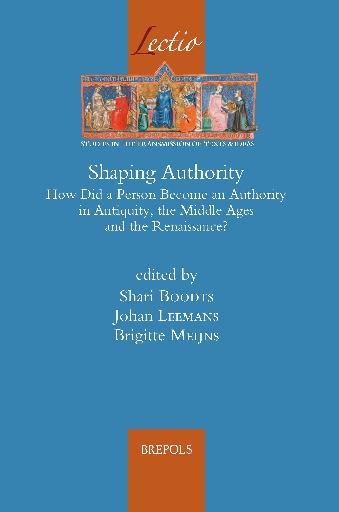
Shaping Authority
How Did a Person Become an Authority in Antiquity, the Middle Ages and the Renaissance?
The cultural and religious history from Antiquity through the Renaissance may be read through the lens of the rise and demise of auctoritates. Throughout this long period of about two millennia many historical persons have been considered as exceptionally authoritative. Obviously this authority derived from their personal achievements. But one does not become an authority on one’s own. In many cases the way an authority’s achievements were received and disseminated by their contemporaries and later generations was the determining factor in the construction of their authority. This volume focuses on the latter aspect: what are the mechanisms and strategies by which participants in intellectual life at large have shaped the authority of historical persons? On what basis why and how were some persons singled out above their peers as exceptional auctoritates and by which processes did this continue (or discontinue) over time? What imposed geographical or other limits on the development and expansion of a person’s auctoritas? Which circumstances led to the disintegration of the authority of persons previously considered to be authoritative? The case-studies in this volume reflect the dazzling variety of trajectories concerns actors and factors that contributed over a time span of two millennia to the fashioning of the postmortem and lasting authority of historical persons.
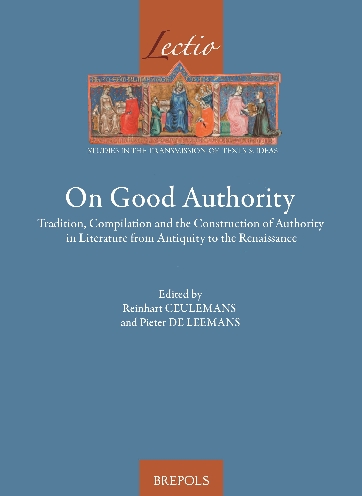
On Good Authority
Tradition, Compilation and the Construction of Authority in Literature from Antiquity to the Renaissance
This book brings together views from various disciplines on the concept of authority in Greek and Latin literature from Antiquity to the Renaissance. More specifically it deals with the questions how texts attempt to gain authority and if and how they use-or abuse-earlier writings in the construction of their own authority. Moreover this volume examines to what extent a text’s authoritative claims influence its transmission and reception and how these claims themselves are subject to evolution over time. In this context special attention is devoted to compilation literature (such as anthologies and commonplace books) which is characterized by extensive use of existing source material and thus specifically poses the problem of the role played by compilers in transmitting and establishing authority. The volume contains fifteen articles in which the contributors discuss various cases and texts that illustrate the different factors at stake in dealing with and constructing authority.
List of contributors: S. Boodts L. Bossina M. Crab E. De Bom E. De Ridder I. De Vos S. Delmas I. Draelants B. Flusin E. Gielen J. Hamesse U. Kenens K. Levrie J. Mansfeld S. Morlet L. Waelkens.
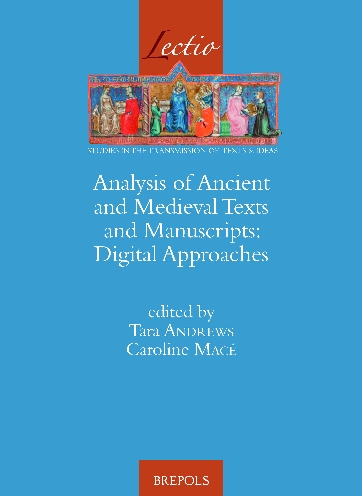
Analysis of Ancient and Medieval Texts and Manuscripts: Digital Approaches
How has the digital turn truly changed the nature of our research particularly in the field of medieval scholarship where our collections are almost never large enough to justify the term 'big data'? All kind of new avenues of research are emerging thanks to the creativity of scholars and to their interest in what digital means can offer. This collection of articles aims to give an up-to-date overview of the use of computer-assisted methods in several fields of scholarship dealing with ancient and medieval texts and manuscripts (from codicology and palaeography to textual criticism and literary or historical studies) across the boundaries of language and period. In moving away from theoretical debates about what the field of digital humanities is or should be we present here a clearer picture of what textual scholars can achieve when they use computers for their research needs and purposes and what their expectations may be in terms of the technology and developments in computational methodology.
List of contributors: T. Andrews P. Andrist F. Cafiero J.-B. Camps A. Cantera A. Castro Correa T. Heikkilä A. Hoenen A. Jordanous E. R. Luján C. Macé E. Orduña I. Rabin P. Roelli M. Romanov S. Rubenson L. Spinazzè F. Stella C. Tupman K. Van Dalen-Oskam J. van Zundert.
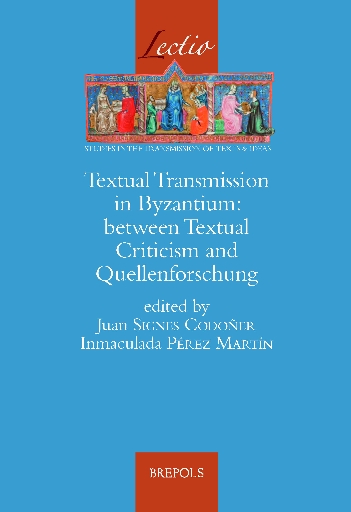
Textual Transmission in Byzantium: between Textual Criticism and Quellenforschung
A workshop was held in February 2012 in Madrid to stimulate a debate on textual criticism centred on the analysis of Byzantine texts and their modes of publication rewriting and diffusion. The main aim was to provide future editors or scholars of the history of texts with a rich typology of concepts to guide their task such as interpolation paraphrasis metaphrasis quotation collection amplification or falsification among others but always taking into account that the principles upon which the discipline of textual criticism was founded needed to be reconsidered when dealing with the transmission of Byzantine texts. The present book brings together the different case studies produced by the participants of the workshop into a coherent whole and distributes them into five different sections according to their methodological approaches: 1. Language and style; 2. Virtual libraries and crossed readings; 3. Philosophical treatises and collections; 4.The sources of history; 5. Law texts and their reception. The results of the different approaches put forward by the contributors offer a broad palette of methodological strategies that are to a great extent complementary and will so we hope illuminate the task of the future editors with new reflections.
List of contributors: F. J. Andrés Santos M. Bandini D. Bianconi B. Crostini L. Cuppi J. M. Featherstone T. Fernández E. Gielen P. Golitsis M. Hinterberger C. Macé M. Menchelli M. Miglietta P. Odorico I. Pérez Martín F. Pontani A. Rhoby J.-D. Rodríguez Martín F. Ronconi J. Signes Codoñer T. E. van Bochove S. Wahlgren T. Wauters.