


Publications of the Journal of Medieval Latin

Crafting Knowledge in the Early Medieval Book
Practices of Collecting and Concealing in the Latin West
This volume explores how knowledge was made in the early medieval book in the Latin West through two interrelated practices: collecting and concealing. The contributions present case studies across cultures and subject areas including exegesis glossography history lexicography literature poetry vernacular and Latin learning. Collectio underpinned scholarly productions from miscellanies to vademecums. It was at the heart of major enterprises such as the creation of commentaries encyclopaedic compendia glosses glossaries glossae collectae and word lists. As a scholarly practice collectio accords with the construction of inventories of inherited materials the ruminative imperative of early medieval exegesis and a kind of reading that required concentration. Concealment likewise played a key role in early medieval book culture. Obscuration was in line with well-known interpretative practices aimed at rendering knowledge less than immediate. This volume explores the practices of obscuring that predate the twelfth-century predilection long recognised by historians for reading that penetrates beneath the “covering” (integumentum involucrum) to reveal the hidden truth. Cumulatively the papers spotlight the currency of two crucial practices in early medieval book culture and demonstrate that early medieval authors artists compilers commentators and scribes were conspicuous collectors and concealers of knowledge.
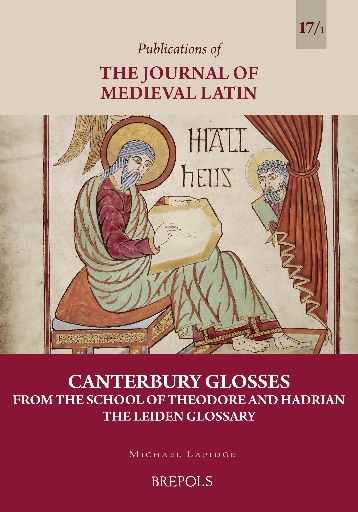
Canterbury Glosses from the School of Theodore and Hadrian: The Leiden Glossary
The ‘Leiden Glossary’ provides a record of the understanding and interpretation of the patristic and grammatical texts studied at the Canterbury School of Theodore and Hadrian regarded by Bede as the high point of Christian culture in early Anglo-Saxon England. Each entry in the ‘Leiden Glossary’ is provided with detailed commentary on the sources consulted by the two Canterbury masters (earlier glossaries; Isidore; Eucherius) and the later uses of the glossary by compilers of the Epinal-Erfurt and Corpus glossaries. The ‘Leiden Glossary’ is thus a key witness to one of the greatest schools of learning in the early Middle Ages.
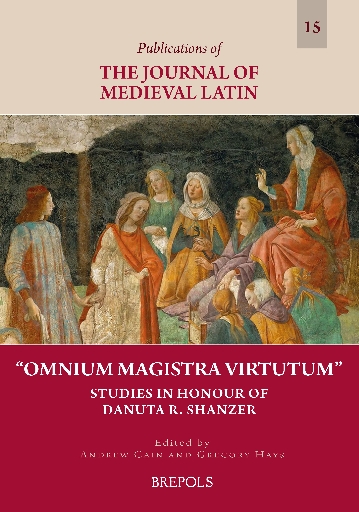
“Omnium Magistra Virtutum”
Studies in Honour of Danuta R. Shanzer
Danuta Shanzer is a scholar of international caliber and this volume honors her career on the occasion of her sixtyfifth birthday (or thereabouts). Most of the contributors are current or former students colleagues collaborators and friends from Oxford Berkeley Cornell Illinois the University of Vienna and elsewhere. They have chosen topics appropriate in some way to the honoree’s scholarly interests. The volume’s center of gravity is in late antiquity and early medieval Gaul but some contributions reach backwards to the Roman period or forward to the later Middle Ages. The contributions embrace a number of authors in whom Shanzer herself has been particularly interested (Augustine Martianus Capella Boethius Avitus of Vienne Gregory of Tours) but the range and variety of the volume is also representative of her approach to the field.
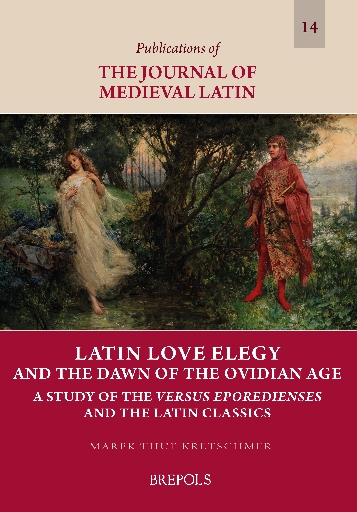
Latin Love Elegy and the Dawn of the Ovidian Age
A Study of the Versus Eporedienses and the Latin Classics
The Versus Eporedienses (Verses from Ivrea) written around the year 1080 and attributed to a certain Wido is a highly fascinating elegiac love poem celebrating worldly pleasures in an age usually associated with contemptus mundi. One of the poem’s intriguing features its extensive use of the Latin classics especially of Ovid makes it a precursor of the poetry of the so-called twelfth-century renaissance. In this first book-length study of the poem the author provides a historical contextualisation an edition and translation a verse-by-verse commentary a detailed analysis of the classical sources and a discussion of its similarities with contemporary and later medieval poetry.

Hope Allen’s Writings Ascribed to Richard Rolle: A Corrected List of Copies
Richard Rolle was perhaps the most influential English spiritual writer of the late Middle Ages. This volume provides references to the more than 600 surviving medieval books that offer the primary evidence for his works and their transmission.
Hope Allen's Writings Ascribed to Richard Rolle now nearly a century old is a foundational work of English palaeography. This volume extends Allen's most basic contribution her catalogue of manuscripts conveying Rolle's works.
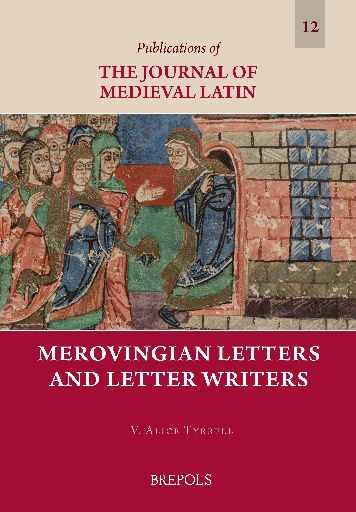
Merovingian Letters and Letter Writers
Primary sources from the Frankish kingdom during the Merovingian era (ca. 500-750) are few and far between. This volume is a survey of more than 600 Latin letters selected by the author that were exchanged between persons in Gaul during that time period. Many are almost entirely unknown and have never been translated into any modern language. While most of the letters were authored by clerics and highly-placed laymen a small but significant number was composed by women both religious and lay.
For elite individuals letter networks were the social media of their day. Letters were written to maintain the bonds of friendship to seek or extend patronage and political alliance to instruct rebuke defend console and recommend. Many have come down to us in collections; others are strays embedded in other texts or deperdita that come to light only in the replies of others.
This book is a valuable tool for scholars and students alike. In seven readable chapters the author discusses numerous aspects of the letters and explores how they fit with and enlarge upon the better-known sources of the period such as the works of Gregory of Tours Fredegar the anonymous History of the Franks (LHF) and various saints’ vitae. An appendix containing a summary of each letter in translation renders these texts more readily accessible to the English speaker.
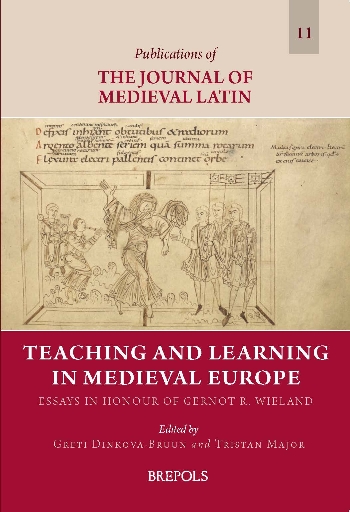
Teaching and Learning in Medieval Europe
Essays in Honour of Gernot R. Wieland
Over the span of his career Gernot R. Wieland has been actively engaged in the contribution and promotion of the study of medieval literature particularly in Anglo-Latin and Old English. From his early work on glosses in Anglo-Saxon manuscripts to his later editorial work for The Journal of Medieval Latin Wieland has provided the field with diverse diligent and creative scholarship. The contributors of this volume pay tribute to the significance of Wieland’s teaching and learning in the literature of medieval Europe by presenting him with twelve essays on varied aspects of the subject.
The first section of the volume aims to honour Wieland’s contributions to the study of medieval glossing. It deals with the history of glossing from early medieval Latin literature to late Middle English grammatical texts as well as the early interpretative history of Walter of Châtillon’s Alexandreis and Geoffrey of Monmouth’s Historia regum Britannie. The following section corresponds with Wieland’s interest in Anglo-Saxon literature with essays on the bilingual letters of Ælfric of Eynsham the poetry of Alcuin of York and the Old English Hexateuch. The second half of the volume which examines elements of Latin literature from the eleventh to the fourteenth century is divided into two sections containing essays that well represent Wieland’s diverse philological and literary interests in medieval Latin. The third section of the volume on the texts and contexts of Latin literature presents essays on the books of Abbot Maiolus of Cluny on scholastic virtues of good teaching and on Walter Map’s Dissuasio Valerii. The final section on the texts and manuscripts of Latin literature provides editions of and commentaries on a Latin-Greek phrase-book a treatise on the firmament of Genesis 1:6.
With these contributions this volume honours the research interests of a great teacher and learner of the Middle Ages: Gernot Weiland.
Insignis Sophiae Arcator
Medieval Latin Studies in Honour of Michael Herren on his 65th Birthday
Some thirty years ago Michael Herren burst on the medieval Latin scene with his edition and translation of the notoriously difficult Hisperica Famina and followed this a few years later with his translation of the prose works of Aldhelm. Notice was given that a junior scholar unafraid to tackle some of the most obscure complex and arcane Latin wished to make it accessible to non-Latinists as well as to those Latinists who lacked his particular skills. Not content with labouring alone in that field Herren gathered scholars in Toronto to a conference on “Insular Latin Studies” the proceedings of which he published two years later. Over the years he shed considerable light on such obscure texts and authors as Virgilius Maro Grammaticus John Scottus Eriugena and the Cosmographia by the pseudonymous Aethicus Ister. His research trail led him again and again to Ireland and the Irish contribution to early medieval Latinity and to English Carolingian and even Italian culture. Recognizing the rich diversity of medieval Latin Herren in 1990 founded The Journal of Medieval Latin and has as its editor provided a home for medieval Latinists of all stripes.
Latin Culture in the Eleventh Century
Proceedings of the Third International Conference on Medieval Latin Studies Cambridge, 9-12 September 1998
Latin Culture in the Eleventh Century is a collection of approximately sixty papers presented at the Third International Conference on Medieval Latin Studies held at the University of Cambridge in September 1998. The collection embraces a wide range of fields related to Medieval Latin including poetry hymnology music theology and philosophy historiography and inscriptions in addition to Latin linguistics and metrics. Contributions are drawn from leading scholars from many European countries as well as from North America and Australia. The volume should prove invaluable to all students of this period.
Anglo-Latin and its Heritage
Essays in Honour of A.G. Rigg on his 64th Birthday
For some 40 years A.G. Rigg has been defining the field of later Anglo-Latin literary scholarship a task culminating in his History of Anglo-Latin Literature 1066-1422. Anglo-Latin and its Heritage is a collection of thirteen essays by his colleagues and students past and present which pays tribute to him both by exploring the field he has defined and by making forays into its antecedents and descendants. The first section “Roots and Debts” includes essays on the migration of classical and late antique motifs and patterns of thought into early medieval Latin and concludes with an essay which shows how a 12th-century writer reached back into that earlier period for stylistic models. The central section of the book “Anglo-Latin Literature 1066-1422” concentrates on Anglo-Latin writers of the period most studied by Rigg himself and the seven essays in this section include analyses of poetic style and borrowing; discussions of patterns of reading; and essays which read Anglo-Latin works through their specific historical and cultural contexts. Two of the essays are elegant translations of significant Anglo-Latin poetic works. The final section of the book “Influence and Survival” offers three essays which consider Anglo-Latin literature in the late medieval and post-medieval world from an edition of a Latin source for a late Middle English saint’s life; through an account of the migration of Latin texts into the royal libraries of Henry VIII; to the concluding essay which explores a “mechanical” means of producing perfect Latin hexameter. A complete bibliography of Rigg’s works closes the volume. The chronological and methodological range of the essays in this collection is offered as a fitting tribute to one of Anglo-Latin’s most learned and indefatigable scholars.