


Religion and Law in Medieval Christian and Muslim Societies
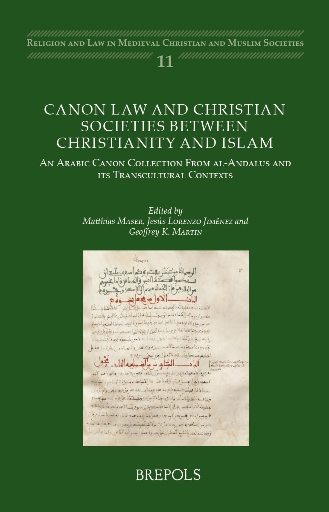
Canon Law and Christian Societies between Christianity and Islam
An Arabic Canon Collection from al-Andalus and its Transcultural Contexts
The unique Arabic version of the Iberian canon law code 'Collectio Hispana' preserved in a mid-eleventh-century manuscript of the Royal Library of El Escorial has been deemed “the most distinguished and characteristic” work of medieval Andalusi Christian writing. It represents an exceptional source witness to the internal legal organisation of Christian communities in Muslim-dominated al-Andalus as well as to their acculturation to Islamicate environments. Yet the Arabic collection has received only little scholarly attention so far. This volume presents the results of a recent interdisciplinary research project on the Arabic canon law manuscript flanked by contributions from neigbouring fields of research that allow for a comparative assessment of the substantial new findings. The individual chapters in this volume address issues such as the origins of the Arabic law code and its sole transmitting manuscript its language and translation strategies its source value for both the persistence and transformation of ecclesiastical institutions after the Muslim conquest or the law code's position in the judicial practice of al-Andalus. The volume brings together the scholarly expertise of distinguished specialists in a broad range of disciplines e.g. history Arabic and Latin philology medieval palaeography and codicology archaeology coptology theology and history of law.

Exégèses de la « mécréance » et statut du non-musulman dans le Commentaire coranique d’al-Qurtubi (m.671/1273)
Al-Qurṭubī (m. 671/1273) est l'auteur d'un commentaire coranique qui constitue depuis le XIIIe siècle jusqu’à nos jours une référence incontournable dans la transmission du savoir islamique. Ce monumental commentaire offre un matériel pluridisciplinaire permettant d’accéder de manière inédite à une représentation à la fois globale et contextualisée du thème de la non-islamité dans les différentes branches de la pensée islamique. Dans ce texte l’exégèse coranique renseigne le matériel juridique : elle a pour fonction de l’expliquer. Ainsi les notions coraniques sont réinterprétées détachées de leur contexte d’origine en vue de fonder le patrimoine juridique ainsi que les règles de droit dans le Coran considéré comme source de loi.
Cette recherche démontre que la notion de mécréance avait initialement un sens purement politique renvoyant à des actes d’insoumission de déloyauté et d’iniquité. La notion s’élabore dans le contexte historico-mythique de paix brisées guerres et conciliations évoquées dans le Coran. L’idée de filiation entre les religions monothéistes tout particulièrement celle que l’islam provient des religions des « Gens du Livre » –Juifs et Chrétiens - est dominante. La “mécréance” devient alors l’argument qui permet de réhabiliter la coexistence entre musulmans et non-musulmans. Puis on découvre que c’est d’avantage la non-islamité accompagnée de l’allégeance politique – plutôt que le critère de mécréance en tant que tel - qui détermine l’octroi de la protection légale (dhimma) aux non-musulmans résidant en Terre d’Islam.

Jews and Muslims under the Fourth Lateran Council
Papers Commemorating the Octocentenary of the Fourth Lateran Council (1215)
The Fourth Lateran Council (1215) was groundbreaking for having introduced to medieval Europe a series of canons that sought to regulate encounters between Christians and Jews and Muslims. Its canon 68 demanded that Jews and Muslims wear distinguishing dress in order to prevent Christians from entering into illicit sexual relations with them restricted the movement of Jews in public spaces during Holy Week and exhorted secular authorities to punish Jews who in any way “insult” or blaspheme against Christ himself. Other canons sought to exercise greater control over moneylending to provide relief to Christian borrowers to extract tithes from Jews who held Christian properties as pledges and prohibited Jews from exercising power as public officials over Christians. The canons condemned converts who preserved elements from their former religion promoted a fifth Crusade to the East exempted Crusaders from taxes and from interest payments to Jewish moneylenders restricted trade with Muslims or Saracens and condemned Christians who provided arms or assistance to Saracens. The Council’s canons affected the missionary efforts of the late medieval Church and its attempts to convert Jewish and Muslim minorities and established essential guidance on minority relations not to be surpassed until Vatican II in the 1960s.
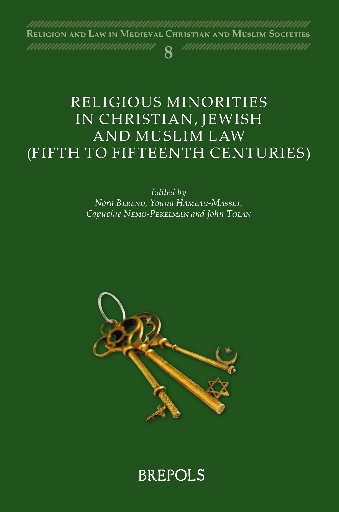
Religious Minorities in Christian, Jewish and Muslim Law (5th - 15th centuries)
The fruit of a sustained and close collaboration between historians linguists and jurists working on the Christian Muslim and Jewish societies of the Middle Ages this book explores the theme of religious coexistence (and the problems it poses) from a resolutely comparative perspective. The authors concentrate on a key aspect of this coexistence: the legal status attributed to Jews and Muslims in Christendom and to dhimmīs in Islamic lands. What are the similarities and differences from the point of view of the law between the indigenous religious minority and the foreigner? What specific treatments and procedures in the courtroom were reserved for plaintiffs defendants or witnesses belonging to religious minorities? What role did the law play in the segregation of religious groups? In limiting combating or on the contrary justifying violence against them? Through these questions and through the innovative comparative method applied to them this book offers a fresh new synthesis to these questions and a spur to new research.
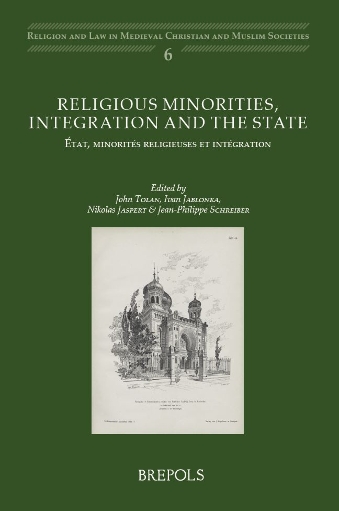
Religious minorities, integration and the State
État, minorités religieuses et intégration
Judaism Christianity and Islam have coexisted in Europe for over 1300 years. The three monotheistic faiths differ in demography in the moment of their arrival on the continent and in the unequal relations they maintain with power: Christianity was chosen by a large number of inhabitants and became - in spite of important differences according to place and time -a religion of state. The organization of the continent into states and the divisions within Christianity often placed minorities in an unstable and at times painful situation. This partially explains the fight against "heresies" the wars of religions the expulsion of Jews from several European kingdoms (as well as the expulsion of Muslims from Sicily and the Iberian peninsula) the "Jewish question" in the 19th century up until the Holocaust. Since the 20th century the debates concerning Islam and concerning public expression of religion are shaped in part by this past.
The 13 studies gathered in this volume explore the ways in which states have treated their religious minorities. We study various policies - repression supervision integration tolerance secularization indifference - as well as the many ways in which minorities have accommodated the majority’s demands. The relation is by no means one-sided: on the contrary state policies have created resistance negotiation (on the legal political and cultural fronts) or compromise. Through these precise and original examples we can see how the protagonists (states religious institutions the elite the faithful) interact try to convince or influence each other in order to transform practices invent and implement common norms and grounds all the while knowing the confessional dimension of "religious" majority and minority does not fully embrace the identity of each citizen in full.

Jews and Christians in Medieval Europe
The historiographical legacy of Bernhard Blumenkranz
The name of Bernhard Blumenkranz is well known to all those who study the history of European Jews in the Middle Ages and in particular the history of Jewish-Christian relations. Blumenkranz was born in Vienna in 1913; he left for Switzerland during the war and obtained a doctorate at the University of Basel on the portrayal of Jews in the works of Augustine. He subsequently moved to France where his numerous publications revived and renovated the field of Jewish studies. The international group of scholars who wrote the fifteen essays in this volume beyond paying homage to Blumenkranz’s work trace the trajectories of various lines of inquiry that he initiated: Christian theology of Judaism problems of conversion and proselytism geography and topography of Medieval Jewish communities the representation of Jews in Christian art. These essays provide both an assessment of Blumenkranz’s intellectual legacy and a snapshot of the evolution of the field over the last sixty years.
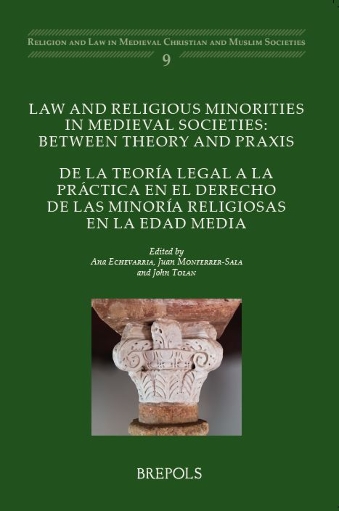
Law and Religious Minorities in Medieval Societies: Between Theory and Praxis
De la teoría legal a la práctica en el derecho de las minoría religiosas en la Edad Media
Muslim law developed a clear legal cadre for dhimmīs inferior but protected non-Muslim communities (in particular Jews and Christians) and Roman Canon law decreed a similar status for Jewish and Muslim communities in Europe. Yet the theoretical hierarchies between faithful and infidel were constantly brought into question in the daily interactions between men and women of different faiths in streets markets bath-houses law courts etc. The twelve essays in this volume explore these tensions and attempts to resolve them. These contributions show that law was used to try to erect boundaries between communities in order to regulate or restrict interaction between the faithful and the non-faithful-and at the same time how these boundaries were repeatedly transgressed and negotiated. These essays explore also the possibilities and the limits of the use of legal sources for the social historian.
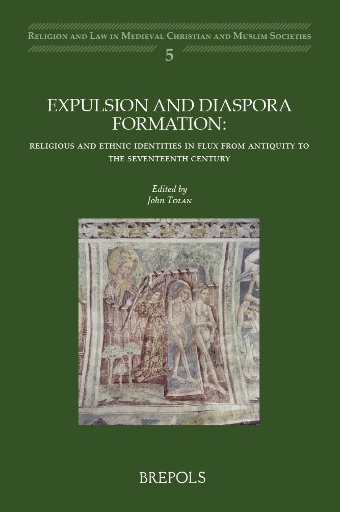
Expulsion and Diaspora Formation: Religious and Ethnic Identities in Flux from Antiquity to the Seventeenth Century
The eleven essays brought together in this volume explore the relations between expulsion diaspora and exile between Late Antiquity and the seventeenth century. The essays range from Hellenistic Egypt to seventeenth-century Hungary and involve expulsion and migration of Jews Muslims and Protestants. The common goal of these essays is to shed light on a certain number of issues: first to try to understand the dynamics of expulsion in particular its social and political causes; second to examine how expelled communities integrate (or not) into their new host societies; and finally to understand how the experiences of expulsion and exile are made into founding myths that establish (or attempt to establish) group identities.
John Tolan is professor of history at the University of Nantes (France) and member of the Academia Europæa. He is author of numerous articles and books in medieval history and cultural studies including Petrus Alfonsi and his Medieval Readers (1993) Saracens: Islam in the Medieval European Imagination (2002) Sons of Ishmael: Muslims through European Eyes in the Middle Ages (2008) and Saint Francis and the Sultan: The Curious History of a Christian-Muslim Encounter (2009). He is director of a major project funded by the European Research Council “RELMIN: The legal status of religious minorities in the Euro-Mediterranean world (5th-15th centuries)” (www.relmin.eu).
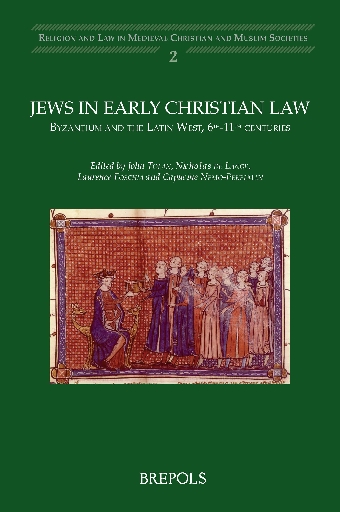
Jews in Early Christian Law
Byzantium and the Latin West, 6th-11th centuries
The sixth to eleventh centuries are a crucial formative period for Jewish communities in Byzantium and Latin Europe: this is also a period for which sources are scarce and about which historians have often had to speculate on the basis of scant evidence. The legal sources studied in this volume provide a relative wealth of textual material concerning Jews and for certain areas and periods are the principal sources. While this makes them particularly valuable it also makes their interpretation difficult given the lack of corroborative sources.
The scholars whose work has been brought together in this volume shed light on this key period of the history of Jews and of Jewish-Christian relations focusing on key sources of the period: Byzantine imperial law the canons of church councils papal bulls royal legislation from the Visigoths or Carolingians inscriptions and narrative sources in Hebrew Greek and Latin. The picture that emerges from these studies is variegated. Some scholars following Bernhard Blumenkranz have depicted this period as one of relative tolerance towards Jews and Judaism; others have stressed the intolerance shown at key intervals by ecclesiastical authors church councils and monarchs.
Yet perhaps more than revealing general tendencies towards “tolerance” or “intolerance” these studies bring to light the ways in which law in medieval societies serves a variety of purposes: from providing a theologically-based rationale for social tolerance to attempting to regulate and restrict inter-religious contact to using anti-Jewish rhetoric to assert the authority or legitimacy of one party of the Christian elite over and against another. This volume makes an important contribution not only to the history of medieval Jewish-Christian relations but also to research on the uses and functions of law in medieval societies.
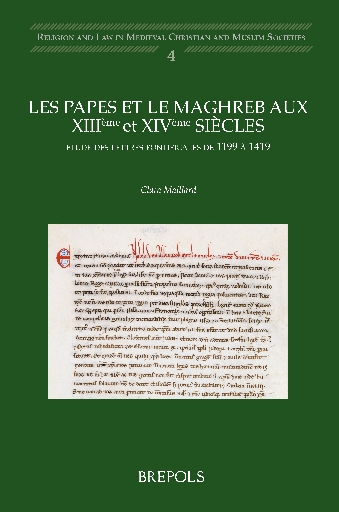
Les papes et le Maghreb aux XIIIème et XIVème siècles
Étude des lettres pontificales de 1199 à 1419
Pour les papes il était inévitable d’entretenir des relations avec le monde arabo-musulman oriental bien entendu - l’Égypte et le Moyen Orient - mais aussi occidental - l’Espagne et le Maghreb -. Ainsi dès 1199 Innocent III s’adressait-il au « Miramolin roi du Maroc ». Quelque deux cent et une lettres rédigées au cours des XIIIème et XIVème siècles et pour la plupart enregistrées dans les registres des Archives secrètes du Vatican permettent d’éclairer la position du Saint-Siège face au Maghreb. Pour mener à bien leur politique et garder des liens avec les fidèles partis en terre lointaine les papes écrivirent aux souverains - chrétiens ou musulmans - envoyèrent des messagers par delà la mer Méditerranée encouragèrent les œuvres des frères dans cette partie du monde et installèrent un évêché à Marrakech. Ils soutinrent régulièrement les tentatives d’expansion du christianisme en Afrique du Nord mais là n’était pas leur seule préoccupation. Ils se soucièrent également des chrétiens qui demeuraient au Maghreb qu’ils soient marchands mercenaires ou captifs. La papauté eut à concilier ces deux aspects et dut s’adapter à la réalité de la vie de ces communautés en terre d’Islam.
Clara Maillard a soutenu à la MSH de Nantes le 8 décembre 2011 sa thèse en histoire médiévale intitulée: « Les papes et le Maghreb aux XIIIème et XIVème siècles étude des lettres apostoliques de 1199 à 1419 » sous la direction de John Tolan professeur à l'Université de Nantes. Elle a travaillé avec le projet RELMIN en 2014 en tant que post-doctorante sur les lettres pontificales concernant les chrétiens qui demeuraient au Maghreb.
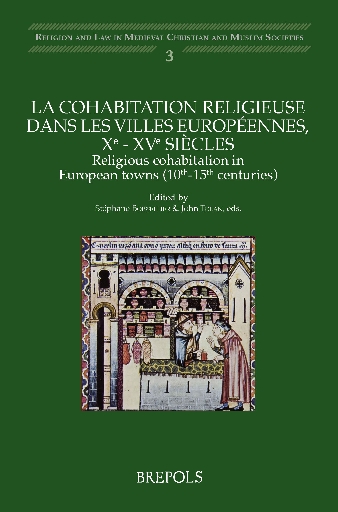
Religious cohabitation in European towns (10th-15th centuries)
La cohabitation religieuse dans les villes Européennes, Xe - XVe siècles
Medieval towns from Portugal to Hungary to Egypt were places of contact between members of different religious communities Muslim Christian and Jewish who rubbed shoulders in the ports and on the streets who haggled in the markets signed contracts and shared wells courtyards dining tables bath houses and sometimes beds. These interactions caused legal problems from the point of view of the Jewish Christian and Muslim judicial scholars of the middle ages not to mention for the rulers of these towns. These legal attempts to define and solve the problems posed by interreligious relations are the subject of this volume which brings together the work of seventeen scholars from nine countries (France Italy Spain Hungary Portugal Lebanon Israel Tunisia USA) specialists in history law archeology and religion.
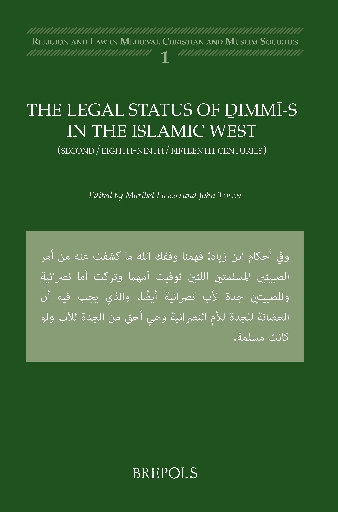
The legal status of ḏimmī-s in the Islamic West (second/eighth-ninth/fifteenth centuries)
The studies brought together in this volume provide an important contribution to the history of ḏimmī-s in the medieval dār al-islām and more generally to the legal history of religious minorities in medieval societies. The central question addressed is the legal status accorded to ḏimmī-s (Jews and Christians) in the Muslim law in the medieval Muslim west (the Maghreb and Muslim Spain). The scholars whose work is brought together in these pages have dealt with a rich and complex variety of legal sources. Many of the texts are from the Mālikī legal tradition; they include fiqh fatwā-s ḥisba manuals. These texts function as the building blocks of the legal framework in which jurists and rulers of Maghrebi and Peninsular societies worked. The very richness and complexity of these texts as well as the variety of responses that they solicited refute the textbook idea of a monolithic ḏimmī system supposedly based on the Pact of ‘Umar applied throughout the Muslim world. In fact when one looks closely at the early legal texts or chronicles from both the Mashreq and the Maghreb there is little evidence for a standard uniform ḏimmī system but rather a wide variety of local adaptations. The articles in this volume provide numerous examples of the richness and complexity of interreligious relations in Medieval Islam and the reactions of jurists to those relations.