


Studia Sententiarum
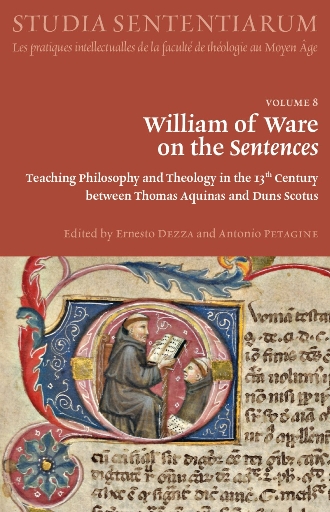
William of Ware on the Sentences
Teaching Philosophy and Theology in the 13th Century between Thomas Aquinas and Duns Scotus
The Franciscan William of Ware – the Magister Scoti – flourished as a theologian at the end of the thirteenth century. Although he wielded significant influence on fourteenth-century theological and philosophical debates his thought remains little known and even less studied than it deserves. A major cause for this situation lies in the difficulty of accessing the text of his Questions on the Four Books of the Sentences which is largely unedited.
This volume is the first entirely devoted to William of Ware. It aims to promote a renewed knowledge of his texts and doctrines. The book includes updated information on studies and editions of Ware's texts and specific studies on crucial aspects of his doctrines such as theology metaphysics physics epistemology Christology and anthropology. Additionally the volume presents previously unpublished questions from his Commentary on the Sentences.
Overall the volume serves as an essential reference for the thought and texts of William of Ware and provides a new and illuminating perspective on scholastic culture during the turn from the thirteenth to the fourteenth century.
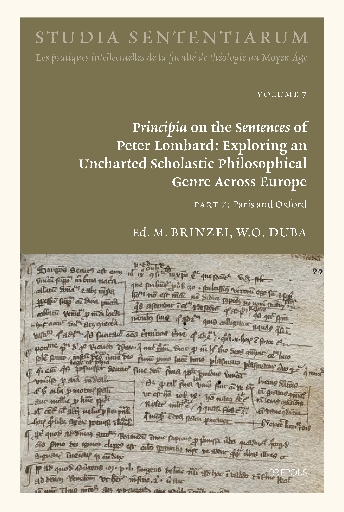
Principia on the Sentences of Peter Lombard
Exploring an Uncharted Scholastic Philosophical Genre Across Europe
Principia were an obligatory step on the medieval university path to becoming a master of theology. As inaugural lectures on the four books of the Sentences of Peter Lombard they provided the first opportunity for a scholastic to defend a philosophical-theological worldview. These lectures were also a way for the theologian now a sententiarius to present himself and to make a name for himself initially by delivering in a speech an introduction to the course and by debating with his fellows. The present book takes a collective approach to offer a survey of the evolution of the genre mapping the dissemination of this exercise during the fourteenth and fifteenth centuries across Europe.
As an academic exercise principia bridge ideas texts authors and institutions across time. Exploring the corpus of surviving principia illuminates the philosophical creativity cultivated in the faculties of theology. The papers in these volumes thus not only discuss the structural aspects of principia but also treat the philosophical and theological ideas defended and attacked during the principial debates and the topics and imagery used in the speeches.
The various chapters delve into the surviving material in a common attempt firstly to assemble pieces of evidence from Paris and Oxford into an image portraying how when and by whom the principia were performed in the first European universities. The second part illustrates the spread of the genre to the new faculties of theology in Central Europe and Italy with case studies from Bologna Cracow Florence Heidelberg Prague and Vienna highlighting the pan-European diffusion of the practice.
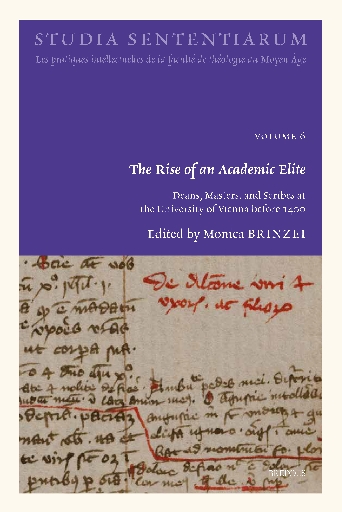
The Rise of an Academic Elite : Deans, Masters, and Scribes at the University of Vienna before 1400
Henry of Rheinfelden a Dominican from Basel spent the last decade of the fourteenth century at the University of Vienna studying theology. During this time he took notes on the academic activities of the first rectors of the university and deans of the Faculties of Arts and Theology. This volume explores Rheinfelden’s contribution to our understanding of the doctrinal curricular administrative and prosopographical history of the early University of Vienna. Deciphering Rheinfelden’s surviving notebooks in the Universitätsbibliothek Basel sheds new light on the rise of an academic elite in Vienna. His manuscripts reveal a network of scholars sharing a passion for knowledge and supply a gallery of intellectual profiles starting with the mentors of the group Henry of Langenstein and Henry Totting of Oyta and continuing with the lesser-known figures Stephen of Enzersdorf Gerhard Vischpekch of Osnabrück Paul (Fabri) of Geldern Andreas of Langenstein Rutger Dole of Roermond Nicholas of Hönhartzkirchen Nicholas of Dinkelsbühl John Berwart of Villingen John Stadel of Russbach Peter de Treysa Michael Suchenschatz of Hausleiten Peter Schad of Walse Thomas of Cleves and Leonhard of Dorffen. The papers gathered in this volume highlight the intricate relationship between a commitment to administrative duty and an appetite for the creation of a doctrinal tradition via debating forging arguments defending and attacking positions commenting on authorities and adopting and adapting academic practices imported from Paris since the majority of the authors in our gallery were educated in Paris and built their careers in Vienna. Through Rheinfelden’s notebooks this volume provides access to unique and previously unknown texts that together offer a new image of the medieval University of Vienna.
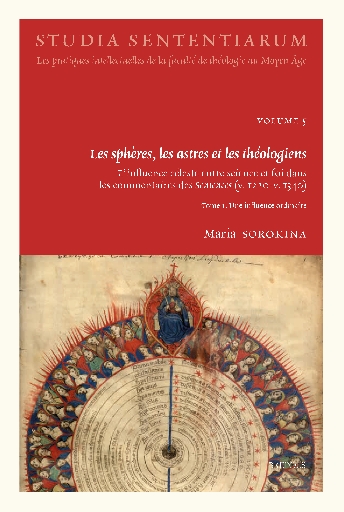
Les sphères, les astres et les théologiens
L’influence céleste entre science et foi dans les commentaires des Sentences (v. 1220 - v. 1340)
Pour la totalité des savants médiévaux les sphères et astres causent de multiples phénomènes terrestres des événements météorologiques jusqu’aux changements dans le corps humain. Mais qu’en disent les théologiens ? Ce livre propose la première reconstitution de la théorie de l’influence céleste à partir d’une analyse exhaustive du corpus des commentaires des Sentences (v. 1220-v. 1340). Non seulement ces auteurs adhèrent à la doctrine de la causalité céleste mais aussi ils prônent une approche originale. D’une part ils traitent de l’influence « ordinaire » celle des corps supérieurs connus des astronomes : son étendue ses mécanismes ses limites. D’autre part ils dépeignent une influence « hors normes » celle des sphères des planètes et des étoiles dont l’existence est postulée par la foi chrétienne : le ciel empyrée demeure des bienheureux ou les corps célestes métamorphosés par l’Apocalypse. Dotés à première vue de propriétés contraires à l’ordre naturel ces cieux sont néanmoins décrits avec la philosophie naturelle aristotélicienne. La théologie s’adapte donc à la science mais en renouvelant cette dernière : en englobant le cas des cieux « atypiques » la théorie de l’influence céleste en ressort profondément modifiée. Il s’agit d’une clé pour comprendre l’innovation du savoir scientifique médiéval et peut-être pour penser les évolutions scientifiques ultérieures.
Ce livre est la version retravaillée d’une thèse de doctorat distinguée par deux prix : leprix Daniel et Michel Dezès (décerné par le Comité français des sciences historiques sous l’égide de la Fondation de France) et le prix de la Société française d’histoire des sciences et des techniques (SFHST).
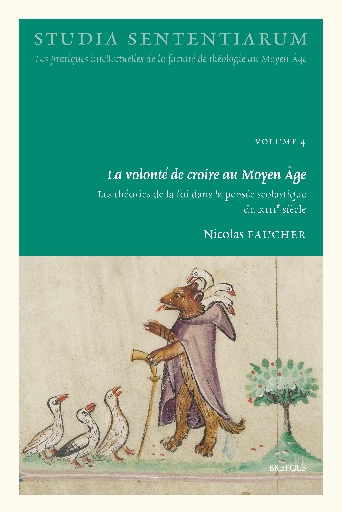
La volonté de croire au Moyen Âge
Les théories de la foi dans la pensée scolastique du XIIIe siècle
Par quels mécanismes notre volonté nos désirs nos affects influencent-ils nos croyances ? Sommes-nous libres de croire ce que nous voulons même ce dont nous n'avons aucune preuve ? Et si nous le sommes comment garantir que nous ne croyions pas au hasard au gré de notre fantaisie ? Y a-t-il des raisons morales objectives de croire ce que nous ne pouvons savoir ? Le présent ouvrage a pour ambition de trouver réponse à ces questions dans les œuvres académiques notamment les commentaires des Sentences de certains des penseurs les plus importants de l'âge d'or de la scolastique médiévale : Alexandre de Halès Bonaventure Thomas d'Aquin Henri de Gand Godefroid de Fontaines Pierre de Jean Olivi et Jean Duns Scot. Si les questions posées ne sont pas toujours celles que les médiévaux ont affrontées leur traitement de la notion de foi et des problèmes philosophiques et théologiques qui lui sont associés leur donne l'occasion d'y apporter des éléments de réponse significatifs pour l'histoire de la pensée occidentale. C'est à la mise au jour de ces éléments que ce livre est consacré. Il démontre l'existence de deux grands mouvements de pensée qui convergent vers un volontarisme doxastique de plus en plus marqué accompagné d'un retrait croissant des ressorts surnaturels dans l'explication des croyances humaines.
Ce livre a été distingué par la mention honorable du Prix international Thomas Ricklin. Il constitue une version enrichie et approfondie de la thèse de doctorat de l'auteur qui a été récompensée par le prix solennel Aguirre-Basualdo de la Chancellerie des Universités de Paris.
The Forge of Doctrine. The Academic Year 1330-31 and the Rise of Scotism at the University of Paris
A rare survival provides unmatched access to the the medieval classroom. In the academic year 1330-31 the Franciscan theologian William of Brienne lectured on Peter Lombard’s Sentences and disputed with the other theologians at the University of Paris. The original official notes of these lectures and disputes survives in a manuscript codex at the National Library of the Czech Republic and they constitute the oldest known original record of an entire university course. An analysis of this manuscript reconstructs the daily reality of the University of Paris in the fourteenth century delineating the pace and organization of instruction within the school and the debates between the schools. The transcription made during William’s lectures and the later modifications and additions reveal how the major vehicle for Scholastic thought the written Sentences commentary relates to fourteenth-century teaching. As a teacher and a scholar William of Brienne was a dedicated follower of the philosophy and theology of John Duns Scotus (+1308). He constructed Scotist doctrine for his students and defended it from his peers. This book shows concretely how scholastic thinkers made communicated and debated ideas at the medieval universities. Appendices document the entire process with critical editions of William’s academic debates (principia) his promotion speech and a selection of his lectures and sources.
Nicholas of Dinkelsbühl and the Sentences at Vienna in the Early Fifteenth Century
This volume examines the faculty of theology of the University of Vienna after the new institution produced its first students. Taking Nicholas of Dinkelsbühl as our guide to this nascent academic milieu the five contributors illuminate the university system at Vienna describe the evolution of doctrine identify the network of professors that developed the specific curriculum and trace the reception of the academic writings outside the university. Traditionally the history of medieval universities is based primarily on statutes cartularies or other documents relating to the organization of the university as an institution. The present studies instead inspect the underside of the iceberg and penetrate the academic context of Vienna by reading and editing the texts issuing from the practice of teaching. The papers gathered here shed new light on the main pedagogical protagonists measure the impact of the transmission of ideas between the Universities of Paris and Vienna and provide access to the community of scholars to whom this material was addressed.