


Semitica et Classica: Supplementa
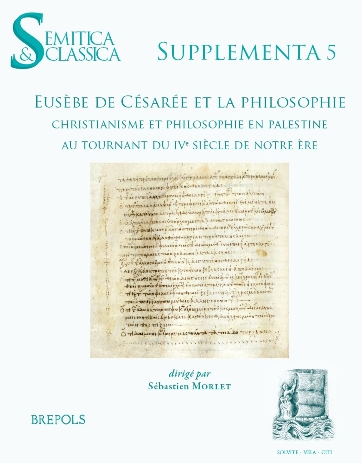
Eusèbe de Césarée et la philosophie
Christianisme et philosophie en Palestine au tournant du IVe siècle de notre ère
Eusebius of Caesarea in Palestine active between the end of the third century and the beginning of the fourth is the Christian author who has handed down to us in the form of quotations the greatest number of Greek philosophical texts. Yet his precise relationship to philosophy has never been the subject of a comprehensive study.
This book which brings together contributions by leading specialists aims to provide an initial overview. The analyses covering most of Eusebius’ works starting with the Preparation for the Gospel show the importance of philosophy in his thought. Beyond the use he makes of philosophers sometimes to criticise them sometimes to appropriate their ideas Eusebius stands out for his fairly good knowledge of philosophy especially Platonic philosophy the issues of which he seems to understand well. Although he takes up from his Christian predecessors the idea that Christianity is as such a “philosophy” this claim sometimes implies a technicality that is revealed not only in the way he quotes and comments on the philosophers but also in the presence in his work less visible at first sight of concepts and methods of exposition that bear witness to a real philosophical culture. At the end of these studies Eusebius of Caesarea too often reduced to a “court theologian” or to the status of “Father of Ecclesiastical History” emerges more as the scholar he was both Greek and Christian whose work and thought are inseparable from the philosophical context in which they were born.
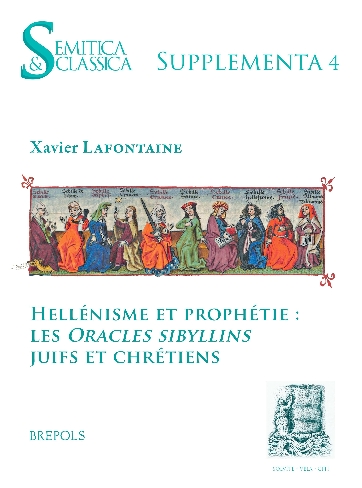
Hellénisme et prophétie
Les Oracles sibyllins juifs et chrétiens
The formal study of the collection of Jewish and Christian texts transmitted under the name of Sibylline Oracles highlights the continuity of the model of biblical prophecy while underlining the heritage of Greek didactic poetry. The interest of this approach is to situate the Sibylline Oracles as a literary work in the context of contemporary Greek versified literary production which implies on the part of their successive editors a familiarity with Greek poetic forms related to a common scholar background.
The study of the retelling of biblical episodes aims at identifying the passages where the fictitious Sibyl claims to announce the events of the biblical past and confronting these narrative sequences with contemporary rhetorical theories of paraphrase in order to highlight the formal technique that runs through them and the interpretation of the biblical hypotext that it presumes. Most of the rewritings preserved in the corpus are compatible with the prevailing doctrine of the third century ce.
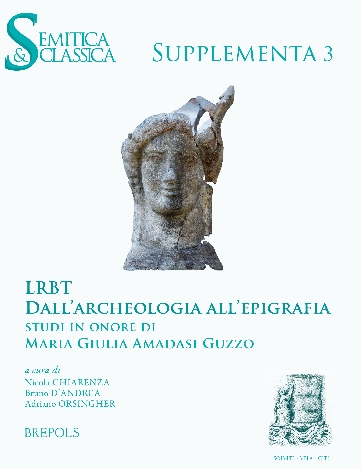
LRBT. Dall’archeologia all’epigrafia / De l'archéologie à l'épigraphie
Studi in onore di Maria Giulia Amadasi Guzzo / Études en hommage à Maria Giulia Amadasi Guzzo
This volume intends to pay tribute to Professor Maria Giulia Amadasi Guzzo who is one of the leading experts in Semitic epigraphy and North-West Semitic philology. This Festschrift mirrors her multifaceted intellectual interests by gathering together eighteen original contributions of students friends and colleagues. Although with a focus mainly on the Phoenician-Punic Mediterranean of the 1st millennium bc this volume also addresses other neighbouring regions and extends up to the Roman imperial period. In doing so it encompasses the publication of new inscriptions and epigraphic corpora provides a fresh look at remarkable finds groups of artefacts and specific sites but also shows a variety of new approaches and issues in historical and religious studies.
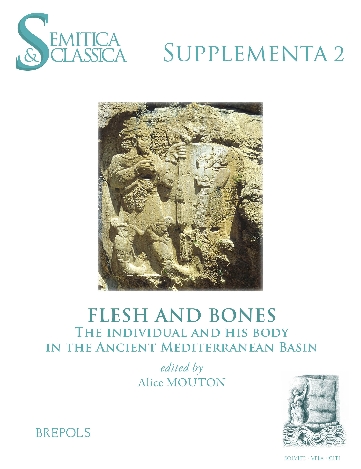
Flesh and Bones
The Individual and His Body in the Ancient Mediterranean Basin
This volume gathers the papers presented during an interdisciplinary research seminar entitled “The individual and his body in the Ancient Mediterranean Basin.” This seminar was at the crossroads of history of religions and social anthropology creating a dialogue between philologists archaeologists historians of religions and anthropologists. Its main aim consisted in studying self-perceptions of the body in the Ancient Near East with incursions in other parts of the Mediterranean Basin in a comparatist perspective. In this volume various themes are examined such as: 1) the relationship between the body and language; 2) the body perceptions and society including a study of the senses as they are described in the texts; 3) the body as a symbol of social belonging; 4) the body as a medium for religious experience.
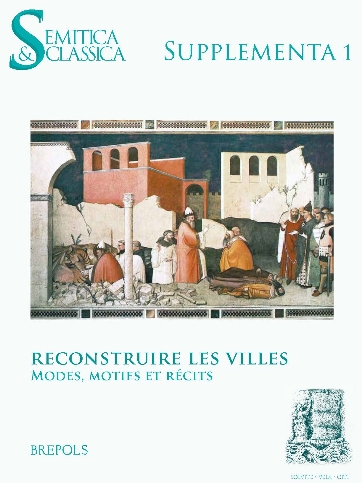
Reconstruire les villes
Modes, motifs et récits
Le dixième anniversaire de la revue Semitica & classica a donné lieu à Paris les 18 et 19 octobre 2017 à un colloque international sur le thème de la reconstruction des villes en Méditerranée du troisième millénaire avant notre ère au Moyen Âge.
Archéologues philologues historiens historiens de l'art et épigraphistes y ont traité de la reconstruction des villes tantôt d'un point de vue général tantôt à partir d'études de cas dont Mari Ougarit Sélinonte Athènes Milet Rome Jérusalem Antioche Hermopolis Byzance Gaza ou Alep.
Issu de ce colloque le présent volume s'appuyant sur les sources antiques textes ou vestiges archéologiques étudie les rapports entre destruction et reconstruction qu'elles soient le fait des habitants eux-mêmes ou de l'envahisseur que la destruction soit un fait de guerre une catastrophe naturelle ou qu'il s'agisse dans un cas comme dans l'autre d'une volonté de rénovation partielle ou totale.
Les modes de destruction d'une ville tout ou partie et les modalités de reconstruction remplois architecturaux formes de restauration et de rénovation sont appréhendés à l'aide des données archéologiques et des récits antiques comme autant de souvenirs de ces illustres cités témoignages de ce qu'elles furent réellement mais aussi parfois récits littéraires et reconstructions fictives du passé.