


Texts and Transitions

Scotland’s Royal Women and European Literary Culture, 1424–1587
Scotland’s Royal Women and European Literary Culture 1424–1587 seeks to fill a significant gap in the rich and ever-growing body of scholarly work on royal and aristocratic women’s literary culture in the fifteenth and sixteenth centuries. There has to date been no book-length study of the literary activities of the female members of any one family across time and little study of Scotland’s royal women in comparison to their European and English counterparts. This book adopts the missing diachronic perspective and examines the wives and daughters of Scotland’s Stewart dynasty and their many and various associations with contemporary Scottish English and European literary culture over a period of just over 150 years. It also adopts a timely cross-border and cross-period perspective by taking a trans-national approach to the study of literary history and examining a range of texts and individuals from across the traditional medieval/early modern divide. In exploring the inter-related lives and letters of the women who married into the Scottish royal family from England and Europe — and those daughters who married outwith Scotland into Europe’s royal families — the resultant study consistently looks beyond Scotland’s land and sea borders. In so doing it moves Scottish literary culture from the periphery to the centre of Europe and demonstrates the constitutive role that Scotland’s royal women played in an essentially shared literary and artistic culture.

Editing and Interpretation of Middle English Texts
Essays in Honour of William Marx
These fifteen essays all published here for the first time explore issues related to the editing and interpretation of Middle English literature. These include the treatment of various types of evidence (variant readings; punctuation; capitalization; rubrication; physical layout) in relation to both manuscript transmission and the transition from manuscript to print. The editorial representation of these and other aspects constitutes an act of textual interpretation at the most fundamental level which subsequently influences scholarly understanding.
Two major fields of writing - religious texts and chronicles - provide the focus of this volume. Major works that receive attention include Trevisa’s translation of the Polychronicon the Middle English Brut Piers Plowman Nicholas Love’s Mirror of the Blessed Life of Jesus Christ and John Mirk’s Festial; a wide range of shorter devotional and historical texts in both verse and prose is also considered as are aspects related to the translation of texts from Latin and French into Middle English. Almost all of the contributors are experienced editors of medieval texts. Several contribute further insights into texts they have edited whilst others discuss or offer new editions of previously unpublished works. Collectively these essays foreground the many and varied matters of interpretation that confront the editor of Middle English texts.

Female Authorship, Patronage, and Translation in Late Medieval France
From Christine de Pizan to Louise Labé
Under what conditions did women in late medieval France learn read and write? What models of female erudition and authorship were available to them in the fourteenth and fifteenth centuries? These questions often difficult to answer in the extant historical record are approached here via a number of perspectives namely the patronage and book ownership of women between the late medieval and early modern periods and their involvement in the translation of works from Latin to French.
Through a close analysis of the female patronage and manuscript production leading up to the early modern period this new study sheds important light on the development of female book ownership reading practices and patronage and ultimately female authorship in the fourteenth fifteenth and sixteenth centuries. The monograph shows how female book owners in the fifteenth century in particular were provided visual and rhetorical models of female erudition and savoir - models which further encouraged these practices in the generations to follow. In particular a focus on translations from Latin to French produced for and by women reveals the ways in which female patrons participated in the production of not only books they were able to read in French but also individual manuscript exemplars that put forward new conceptual frameworks around women’s reading practices. Chapters examine adaptations and translations of Ovid’s Heroides and Boccacio’s De mulieribus claris; the libraries and patronage of Anne de Bretagne and Louise de Savoie; and works by Christine de Pizan Anne de Graville Marguerite de Navarre and Louise Labé.

Alchemy, Medicine, and Commercial Book Production
A Codicological and Linguistic Study of the Voigts-Sloane Manuscript Group
The Voigts-Sloane group of Middle English manuscripts first described by Professor Emerita Linda Voigts in 1990 has attracted much curiosity and scholarly attention. The manuscripts exhibit a degree of uniformity that may originate from systematic copying of medical and alchemical manuscripts (possibly for speculative sale) in London or its metropolitan area in 1450s and 1460s — only decades before William Caxton established his printing press in Westminster. Some of the manuscripts share a strikingly similar mise-en-page others present a standard anthology of medical treatises in a standard order.
This book provides a thorough re-examination of these manuscripts through a combination of codicological and linguistic methodologies. It examines different procedures which may have facilitated the production of the manuscripts including speculative production and copying of separate booklets. The study also addresses the dialect of the manuscripts and code-switching between Latin and Middle English. By showing that the manuscripts sharing a similar layout are also written in the same dialect the book thus provides important new information on the dialects of medical writing and shows that dialect is a further defining feature for this manuscript group. The book also highlights late medieval concerns over alchemy and medicine explaining the apparent contradiction of the inclusion of alchemy (which was illegal) in commercially copied manuscripts.
This study thus provides both a comprehensive new description of these manuscripts and sheds new light on the commercial and cultural contexts of book production in late medieval England.

Pursuing Middle English Manuscripts and their Texts
Essays in Honour of Ralph Hanna
This volume brings together essays by leading authorities on the production reception and editing of medieval English manuscripts in honour of Ralph Hanna on the occasion of his retirement as Professor of Palaeography at the University of Oxford. Ralph Hanna has made an enormous contribution to the study of Middle English manuscripts; his numerous essays and books have discussed the development of London literature alliterative poetry (especially Piers Plowman) regionalism and the production and circulation of manuscripts. The essays included in this volume are arranged into four major sections corresponding to Ralph Hanna’s core areas of interest: Manuscript production; Dialect; Regionalism; Reading and Editing manuscripts.
These essays written by leading scholars in their fields offer new insights into the manuscripts of major Middle English writers and on scribal practice as well as studies of individual codices. Essays cover a wide regional and chronological range stretching from the beginnings of London literature traced in the works of Peter of Cornwall to the circulation of John Lydgate’s Troy Book and encompassing manuscripts and texts composed and circulated outside the capital. Dialectal studies offer reconsiderations of the evidence for a Wycliffite orthography the dialect of William Langland and the vocabulary of the alliterative Morte Arthure. A final section on reading and editing investigates the structure and divisions in the manuscripts of the A Version of Piers Plowman and examines specific readings in the Prick of Conscience and the Canterbury Tales. The volume also includes a tribute to Ralph Hanna and a list of his extensive publications.

Medieval Anglo-Irish Troubles
A Cultural Study of BL MS Harley 913
British Library MS Harley 913 is an early fourteenth-century trilingual manuscript whose paradoxically devotional and ribald contents display many distinct aspects of the Anglo-Irish socio-political reality of the day. However several of its texts have in the past suffered from repeated scholarly misreadings in part because scholars have not taken the time to seriously consider the manuscript’s contents as a whole and in part because fluctuations in the political social and religious climate between Ireland and England have prejudiced how some scholars have approached these works.
This book examines these texts as well as their subsequent misinterpretations in the order in which they occur in the manuscript and reveals the pattern of politicized discourse surrounding this important medieval Anglo-Irish cultural artefact that has hitherto obscured rather than elucidated the very personal interactions of some of the era’s key figures. For the first time this volume allows readers to visualize the manuscript in its entirety and complexity. Texts touching on the taboos of incest regicide and witchcraft together with the clandestine manoeuvrings of the power-hungry and influential reveal a surprisingly complicated interlacing of events across medieval Ireland England and the Continent.
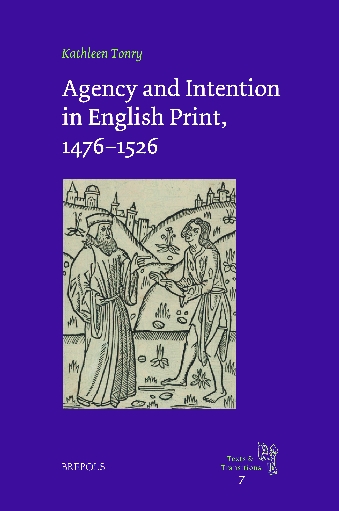
Agency and Intention in English Print, 1476–1526
This volume offers a new intellectual framework for early print that bridges divisions between the study of print and the study of literature between manuscripts and printed books and between pre- and post-1500 textual cultures. Through an extensive focus on medieval texts and ideas it is demonstrated here that in the half-century before the Reformation English print was part of a highly energetic tradition of late medieval textual production. Central to this tradition was the expression of ethical agency or moral ‘entente’ through the creation of texts and books. This insight reveals how the first English printed books expressed the deliberate moral and cultural commitments of individual printers.
By following early print across a range of genres (history writing religious instruction hagiography law books and translation) this study also sheds light on the contexts within which the agencies of early printers mattered including mercantile politics civic and statute law and theological economics.
The volume which treats the pre-Reformation press as a whole is based in particular on the bibliographical evidence provided in editions by William Caxton Wynkyn de Worde Richard Pynson John Rastell and Thomas Berthelet as well as on close readings of texts and contextual materials. The questions raised here however are about more than old books and early printers: ultimately this study argues that the history of the material book is an intellectual history of agency and textual production.

Probable Truth
Editing Medieval Texts from Britain in the Twenty-First Century
Editing as an academic mode of work has had a variable ‘press’ - it is often seen as just plumbing. But without editions no historian of whatever critical persuasion could operate. Texts that are not edited are effectively invisible.
The advent of electronic means of text production has also raised new possibilities and new problems that need to be openly considered rather than ignored. The papers in this volume reflect those concerns and explore the ways forward. How do the best editorial procedures of the past get transmitted to the future? A distinguished line-up of experienced editors and younger scholars actively grappling with these issues reflect on their engagement with the challenges of textual theory and editorial practice.
No single solution emerges as applicable to all texts and for all editions; the individual characteristics of each text and its transmission together with the intended audience of each edition emerge as primary areas for consideration.
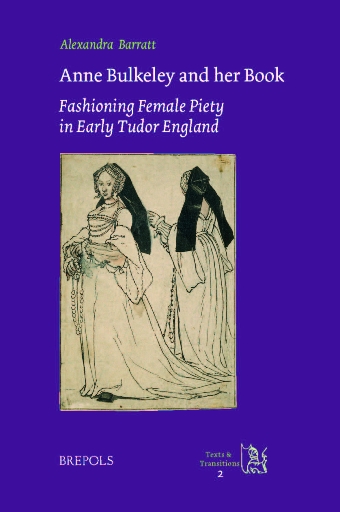
Anne Bulkeley and her Book
Fashioning Female Piety in Early Tudor England
This study is focused on bl ms Harley 494 a small manuscript book which can be dated between 1532 and 1535 and which has many of the features of a preces privatae volume or private prayer book. It contains prayers in English and Latin but also a number of brief devotional treatises in English. ms Harley 494 possesses two more features of interest: it belonged to a Hampshire widow Anne Bulkeley (and possibly later to her daughter Anne a nun at Amesbury Priory); and it emerged from a Birgittine textual community. Barratt edits and annotates the complete manuscript to provide an accessible and informative edition of this little known manuscript. However Anne Bulkeley and her Book is not a conventional edition of a late Middle English text. Rather Barratt carefully contextualizes the manuscript within its historical background just before the Dissolution of the Monasteries and meticulously investigates the varied and often unusual sources of many of the individual items in the book. In addition the discussion encompasses several related manuscripts (principally Lambeth Palace ms 3600 and the so-called Burnet Psalter (Aberdeen University Library ms 25)). This broad focus enables the volume to examine not only the evolution of the manuscript as a whole but also to answer wider questions of its owner’s identity her family connections and her (and her book’s) place in literary cultural and religious history.
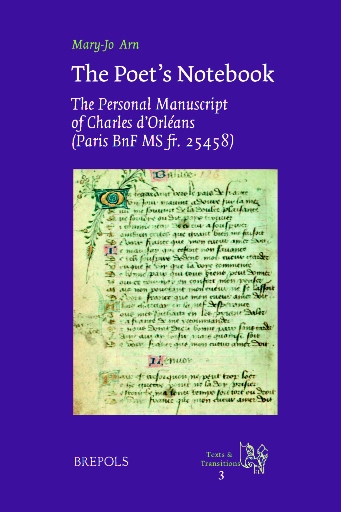
The Poet's Notebook
The Personal Manuscript of Charles d'Orléans (Paris, BnF MS fr. 25458)
This study of Charles d'Orléans's personal manuscript of his poetry - the first in nearly a century - paves the way not only for a new edition of the duke's œuvre (by Mary-Jo Arn John Fox and R. Barton Palmer) but for a new view of it. Following the first complete modern description of the manuscript this study reconstructs the history of the manuscript copying layer by copying layer. Codicological observations supplemented with palaeographical historical art-historical and textual information reveal the approximate sequence of the manuscript’s composition which in turn allows a re-dating of the manuscript and some of the poems in it. Charles saw lyric form differently than did his predecessors and contemporaries a view made manifest in the poet’s own numbering of his poems. He mixed his complaintes with ballades and his rondels with chansons each pair of forms in a numbered series but never presenting the longer alongside the shorter forms. The analysis of the manuscript’s construction corrects the current physical disorder of the later chansons and rondels as well as that of the ‘En la forest de longue actente’ series (including the lyric omitted from the standard edition) and re-evaluates the handful of English poems in the manuscript. In the end we come to understand the relationship between the visual ‘messiness’ of the manuscript and the poet’s strong concept of lyric order. The technical aspects of the study are clarified by many tables and fascimile pages; the interactive cd contains an index of first lines that can be sorted in various ways to reveal a variety of kinds of manuscript relationships.
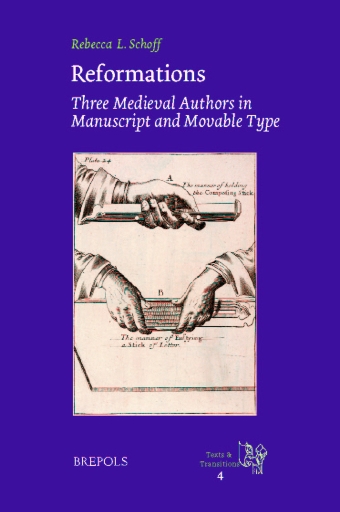
Reformations
Three Medieval Authors in Manuscript and Movable Type
This volume discusses the key shift from manuscript to print culture in the history of books taking The Canterbury Tales The Book of Margery Kempe and Piers Plowman as models of the way in which a medieval text's unique tradition influenced its transition from manuscript to print. The forces of the Reformation era did not produce the same effect across the varied textual legacy of the Middle Ages. Every text that made the transition from manuscript to print brought with it a set of concerns a tendency to address a particular readership in particular ways a physical presence developed in manuscript culture all of which might shape the pathways by which a text might arrive in print and what it might look like when it got there. This study follows The Canterbury Tales The Book of Margery Kempe and Piers Plowman from their circulation in manuscript to their presentation in print in order to track how each of them survived the metamorphosis of the relationship between writers and readers as the new technology was introduced. Taken together the three case studies demonstrate to scholars of any medieval literature the variety of possible impacts made when texts composed in manuscript culture were prepared for printing. The great force exerted by the technological and cultural developments of the English Reformation not least the more centralized legislative regulation of the press has long been central to the study of the history of books. This volume takes into account the ways in which individual textual traditions pushed back or accelerated the forces of early modern reform producing their own plural reformations.
The Making of Poetry
Late-Medieval French Poetic Anthologies
In this ground-breaking book the author explores some late-medieval lyric anthologies. Taking a cue from the French sociologist Pierre Bourdieu she sets poetic creation in the context of an understanding of the structures of court society and sketches the range of social intellectual and aesthetic positions available to the poet and the patron. Her primary focus is on a series of manuscripts which she argues reveal much about the socioliterary dynamics of particular poems and about the way in which they are vessels for the participation by individuals in a common culture of literary exchange: Charles d'Orléans's personal manuscript bnf français 25458 in which she argues the poets leave implicit or explicit traces of their social interactions; his duchess Marie's album Carpentras 375 which is interestingly different from the Duke's; bnf fr. 9223 and n.a.f. 15771 'coterie' manuscripts which allow us to see how social milieu determines shared literary forms and conventions; Marguerite d'Autriche's Album poétique Brussels br 10572 an anthology which is a cultural commodity allowing a princely court to recognise stylistic expertise and control of form. She finishes by examining the first great French poetic anthology Antoine Vérard's Jardin de Plaisance (1501) which seeks to recreate knowingly and imaginatively via rubrics illustrations and choice of texts the elite sociability for which the other anthologies are evidence.