


Manuscripta
A Journal for Manuscript Research
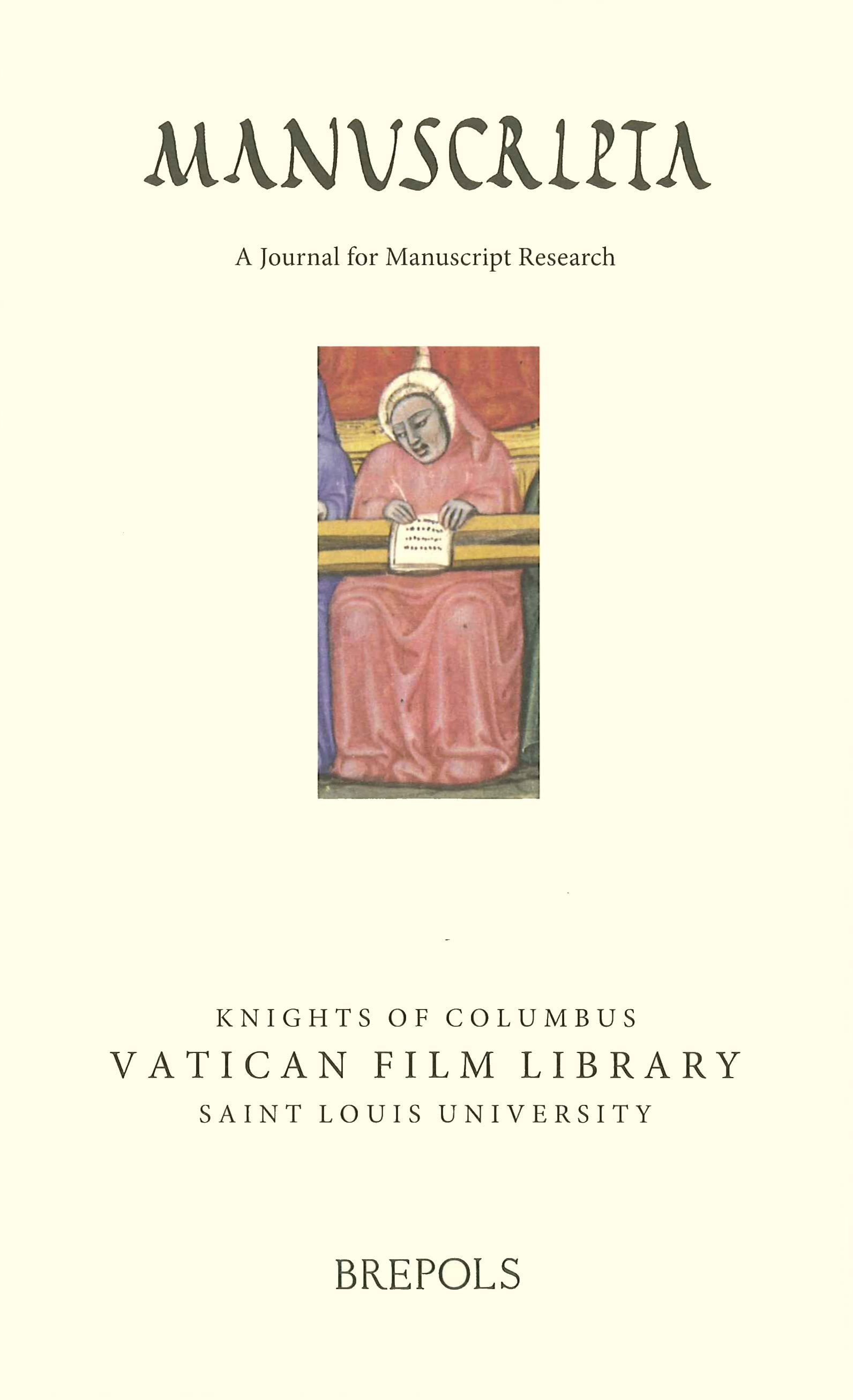
Volume 64, Issue 1, 2020
-
-
The Manuscripts of the Armenian Homilies of Jacob of Serugh: Preliminary Observations and Checklist
show More to view fulltext, buy and share links for:The Manuscripts of the Armenian Homilies of Jacob of Serugh: Preliminary Observations and Checklist show Less to hide fulltext, buy and share links for: The Manuscripts of the Armenian Homilies of Jacob of Serugh: Preliminary Observations and ChecklistBy: Andy HilkensAbstractThis article presents the results of the first investigation of the manuscript transmission of the Armenian translations of the homilies of Jacob of Serugh (d. 520/1). At least twenty-five homilies (or parts thereof) survive in Armenian, some of which are no longer extant in Syriac. From the twelfth century until as late as the nineteenth or twentieth century, these translations were transmitted via several types of manuscripts. The first part of this article briefly describes these types and their relevance to the reader who is unfamiliar with the Armenian manuscript tradition: a recension of the Armenian synaxarion, produced by Gregory of Khlat (d. 1425), two types of homiliaries (k‘arozgirk‘, tōnakan), a čaṙǝntir, which is a collection of homilies, hagiographical and apocryphal texts called čaṙǝntir, other miscellanies, the lectionary (čashoc‘) as well as the tōnapatčaṙ, a manuscript/collection with a polemical purpose. The second part lists the manuscripts that contain each of these Armenian texts, sorted first according to the type of manuscript, or at least the label it received in the manuscript catalogue, and then chronologically. This list will facilitate future research and will allow scholars to observe patterns in the transmission of certain texts.
-
-
-
Retrofitting the Apocalypse: Identifying the Image Cycle in London, British Library, Additional MS 17399
show More to view fulltext, buy and share links for:Retrofitting the Apocalypse: Identifying the Image Cycle in London, British Library, Additional MS 17399 show Less to hide fulltext, buy and share links for: Retrofitting the Apocalypse: Identifying the Image Cycle in London, British Library, Additional MS 17399AbstractLondon, British Library, Additional MS 17399 initially seems an unremarkable late witness to the vibrant Anglo-French illuminated vernacular Apocalypse tradition. However, the vernacular glossed prose text of this manuscript has a completely different cycle of images than one would expect. Starting on fol. 4r, Add. 17399’s miniatures are adapted closely from the program found in the manuscript picture-books related to the Berengaudus Apocalypse tradition that later inspired the block-book Apocalypses. Indeed, Add. 17399 is the only instance of a vernacular prose Apocalypse text with images derived from a block-book or a late picture-book. This marriage of text and image was not intended from the manuscript’s inception but represents an innovative, or at least resourceful, updating in completing an unfinished codex. While not exceptionally gifted, the artist displays thoughtful choices as images originally designed to accompany one commentary are modified to satisfy the demands of another. As such, Add. 17399 serves as a case study for continued manuscript customization and for the persistence of manuscript production contemporaneous with the technologies of xylographic book-making and print.
-
-
-
A Late Medieval Bible in Rugby School Archives
show More to view fulltext, buy and share links for:A Late Medieval Bible in Rugby School Archives show Less to hide fulltext, buy and share links for: A Late Medieval Bible in Rugby School ArchivesBy: Thomas W. SmithAbstractThis note describes an illuminated Latin bible manuscript in the collection of Rugby School Archives that is little known to scholars. Originally, the codex, Rugby School MS A2, was a pandect late medieval bible, produced in England or France, between ca. 1230 and ca. 1300. A somewhat mangled example of the genre, it has been heavily damaged by moisture at some point in its existence and, at 143 folios, has lost many of its leaves.
-
-
-
Quanto nobilius membrum: A Letter of Pope Gregory IX (1228)
show More to view fulltext, buy and share links for:Quanto nobilius membrum: A Letter of Pope Gregory IX (1228) show Less to hide fulltext, buy and share links for: Quanto nobilius membrum: A Letter of Pope Gregory IX (1228)AbstractThe conflict between Pope Gregory IX and Emperor Frederick II in 1227-30 offers a view into the functioning of Gregory’s chancery. When Gregory excommunicated Frederick in 1228, the papal chancery produced a series of letters condemning Frederick, sent to both clerical and royal addressees. These letters were seemingly written before Gregory’s excommunication of the emperor, but only dated afterwards, leading to one letter accidently being sent without any date. The process by which these letters were made and registered throws light on the innovative procedures of the thirteenth-century papal curia.
-
Volumes & issues
-
Volume 67 (2023)
-
Volume 66 (2022)
-
Volume 65 (2021)
-
Volume 64 (2020)
-
Volume 63 (2019)
-
Volume 62 (2018)
-
Volume 61 (2017)
-
Volume 60 (2016)
-
Volume 59 (2015)
-
Volume 58 (2014)
-
Volume 57 (2013)
-
Volume 56 (2012)
-
Volume 55 (2011)
-
Volume 54 (2010)
-
Volume 53 (2009)
-
Volume 52 (2008)
-
Volume 51 (2007)
-
Volume 50 (2006)
-
Volume 49 (2005)
-
Volume 47-48 (2004)
-
Volume 43-44 (2003)
-
Volume 45-46 (2003)
-
Volume 42 (1998)
-
Volume 41 (1997)
-
Volume 40 (1996)
-
Volume 39 (1995)
-
Volume 38 (1994)
-
Volume 37 (1993)
-
Volume 36 (1992)
-
Volume 35 (1991)
-
Volume 34 (1990)
-
Volume 33 (1989)
-
Volume 32 (1988)
-
Volume 31 (1987)
-
Volume 30 (1986)
-
Volume 29 (1985)
-
Volume 28 (1984)
-
Volume 27 (1983)
-
Volume 26 (1982)
-
Volume 25 (1981)
-
Volume 24 (1980)
-
Volume 23 (1979)
-
Volume 22 (1978)
-
Volume 21 (1977)
-
Volume 20 (1976)
-
Volume 19 (1975)
-
Volume 18 (1974)
-
Volume 17 (1973)
-
Volume 16 (1972)
-
Volume 15 (1971)
-
Volume 14 (1970)
-
Volume 13 (1969)
-
Volume 12 (1968)
-
Volume 11 (1967)
-
Volume 10 (1966)
-
Volume 9 (1965)
-
Volume 8 (1964)
-
Volume 7 (1963)
-
Volume 6 (1962)
-
Volume 5 (1961)
-
Volume 4 (1960)
-
Volume 3 (1959)
-
Volume 2 (1958)
-
Volume 1 (1957)
Most Read This Month
