


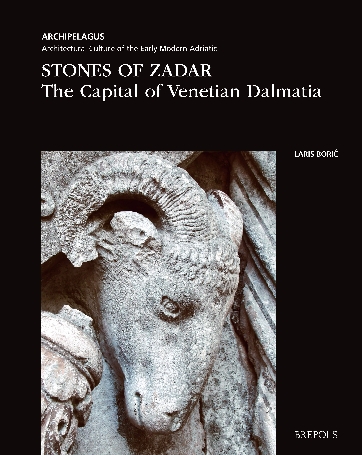
Stones of Zadar
The Capital of Venetian Dalmatia
Abstract
The book investigates the transformation of the architectural and visual language in Zadar, eastern Adriatic town, at the dawn of the early modern era, when the mighty mediaeval commune was being transformed by the emerging governmental structures of the Republic of Venice. These events coincided with the Ottoman Empire's takeover of the hinterland of Dalmatian cities, transforming Zadar into a city on the brink of two worlds.
A highly autonomous mediaeval commune was a lively trans-Adriatic artistic centre, a network of builders, painters, and sculptors from Dalmatia, Venice, Marche and Lombardy, so with the early adoption of humanist concepts by the local elite, this practice continued. However, the transformations the governmental structure and economic policies steadily limited its community autonomy and commercial sources. The crisis worsened in the 16th century, when the local elites lost a large portion of their revenue from the fertile hinterland captured by the Ottoman Empire.
This launched an ongoing militarisation of social structures and fortifying the town. These events were reflected in the fields of architecture and art. The process of adopting a new architectural and artistic language began in the second half of the 15th century, as demonstrated by motifs in architectural decoration and sculpture with impulses from important Dalmatian sculptural and stonemasons’ circles, as well as Venetian models from the circles of Pietro Lombardo and Mauro Codussi. When the new classical language of architecture began spreading in the middle of the 16th century, it expressed mostly in the renovation of administrative structures, with occasional departures from the stylistic canons of artistic centres.
