
Full text loading...





Marginalia decorata, Page 1 of 1
< Previous page | Next page > /docserver/preview/fulltext/10.1484/M.BIB-EB.6.09070802050003050305020003/M.BIB-EB.3.4518-1.gif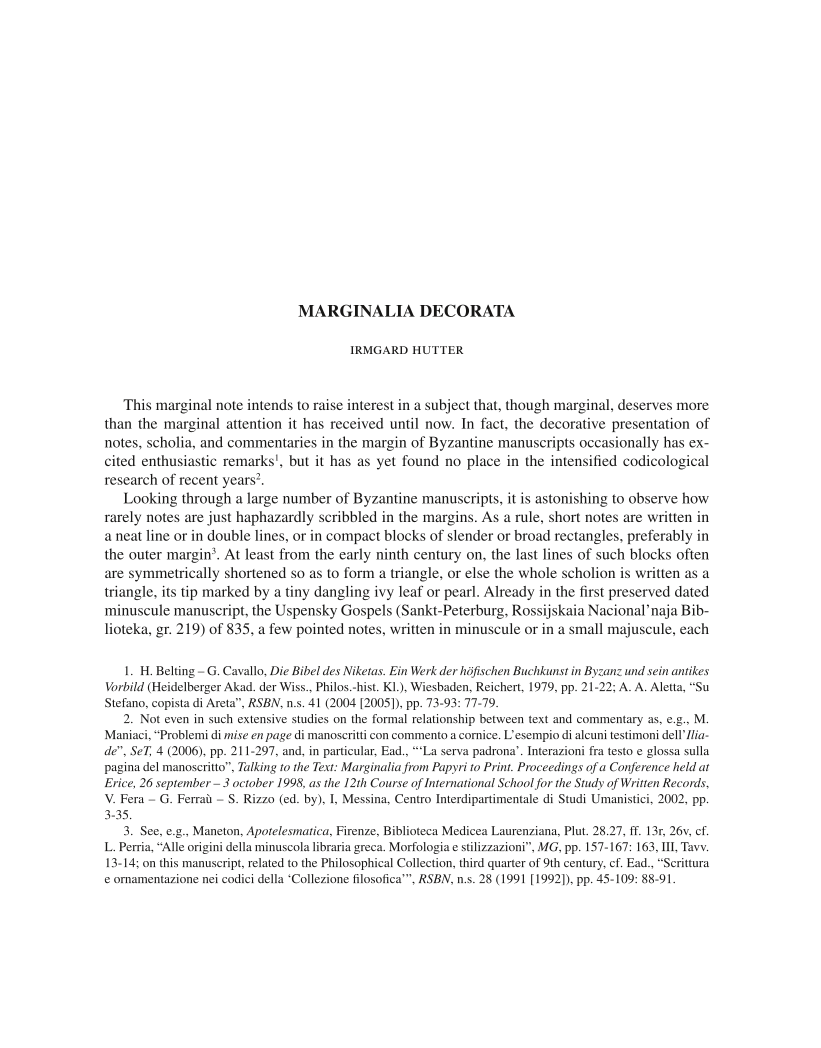
[
The paper deals with the decorative presentation of notes, scholia, and commentaries in the margins of Byzantine manuscripts, and their formal types and development. From the early 9th century on, and increasing in number and variety, short marginal scholia are written in geometric forms or figural shapes and the first instances occur of commentaries that frame the main text in a sequence of long lines and figural forms. Both systems seem to have been developed in the intellectual circles of the second half of the 9th and the early 10th century, probably with reference to much earlier scholia and to antique carmina figurata. The further history of decorated marginalia is one of technical and aesthetic enrichment and refinement. While single scholia, sometimes framed, continue to be used occasionally, from the second half of the 10th century on the scribes’ main interest is concentrated on catena manuscripts and on the harmonious, closed layout of the written page with broad commentary frames and integrated figural scholia. Masterpieces of this artificial practice are known from the late 10th and the early 14th century, in which decorative marginalia transform the written page into art. Thus the rare field of pagan art in Byzantium is extended, owing to scribal and bibliophile extravagance.
,In September 2008, the seventh edition of the International Colloquium of Greek Palaeography (Madrid-Salamanca, 15-20 September 2008) celebrated the 300th anniversary of the Palaeographia Graeca, the pioneer work of the Benedictine Bernard de Montfaucon that established the fundamentals of the discipline. Papers by renowned specialists in the field contributed to the methodology of study and to our knowledge of Greek manuscripts, and opened new perspectives for the study of the Greek manuscripts preserved mostly in European libraries, taking into account new methodological approaches, the possibilities of online resources and the results of ongoing research projects.
The Proceedings published here include contributions by specialists from over ten different countries, dealing with palaeographical issues such as ancient capital and lower-case lettering, writing and books in the Macedonian, Comnenian and Palaeologan periods, and Greek scribes and ateliers in the Renaissance (especially in manuscripts from the Iberian Peninsula). Many contributors also take a codicological approach and consider the material aspects of the codex, as well as other new research techniques. Finally, some papers deal with the book as object and how this relates to its content, as well as with the history of texts.
The International Colloquia of Greek Palaeography are organized by the International Committee of Greek Palaeography, presided by Prof. Dieter Harlfinger. The seventh edition payed tribute to the memory of the late Jean Irigoin, who died in 2006.
]
Full text loading...