
Full text loading...





Deux manuscrits de Ménées du monastère du Prodrome de Pétra et le groupe de Kokkinobaphos, Page 1 of 1
< Previous page | Next page > /docserver/preview/fulltext/10.1484/M.BIB-EB.6.09070802050003050305020003/M.BIB-EB.3.4519-1.gif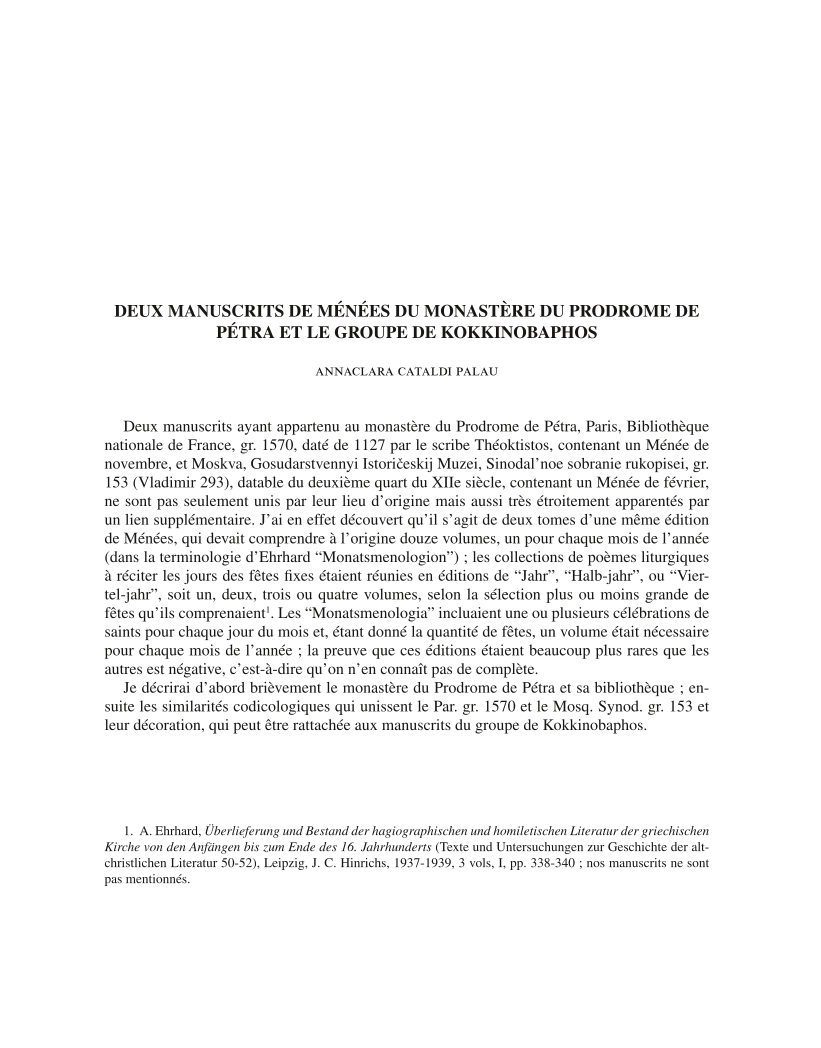
[
In September 2008, the seventh edition of the International Colloquium of Greek Palaeography (Madrid-Salamanca, 15-20 September 2008) celebrated the 300th anniversary of the Palaeographia Graeca, the pioneer work of the Benedictine Bernard de Montfaucon that established the fundamentals of the discipline. Papers by renowned specialists in the field contributed to the methodology of study and to our knowledge of Greek manuscripts, and opened new perspectives for the study of the Greek manuscripts preserved mostly in European libraries, taking into account new methodological approaches, the possibilities of online resources and the results of ongoing research projects.
The Proceedings published here include contributions by specialists from over ten different countries, dealing with palaeographical issues such as ancient capital and lower-case lettering, writing and books in the Macedonian, Comnenian and Palaeologan periods, and Greek scribes and ateliers in the Renaissance (especially in manuscripts from the Iberian Peninsula). Many contributors also take a codicological approach and consider the material aspects of the codex, as well as other new research techniques. Finally, some papers deal with the book as object and how this relates to its content, as well as with the history of texts.
The International Colloquia of Greek Palaeography are organized by the International Committee of Greek Palaeography, presided by Prof. Dieter Harlfinger. The seventh edition payed tribute to the memory of the late Jean Irigoin, who died in 2006.
,Two twelfth century manuscripts, Par., gr. 1570 (November Menaion, dated a. 1127 by the scribe Theoktistos) and Mosq. Synod. gr. 153 (February Menaion, copied by an unidentified scribe), both bearing the ex-libris of the monastery of the Prodromos of Petra in Constantinople, have the same dimensions and the same peculiar codicological characteristics, showing that they were two volumes of the same twelve-month set of Menaia. The decorative headbands on the first page of both books recall the type of decoration of the Kokkinobaphos group of manuscripts comprising ca. thirteen magnificently decorated manuscripts, so called after monk James, the main artist, belonging to the monastery of Kokkinobaphos in Constantinople (second quarter of the 12th century). Our two exemplars, though much simpler, show the same decorative motifs, drawn by a very experienced artist.
]
Full text loading...