
Full text loading...





La production de manuscrits scientifiques dans l’atelier de Michel Apostolis: l’exemple du De materia medica de Dioscoride, Page 1 of 1
< Previous page | Next page > /docserver/preview/fulltext/10.1484/M.BIB-EB.6.09070802050003050305020003/M.BIB-EB.3.4546-1.gif
[
Five Greek manuscripts contain a very peculiar version of Dioscorides’ De materia medica. In these manuscripts, the treatise has been reorganized so that all the chapters appear in alphabetical order (the so-called “Dioscorides alphabeticus”): Escur. T.II.12, Ballard 736; Leid. Voss. gr. F.59; Marc. gr. 272 and 597. Some codicological observations, along with a palaeographical analysis, allow me to attribute these five manuscripts to the same scriptorium, during the years 1455-70. From a philological point of view, two groups can be distinguished, the first containing: Voss. gr. F.59, Marc. gr. 272 and Ballard 736 (moreover, all three were produced, at least partly, by the same copyist); the second: Marc. gr. 597 and Escur. T.II.12 (both partially copied by the same scribe, not the copyist of the first group). Several clues lead me to conclude that this activity took place in the scriptorium that Michael Apostolis set up in Crete after he left Constantinople: for example, Michael Apostolis is one of the copyists of Marc. gr. 272; moreover, Escur. T.II.12 still bears its original binding, in which I found Cretan characteristics. We are thus facing a form of “mass-production” of Dioscorides manuscripts, where almost no interest is given to the text itself but showing obvious commercial views, probably to meet the demand from occidental clients for original Greek texts.
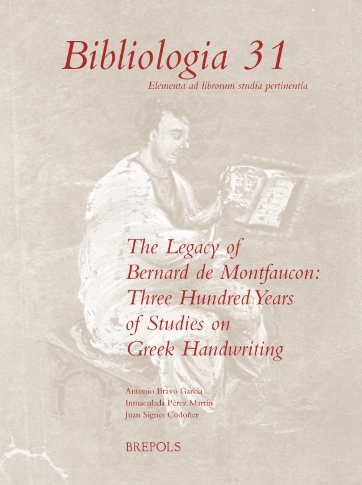
,In September 2008, the seventh edition of the International Colloquium of Greek Palaeography (Madrid-Salamanca, 15-20 September 2008) celebrated the 300th anniversary of the Palaeographia Graeca, the pioneer work of the Benedictine Bernard de Montfaucon that established the fundamentals of the discipline. Papers by renowned specialists in the field contributed to the methodology of study and to our knowledge of Greek manuscripts, and opened new perspectives for the study of the Greek manuscripts preserved mostly in European libraries, taking into account new methodological approaches, the possibilities of online resources and the results of ongoing research projects.
The Proceedings published here include contributions by specialists from over ten different countries, dealing with palaeographical issues such as ancient capital and lower-case lettering, writing and books in the Macedonian, Comnenian and Palaeologan periods, and Greek scribes and ateliers in the Renaissance (especially in manuscripts from the Iberian Peninsula). Many contributors also take a codicological approach and consider the material aspects of the codex, as well as other new research techniques. Finally, some papers deal with the book as object and how this relates to its content, as well as with the history of texts.
The International Colloquia of Greek Palaeography are organized by the International Committee of Greek Palaeography, presided by Prof. Dieter Harlfinger. The seventh edition payed tribute to the memory of the late Jean Irigoin, who died in 2006.
]
Full text loading...