
Full text loading...





Kopieren und Exzerpieren in der Palaiologenzeit, Page 1 of 1
< Previous page | Next page > /docserver/preview/fulltext/10.1484/M.BIB-EB.6.09070802050003050305020003/M.BIB-EB.3.4547-1.gif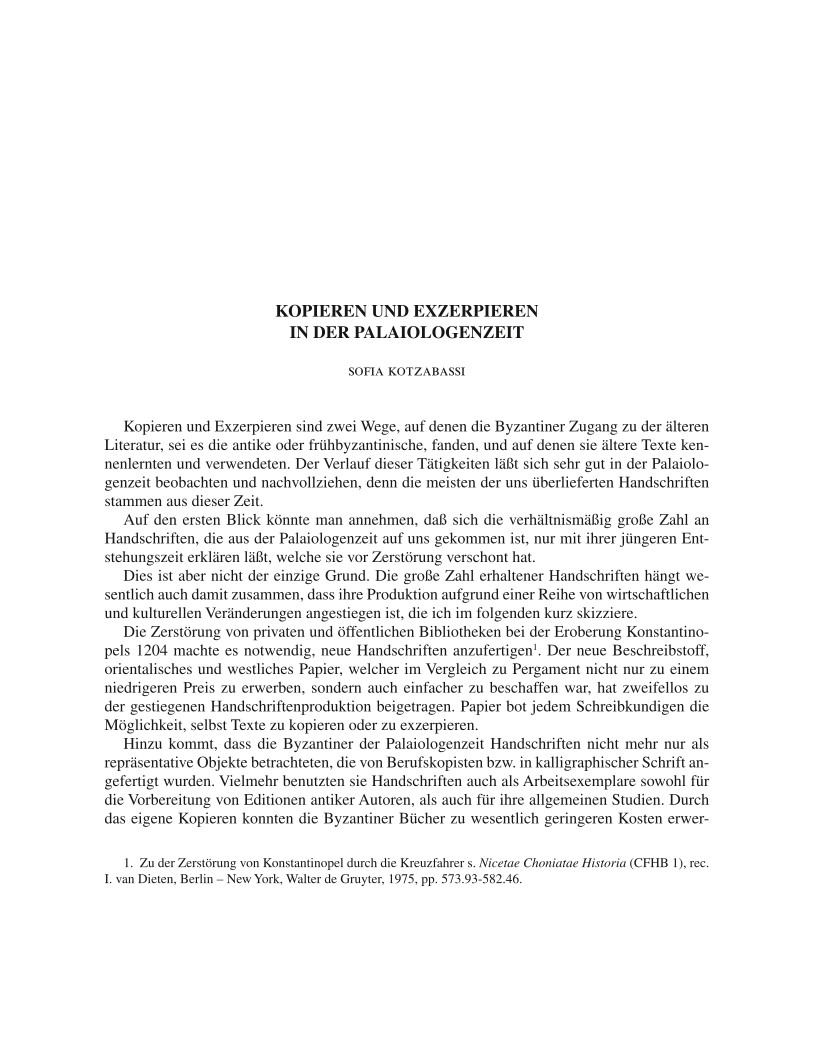
[
Copying and anthologising were two means by which the Byzantines retained access to classical and earlier Byzantine literature.
The manuscripts that were copied during the Palaeologan period can be divided into two groups: (a) those written for the personal use of the scribe, which may be classified on the basis of two criteria, namely the occupation or educational level of the writer and the currents of the age or the intellectual circle to which he belonged, and (b) those produced to order by professional scribes, a category which may include manuscripts for “public” use, e.g. liturgical manuscripts.
The collections of excerpts created during this period can also be divided into two main groups, namely thematic (anthologies, usually anonymous, of theological, philosophical, and other related kinds of content) and non-thematic collections. This latter group includes the “Hausbücher” and anthologies of scholars such as Gregory II Cyprius, Nicephoros Gregoras or John Chortasmenos, and collections that reflect the literary interests of their compilers, like those of, among others, the monk Gabriel and John Critopoulos (Par. gr. 1220, Vat. Chis. R.IV.12); this latter group also includes a number of anonymous anthologies, e.g. Athos, Panteleimon 174.
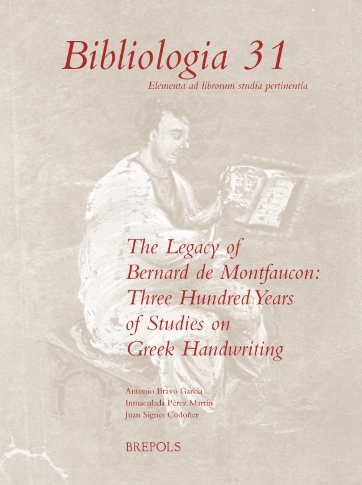
,In September 2008, the seventh edition of the International Colloquium of Greek Palaeography (Madrid-Salamanca, 15-20 September 2008) celebrated the 300th anniversary of the Palaeographia Graeca, the pioneer work of the Benedictine Bernard de Montfaucon that established the fundamentals of the discipline. Papers by renowned specialists in the field contributed to the methodology of study and to our knowledge of Greek manuscripts, and opened new perspectives for the study of the Greek manuscripts preserved mostly in European libraries, taking into account new methodological approaches, the possibilities of online resources and the results of ongoing research projects.
The Proceedings published here include contributions by specialists from over ten different countries, dealing with palaeographical issues such as ancient capital and lower-case lettering, writing and books in the Macedonian, Comnenian and Palaeologan periods, and Greek scribes and ateliers in the Renaissance (especially in manuscripts from the Iberian Peninsula). Many contributors also take a codicological approach and consider the material aspects of the codex, as well as other new research techniques. Finally, some papers deal with the book as object and how this relates to its content, as well as with the history of texts.
The International Colloquia of Greek Palaeography are organized by the International Committee of Greek Palaeography, presided by Prof. Dieter Harlfinger. The seventh edition payed tribute to the memory of the late Jean Irigoin, who died in 2006.
]
Full text loading...