
Full text loading...





Circolazione e riuso della Biblioteca di Fozio in età bizantina, Page 1 of 1
< Previous page | Next page > /docserver/preview/fulltext/10.1484/M.BIB-EB.6.09070802050003050305020003/M.BIB-EB.3.4548-1.gif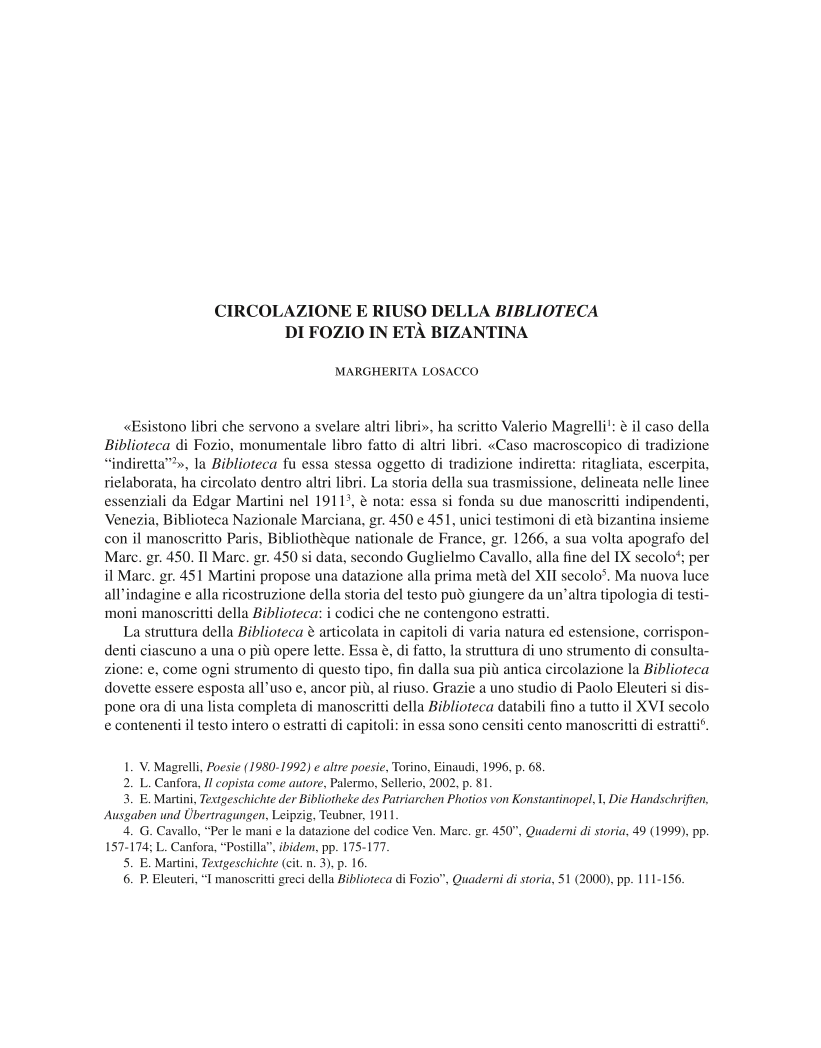
[
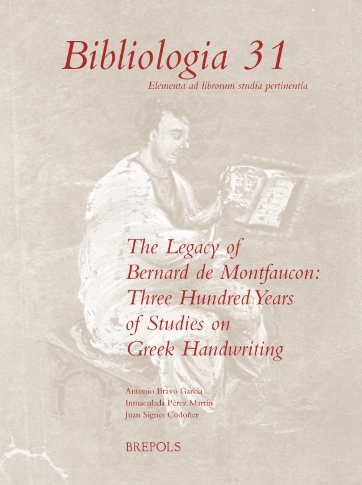
In September 2008, the seventh edition of the International Colloquium of Greek Palaeography (Madrid-Salamanca, 15-20 September 2008) celebrated the 300th anniversary of the Palaeographia Graeca, the pioneer work of the Benedictine Bernard de Montfaucon that established the fundamentals of the discipline. Papers by renowned specialists in the field contributed to the methodology of study and to our knowledge of Greek manuscripts, and opened new perspectives for the study of the Greek manuscripts preserved mostly in European libraries, taking into account new methodological approaches, the possibilities of online resources and the results of ongoing research projects.
The Proceedings published here include contributions by specialists from over ten different countries, dealing with palaeographical issues such as ancient capital and lower-case lettering, writing and books in the Macedonian, Comnenian and Palaeologan periods, and Greek scribes and ateliers in the Renaissance (especially in manuscripts from the Iberian Peninsula). Many contributors also take a codicological approach and consider the material aspects of the codex, as well as other new research techniques. Finally, some papers deal with the book as object and how this relates to its content, as well as with the history of texts.
The International Colloquia of Greek Palaeography are organized by the International Committee of Greek Palaeography, presided by Prof. Dieter Harlfinger. The seventh edition payed tribute to the memory of the late Jean Irigoin, who died in 2006.
,The structure of Photius’ Library is articulated in chapters, each containing notice of one work, or in some cases, more than one. Its structure can be considered analogous to that of a reference book. Beginning with its earliest stages of transmission, the Library seemed apt for re-use, that is, for extraction of single texts for the individual purposes of its readers. Therefore, the history of the transmission of the Library would greatly profit from an inquiry regarding the manuscripts containing excerpts from it. For the most part, the manuscripts containing excerpts were produced in the 15th and 16th centuries in Western Europe, penned by émigré Greek scholars and scribes. Nevertheless, one can attempt to reconstruct the history of its circulation and use during the Byzantine Empire—by Byzantine readers—with the help of only a handful of manuscripts copied up to the middle of the fifteenth century.
This paper explores three cases that highlight different facets of the Library’s transmission. The first case is represented by Marc. gr. 49, which contains an excerpt from chapters 139-140; it shows how Photius’ text—as is typical of reference books—functioned as a repository of bio-bibliographical information, reworked in order to create new reference texts. The second instance brings into focus Nicephorus Gregoras; among Byzantine scholars, Nicephorus shows the greatest familiarity with Photius’ Library, insofar as he not only quoted it in his Letters, but also copied, either entirely or partially, three manuscripts containing excerpts from Photius’ Library. The third case re-considers the palimpsest, London, British Library, Arundel 529 (copied in 1111), which has been supposed to bear traces of Photius’ Library in the scriptio inferior and therefore to be its oldest surviving copy, in majuscule. This third case draws attention to a methodological impasse, the tricky overlap of texts containing quotations and quoted texts, of direct and indirect transmission.
]
Full text loading...