
Full text loading...





On Jerusalem Vestiges of the Byzantine Gospel Lectionary, Page 1 of 1
< Previous page | Next page > /docserver/preview/fulltext/10.1484/M.CBM-SUBSIDIA-EB.6.09070802050003050408090501/M.CBM.1.101393-1.gif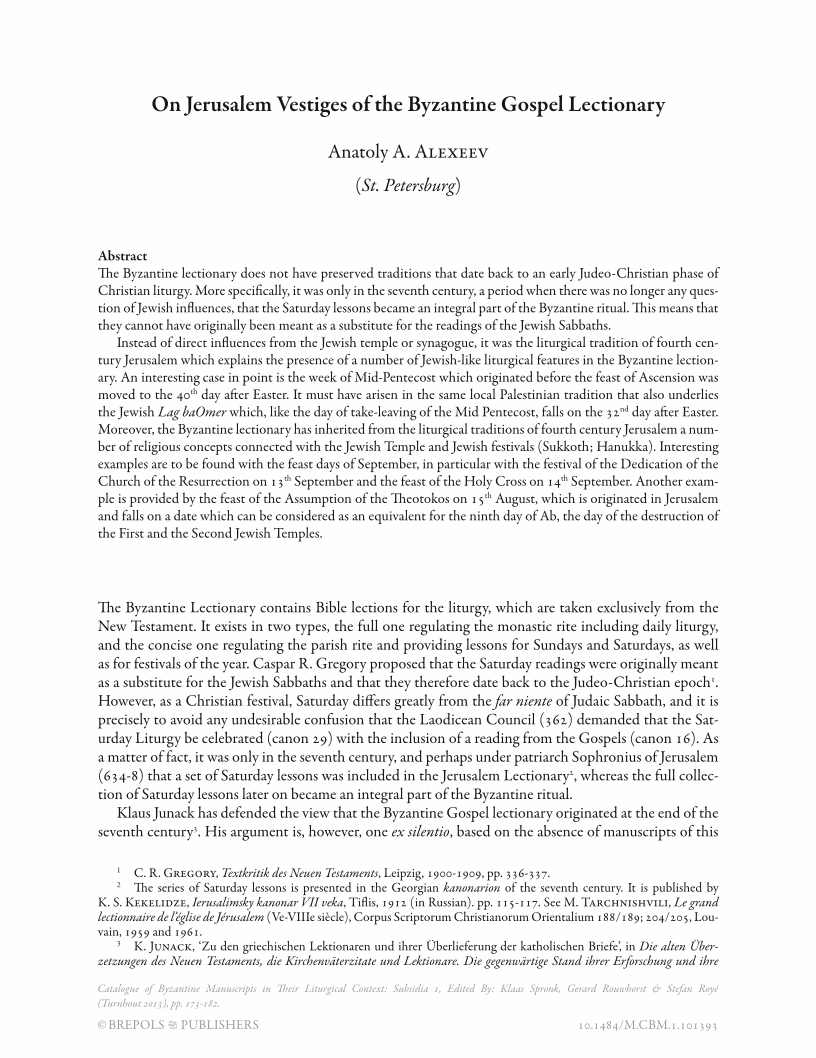
[
The Byzantine lectionary does not have preserved traditions that date back to an early Judeo-Christian phase of Christian liturgy. More specifically, it was only in the seventh century, a period when there was no longer any question of Jewish influences, that the Saturday lessons became an integral part of the Byzantine ritual. This means that they cannot have originally been meant as a substitute for the readings of the Jewish Sabbaths.
Instead of direct influences from the Jewish temple or synagogue, it was the liturgical tradition of fourth century Jerusalem which explains the presence of a number of Jewish-like liturgical features in the Byzantine lectionary. An interesting case in point is the week of Mid-Pentecost which originated before the feast of Ascension was moved to the 40th day after Easter. It must have arisen in the same local Palestinian tradition that also underlies the Jewish Lag baOmer which, like the day of take-leaving of the Mid Pentecost, falls on the 32nd day after Easter. Moreover, the Byzantine lectionary has inherited from the liturgical traditions of fourth century Jerusalem a number of religious concepts connected with the Jewish Temple and Jewish festivals (Sukkoth; Hanukka). Interesting examples are to be found with the feast days of September, in particular with the festival of the Dedication of the Church of the Resurrection on 13th September and the feast of the Holy Cross on 14th September. Another example is provided by the feast of the Assumption of the Theotokos on 15th August, which is originated in Jerusalem and falls on a date which can be considered as an equivalent for the ninth day of Ab, the day of the destruction of the First and the Second Jewish Temples.
,The world of Byzantine manuscripts is fascinating but also confusing. Although they play an important part in modern studies on the history of Christian liturgy and on the textual history of the Bible, a clear overview of the vast amount of these manuscripts in their many different forms is lacking. A new approach in their cataloguing is called for. The present volume brings together a number of specialists in the field of Byzantine, liturgical and Biblical studies with the aim to develop a new methodology for codicological research of the Byzantine manuscripts, taking seriously the original environment of the integral codices in the monasteries and the churches in which they were manufactured and functioned.
Prof. dr. Klaas Spronk is Head of the Research Department Sources of the Protestant Theological University (PThU), location Amsterdam, and chairman of the CBM Academic Board.
Prof. dr. Gerard Rouwhorst is Professor of Liturgical History at the Tilburg School of Catholic Theology and member of the Department of Biblical Sciences and Church History of that institution. He is member of the CBM Academic Board.
Dr. Stefan Royé is member of the Research Department Sources of the Protestant Theological University (PThU), location Amsterdam, and CBM programme coordinator and secretary of the Academic Board.
]
Full text loading...