Skip to content
1882

The Composite Nature of Poland‑Lithuania. Political, Cultural, and Social Dynamics in the Early Modern East Central Europe

image of The Composite Nature of Poland‑Lithuania. Political, Cultural, and Social Dynamics in the Early Modern East Central Europe
Preview this chapter:
Loading full text...

Full text loading...

/content/books/10.1484/M.ECE-EB.5.151724
View: Figures

Figures

Image of Figure 1.
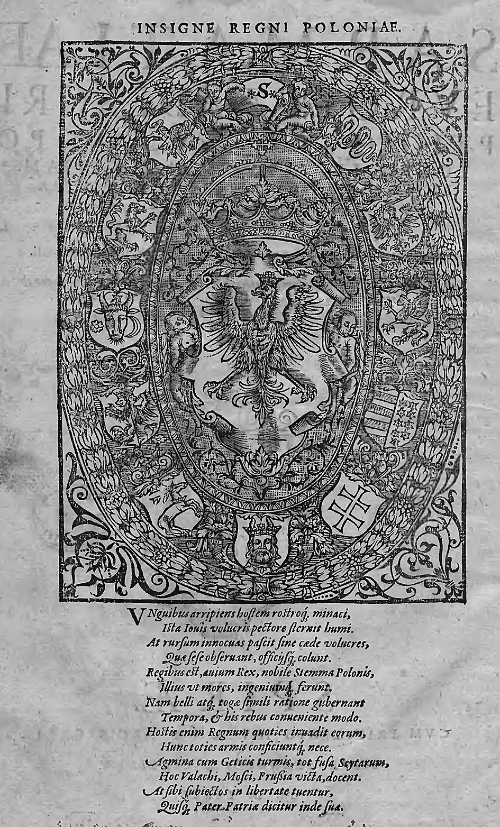
Figure 1. Composition of dynastic and terrestrial coats of arms surrounding the coats of arms of the Kingdom of Poland, woodcut, printed on the reverse side of the title page of Allessandro Guagnini’s …, Kraków 1578, Wrocław, ZNO, XVI.F.4204. Source: Public domain through Wikimedia: https://upload.wikimedia.org/wikipedia/commons/9/93/Sarmatiae_Europae_Descriptio%2C_Insigne_Regni_Poloniae.jpg
Image of Figure 2.
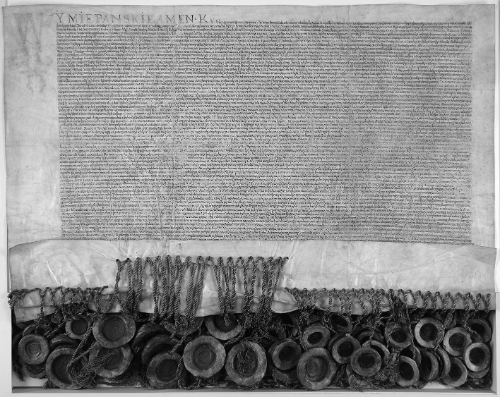
Figure 2. The charter of the Union of Lublin (founding act of the Polish-Lithuanian Commonwealth, sealed with 77 seals), Warszawa, AGAD, collection of parchment documents, nr 5627. Source: Wikimedia Commons, https://en.wikipedia.org/wiki/File:Unia_Lubelska_1569_r..jpg
Image of Figure 3.
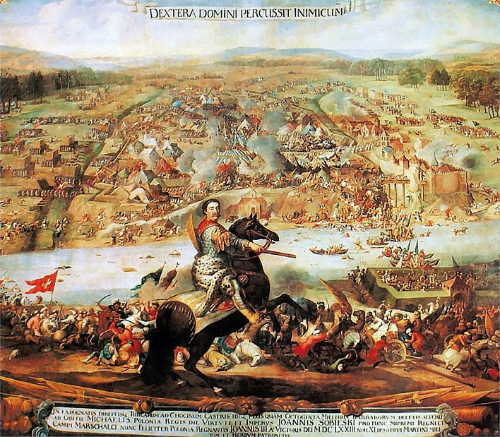
Figure 3. John III Sobieski as the triumphant in the Battle of Khotyn (1673), painting of Andreas Stech, Ferdinand von Kessel the Older (oil on canvass), 1674–1679, Borys Voznytsky Lviv National Art Gallery (originally in the Church of St Lawrence in Zhovkva). Source: Public Domain through Wikimedia Commons, https://en.wikipedia.org/wiki/File:Stech_Kessel_Bitwa_pod_Chocimiem.jpg
Image of Figure 4.
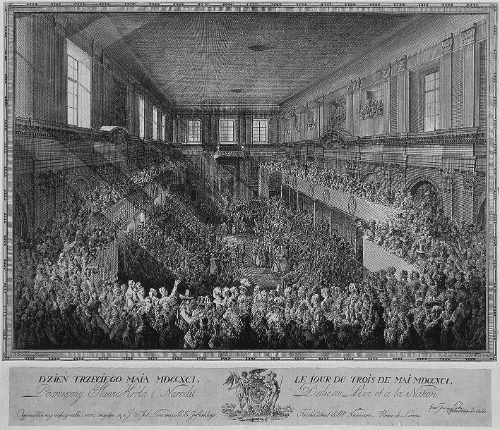
Figure 4. Resolution of the 3 May Constitution (1791), etching, Jean Pierre Norblin, 1792, Warszawa, Muzeum Narodowe, collection of Polish prints, signature Gr.Pol.2364 MNW. Source: Public Domain through https://cyfrowe.mnw.art.pl/en/catalog/839010

References

  1. Primary Sources
    Archiwum Jana Zamoyskiego, kanclerza i hetmana wielkiego koronnego, ed. by Wacław Sobieski. Vol. 1 (Warszawa: Piotr Laskauer i S-ka, 1904)
  2. Bartłomiej Groicki, Porządek sądów i spraw miejskich prawa maydeburskiego w Koronie Polskiej (Kraków: [n. pub.], 1566)
  3. Bernard O’Connor, The History of Poland in Several Letters to Persons of Quality, Giving an Account of the Antient and Present State of that Kingdom, Historical, Geographical, Physical, Political and Ecclesiastical […], with Sculptures and a New Map after the Best Geographers, with Several Letters Relating to Physick. Vol. 1 (London: J. D. for Dan. Brown […] and A. Roper […], 1698)
  4. Stanisław Konarski, O skutecznym rad sposobie, albo o utrzymywaniu sejmów ordynaryjnych. Vol. 1 (Warszawa: Drukarnia Scholarum Piarum, 1760)
  5. Volumina Constitutionum. Vol. 2.1, ed. by Stanisław Grodziski, Irena Dwornicka, and Wacław Uruszczak (Warszawa: Wydawnictwo Sejmowe, 2005)
  6. William Coxe, Travels into Poland, Russia, Sweden, and Denmark: Interspersed with Historical Relations and Political Inquiries. Vol. 1 (Dublin: Printed for S. Price et alt., 1784)
  7. Secondary Studies
    Augustyniak, Urszula, History of the Polish-Lithuanian Commonwealth. State – Society – Culture, ed. by Iwo Hryniewicz, trans. by Grażyna Waluga and Dorota Sobstel (Frankfurt am Main: Peter Lang, 2015)
  8. Augustyniak, Urszula, ‘Non de fide, sed de securitate pacis: wiara i polityka w poglądach ewangelików w Rzeczypospolitej w latach 1631–1632’, Odrodzenie i Reformacja w Polsce, 44 (2000), 7199
    [Google Scholar]
  9. Augustyniak, Urszula, Wazowie i ‘królowie rodacy’. Studium władzy królewskiej w Rzeczypospolitej XVII wieku (Warszawa: Semper, 1999)
  10. Bill, Stanley, and Simon Lewis, ‘Introduction: Diverse Histories and Contested Memories’, in Multicultural Commonwealth. Poland-Lithuania and its Afterlives, ed. by Stanley Binn and Simon Lewis (Pittsburgh: University of Pittsburgh Press, 2023), pp. 3–24
  11. Bues, Almut, ‘The Formation of the Polish-Lithuanian Monarchy in the Sixteenth Century’, in The Polish-Lithuanian Monarchy in European Context, c. 1500–1795, ed. by Richard Butterwick (New York: Palgrave, 2001), pp. 58–81
  12. Butterwick, Richard, ‘Confessions, Confessionalisation, and the Partitions of the Polish-Lithuanian Commonwealth’, in Multicultural Commonwealth: Poland-Lithuania and its Afterlives, ed. by Stanley Binn and Simon Lewis (Pittsburgh: University of Pittsburgh Press, 2023), pp. 136–54
  13. Butterwick, Richard, Poland’s Last King and English Culture (Oxford: Clarendon Press, 1998)
  14. Butterwick, Richard, The Constitution of 3 May 1791: Testament of the Polish-Lithuanian Commonwealth (Warszawa: Muzeum Historii Polski, 2021)
  15. Butterwick, Richard, The Polish-Lithuanian Commonwealth, 1733–1795: Light and Flame (New Haven: Yale University Press, 2020)
  16. Butterwick, Richard, The Polish Revolution and the Catholic Church, 1788–1792: A Political History (Oxford: Oxford University Press, 2012)
  17. Choińska-Mika, Jolanta, Między społeczeństwem szlacheckim a władzą. Problemy komunikacji społeczności lokalne – władza w epoce Jana Kazimierza (Warszawa: Neriton, 2002)
  18. Choińska-Mika, Jolanta, ‘Representation, Society, and the Jagiellon Monarchy, 1506–1572’, in The Jagiellon Dynasty, 1386–1596: Politics, Culture, Diplomacy, ed. by Darius von Güttner Sporzyński with assistance of Matthew Firth, Robert T. Tomczak, and Magdalena Biniaś-Szkopek, East Central Europe, 476–1795 ad/ce, 1 (Turnhout: Brepols, 2024), pp. 241–62
  19. Choińska-Mika, Jolanta, and David Dean, ‘Representation and Accountability: A Comparison of Early Modern England and Poland’, Parliaments, Estates and Representation, 21.1 (2001), 91101
    [Google Scholar]
  20. Choińska-Mika, Jolanta, and Katarzyna Kuras, ‘Free Election, Divine Providence, and Constitution: Legitimacy of Royal Power in the Early Modern Polish-Lithuanian Commonwealth’, in Dynastic Change: Legitimacy and Gender in Medieval and Early Modern Monarchy, ed. by Ana Maria S. Rodrigues, Manuela Santos Silva, and Jonathan Spangler (London: Routledge, 2020), pp. 103–22
  21. Dygdała, Jerzy, ‘Suwerenność Rzeczypospolitej czy suwerenność “państw” magnackich? (z doświadczeń bezkrólewia 1733 roku)’, Klio, 54 (2020), 334
    [Google Scholar]
  22. Elliott, John H., ‘A Europe of Composite Monarchies’, Past & Present, 137 (1992), 4871
    [Google Scholar]
  23. Ertman, Thomas, Birth of the Leviathan: Building States and Regimes in Medieval and Early Modern Europe (Cambridge: Cambridge University Press, 1997)
  24. Friedrich, Karin, ‘Multiconfessionalism and Interconfessionality’, in Multicultural Commonwealth: Poland-Lithuania and its Afterlives, ed. by Stanley Binn and Simon Lewis (Pittsburgh: University of Pittsburgh Press, 2023), pp. 45–65
  25. Friedrich, Karin, The Other Prussia: Royal Prussia, Poland and Liberty, 1569–1772 (Cambridge: Cambridge University Press, 2000)
  26. Frost, Robert, ‘Obsequious Disrespect: The Problem of Royal Power in the Polish-Lithuanian Commonwealth under the Vasas, 1587–1668’, in The Polish-Lithuanian Monarchy in European Context, c. 1500–1795, ed. by Richard Butterwick (New York: Palgrave, 2001), pp. 150–71
  27. Frost, Robert, ‘Ordering the Kaleidoscope: The Construction of Identities in the Lands of the Polish-Lithuanian Commonwealth since 1569’, in Power and the Nation in European History, ed. by Len Scales and Oliver Zimmer (Cambridge: Cambridge University Press, 2005), pp. 212–31
  28. Frost, Robert, The Oxford History of Poland-Lithuania, vol. 1: The Making of the Polish-Lithuanian Union, 1385–1569 (Oxford: Oxford University Press, 2015)
  29. Gierowski, Józef Andrzej, The Polish-Lithuanian Commonwealth in the XVIIIth century (Kraków: PAU, 1996)
  30. Grodziski, Stanisław, Obywatelstwo w szlacheckiej Rzeczypospolitej (Kraków: PWN, 1953)
  31. Grześkowiak-Krwawicz, Anna, ‘Citizen, Fatherland, and Patriotism in the Political Discourse in the Polish-Lithuanian Commonwealth’, in Whose Love of Which Country? Composite States, National Histories and Patriotic Discourses in Early Modern East Central Europe, ed. by Balazs Trencsenyi and Márton Zászkaliczky, Studies in the History of Political Thought, 3 (Leiden: Brill, 2010), pp. 255–81
  32. Grześkowiak-Krwawicz, Anna, Queen Liberty: The Concept of Freedom in the Polish-Lithuanian Commonwealth, trans. by Daniel J. Sax (Leiden: Brill, 2012)
  33. Grześkowiak-Krwawicz, Anna, ‘Rzeczpospolita: Państwo czy wspólnota? Zmiany w systemie wartości w dyskursie politycznym wieku XVIII’, in Wartości polityczne Rzeczypospolitej Obojga narodów: Struktury aksjologiczne i granice cywilizacyjne, ed. by Anna Grześkowiak-Krwawicz, in cooperation with Jerzy Axer, Kultura Pierwszej Rzeczypospolitej w dialogu z Europą: Hermeneutyka wartości. Vol. 3 (Warszawa: UW, 2017), pp. 88–116
  34. Grześkowiak-Krwawicz, Anna, The Political Discourse of the Polish-Lithuanian Commonwealth: Concepts and Ideas (Abington: Routledge, 2021)
  35. Grzybowski, Konstanty, ‘The Three Parliamentary Estates’, in The Polish Parliament at the Summit of Its Development (16th17th Centuries). Anthologies, ed. by Władysław Czapliński (Wrocław: ZNO, 1985), pp. 85–110
  36. Kiaupienė, Jūratė, ‘Some Features of Parliamentary Culture of the Grand Duchy of Lithuania’, in Unie międzypaństwowe, parlamentaryzm, samorządność. Studia z dziejów ustroju Rzeczypospolitej Obojga Narodów, ed. by Wacław Uruszczak, Zdzisław Noga, Michał Zwierzykowski, and Krzysztof Fokt (Warszawa: Wydawnictwo Sejmowe, 2020), pp. 203–19
  37. Koenigsberger, Helmut Georg, ‘Monarchies and Parliaments in Early Modern Europe. Dominium Regale or Dominium Politicum et Regale’, Theory and Society, 5 (1978), 191217
    [Google Scholar]
  38. Kutrzeba, Stanisław ‘The composition of the Polish Sejm’, in The Polish Parliament at the Summit of Its Development (16th17th Centuries). Anthologies, ed. by Władysław Czapliński (Wrocław: ZNO, 1985), pp. 13–20
  39. Lewandowska-Malec, Izabela, ‘Zapomniana demokracja. O demokracji deliberacyjnej w Pierwszej Rzeczypospolitej’, Studia Iuridica Toruniensia, 10 (2012), 12346
    [Google Scholar]
  40. Lukowski, Jerzy, Liberty’s Folly: The Polish-Lithuanian Commonwealth in the Eighteenth Century, 1697–1795 (London: Routledge, 1991)
  41. Lukowski, Jerzy, ‘The Szlachta and the Monarchy: Reflections on the Struggle inter maiestatem ac libertatem’, in The Polish-Lithuanian Monarchy in European Context, c. 1500–1795, ed. by Richard Butterwick (New York: Palgrave, 2001), pp. 132–49
  42. Łosowski, Janusz, Dokumentacja w życiu chłopów w okresie staropolskim. Studium z dziejów kultury (Lublin: Olech, 2013)
  43. Markiewicz, Mariusz, Historia Polski, 1492–1795 (Kraków: Wydawnictwo Literackie, 2004)
  44. Markiewicz, Mariusz, ‘Jedyna i nieporównywalna? – normalne państwo europejskie czy może państwo pogranicza?’, in Między Zachodem a Wschodem. Studia z dziejów Rzeczypospolitej w epoce nowożytnej, ed. by Jacek Staszewski, Krzysztof Mikulski, and Jarosław Dumanowski (Toruń: Adam Marszałek, 2002), pp. 17–22
  45. Markiewicz, Mariusz, ‘Stosunki między Rzeczpospolitą a Saksonią za panowania Augusta II i Augusta III’, in Europa unii i federacji. Idea jedności narodów i państw od średniowiecza do czasów współczesnych, ed. by Krzysztof Ślusarek with the introduction by Franciszek Ziejka (Kraków: Historia Iagellonica, 2004), pp. 83–90
  46. Markiewicz, Mariusz, ‘The Functioning of the Monarchy during the Reigns of the Electors of Saxony, 1697–1763’, in The Polish-Lithuanian Monarchy in European Context, c. 1500–1795, ed. by Richard Butterwick (New York: Palgrave, 2001), pp. 172–92
  47. Mat’a, Petr, ‘Negotiating Fiscal-Military Coordination: Provincial Tax Quotas for the Habsburg Army 1648–1748’, in The Habsburg Monarchy as a Fiscal-Military State: Contours and Perspectives 1648–1815, ed. by William D. Godsey and Petr Maťa (Oxford: Oxford University Press, 2022), pp. 183–200
  48. Mączak, Antoni, ‘Jedyna i nieporównywalna? Kwestia odrębności Rzeczypospolitej w Europie XVI–XVII wieku’, Kwartalnik Historyczny, 100.4 (1993), 12136
    [Google Scholar]
  49. Mączak, Antoni, Klientela. Nieformalne systemy władzy w Polsce i Europie XVI–XVIII w. (Warszawa: Semper, 1994)
  50. McKenna, Catherine, ‘The Liberum Veto, Born of Constitutional Crisis’, in Unie międzypaństwowe, parlamentaryzm, samorządność. Studia z dziejów ustroju Rzeczypospolitej Obojga Narodów, ed. by Wacław Uruszczak, Zdzisław Noga, Michał Zwierzykowski, and Krzysztof Fokt (Warszawa: Wydawnictwo Sejmowe, 2020), pp. 255–74
  51. New Directions in the History of the Jews in the Polish Lands, ed. by Antony Polonsky, Hanna Węgrzynek, and Andrzej Żbikowski (Boston: Academic Studies Press, 2018)
  52. Opaliński, Edward, ‘Sejm of the Commonwealth of Two Nations 1572–1668’, Przegląd Sejmowy/The Sejm Review, 6/167 (2021), 85–114
  53. Penkała-Jastrzębska, Anna, ‘Noble Matrimonial Policy at the Royal Court in Dresden during the Reign of King Augustus the Strong (1697–1733): Public Affairs, Private Interest’, The Court Historian, 28.1 (2023), 8095
    [Google Scholar]
  54. Pietrzyk-Reeves, Dorota, Polish Republican Discourse in the Sixteenth Century (Cambridge: Cambridge University Press, 2020)
  55. Płaza, Stanisław, Sejmiki i zjazdy szlacheckie województw poznańskiego i kaliskiego: Ustrój i funkcjonowanie (Warszawa: PWN, 1984)
  56. The Polish-Lithuanian Commonwealth: History, Memory, Legacy, ed. by Andrzej Chwalba and Krzysztof Zamorski (New York: Routledge, 2021)
  57. The Polish Parliament at the Summit of Its Development (16th17th Centuries). Anthologies, ed. by Władysław Czapliński (Wrocław: ZNO, 1985)
  58. Polonsky, Antony, ‘The Polish-Lithuanian Commonwealth: History, Memory, Legacy’, in The Polish-Lithuanian Commonwealth: History, Memory, Legacy, ed. by Andrzej Chwalba and Krzysztof Zamorski (New York: Routledge, 2021), pp. 26–37
  59. Rachuba, Andrzej, ‘Co zrealizowano z treści aktu unii lubelskiej z 1569 r.? Wielkie Księstwo Litewskie w składzie Rzeczypospolitej’, in Unie międzypaństwowe, parlamentaryzm, samorządność. Studia z dziejów ustroju Rzeczypospolitej Obojga Narodów, ed. by Wacław Uruszczak, Zdzisław Noga, Michał Zwierzykowski, and Krzysztof Fokt (Warszawa: Wydawnictwo Sejmowe, 2020), pp. 147–65
  60. Robertson, John, Empire and Union: The Concepts of the Early Modern European Political Order, in A Union for Empire. Political thought and the British Union od 1707, ed. by John Robertson (Cambridge: Cambridge University Press, 1995), pp. 3–36
  61. Robertson, John, ‘Union, State and Empire: The Britain of 1707 in its European Setting’, in An Imperial State and War: Britain from 1689 to 1815, ed. by Lawrence Stone (London: Routledge, 1994), pp. 224–57
  62. Rosman, Murray J., The Lords’ Jews: Magnate-Jewish Relations in the Polish-Lithuanian Commonwealth during the Eighteenth Century (Cambridge, MA: Harvard University Press, 1990)
  63. Skinner, Barbara, The Western Front of the Eastern Church: Uniate and Orthodox Conflict in Eighteenth-Century Poland, Ukraine, Belarus, and Russia (DeKalb: Northern Illinois University Press, 2009)
  64. Teter, Magda, ‘How Jewish is the History of the Polish-Lithuanian Commonwealth?’, in Multicultural Commonwealth: Poland-Lithuania and its Afterlives, ed. by Stanley Binn and Simon Lewis (Pittsburgh: University of Pittsburgh Press, 2023), pp. 27–44
  65. Tollet, David, ‘The Private Life of Polish Jews in the Vasa Period’, in The Jews in Old Poland, 1000–1795, ed. by Antony Polonsky, Jakub Basista, and Andrzej Link-Lenczowski (London: Bloomsbury Academic, 2022), pp. 45–62
  66. Uruszczak, Wacław, ‘Najstarszy sejm walny koronny dwuizbowy w Piotrkowie w 1468 roku’, in Narodziny Rzeczypospolitej. Studia z dziejów średniowiecza i czasów nowożytnych, ed. by Waldemar Bukowski and Tomasz Jurek (Kraków: Societas Vistulana, 2012), pp. 1033–56
  67. Vasiliauskas, Artūras, ‘The Practice of Citizenship among the Lithuanian Nobility, ca. 1580–1630’, in Citizenship and Identity in a Multinational Commonwealth Poland-Lithuania in Context, 1550–1772, ed. by Karin Friedrich and Barbara Pendzich, Studies in Central European Histories, 46 (Leiden: Brill, 2009), pp. 71–102
  68. Vermeesch, GrietReflections on the Relative Accessibility of Law Courts in Early Modern Europe’, Crime, History & Societies, 19.2 (2015), 5376
    [Google Scholar]
  69. Wagner-Rundell, Benedict, ‘Liberty, Virtue, and the Chosen People: British and Polish Republicanism in the Early Eighteenth Century’, in Britain and Poland–Lithuania: Contacts and Comparison from the Middle Ages to 1795, ed. by Richard Unger with the assistance of Jakub Basista (Leiden: Brill, 2008), pp. 197–214
  70. Wiślicz, Tomasz, Zelman Wolfowicz i jego rządy w starostwie drohobyckim w połowie XVIII w. (Kraków: Universitas, 2020)
  71. Wyżga, Mateusz, Homo movens. Mobilność chłopów w mikroregionie krakowskim w XVI–XVIII wieku (Kraków: UP, 2019)
  72. Zakrzewski, Andrzej, ‘Between the Union of Lublin and the Mutual Pledge of the Two Nations’, Zapiski Historyczne, 84.4 (2019), 540
    [Google Scholar]

References

  1. Primary Sources
    Archiwum Jana Zamoyskiego, kanclerza i hetmana wielkiego koronnego, ed. by Wacław Sobieski. Vol. 1 (Warszawa: Piotr Laskauer i S-ka, 1904)
  2. Bartłomiej Groicki, Porządek sądów i spraw miejskich prawa maydeburskiego w Koronie Polskiej (Kraków: [n. pub.], 1566)
  3. Bernard O’Connor, The History of Poland in Several Letters to Persons of Quality, Giving an Account of the Antient and Present State of that Kingdom, Historical, Geographical, Physical, Political and Ecclesiastical […], with Sculptures and a New Map after the Best Geographers, with Several Letters Relating to Physick. Vol. 1 (London: J. D. for Dan. Brown […] and A. Roper […], 1698)
  4. Stanisław Konarski, O skutecznym rad sposobie, albo o utrzymywaniu sejmów ordynaryjnych. Vol. 1 (Warszawa: Drukarnia Scholarum Piarum, 1760)
  5. Volumina Constitutionum. Vol. 2.1, ed. by Stanisław Grodziski, Irena Dwornicka, and Wacław Uruszczak (Warszawa: Wydawnictwo Sejmowe, 2005)
  6. William Coxe, Travels into Poland, Russia, Sweden, and Denmark: Interspersed with Historical Relations and Political Inquiries. Vol. 1 (Dublin: Printed for S. Price et alt., 1784)
  7. Secondary Studies
    Augustyniak, Urszula, History of the Polish-Lithuanian Commonwealth. State – Society – Culture, ed. by Iwo Hryniewicz, trans. by Grażyna Waluga and Dorota Sobstel (Frankfurt am Main: Peter Lang, 2015)
  8. Augustyniak, Urszula, ‘Non de fide, sed de securitate pacis: wiara i polityka w poglądach ewangelików w Rzeczypospolitej w latach 1631–1632’, Odrodzenie i Reformacja w Polsce, 44 (2000), 7199
    [Google Scholar]
  9. Augustyniak, Urszula, Wazowie i ‘królowie rodacy’. Studium władzy królewskiej w Rzeczypospolitej XVII wieku (Warszawa: Semper, 1999)
  10. Bill, Stanley, and Simon Lewis, ‘Introduction: Diverse Histories and Contested Memories’, in Multicultural Commonwealth. Poland-Lithuania and its Afterlives, ed. by Stanley Binn and Simon Lewis (Pittsburgh: University of Pittsburgh Press, 2023), pp. 3–24
  11. Bues, Almut, ‘The Formation of the Polish-Lithuanian Monarchy in the Sixteenth Century’, in The Polish-Lithuanian Monarchy in European Context, c. 1500–1795, ed. by Richard Butterwick (New York: Palgrave, 2001), pp. 58–81
  12. Butterwick, Richard, ‘Confessions, Confessionalisation, and the Partitions of the Polish-Lithuanian Commonwealth’, in Multicultural Commonwealth: Poland-Lithuania and its Afterlives, ed. by Stanley Binn and Simon Lewis (Pittsburgh: University of Pittsburgh Press, 2023), pp. 136–54
  13. Butterwick, Richard, Poland’s Last King and English Culture (Oxford: Clarendon Press, 1998)
  14. Butterwick, Richard, The Constitution of 3 May 1791: Testament of the Polish-Lithuanian Commonwealth (Warszawa: Muzeum Historii Polski, 2021)
  15. Butterwick, Richard, The Polish-Lithuanian Commonwealth, 1733–1795: Light and Flame (New Haven: Yale University Press, 2020)
  16. Butterwick, Richard, The Polish Revolution and the Catholic Church, 1788–1792: A Political History (Oxford: Oxford University Press, 2012)
  17. Choińska-Mika, Jolanta, Między społeczeństwem szlacheckim a władzą. Problemy komunikacji społeczności lokalne – władza w epoce Jana Kazimierza (Warszawa: Neriton, 2002)
  18. Choińska-Mika, Jolanta, ‘Representation, Society, and the Jagiellon Monarchy, 1506–1572’, in The Jagiellon Dynasty, 1386–1596: Politics, Culture, Diplomacy, ed. by Darius von Güttner Sporzyński with assistance of Matthew Firth, Robert T. Tomczak, and Magdalena Biniaś-Szkopek, East Central Europe, 476–1795 ad/ce, 1 (Turnhout: Brepols, 2024), pp. 241–62
  19. Choińska-Mika, Jolanta, and David Dean, ‘Representation and Accountability: A Comparison of Early Modern England and Poland’, Parliaments, Estates and Representation, 21.1 (2001), 91101
    [Google Scholar]
  20. Choińska-Mika, Jolanta, and Katarzyna Kuras, ‘Free Election, Divine Providence, and Constitution: Legitimacy of Royal Power in the Early Modern Polish-Lithuanian Commonwealth’, in Dynastic Change: Legitimacy and Gender in Medieval and Early Modern Monarchy, ed. by Ana Maria S. Rodrigues, Manuela Santos Silva, and Jonathan Spangler (London: Routledge, 2020), pp. 103–22
  21. Dygdała, Jerzy, ‘Suwerenność Rzeczypospolitej czy suwerenność “państw” magnackich? (z doświadczeń bezkrólewia 1733 roku)’, Klio, 54 (2020), 334
    [Google Scholar]
  22. Elliott, John H., ‘A Europe of Composite Monarchies’, Past & Present, 137 (1992), 4871
    [Google Scholar]
  23. Ertman, Thomas, Birth of the Leviathan: Building States and Regimes in Medieval and Early Modern Europe (Cambridge: Cambridge University Press, 1997)
  24. Friedrich, Karin, ‘Multiconfessionalism and Interconfessionality’, in Multicultural Commonwealth: Poland-Lithuania and its Afterlives, ed. by Stanley Binn and Simon Lewis (Pittsburgh: University of Pittsburgh Press, 2023), pp. 45–65
  25. Friedrich, Karin, The Other Prussia: Royal Prussia, Poland and Liberty, 1569–1772 (Cambridge: Cambridge University Press, 2000)
  26. Frost, Robert, ‘Obsequious Disrespect: The Problem of Royal Power in the Polish-Lithuanian Commonwealth under the Vasas, 1587–1668’, in The Polish-Lithuanian Monarchy in European Context, c. 1500–1795, ed. by Richard Butterwick (New York: Palgrave, 2001), pp. 150–71
  27. Frost, Robert, ‘Ordering the Kaleidoscope: The Construction of Identities in the Lands of the Polish-Lithuanian Commonwealth since 1569’, in Power and the Nation in European History, ed. by Len Scales and Oliver Zimmer (Cambridge: Cambridge University Press, 2005), pp. 212–31
  28. Frost, Robert, The Oxford History of Poland-Lithuania, vol. 1: The Making of the Polish-Lithuanian Union, 1385–1569 (Oxford: Oxford University Press, 2015)
  29. Gierowski, Józef Andrzej, The Polish-Lithuanian Commonwealth in the XVIIIth century (Kraków: PAU, 1996)
  30. Grodziski, Stanisław, Obywatelstwo w szlacheckiej Rzeczypospolitej (Kraków: PWN, 1953)
  31. Grześkowiak-Krwawicz, Anna, ‘Citizen, Fatherland, and Patriotism in the Political Discourse in the Polish-Lithuanian Commonwealth’, in Whose Love of Which Country? Composite States, National Histories and Patriotic Discourses in Early Modern East Central Europe, ed. by Balazs Trencsenyi and Márton Zászkaliczky, Studies in the History of Political Thought, 3 (Leiden: Brill, 2010), pp. 255–81
  32. Grześkowiak-Krwawicz, Anna, Queen Liberty: The Concept of Freedom in the Polish-Lithuanian Commonwealth, trans. by Daniel J. Sax (Leiden: Brill, 2012)
  33. Grześkowiak-Krwawicz, Anna, ‘Rzeczpospolita: Państwo czy wspólnota? Zmiany w systemie wartości w dyskursie politycznym wieku XVIII’, in Wartości polityczne Rzeczypospolitej Obojga narodów: Struktury aksjologiczne i granice cywilizacyjne, ed. by Anna Grześkowiak-Krwawicz, in cooperation with Jerzy Axer, Kultura Pierwszej Rzeczypospolitej w dialogu z Europą: Hermeneutyka wartości. Vol. 3 (Warszawa: UW, 2017), pp. 88–116
  34. Grześkowiak-Krwawicz, Anna, The Political Discourse of the Polish-Lithuanian Commonwealth: Concepts and Ideas (Abington: Routledge, 2021)
  35. Grzybowski, Konstanty, ‘The Three Parliamentary Estates’, in The Polish Parliament at the Summit of Its Development (16th17th Centuries). Anthologies, ed. by Władysław Czapliński (Wrocław: ZNO, 1985), pp. 85–110
  36. Kiaupienė, Jūratė, ‘Some Features of Parliamentary Culture of the Grand Duchy of Lithuania’, in Unie międzypaństwowe, parlamentaryzm, samorządność. Studia z dziejów ustroju Rzeczypospolitej Obojga Narodów, ed. by Wacław Uruszczak, Zdzisław Noga, Michał Zwierzykowski, and Krzysztof Fokt (Warszawa: Wydawnictwo Sejmowe, 2020), pp. 203–19
  37. Koenigsberger, Helmut Georg, ‘Monarchies and Parliaments in Early Modern Europe. Dominium Regale or Dominium Politicum et Regale’, Theory and Society, 5 (1978), 191217
    [Google Scholar]
  38. Kutrzeba, Stanisław ‘The composition of the Polish Sejm’, in The Polish Parliament at the Summit of Its Development (16th17th Centuries). Anthologies, ed. by Władysław Czapliński (Wrocław: ZNO, 1985), pp. 13–20
  39. Lewandowska-Malec, Izabela, ‘Zapomniana demokracja. O demokracji deliberacyjnej w Pierwszej Rzeczypospolitej’, Studia Iuridica Toruniensia, 10 (2012), 12346
    [Google Scholar]
  40. Lukowski, Jerzy, Liberty’s Folly: The Polish-Lithuanian Commonwealth in the Eighteenth Century, 1697–1795 (London: Routledge, 1991)
  41. Lukowski, Jerzy, ‘The Szlachta and the Monarchy: Reflections on the Struggle inter maiestatem ac libertatem’, in The Polish-Lithuanian Monarchy in European Context, c. 1500–1795, ed. by Richard Butterwick (New York: Palgrave, 2001), pp. 132–49
  42. Łosowski, Janusz, Dokumentacja w życiu chłopów w okresie staropolskim. Studium z dziejów kultury (Lublin: Olech, 2013)
  43. Markiewicz, Mariusz, Historia Polski, 1492–1795 (Kraków: Wydawnictwo Literackie, 2004)
  44. Markiewicz, Mariusz, ‘Jedyna i nieporównywalna? – normalne państwo europejskie czy może państwo pogranicza?’, in Między Zachodem a Wschodem. Studia z dziejów Rzeczypospolitej w epoce nowożytnej, ed. by Jacek Staszewski, Krzysztof Mikulski, and Jarosław Dumanowski (Toruń: Adam Marszałek, 2002), pp. 17–22
  45. Markiewicz, Mariusz, ‘Stosunki między Rzeczpospolitą a Saksonią za panowania Augusta II i Augusta III’, in Europa unii i federacji. Idea jedności narodów i państw od średniowiecza do czasów współczesnych, ed. by Krzysztof Ślusarek with the introduction by Franciszek Ziejka (Kraków: Historia Iagellonica, 2004), pp. 83–90
  46. Markiewicz, Mariusz, ‘The Functioning of the Monarchy during the Reigns of the Electors of Saxony, 1697–1763’, in The Polish-Lithuanian Monarchy in European Context, c. 1500–1795, ed. by Richard Butterwick (New York: Palgrave, 2001), pp. 172–92
  47. Mat’a, Petr, ‘Negotiating Fiscal-Military Coordination: Provincial Tax Quotas for the Habsburg Army 1648–1748’, in The Habsburg Monarchy as a Fiscal-Military State: Contours and Perspectives 1648–1815, ed. by William D. Godsey and Petr Maťa (Oxford: Oxford University Press, 2022), pp. 183–200
  48. Mączak, Antoni, ‘Jedyna i nieporównywalna? Kwestia odrębności Rzeczypospolitej w Europie XVI–XVII wieku’, Kwartalnik Historyczny, 100.4 (1993), 12136
    [Google Scholar]
  49. Mączak, Antoni, Klientela. Nieformalne systemy władzy w Polsce i Europie XVI–XVIII w. (Warszawa: Semper, 1994)
  50. McKenna, Catherine, ‘The Liberum Veto, Born of Constitutional Crisis’, in Unie międzypaństwowe, parlamentaryzm, samorządność. Studia z dziejów ustroju Rzeczypospolitej Obojga Narodów, ed. by Wacław Uruszczak, Zdzisław Noga, Michał Zwierzykowski, and Krzysztof Fokt (Warszawa: Wydawnictwo Sejmowe, 2020), pp. 255–74
  51. New Directions in the History of the Jews in the Polish Lands, ed. by Antony Polonsky, Hanna Węgrzynek, and Andrzej Żbikowski (Boston: Academic Studies Press, 2018)
  52. Opaliński, Edward, ‘Sejm of the Commonwealth of Two Nations 1572–1668’, Przegląd Sejmowy/The Sejm Review, 6/167 (2021), 85–114
  53. Penkała-Jastrzębska, Anna, ‘Noble Matrimonial Policy at the Royal Court in Dresden during the Reign of King Augustus the Strong (1697–1733): Public Affairs, Private Interest’, The Court Historian, 28.1 (2023), 8095
    [Google Scholar]
  54. Pietrzyk-Reeves, Dorota, Polish Republican Discourse in the Sixteenth Century (Cambridge: Cambridge University Press, 2020)
  55. Płaza, Stanisław, Sejmiki i zjazdy szlacheckie województw poznańskiego i kaliskiego: Ustrój i funkcjonowanie (Warszawa: PWN, 1984)
  56. The Polish-Lithuanian Commonwealth: History, Memory, Legacy, ed. by Andrzej Chwalba and Krzysztof Zamorski (New York: Routledge, 2021)
  57. The Polish Parliament at the Summit of Its Development (16th17th Centuries). Anthologies, ed. by Władysław Czapliński (Wrocław: ZNO, 1985)
  58. Polonsky, Antony, ‘The Polish-Lithuanian Commonwealth: History, Memory, Legacy’, in The Polish-Lithuanian Commonwealth: History, Memory, Legacy, ed. by Andrzej Chwalba and Krzysztof Zamorski (New York: Routledge, 2021), pp. 26–37
  59. Rachuba, Andrzej, ‘Co zrealizowano z treści aktu unii lubelskiej z 1569 r.? Wielkie Księstwo Litewskie w składzie Rzeczypospolitej’, in Unie międzypaństwowe, parlamentaryzm, samorządność. Studia z dziejów ustroju Rzeczypospolitej Obojga Narodów, ed. by Wacław Uruszczak, Zdzisław Noga, Michał Zwierzykowski, and Krzysztof Fokt (Warszawa: Wydawnictwo Sejmowe, 2020), pp. 147–65
  60. Robertson, John, Empire and Union: The Concepts of the Early Modern European Political Order, in A Union for Empire. Political thought and the British Union od 1707, ed. by John Robertson (Cambridge: Cambridge University Press, 1995), pp. 3–36
  61. Robertson, John, ‘Union, State and Empire: The Britain of 1707 in its European Setting’, in An Imperial State and War: Britain from 1689 to 1815, ed. by Lawrence Stone (London: Routledge, 1994), pp. 224–57
  62. Rosman, Murray J., The Lords’ Jews: Magnate-Jewish Relations in the Polish-Lithuanian Commonwealth during the Eighteenth Century (Cambridge, MA: Harvard University Press, 1990)
  63. Skinner, Barbara, The Western Front of the Eastern Church: Uniate and Orthodox Conflict in Eighteenth-Century Poland, Ukraine, Belarus, and Russia (DeKalb: Northern Illinois University Press, 2009)
  64. Teter, Magda, ‘How Jewish is the History of the Polish-Lithuanian Commonwealth?’, in Multicultural Commonwealth: Poland-Lithuania and its Afterlives, ed. by Stanley Binn and Simon Lewis (Pittsburgh: University of Pittsburgh Press, 2023), pp. 27–44
  65. Tollet, David, ‘The Private Life of Polish Jews in the Vasa Period’, in The Jews in Old Poland, 1000–1795, ed. by Antony Polonsky, Jakub Basista, and Andrzej Link-Lenczowski (London: Bloomsbury Academic, 2022), pp. 45–62
  66. Uruszczak, Wacław, ‘Najstarszy sejm walny koronny dwuizbowy w Piotrkowie w 1468 roku’, in Narodziny Rzeczypospolitej. Studia z dziejów średniowiecza i czasów nowożytnych, ed. by Waldemar Bukowski and Tomasz Jurek (Kraków: Societas Vistulana, 2012), pp. 1033–56
  67. Vasiliauskas, Artūras, ‘The Practice of Citizenship among the Lithuanian Nobility, ca. 1580–1630’, in Citizenship and Identity in a Multinational Commonwealth Poland-Lithuania in Context, 1550–1772, ed. by Karin Friedrich and Barbara Pendzich, Studies in Central European Histories, 46 (Leiden: Brill, 2009), pp. 71–102
  68. Vermeesch, GrietReflections on the Relative Accessibility of Law Courts in Early Modern Europe’, Crime, History & Societies, 19.2 (2015), 5376
    [Google Scholar]
  69. Wagner-Rundell, Benedict, ‘Liberty, Virtue, and the Chosen People: British and Polish Republicanism in the Early Eighteenth Century’, in Britain and Poland–Lithuania: Contacts and Comparison from the Middle Ages to 1795, ed. by Richard Unger with the assistance of Jakub Basista (Leiden: Brill, 2008), pp. 197–214
  70. Wiślicz, Tomasz, Zelman Wolfowicz i jego rządy w starostwie drohobyckim w połowie XVIII w. (Kraków: Universitas, 2020)
  71. Wyżga, Mateusz, Homo movens. Mobilność chłopów w mikroregionie krakowskim w XVI–XVIII wieku (Kraków: UP, 2019)
  72. Zakrzewski, Andrzej, ‘Between the Union of Lublin and the Mutual Pledge of the Two Nations’, Zapiski Historyczne, 84.4 (2019), 540
    [Google Scholar]
/content/books/10.1484/M.ECE-EB.5.151724
dcterms_title,dcterms_subject,pub_serialIdent,pub_author,pub_keyword
-contentType:Contributor -contentType:Concept -contentType:Institution
10
5
This is a required field.
Please enter a valid email address.
Approval was a Success
Invalid data
An error occurred.
Approval was partially successful, following selected items could not be processed due to error:
Please enter a valid_number test
aHR0cHM6Ly93d3cuYnJlcG9sc29ubGluZS5uZXQv