


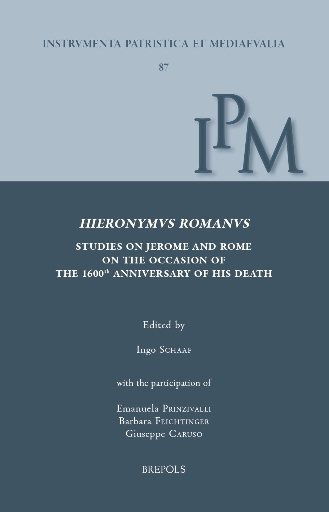
Hieronymus Romanus
Studies on Jerome and Rome on the Occasion of the 1600th Anniversary of his Death
Abstract
Rome, be it as a concrete space or as a concept and idea, occupies an outstanding place in the thoughts and actions of Jerome of Stridon (c. 347-419). Glowing propagandist of the ideal of asceticism in the Latin sphere and highly influential scholar of the Bible, he received his philological education here as well as his baptism. Beyond this background of study and adherence to the church of Rome, the Vrbs continued to hold a key position for him, who under the pontificate of Damasus established himself as a mediator between East and West and translator of Scripture. A sharp-tongued and increasingly controversial figure at the same time, Jerome subsequently turned into the target of antiascetic criticism and, once bereft of papal protection, had to leave Rome for good. However, even in distant Palestine, the city on the Tiber and its memories remained present in the writings of Jerome, who did not stop using a Roman network in order to have his works circulate within the Vrbs and eventually lamented its fall as that of “the entire world in a city”.
From multifaceted perspectives - historical, philological, theological, exegetical and archaeological - the papers collected in this volume explore Rome’s unique and exemplary meaning for Jerome’s life and works. In the juxtaposition of both lieux de mémoire, the father of the Church and the Vrbs, this reciprocal thematic cut illuminates additional aspects of a Roma Christiana as imagined by Jerome, and of the Stridonian himself as both key figurations of Late Antiquity.
