


oa Notes on the Late Latin Accusative Absolute construction
- Authors: Paola Cotticelli-Kurras, Eystein Dahl and Jelena Živojinović
- Publication: Varietate delectamur: Multifarious Approaches to Synchronic and Diachronic Variation in Latin , pp 451-464
- Publisher: Brepols
- Publication Date: January 2025
- DOI: https://doi.org/10.1484/M.LVLT-EB.5.143317


Notes on the Late Latin Accusative Absolute construction, Page 1 of 1
< Previous page | Next page > /docserver/preview/fulltext/10.1484/M.LVLT-EB.5.142508/M.LVLT-EB.5.143317-1.gif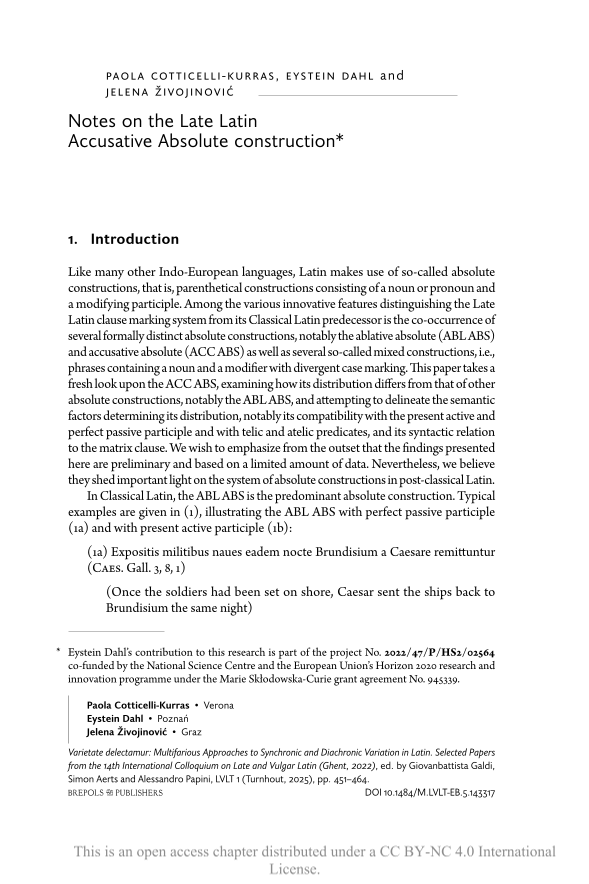
It is well known that the accusative absolute construction competes with and eventually replaces the absolute ablative in Late Latin. The functional parallelism between the two constructions in Late Latin is reflected in the fact that they are sometimes iuxtaposed, cf. e.g. Hic captiuitatem Iudaeorum relaxatam muneribusque Eleazaro pontifice Iudaeorum placato (Iord. Rom. 74). Adams (2003, 612) mentions a number of cases in Vulgar and Late Latin where absolute constructions have a nominal element with accusative case marking and a verbal element in the ablative, cf. e.g. iunctis secum Gepidas cum Ardarico, Gothosque cum Valamir (Iord. Rom. 331), nonnullis nares auresque omissis (Greg. Tvr. Franc. 10, 18). Hybrid constructions of this type are most likely motivated by the spread of the absolute accusative construction of the type regina […] neminem scientem subterfugit (Iord. Rom. 350), which is attested from the third century adonwards (cf. Biese 1928) and gradually replaced the absolute ablative construction. Väänänen (1981, 166) notes that the absolute ablative is a subordination strategy characteristic of the literary language of the classical period (cf. also Rovai 2014, 131). According to Halla-aho (2009, 104), the ablative case marking in the abovementioned hybrid constructions represents a marker of subordination rather than agreement with the participial subject argument. The aim of this research is twofold: (1) to determine the mechanisms of change in the absolute constructions and to establish a chronological order in the development of mixed and
absolute constructions with a focus on the accusative absolute; (2) to provide a better understanding of non-finite syntax and competitive structures in Late and Vulgar Latin.

Full text loading...
-
From This Site
/content/books/10.1484/M.LVLT-EB.5.143317dcterms_title,dcterms_subject,pub_serialIdent,pub_author,pub_keyword-contentType:Contributor -contentType:Concept -contentType:Institution105