
Full text loading...





Norme et style dans les textes narratifs latins du Haut Moyen Âge . Essai de typologie, Page 1 of 1
< Previous page | Next page > /docserver/preview/fulltext/10.1484/M.LVLT-EB.5.142508/M.LVLT-EB.5.143329-1.gif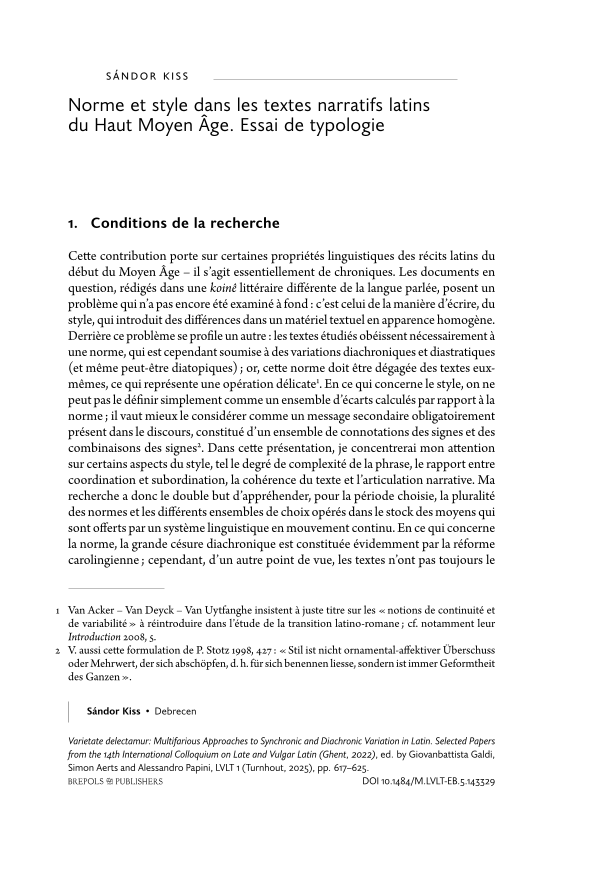
In this paper, I wish to show some linguistic features of Latin narrative texts of the beginning of the Middle Ages. The documents investigated are chronicles written between the sixth and the eighth centuries. This is a material apparently homogeneous, but the texts can exhibit differences of formulation that depend on cultural level and individual stylistic habits. The norm that determines historical narration is a traditional one; however, it undergoes variation with the progress of time. In the present study, I would like to examine the degree of complexity of the sentences, the relative frequency of coordination and subordination, textual coherence, and narrative structure. In the scalar typology that I propose here, the two extreme points are the fragmentary text of Hydatius (with some chapters of Fredegar’s chronicle) and Paulus Diaconus’ historical work showing a great richness of anaphoric constructions and of other cohesive means. The distance between spoken language and written language is continually growing in the Late Latin period, and this fact seems to trigger two opposed reactions: written texts can search for the simplicity of the expression or, on the contrary, they can return to the classical tradition. In the latter case, one recognizes also the influence of the biblical style.
Full text loading...