
Full text loading...





Sur l’interaction entre négation, verbes modaux et modalités, Page 1 of 1
< Previous page | Next page > /docserver/preview/fulltext/10.1484/M.LVLT-EB.5.142508/M.LVLT-EB.5.143337-1.gif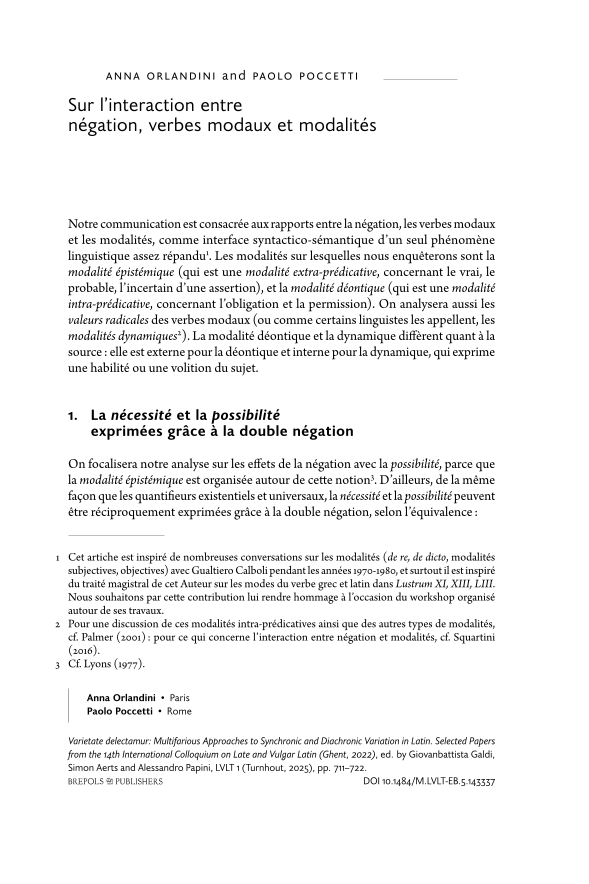
This paper investigates the relationship between negation and modal verbs in both diachronic and synchronic perspective. In the evolution from Latin to the Romance languages negation has a twofold impact on the change of the modalities from a semantic and syntactic point of view. Firstly, the rise of modal verbs in the Romance languages, replacing the mere moods (especially the subjunctive) employed in Latin was favoured by occurrences in negative contexts, that increasingly show a redundant use of modal verbs even in subordinate clauses. Secondly, the impact of the double negation on the reciprocal shift from epistemic to deontic modalities, basing on the distinction, on the one hand, between objective and subjective possibility and, on the other hand, between weak and strong necessity. Particularly the double negation triggers the shift from one to another one among those types of modalities, especially crossing subjective possibility and weak necessity. Different results, however, are evidenced by contrasting the Latin and Romance systems of negation, that are distinguished by different structures of marked and unmarked negation. Generally, however, the double negation has an emphatic force, so that it is stylistically marked. That is why double negation often occur in argumentative contexts, conveying different nuances of interpretation, especially between weak and strong deontic modality.
Full text loading...