
Full text loading...





Ille in the Latin Gospel of John. Demonstratives and articles in translation, Page 1 of 1
< Previous page | Next page > /docserver/preview/fulltext/10.1484/M.LVLT-EB.5.142508/M.LVLT-EB.5.143338-1.gif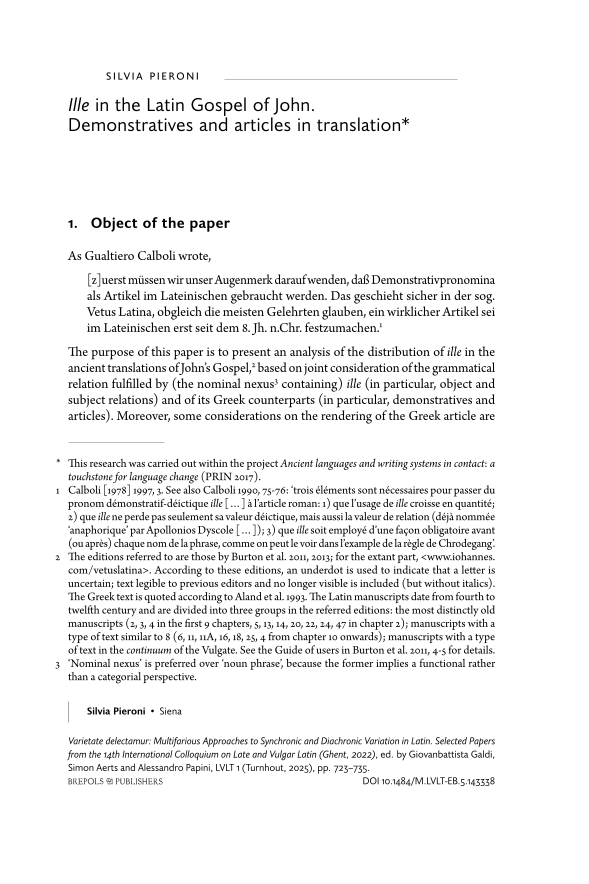
This paper presents an analysis of the occurrences of ille in the ancient Latin translations of John’s Gospel. Joint consideration of the corresponding Greek term and of the grammatical functions
involved immediately reveals an asymmetry: when functioning as non-contrastive object pronouns, the forms of ille are usually related to forms of αὐτός; on the other hand, in subject function the occurrences of ille (both pronominal and adnominal) correspond either to the Greek article or to ἐκεῖνος.
The second part of the paper focuses on the Latin correlatives of the Greek article. This is usually not rendered at all, but, when rendered, ille is the privileged choice among demonstratives, both in combination with adjectives and participles (mulier illa sammaritana, ille mortuus) and with true nouns (ille homo, ille discipulus). The strategy that competes and actually outmatches ille in rendering the Greek article (especially when combined with a participle) is the relative pronoun, which is used as a ‘syntactic article’ to introduce an attributive clause (ὁ βαπτίζων: qui baptizat). The analysis of these cases suggests that a functional, rather than categorial, perspective could help to grasp what the development of unemphatic pronouns and articles have in common: making the argument function explicit.
Full text loading...