


f Back Matter ("Bibliography", "Index")
Access full text
Chapter
- Publication: Medieval Livonia , pp 347-412
- Publisher: Brepols
- Publication Date: January 2025
- DOI: https://doi.org/10.1484/M.OUTREMER-EB.5.144283
Preview this chapter:
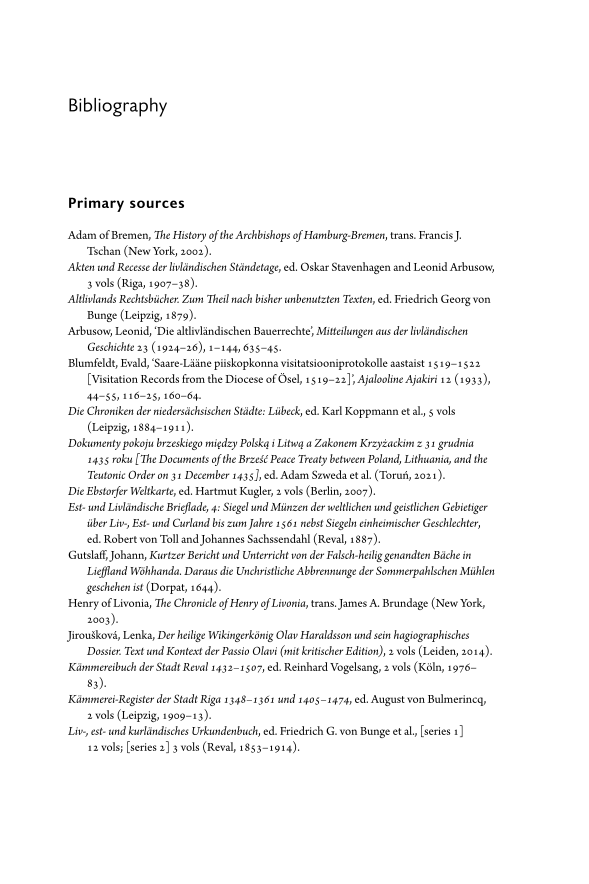


Back Matter ("Bibliography", "Index"), Page 1 of 1
< Previous page | Next page > /docserver/preview/fulltext/10.1484/M.OUTREMER-EB.5.114279/M.OUTREMER-EB.5.144283-1.gif
Hardbound ISBN:
978-2-503-57806-4
E-book ISBN:
978-2-503-57807-1

Full text loading...
Back Matter ("Bibliography", "Index")
https://doi.org/10.1484/M.OUTREMER-EB.5.144283
/content/books/10.1484/M.OUTREMER-EB.5.144283
/content/books/10.1484/M.OUTREMER-EB.5.144283
[Citing articles]
[Web of Science]
[Medline]
References
-
Primary sourcesAdam of Bremen, The History of the Archbishops of Hamburg-Bremen, trans. Francis J. Tschan (New York, 2002).
-
Akten und Recesse der livländischen Ständetage, ed. Oskar Stavenhagen and Leonid Arbusow, 3 vols (Riga, 1907–38).
-
Altlivlands Rechtsbücher. Zum Theil nach bisher unbenutzten Texten, ed. Friedrich Georg von Bunge (Leipzig, 1879).
-
Arbusow, Leonid, ‘Die altlivländischen Bauerrechte’, Mitteilungen aus der livländischen Geschichte 23 (1924–26), 1–144, 635–45.
-
Blumfeldt, Evald, ‘Saare-Lääne piiskopkonna visitatsiooniprotokolle aastaist 1519–1522 [Visitation Records from the Diocese of Ösel, 1519–22]’, Ajalooline Ajakiri 12 (1933), 44–55, 116–25, 160–64.
-
Die Chroniken der niedersächsischen Städte: Lübeck, ed. Karl Koppmann et al., 5 vols (Leipzig, 1884–1911).
-
Dokumenty pokoju brzeskiego między Polską i Litwą a Zakonem Krzyżackim z 31 grudnia 1435 roku [The Documents of the Brześć Peace Treaty between Poland, Lithuania, and the Teutonic Order on 31 December 1435], ed. Adam Szweda et al. (Toruń, 2021).
-
Die Ebstorfer Weltkarte, ed. Hartmut Kugler, 2 vols (Berlin, 2007).
-
Est- und Livländische Brieflade, 4: Siegel und Münzen der weltlichen und geistlichen Gebietiger über Liv-, Est- und Curland bis zum Jahre 1561 nebst Siegeln einheimischer Geschlechter, ed. Robert von Toll and Johannes Sachssendahl (Reval, 1887).
-
Gutslaff, Johann, Kurtzer Bericht und Unterricht von der Falsch-heilig genandten Bäche in Lieffland Wöhhanda. Daraus die Unchristliche Abbrennunge der Sommerpahlschen Mühlen geschehen ist (Dorpat, 1644).
-
Henry of Livonia, The Chronicle of Henry of Livonia, trans. James A. Brundage (New York, 2003).
-
Jiroušková, Lenka, Der heilige Wikingerkönig Olav Haraldsson und sein hagiographisches Dossier. Text und Kontext der Passio Olavi (mit kritischer Edition), 2 vols (Leiden, 2014).
-
Kämmereibuch der Stadt Reval 1432–1507, ed. Reinhard Vogelsang, 2 vols (Köln, 1976–83).
-
Kämmerei-Register der Stadt Riga 1348–1361 und 1405–1474, ed. August von Bulmerincq, 2 vols (Leipzig, 1909–13).
-
Liv-, est- und kurländisches Urkundenbuch, ed. Friedrich G. von Bunge et al., [series 1] 12 vols; [series 2] 3 vols (Reval, 1853–1914).
-
Liv-, est- und kurländisches Urkundenbuch, ed. Klaus Neitmann and Matthias Thumser, [series 1] vols 13–14 (Köln, 2018–20).
-
Lübecki õiguse Tallinna koodeks 1282 / Der Revaler Kodex des Lübischen Rechts 1282, ed. Tiina Kala (Tallinn, 1998).
-
Mackensen, Lutz, Baltische Texte der Frühzeit (Riga, 1936).
-
Müller, Ulrich, Johann Lohmüller und seine livländische Chronik ‘Warfaftig Histori’. Biographie des Autors, Interpretation und Edition des Werkes (Lüneburg, 2001).
-
Nazarova, Evgeniya L., ‘Ливонские правды как исторический источник [Livonian Peasants’ Laws as a Historical Source]’, Древнейшие государства на территории СССР. Материалы и исследования 1979 год (1980), 5–218.
-
Pärnu linna ajaloo allikad 13.–16. sajandini / Quellen zur Geschichte der Stadt Pernau, 13.–16. Jahrhundert, 1, ed. Inna Põltsam and Aldur Vunk (Pärnu, 2001).
-
Possevino, Antonio, Kiri Mantova hertsoginnale / Lettera alla Duchessa di Mantova, ed. Vello Helk (Roma, 1973).
-
Die Quellen des Rigischen Stadtrechts bis zum Jahr 1673, ed. J. G. Leonhard Napiersky (Riga, 1876).
-
Das Revaler Bürgerbuch 1409–1624, ed. Otto Greiffenhagen (Reval, 1932).
-
Das Rigische Schuldbuch (1286–1352), ed. Hermann Hildebrand (St. Petersburg, 1872).
-
Russow, Balthasar, The Chronicle of Balthasar Russow, trans. Jerry C. Smith (Madison, 1988).
-
Schragen der Gilden und Aemter der Stadt Riga bis 1621, ed. Wilhelm Stieda and Constantin Mettig (Riga, 1896).
-
Smoļenskas-Rīgas aktis 13. gs.–14. gs. pirmā puse: Kompleksa ‘Moscowitica-Ruthenica’ dokumenti par Smoļenskas un Rīgas attiecībām / Смоленско-рижские акты XIII в. – первая половина XIV в.: Документы комплекса Moscowitica-Ruthenica об отношениях Смоленска и Риги [Smolensk-Riga Acts in the 13th and the First Half of the 14th Centuries: The Documents of the Moscowitica-Ruthenica Collection on the Relations between Smolensk and Riga], ed. Aleksandrs Ivanovs and Anatolijs Kuzņecovs (Rīga, 2009).
-
Urkundenbuch der Familie von Mallinckrodt, ed. Gustav von Mallinckrodt, 2 vols (Bonn, 1911).
-
Visitationen im Deutschen Orden im Mittelalter, ed. Marian Biskup and Irena Janosz-Biskupowa, 3 vols (Marburg, 2002–8).
-
Das Zeugenverhör des Franciscus de Moliano (1312). Quellen zur Geschichte des Deutschen Ordens, ed. August Seraphim (Königsberg, 1912).
-
Secondary literatureAhvenainen, Jorma, Der Getreidehandel Livlands im Mittelalter (Helsinki, 1963).
-
Allmäe, Raili, ‘Stature and Sexual Dimorphism in Estonians of the 13th–18th Centuries’, Papers on Anthropology 9 (2000), 11–23.
-
Altof, Kaja, ‘Vaesed koolipoisid Tallinnas [The Poor Schoolboys in Tallinn]’, in Religiooni ja ateismi ajaloost Eestis, 3, ed. Jüri Kivimäe (Tallinn, 1987), pp. 57–91.
-
Amelung, Friedrich, and Georges Wrangell, Geschichte der Revaler Schwarzenhäupter (Reval, 1930).
-
Angermann, Norbert, ‘Die mittelalterliche Chronistik’, in Geschichte der deutschbaltischen Geschichtsschreibung, ed. Georg von Rauch (Köln, 1986), pp. 3–20.
-
Angermann, Norbert, ‘Die Stellung der livländischen Städte in der hansischen Gemeinschaft’, Hansische Geschichtsblätter 113 (1995), 111–25.
-
Arbusow, Leonid, Die Einführung der Reformation in Liv-, Est- und Kurland (Leipzig, 1921).
-
Archaeological Research in Estonia 1865–2005, ed. Valter Lang and Margot Laneman (Tartu, 2006).
-
Art History of Latvia I. Prehistory and Middle Ages 9th Millennium BC – 1562, ed. Elita Grosmane (Riga, 2024).
-
Auns, Muntis, ‘Acquisition of the Acquired: The Establishing of a Real Administration in Livonia’, in The North-Eastern Frontiers of Medieval Europe: The Expansion of Latin Christendom in the Baltic Lands, ed. Alan V. Murray (Farnham, 2014), pp. 179–87.
-
Auns, Muntis, ‘Livonia and Latvians’, in Latvia and Latvians, 2, ed. Jānis Stradiņš et al. (Rīga, 2018), pp. 243–79.
-
Baltic Hospitality from the Middle Ages to the Twentieth Century: Receiving Strangers in Northeastern Europe, ed. Sari Nauman et al. (Cham, 2022).
-
Die Baltischen Lande im Zeitalter der Reformation und Konfessionalisierung. Livland, Estland, Ösel, Ingermanland, Kurland und Lettgallen. Stadt, Land und Konfession, 1500–1721, ed. Matthias Asche, Werner Buchholz and Anton Schindling, 4 vols (Münster, 2009–12).
-
Baltisches historisches Ortslexikon, ed. Hans Feldmann and Heinz von zur Mühlen, 2 vols (Köln, 1985–90).
-
Baranov, Alexander, ‘Contra Multitudinem Ruthenorum Armatorum: The Russian-Livonian Battle of Lake Smolino (1502) Reconsidered’, in The Art of Siege Warfare and Military Architecture from the Classical World to the Middle Ages, ed. Michael Eisenberg and Rabei Khamisy (Oxford, 2021), pp. 227–32.
-
Baranov, Alexander, ‘Die Frühzeit des Deutschen Ordens in Livland und die Eroberung Kurlands. Ein peripheres Tätigkeitsfeld?’, in Livland – Eine Region am Ende der Welt? Forschungen zum Verhältnis zwischen Zentrum und Peripherie im späten Mittelalter / Livonia – A Region at the End of the World? Studies on the Relations between Centre and Periphery in the Later Middle Ages, ed. Anti Selart and Matthias Thumser (Köln, 2017), pp. 315–45.
-
Baranov, Alexander, ‘Zwischen Bündnis und Konfrontation. Der livländische Ordensmeister Bernd von der Borch und Großfürst Ivan III. von Moskau (1471–1483)’, in Akteure mittelalterlicher Außenpolitik. Das Beispiel Ostmitteleuropas, ed. Stephan Flemmig and Norbert Kersken (Marburg, 2017), pp. 127–44.
-
Benninghoven, Friedrich, ‘Die Burgen als Grundpfeiler des spätmittelalterlichen Wehrwesens im preußisch-livländischen Deutschordensstaat’, in Die Burgen im deutschen Sprachraum. Ihre rechts- und verfassungsgeschichtliche Bedeutung, ed. Hans Patze, 2 vols (Sigmaringen, 1976), 1: 565–601.
-
Benninghoven, Friedrich, Der Orden der Schwertbrüder. Fratres milicie Christi de Livonia (Köln, 1965).
-
Benninghoven, Friedrich, Rigas Entstehung und der frühhansische Kaufmann (Hamburg, 1961).
-
Benninghoven, Friedrich, ‘Zur Technik spätmittelalterlicher Feldzüge in Ostbaltikum’, Zeitschrift für Ostforschung 20 (1970), 631–51.
-
Berendsen, Veiko, and Margus Maiste, ‘Rahvastik [Population]’, in Tartu. Ajalugu ja kultuurilugu, ed. Heivi Pullerits (Tartu, 2005), pp. 107–33.
-
Berga, Tatjana, Augšdaugavas 14.–17. gadsimta senvietas no Krāslavas līdz Slutišķiem [14th–17th-Century Archaeological Sites along the Upper Daugava between Krāslava and Slutišķi] (Rīga, 2007).
-
Bergholde-Wolf, Agnese, ‘Das mittelalterliche Ensemble des Doms zu Riga’, Kunstiteaduslikke Uurimusi. Studies on Art and Architecture 25 (2016), 73–101.
-
Bernotas, Rivo, ‘Brick-Making in Medieval Livonia: The Estonian Example’, Estonian Journal of Archaeology 17 (2013), 139–56.
-
Bernotas, Rivo, New Aspects of the Genesis of the Medieval Town Walls in the Northern Baltic Sea Region (Turku, 2017).
-
Bernotas, Rivo, Keiti Randoja and Andres Tvauri, ‘Archaeological Research in the Area between Pärnu Road and Peeter Süda Street in Tallinn’, Archaeological Fieldwork in Estonia 2016 (2017), 155–62.
-
Bessudnova, Marina, Россия и Ливония в конце XV века. Истоки конфликта [Livonia and Russia at the End of the 15th Century. Origins of the Conflict] (Moskva, 2015).
-
Bessudnova, Marina, ‘Die Schließung des hansischen Kontors in Novgorod im Jahre 1494 im Kontext der Beziehungen des Großfürsten von Moskau zu Maximilian von Habsburg’, Hansische Geschichtsblätter 127 (2009), 69–99.
-
Bibliotheca Rigensis – 480. Latvijas Akadēmiskā bibliotēka gadsimtu liecībās [Bibliotheca Rigensis – 480. Latvian Academic Library in Testimonies of Centuries], ed. Liga Krumina (Rīga, 2004).
-
Die Bischöfe des Heiligen Römischen Reiches 1198 bis 1448. Ein biographisches Lexikon, ed. Erwin Gatz (Berlin, 2001).
-
Die Bistümer des Heiligen Römischen Reiches von ihren Anfängen bis zur Säkularisation, ed. Erwin Gatz (Freiburg, 2003).
-
Blomkvist, Nils, The Discovery of the Baltic: The Reception of a Catholic World-System in the European North (AD 1075–1225) (Leiden, 2005).
-
Blumfeldt, Evald, ‘Estlandssvenskarnas historia’, in En bok om Estlands svenskar, 1, ed. Edvin Lagman (Stockholm, 1961), pp. 63–178.
-
Blumfeldt, Evald, Über die Freibauern in Jerwen zur Ordens- und Schwedenzeit (Bonn, 1957).
-
Blumfeldt, Evald, ‘Über die Geiselschaft während der Kämpfe in Alt-Livland im 13. Jahrhundert’, Eesti Teadusliku Seltsi Rootsis aastaraamat 9 (1985), 17–28.
-
Boestad, Tobias, ‘La “liberté des plages”: Un droit commun d’accès au littoral dans la Livonie médiévale (XIIe–XVe siècle)’, Le Moyen Âge 130 (2024), 93–110.
-
Boestad, Tobias, Pour le profit du commun marchand. La genèse de la Hanse (XIIe – milieu du XIVe siècle) (Genève, 2022).
-
Bolte, Henrike, Bischofserhebungen und geistliche Landesherrschaften im spätmittelalterlichen Livland. Dorpat – Ösel – Kurland (Münster, 2023).
-
Bolte, Henrike, ‘Die livländischen Bistümer im Spätmittelalter. Bedeutung und Forschungsinteresse am Beispiel ihrer Besetzung’, in Leonid Arbusow (1882–1951) und die Erforschung des mittelalterlichen Livland, ed. Ilgvars Misāns and Klaus Neitmann (Köln, 2014), pp. 209–27.
-
Bombi, Barbara, ‘Celestine III and the Conversion of the Heathen on the Baltic Frontier’, in Pope Celestine III, 1191–1198: Diplomat and Pastor, ed. John Doran and Damian Smith (Farnham, 2008), pp. 145–58.
-
Bombi, Barbara, ‘Innocent III and the Baltic Crusade after the Conquest of Constantinople’, in Crusading on the Edge: Ideas and Practice of Crusading in Iberia and the Baltic Region, 1100–1500, ed. Torben K. Nielsen and Iben Fonnesberg-Schmidt (Turnhout, 2016), pp. 117–33.
-
Bombi, Barbara, ‘Innocent III and the Origins of the Order of Sword Brothers’, in The Military Orders, 3: History and Heritage, ed. Victor Mallia Milanes (Aldershot, 2008), pp. 147–53.
-
Bombi, Barbara, Novella plantatio fidei. Missione e crociata nel nord Europa tra la fine del XII e i primi decenni del XIII secolo (Roma, 2007).
-
Bombi, Barbara, ‘The Teutonic Order and its Networks at the Papal Curia in the Thirteenth Century’, in Akkon – Venedig – Marienburg. Mobilität und Immobilität im Deutschen Orden, ed. Hubert Houben (Ilmtal-Weinstraße, 2022), pp. 70–86.
-
Bonsdorff, Jan von, Kunstproduktion und Kunstverbreitung im Ostseeraum des Spätmittelalters (Helsinki, 1993).
-
Boockmann, Hartmut, ‘Zur ethnischen Struktur der Bevölkerung deutscher Ostseestädte’, in Hartmut Boockmann, Wege ins Mittelalter (München, 2000), pp. 123–32.
-
Bosse, Heinrich, ‘Der livländische Bauer am Ausgang der Ordenszeit (bis 1561)’, Mitteilungen aus der livländischen Geschichte 24 (1933), 281–511.
-
Bourgeois, Nicolas, ‘Les Cisterciens et la croisade de Livonie’, Revue historique 307 (2005), 521–60.
-
Brück, Thomas, ‘Bemerkungen zur Kaufmannschaft Rigas in der ersten Hälfte des 15. Jahrhunderts unter besonderer Berücksichtigung der Schwarzhäupter zwischen 1413 und 1424’, in ‘Kopet uns werk by tyden’: Beiträge zur hansischen und preußischen Geschichte. Festschrift für Walter Stark zum 75. Geburtstag, ed. Nils Jörn, Detlef Kattinger and Horst Wernicke (Schwerin, 1999), pp. 113–30.
-
Brück, Thomas, ‘Zwischen ständischer Repräsentanz und Interessenkonflikten – Bemerkungen zur Entwicklung der Großen Gilde in Riga im ersten Drittel des 15. Jahrhunderts’, in Genossenschaftliche Strukturen der Hanse, ed. Nils Jörn, Detlef Kattinger and Horst Wernicke (Köln, 1999), pp. 239–71.
-
Bruiningk, Hermann von, Messe und kanonisches Stundengebet nach dem Brauche der Rigaschen Kirche im späteren Mittelalter (Riga, 1904).
-
Brundage, James A., ‘Christian Marriage in Thirteenth-Century Livonia’, in James A. Brundage, The Crusades, Holy War and Canon Law (Aldershot, 1991), Essay XVIII: 313–20.
-
Brünjes, Holger Stefan, Die Deutschordenskomturei in Bremen (Marburg, 1997).
-
Burgen in Livland. Mittelalterliche Wehrbauten in Estland und Lettland, ed. Christofer Herrmann (Petersberg, 2023).
-
Bysted, Ane L., Carsten Selch Jensen, Kurt Villads Jensen and John H. Lind, Jerusalem in the North: Denmark and the Baltic Crusades, 1100–1522 (Turnhout, 2012).
-
Castella Maris Baltici, 14 vols (Stockholm, 1993–2021).
-
Caune, Andris, ‘Christentum und heidnischer Volksglaube in Lettland während des 13.–14. Jahrhunderts im Spiegel archäologischer Quellen’, in Rom und Byzanz im Norden. Mission und Glaubenswechsel im Ostseeraum während des 8.–14. Jahrhunderts, ed. Michael Müller-Wille, 2 vols (Stuttgart, 1998), 2: 69–80.
-
Caune, Andris, and Ieva Ose, Latvijas 12. gadsimta beigu – 17. gadsimta vācu piļu leksikons [Dictionary of German Castles in Latvia, End of the 12th – 17th Century] (Rīga, 2004).
-
Caune, Andris, and Ieva Ose, Latvijas viduslaiku mūra baznīcas 12. gs. beigas – 16. gs. sākums. Enciklopēdija [Encyclopaedia of Medieval Stone Churches in Latvia, End of the 12th – Beginning of the 16th Century] (Rīga, 2010).
-
Ceļā uz latviešu tautu / On the Road to Becoming Latvian, ed. Vitolds Muižnieks (Rīga, 2016).
-
Cerman, Markus, Villagers and Lords in Eastern Europe, 1300–1800 (Basingstoke, 2012).
-
Chollet, Loïc, ‘Cohabiter sur la frontière: L’Ordre teutonique et ses sujets de Livonie au début du XIVe siècle’, in Ordres militaires et territorialité au Moyen Âge. Entre Orient et Occident, ed. Marie-Anna Chevalier (Paris, 2020), pp. 369–84.
-
Ciglis, Jānis, ‘Territory and Borders’, in Ceļā uz latviešu tautu / On the Road to Becoming Latvian, ed. Vitolds Muižnieks (Rīga, 2016), pp. 13–34.
-
The Clash of Cultures on the Medieval Baltic Frontier, ed. Alan V. Murray (Farnham, 2009).
-
Common Roots of the Latvian and Estonian Literary Languages, ed. Kristiina Ross and Pēteris Vanags (Frankfurt, 2008).
-
A Companion to the Hanseatic League, ed. Donald J. Harreld (Leiden, 2015).
-
Crusading and Chronicle Writing on the Medieval Baltic Frontier: A Companion to the Chronicle of Henry of Livonia, ed. Marek Tamm, Linda Kaljundi and Carsten Selch Jensen (Farnham, 2011).
-
Culture Clash or Compromise: The Europeanization of the Baltic Sea Area, 1100–1400 AD, ed. Nils Blomkvist (Visby, 1998).
-
Czaja, Roman, ‘Die Entwicklung der ständischen Versammlungen in Livland, Preußen und Polen im Spätmittelalter’, Zeitschrift für Ostmitteleuropa-Forschung 58 (2009), 312–28.
-
Czaja, Roman, ‘Kommunale Dienstämter in Riga und Reval im Mittelalter’, in Zwischen der Geschichte von Ereignissen, Phänomenen und Prozessen. Länder, Regionen und Städte und ihre weltlichen und geistlichen Einwohner:innen. Festschrift für Prof. Dr. Helmut Flachenecker, ed. Renata Skowrońska (Göttingen, 2023), pp. 301–17.
-
Demel, Bernhard, Der Deutsche Orden im Spiegel seiner Besitzungen und Beziehungen in Europa (Frankfurt, 2004).
-
Dircks, Bernhard, ‘Der Krieg des Deutschen Ordens gegen Novgorod 1443–1448’, in Deutschland – Livland – Russland. Ihre Beziehungen vom 15. bis zum 17. Jahrhundert, ed. Norbert Angermann (Lüneburg, 1988), pp. 29–52.
-
Die Domkapitel des Deutschen Ordens in Preußen und Livland, ed. Radoslav Biskup and Mario Glauert (Münster, 2004).
-
Donner, Gustav Adolf, Kardinal Wilhelm von Sabina, Bischof von Modena, 1222–1234. Päpstlicher Legat in den nordischen Ländern (†1251) (Helsingfors, 1929).
-
Doroshenko, Vasilii, Очерки аграрной истории Латвии в XVI веке [Studies on the Agrarian History of Latvia in the 16th Century] (Riga, 1960).
-
Eesti keele vanimad tekstid ja sõnastik [The Oldest Texts in Estonian and Vocabulary], ed. Epp Ehasalu et al. (Tartu, 1997).
-
Eesti kunsti ajalugu [History of Estonian Art], 1: 1100–1250, ed. Kersti Markus (Tallinn, 2023).
-
Eesti talurahva ajalugu [History of the Estonian Peasantry], 1, ed. Juhan Kahk (Tallinn, 1992).
-
Eesti vanimad raamatud Tallinnas / Die ältesten estnischen Bücher in Tallinn (Reval), ed. Lea Kõiv (Tallinn, 2000).
-
Eihmane, Eva, ‘Livonijas bīskapu delegācijas slepkavība 1428. gadā: Zināmais un nezināmais’, Latvijas Vēstures Institūta Žurnāls 1 (2013), 29–59.
-
Ekdahl, Sven, ‘Crusades and Colonization in the Baltic’, in Palgrave Advances in the Crusades, ed. Helen Nicholson (New York, 2005), pp. 172–203.
-
Ex archivio civitatis. Tallinna Linnaarhiivi ajaloost [Studies on the History of the Tallinn Town Archives], ed. Lea Kõiv (Tallinn, 2008).
-
Fernhandel und Handelspolitik der baltischen Städte in der Hansezeit, ed. Norbert Angermann and Paul Kaegbein (Lüneburg, 2001).
-
Fonnesberg-Schmidt, Iben, ‘Pope Alexander III (1159–1181) and the Baltic Crusades’, in Medieval History Writing and Crusading Ideology, ed. Tuomas M. S. Lehtonen et al. (Helsinki, 2005), pp. 242–56.
-
Fonnesberg-Schmidt, Iben, ‘Pope Honorius III and Mission and Crusades in the Baltic Region’, in The Clash of Cultures on the Medieval Baltic Frontier, ed. Alan V. Murray (Farnham, 2009), pp. 103–22.
-
Fonnesberg-Schmidt, Iben, The Popes and the Baltic Crusades, 1147–1254 (Leiden, 2007).
-
Forms of Servitude in Northern and Central Europe: Decline, Resistance, and Expansion, ed. Paul Freedman and Monique Bourin (Turnhout, 2005).
-
Fraundorfer, Peter, ‘How Do the “Livs” Fit into Sacred History? Identifying the Cultural “Other” in the Earliest Latin Sources Depicting the Livonian Crusade’, in Transcultural Approaches to the Bible: Exegesis and Historical Writing across Medieval Worlds, ed. Matthias M. Tischler and Patrick S. Marschner (Turnhout, 2021), pp. 173–99.
-
Friedenthal, Adolf, Die Goldschmiede Revals (Lübeck, 1931).
-
Gąssowska, Maja, ‘Livländer auf der Wallfahrt nach Wilsnack und das Heilige Blut zu Riga’, in Die Wilsnackfahrt. Ein Wallfahrts- und Kommunikationszentrum Nord- und Mitteleuropas im Spätmittelalter, ed. Felix Escher and Hartmut Kühne (Frankfurt, 2006), pp. 97–113.
-
Gernet, Axel von, Die Anfänge der Livländischen Ritterschaften (Reval, 1895).
-
Gernet, Axel von, Die Harrisch-Wierische Ritterschaft unter Herrschaft des Deutschen Ordens bis zum Erwerb der Jungingenschen Gnade (Reval, 1893).
-
Geschichtsschreibung im mittelalterlichen Livland, ed. Matthias Thumser (Berlin, 2011).
-
Ghosh, Shami, ‘Conquest, Conversion, and Heathen Customs in Henry of Livonia’s Chronicon Livoniae and the Livländische Reimchronik’, Crusades 11 (2012), 87–108.
-
Girgensohn, Paul, ‘Die Inkorporationspolitik des Deutschen Ordens in Livland 1378 bis 1397’, Mitteilungen aus der livländischen Geschichte 20 (1910), 1–86.
-
Glauert, Mario, ‘Die Bindung des Domkapitels von Riga an die Regel des Deutschen Ordens’, in Die Domkapitel des Deutschen Ordens in Preußen und Livland, ed. Radosław Biskup and Mario Glauert (Münster, 2004), pp. 269–316.
-
Gnegel-Waitschies, Gisela, Bischof Albert von Riga: Ein Bremer Domherr als Kirchenfürst im Osten (Hamburg, 1958).
-
Goetz, Leopold K., Deutsch-russische Handelsgeschichte des Mittelalters (Lübeck, 1922).
-
Goetz, Leopold K., Deutsch-russische Handelsverträge des Mittelalters (Hamburg, 1916).
-
Götz, Johannes, ‘Das Archiv des livländischen Deutschordenszweiges: Eine archivgeschichtliche Untersuchung’, in Die Kirche im mittelalterlichen Livland, ed. Radosław Biskup et al. (Toruń, 2019), pp. 9–77.
-
Götz, Johannes, ‘Die Domkapitel von Kurland und Riga. Ein Beitrag zum Inkorporationsbegriff im Deutschen Orden’, Zeitschrift für Ostmitteleuropa-Forschung 72 (2023), 325–76.
-
Götz, Johannes, ‘Die Wahl des livländischen Meisters. Ein Indikator für das Verhältnis zwischen Zentrum und Provinz im Deutschen Orden’, Forschungen zur baltischen Geschichte 14 (2019), 11–70.
-
Guimon, Timofey, ‘Estonia during the Eleventh and Twelfth Centuries in the Novgorodian Chronicles’, Forschungen zur baltischen Geschichte 10 (2015), 31–45.
-
Haak, Arvi, ‘Problems of Defining Ethnic Identity in Medieval Towns of Estonia on the Basis of Archaeological Sources’, in Today I Am Not the One I Was Yesterday: Archaeology, Identity, and Change, ed. Arvi Haak, Valter Lang and Mika Lavento (Tartu, 2015), pp. 13–27.
-
Hägglund, Anna-Stina, Birgittine Landscapes: Three Monasteries in their Local and Regional Environment across the Baltic Sea Region, c. 1410–1530 (Åbo, 2022).
-
Hahn, Kadri-Rutt, Revaler Testamente im 15. und 16. Jahrhundert (Berlin, 2015).
-
Haller, Johannes, ‘Die Verschwörung von Segewold (1316)’, Mitteilungen aus dem Gebiete der Geschichte Liv-, Est- und Kurlands 20 (1910), 125–68.
-
The Hansa Town Riga as Mediator between East and West, ed. Andris Caune and Ieva Ose (Riga, 2009).
-
Hansen, Gotthard von, ‘Altlivländische und revalsche Kleiderordnungen des 16. und 17. Jahrhunderts’, in Aus baltischer Vergangenheit. Miscellaneen aus dem Revaler Stadtarchiv (Reval, 1894), pp. 17–35.
-
Hansen, Mikael Kristian, ‘Die Kalmarer Union und der Deutsche Orden 1410–1423: Die Estlandfrage’, Forschungen zur baltischen Geschichte 4 (2009), 11–39.
-
Heckmann, Dieter, ‘Kriegstechnische Innovationen in den mittelalterlichen Deutschordenslanden Preußen und Livland’, Militärgeschichtliche Zeitschrift 65 (2006), 113–29.
-
Heckmann, Dieter, Amtsträger des Deutschen Ordens (Toruń, 2020).
-
Hein, Ants, Stenhus’id, arx’id, torne’d … Eesti mõisaarhitektuuri vanem kihistus / Stenhus, arx, torne … Die älteste Schicht der Gutshofarchitektur Estlands (Tartu, 2016).
-
Helk, Vello, Die Jesuiten in Dorpat, 1583–1625. Ein Vorposten der Gegenreformation in Nordosteuropa (Odense, 1977).
-
Hergemöller, Bernd-Ulrich, ‘Der Revaler Kirchenstreit (1424–1428)’, Hansische Geschichtsblätter 109 (1991), 13–41.
-
Herrmann, Axel, Der Deutsche Orden unter Walter von Cronberg (1525–1543) (Bonn-Bad Godesberg, 1974).
-
Hertwich, Erwin, ‘Das Kurländische Domkapitel bis 1561’, in Die Domkapitel des Deutschen Ordens in Preußen und Livland, ed. Radosław Biskup and Mario Glauert (Münster, 2004), pp. 147–267.
-
Die Hochmeister des Deutschen Ordens, 1190–1994, ed. Udo Arnold (Weimar, 2014).
-
Höhlbaum, Konstantin, ‘Beiträge zur Quellenkunde Alt-Livlands’, Verhandlungen der Gelehrten Estnischen Gesellschaft zu Dorpat 7 (1873), 21–77.
-
Höhlbaum, Konstantin, ‘Zur deutsch-dänischen Geschichte der Jahre 1332–1346’, Hansische Geschichtsblätter 1878 (1879), 71–99.
-
Hollihn, Gerd, ‘Die Stapel- und Gästepolitik Rigas in der Ordenszeit (1201–1562)’, Hansische Geschichtsblätter 60 (1935), 91–207.
-
Hösch, Edgar, ‘Die Ostpolitik des Deutschen Ordens im 13. Jahrhundert’, in Balten – Slaven – Deutsche: Aspekte und Perspektiven kultureller Kontakte: Festschrift für Friedrich Scholz zum 70. Geburtstag, ed. Ulrich Obst und Gerhard Ressel (Münster, 1999), pp. 87–102.
-
Hucker, Bernd Ulrich, ‘Liv- und estländische Königspläne?’ in Studien über die Anfänge der Mission in Livland, ed. Manfred Hellmann (Sigmaringen, 1989), pp. 65–106.
-
Ilves, Kristin, ‘Sea and Seafaring in the Chronicles. The Study of the Chronicle of Henry of Livonia and the Livonian Rhymed Chronicle on the Navigation on the Baltic Sea in the 12th and 13th Centuries’, in Tjop tjop! Vänbok till Christer Westerdahl med anledning av hans 70-årsdag den 13 November 2015, ed. Staffan von Arbin et al. (Skärhamn, 2015), pp. 205–17.
-
Gli inizi del cristianesimo in Livonia-Lettonia, ed. Michele Maccarrone (Città del Vaticano, 1989).
-
Jääts, Liisi, et al., ‘Fire Cultivation in Estonian Cultural Landscapes’, in The Space of Culture – The Place of Nature in Estonia and Beyond, ed. Tiina Peil (Tartu, 2011), pp. 165–80.
-
Jackson, Tatjana N., ‘The Relations of the Eastern Baltic Lands with Scandinavia in the Light of Place-Name Study’, in Riga und der Ostseeraum: Von der Gründung 1201 bis in die Frühe Neuzeit, ed. Ilgvars Misāns and Horst Wernicke (Marburg, 2005), pp. 1–9.
-
Jackson, Tatjana N., Четыре норвежских конунга на Руси [Four Norwegian Konungs in the Rus’] (Moskva, 2000).
-
Jähnig, Bernhart, ‘Der Deutsche Orden und Karl IV.’, Blätter für deutsche Landesgeschichte 114 (1978), 103–49.
-
Jähnig, Bernhart, ‘Der Deutsche Orden und die livländischen Bischöfe im Spannungsfeld von Kaiser und Papst’, Nordost-Archiv: Zeitschrift für Regionalgeschichte 7 (1998), 47–63.
-
Jähnig, Bernhart, Johann von Wallenrode O.T. Erzbischof von Riga, Königlicher Rat, Deutschordensdiplomat und Bischof von Lüttich im Zeitalter des Schismas und des Konstanzer Konzils (um 1370–1419) (Bonn-Bad Godesberg, 1970).
-
Jähnig, Bernhart, ‘Der Kampf des Deutschen Ordens um die Schutzherrschaft über die livländischen Bistümer’, in Ritterorden und Kirche im Mittelalter, ed. Zenon Hubert Nowak (Toruń, 1997), pp. 97–111.
-
Jähnig, Bernhart, ‘Die rigische Sache zur Zeit des Erzbischofs Johannes Ambundii (1418–1424)’, in Von Akkon bis Wien. Studien zur Deutschordensgeschichte vom 13. bis zum 20. Jahrhundert. Festschrift zum 90. Geburtstag von Althochmeister P. Dr. Marian Tumler O.T. am 21. Oktober 1977, ed. Udo Arnold (Marburg, 1978), pp. 84–105.
-
Jähnig, Bernhart, ‘Das Ringen zwischen Deutschem Orden und bischöflicher Gewalt in Livland und Preußen’, Römische Quartalschrift für christliche Altertumskunde und Kirchengeschichte 97 (2002), 215–37.
-
Jähnig, Bernhart, ‘Die Verfassung der Domkapitel der Kirchenprovinz Riga’, in Kirchengeschichtliche Probleme des Preussenlandes aus Mittelalter und Früher Neuzeit, ed. Bernhart Jähnig (Marburg, 2001), pp. 53–72.
-
Jähnig, Bernhart, Verfassung und Verwaltung des Deutschen Ordens und seiner Herrschaft in Livland (Berlin, 2011).
-
Jahnke, Carsten, ‘Handelsnetze im Ostseeraum’, in Netzwerke im europäischen Handel des Mittelalters, ed. Gerhard Fouquet and Hans-Jörg Gilomen (Ostfildern, 2010), pp. 189–212.
-
Jahnke, Carsten, ‘Handelsstrukturen im Ostseeraum im 12. und beginnenden 13. Jahrhunderts. Ansätze einer Neubewertung’, Hansische Geschichtsblätter 126 (2008), 145–85.
-
Jahnke, Carsten, ‘Lübeck, der Bankenplatz des Nordens? Lübecker Banken des 15. Jahrhunderts als Indikatoren eines neuen Kommunikationsmodells und eines sich ausweitenden Handelsraumes’, Scripta Mercaturae 40 (2006), 149–68.
-
Jahnke, Carsten, Das Silber des Meeres. Fang und Vertrieb von Ostseehering zwischen Norwegen und Italien (12.–16. Jahrhundert) (Köln, 2000).
-
Jahnke, Carsten, ‘Trade in Different Worlds: Trade between Western Europe and Novgorod from the End of the Viking Age to the Time of the Medieval Hanseatic League’, in Merchants, Measures and Money: Understanding Technologies of Early Trade in a Comparative Perspective, ed. Lorenz Rahmstorf et al. (Kiel, 2021), pp. 13–34.
-
Jahnke, Carsten, ‘Zum Nutze der guten Stadt Reval: Hans Selhorst, ein Revaler Kaufmann und Ratsherr zu Beginn des 16. Jahrhunderts’, Vana Tallinn 16 (2005), 88–107.
-
Jansons, Gunars, Ikšķiles viduslaiku baznīca un pils [The Medieval Church and Castle of Ikšķile] (Rīga, 2004).
-
Jarockis, Romas, ‘Graves, Plains and Settlement Development: Semgallia 600–1600 AD’, in The Reception of Medieval Europe in the Baltic Sea Region, ed. Jörn Staecker (Visby, 2009), 243–62.
-
Jensen, Carsten Selch, ‘Appropriating History: Remembering the Crusades in Latvia and Estonia’, in Remembering the Crusades and Crusading, ed. Megan Cassidy-Welch (London, 2017), pp. 231–46.
-
Jensen, Carsten Selch, ‘Bishops and Abbots at War. Some Aspects of Clerical Involvement in Warfare in Twelfth and Early Thirteenth Century Livonia and Estonia’, in Between Sword and Prayer: Warfare and Medieval Clergy in Cultural Perspective, Explorations in Medieval Culture, ed. Radosław Kotecki et al. (Leiden, 2018), pp. 404–34.
-
Jensen, Carsten Selch, Holy War in the Baltic and the Battle of Lyndanise 1219 (Leeds, 2024).
-
Jensen, Carsten Selch, ‘The Nature of Early Missionary Activities and Crusades in Livonia, 1185–1201’, in Medieval Spirituality in Scandinavia and Europe: A Collection of Essays in Honour of Tore Nyberg, ed. Lars Bisgaard et al. (Odense, 2001), pp. 121–37.
-
Jensen, Carsten Selch, ‘Rituals of War as Religious Markers during the Early Crusades in Livonia and Estonia in the Light of Henry’s Chronicon Livoniae’, in Religious Rites of War beyond the Medieval West, 1: Northern Europe and the Baltic, ed. Radosław Kotecki et al. (Leiden, 2023), pp. 231–59.
-
Jensen, Carsten Selch, Through Words, Not Wounds: History and Theology in the Chronicle of Henry of Livonia (Turnhout, 2024).
-
Jensen, Carsten Selch, ‘Verbis non verberibus: The Representation of Sermons in the Chronicle of Henry of Livonia’, in Crusading and Chronicle Writing on the Medieval Baltic Frontier: A Companion to the Chronicle of Henry of Livonia, ed. Marek Tamm, Linda Kaljundi and Carsten Selch Jensen (Farnham, 2011), pp. 179–206.
-
Jensen, Janus Møller, ‘Politics and Crusade: Scandinavia, the Avignon Papacy and the Crusade in the XIVth Century’, in Le Papauté et les croisades / The Papacy and the Crusades, ed. Michel Balard (Farnham, 2011), pp. 269–85.
-
Jensen, Kurt Villads, ‘Burning of Idols – Mission and Theology around the Baltic Sea’, in The Expansion of the Faith: Crusading on the Frontiers of Latin Christendom in the High Middle Ages, ed. Paul Srodecki and Norbert Kersken (Turnhout, 2022), pp. 99–111.
-
Jensen, Kurt Villads, ‘Denmark and the Crusading Movement: The Integration of the Baltic Region into Medieval Europe’, in Ships, Guns and Bibles in the North Sea and Baltic States, c. 1350–c. 1700, ed. Allan I. Macinnes, Thomas Riis and Frederik Pedersen (East Linton, 2000), pp. 188–205.
-
Jezierski, Wojtek, Risk, Emotions, and Hospitality in the Christianization of the Baltic Rim, 1000–1300 (Turnhout, 2022).
-
Johansen, Paul, Die Estlandliste der Liber Census Daniae (Reval, 1933).
-
Johansen, Paul, ‘Johann von Hilten in Livland’, Archiv für Reformationsgeschichte 36 (1939), 24–50.
-
Johansen, Paul, ‘Die Kaufmannskirche im Ostseegebiet’, in Studien zu den Anfängen des europäischen Städtewesens: Reichenauer Vorträge 1955–1956 (Sigmaringen, 1958), pp. 499–525.
-
Johansen, Paul, Nordische Mission. Revals Gründung und die Schwedensiedlung in Estland (Stockholm, 1951).
-
Johansen, Paul, ‘Paide linna asutamisest [On the Foundation of the Town of Paide]’, Verhandlungen der Gelehrten Estnischen Gesellschaft 30 (1939), 201–8.
-
Johansen, Paul, Siedlung und Agrarwesen der Esten im Mittelalter. Ein Beitrag zur estnischen Kulturgeschichte (Dorpat, 1925).
-
Johansen, Paul, ‘Westfälische Wesenszüge in der Geschichte und Kultur Alt-Livlands’, in Der Raum Westfalen, 4: Wesenszüge seiner Kultur, ed. Hermann Aubin, Franz Petri and Herbert Schlenger (Münster, 1958), pp. 269–87.
-
Johansen, Paul, and Heinz von zur Mühlen, Deutsch und Undeutsch im mittelalterlichen und frühneuzeitlichen Reval (Köln, 1973).
-
Johanson, Kristiina, and Tõnno Jonuks, ‘Superstition in the House of God? Some Estonian Case Studies of Vernacular Practices’, Mirator 16 (2015), 118–40.
-
Jonuks, Tõnno, ‘A Few Additions to the Depiction of Estonia and the Eastern Shore of the Baltic Sea in Scandinavian Sagas’, in Dialogues with Tradition: Studying the Nordic Saga Heritage, ed. Kristel Zilmer (Tartu, 2005), pp. 54–63.
-
Jonuks, Tõnno, and Lauri Joosu, ‘Pendants of St. Anthony Cross with the Crucifixion from Estonia – Possible Badges of a Folk Pilgrimage’, Estonian Journal of Archaeology 17 (2013), 123–38.
-
Jonuks, Tõnno, and Tuuli Kurisoo, ‘To Be or Not to Be … a Christian. Some New Perspectives on Understanding the Christianisation of Estonia’, Folklore: Electronic Journal of Folklore 55 (2013), 69–98.
-
Jörn, Nils, ‘Die Emanzipationsbestrebungen der livländischen Städte in der Hanse in der zweiten Hälfte des 14. Jahrhunderts’, in Hansekaufleute in Brügge, 4, ed. Nils Jörn, Werner Paravicini and Horst Wernicke (Frankfurt am Main, 2000), pp. 249–82.
-
Kahk, Juhan, and Enn Tarvel, An Economic History of the Baltic Countries (Stockholm, 1997).
-
Kala, Tiina, ‘Deutsch und Undeutsch in Livland im 16. und 17. Jahrhundert. Sprachengebrauch und -bezeichnung im frühneuzeitlichen Livland nach kirchlichen Quellen aus Reval (Tallinn)’, Jahrbuch des Vereins für niederdeutsche Sprachforschung 139 (2016), 37–56.
-
Kala, Tiina, ‘Dokumendid ja inimesed 13. sajandi Liivimaal [The Character of Charters and the Social Background of their Witnesses in 13th-Century Livonia]’, in Sõnasse püütud minevik in honorem Enn Tarvel, ed. Priit Raudkivi and Marten Seppel (Tallinn, 2009), pp. 92–114.
-
Kala, Tiina, ‘Dominicans in Old Livonia’, in Dominikaanit Suomessa ja Itämeren alueella keskiajalla, ed. Keijo Virtaten et al. (Turku, 2003), pp. 63–67.
-
Kala, Tiina, ‘Gab es eine “nationale Frage” im mittelalterlichen Reval?’, Forschungen zur baltischen Geschichte 7 (2012), 11–34.
-
Kala, Tiina, ‘Das Geschriebene und das Mündliche: Das lübische Recht und die alltägliche Rechtspflege im mittelalterlichen Reval’, in Hansisches und hansestädtisches Recht, ed. Albrecht Cordes (Trier, 2008), pp. 91–112.
-
Kala, Tiina, Jutlustajad ja hingede päästjad. Dominiiklaste ordu ja Tallinna Püha Katariina konvent [Preachers and Saviours of the Soul. The Dominican Order and the Friary of St Catherine in Tallinn] (Tallinn, 2013).
-
Kala, Tiina, ‘Keskaegse Liivimaa kirikliku kirjasõna hulgast ja laadist [On the Character and Quantity of Religious Literature in Medieval Livonia]’, in Konfessioon ja kirjakultuur, ed. Piret Lotman (Tallinn, 2016), pp. 13–40.
-
Kala, Tiina, ‘Languages in a Medieval North European City: An Example from Medieval Tallinn’, in The North-Eastern Frontiers of Medieval Europe: The Expansion of Latin Christendom in the Baltic Lands, ed. Alan V. Murray (Farnham, 2014), pp. 287–306.
-
Kala, Tiina, Lübeck Law and Tallinn (Tallinn, 1998).
-
Kala, Tiina, ‘Medieval Books and Book Fragments in the Collections of the Tallinn City Archives’, in Books and Libraries in the Baltic Sea Region from the 16th to the 18th Century, ed. Lea Kõiv and Tiiu Reimo (Tallinn, 2006), pp. 127–37.
-
Kala, Tiina, Mittelalterliche Handschriften in den Sammlungen des Stadtarchivs Tallinn und des Estnischen Historischen Museums. Katalog (Tallinn, 2007).
-
Kala, Tiina, ‘Old Documents – New Meanings. Some Interpretations of Danish Privilege Charters for North Estonian Towns’, Ajalooline Ajakiri 2–3 (2022), 149–69.
-
Kala, Tiina, ‘Regional and Trans-Regional Traditions in Saints’ Cults: A Dominican Calendar from Late Medieval Tallinn’, in Symbolic Identity and the Cultural Memory of Saints, ed. Nils Holger Petersen et al. (Newcastle, 2018), pp. 122–44.
-
Kala, Tiina, ‘The Religious Practices of Minor Corporations in Late Medieval Tallinn: Institutional and Legal Frameworks’, in Guilds, Towns, and Cultural Transmission in the North, 1300–1500, ed. Lars Bisgaard, Lars Boje Mortensen and Tom Pettitt (Odense, 2013), pp. 251–76.
-
Kala, Tiina, ‘Rural Society and Religious Innovation: Acceptance and Rejection of Catholicism among the Native Inhabitants of Medieval Livonia’, in The Clash of Cultures on the Medieval Baltic Frontier, ed. Alan V. Murray (Farnham, 2009), pp. 169–90.
-
Kala, Tiina, ‘Tallinna raad ja katoliku kirik reformatsiooni algaastail [Tallinn Town Council and the Catholic Church in the First Years of the Reformation]’, in Muinasaja loojangust omariikluse läveni, ed. Andres Andresen (Tartu, 2001), pp. 156–60.
-
Kala, Tiina, ‘Tumedad jõud ja evangeeliumi valgus. Liivimaa pildirüüste allikad ja tõlgendused [Dark Forces and the Light of the Gospel. The Sources and Interpretations of Reformation Iconoclasm in Livonia]’, Tuna. Ajalookultuuri ajakiri 3 (2024), 17–42.
-
Kala, Tiina, ‘Verkündigung und Kreuzpredigt in und für Livland im 13. Jahrhundert’, in Leonid Arbusow (1882–1951) und die Erforschung des mittelalterlichen Livland, ed. Ilgvars Misāns and Klaus Neitmann (Köln, 2014), pp. 187–207.
-
Kaljundi, Linda, ‘The Chronicler and the Modern World: Henry of Livonia and the Baltic Crusades in the Enlightenment and National Traditions’, in Crusading and Chronicle Writing on the Medieval Baltic Frontier, ed. Marek Tamm, Linda Kaljundi and Carsten Selch Jensen (Farnham, 2011), pp. 409–55.
-
Kaljundi, Linda, ‘Expanding Communities: Henry of Livonia on the Making of a Christian Colony, Early Thirteenth Century’, in Imagined Communities on the Baltic Rim, from the Eleventh to Fifteenth Centuries, ed. Wojtek Jezierski and Lars Hermanson (Amsterdam, 2016), pp. 191–221.
-
Kaljundi, Linda, ‘Livonia as a Mariological Periphery. A Comparative Look at Henry of Livonia’s Representations of the Mother of God’, in Livland – Eine Region am Ende der Welt? Forschungen zum Verhältnis zwischen Zentrum und Peripherie im späten Mittelalter / Livonia – A Region at the End of the World? Studies on the Relations between Centre and Periphery in the Later Middle Ages, ed. Anti Selart and Matthias Thumser (Köln, 2017), pp. 431–60.
-
Kaljundi, Linda, ‘Neophytes as Actors in the Livonian Crusades’, in Making Livonia: Actors, Institutions, and Networks in Medieval and Early Modern Baltic Region, ed. Anu Mänd and Marek Tamm (Abingdon, 2020), pp. 93–113.
-
Kaljundi, Linda, ‘Waiting for the Barbarians: Reconstruction of Otherness in the Saxon Missionary and Crusading Chronicles, 11th–13th Centuries’, in The Medieval Chronicle, V, ed. Erik Kooper (Amsterdam, 2008), pp. 113–27.
-
Kaljusaar, Kristjan, ‘Exploiting the Conquerors: Socio-Political Strategies of Estonian Elites during the Crusades and Christianisation, 1200–1300’, in Baltic Crusades and Societal Innovation in Medieval Livonia, 1200–1350, ed. Anti Selart (Leiden, 2022), pp. 55–89.
-
Kaljusaar, Kristjan, ‘The Lives of Hostages and Their Influence on the Conversion and Acculturation of Livonia and Prussia during the Baltic Crusades in the 13th Century’, in Verbum movet, exemplum trahit: The Emerging Christian Community in the Eastern Baltic, ed. Marius Ščavinskas (Klaipėda, 2016), pp. 23–46.
-
Kaljusaar, Kristjan, ‘A North German Prince on a Pilgrimage in Arms. Political Implications of the Livonian Crusade of Albert I, Duke of Saxony’, in The Expansion of the Faith: Crusading on the Frontiers of Latin Christendom in the High Middle Ages, ed. Paul Srodecki and Norbert Kersken (Turnhout, 2022), pp. 131–45.
-
Kangropool, Rasmus, and Mai Lumiste, ‘Tallinna maalijad ja puunikerdajad 14. ja 15. sajandil [Tallinn Painters and Woodcarvers in the 14th and 15th Centuries]’, in Kunstiteadus, kunstikriitika 4 (1981), 155–76.
-
Kaplinski, Küllike, ‘Die handwerkliche Produktion in Tallinn im 14. Jahrhundert’, in Hansische Studien, IV: Gewerbliche Produktion und Stadt-Land Beziehungen, ed. Konrad Fritze, Eckhard Müller-Mertens and Johannes Schildhauer (Weimar, 1979), pp. 26–40.
-
Kaplinski, Küllike, ‘Über die Einwohnerzahl und die Sozialstruktur Tallinns von 1369 bis 1399’, Jahrbuch für Geschichte des Feudalismus 3 (1979), 111–39.
-
Kaplinski, Küllike, Tallinna käsitöölised 14. sajandil [Tallinn Craftsmen in the 14th Century], 2 vols (Tallinn, 1980).
-
Kattinger, Detlef, Die Gotländische Genossenschaft. Der frühhansisch-gotländische Handel in Nord- und Westeuropa (Köln, 1999).
-
Kerkkonen, Gunvor, Borgare och bondeseglare. Handelssjöfart på Reval genom och i SV-Finlands skärgård under tidigt 1500-tal [Burghers and Peasant Sailors: Merchant Shipping to Tallinn through and in the SW Finland Archipelago during the Early 16th Century] (Helsingfors, 1977).
-
Kersken, Norbert, ‘Städtische Freiheit und die nichtdeutsche Bevölkerung. Livland und die Oberlausitz im Vergleich’, Zeitschrift für Ostmitteleuropa-Forschung 57 (2008), 4–22.
-
Keskaja sild Padise ja Vantaa vahel / Keskiajan silta Padisen ja Vantaan välillä [The Medieval Bridge between Padise and Vantaa], ed. Erki Russow (Padise, 2012).
-
Kivimäe, Jüri, ‘Eesti keele kaja Helmich Ficke kaubaraamatus 1536–1542 [The Echo of Vernacular Estonian in Helmich Ficke’s Account Book 1536–42]’, Keel ja Kirjandus 8–9 (2009), 583–94.
-
Kivimäe, Jüri, ‘Henricus the Ethnographer: Reflections on Ethnicity in the Chronicle of Livonia’, in Crusading and Chronicle Writing on the Medieval Baltic Frontier, ed. Marek Tamm, Linda Kaljundi and Carsten Selch Jensen (Farnham, 2011), pp. 77–106.
-
Kivimäe, Jüri, ‘Iuravit iuxta formam prescriptam. Zur Rechtslage der Kleinstädte des Bistums Ösel-Wiek am Ausgang des Mittelalters’, in Festschrift für Vello Helk zum 75. Geburtstag. Beiträge zur Verwaltungs-, Kirchen- und Bildungsgeschichte des Ostseeraumes, ed. Enn Küng and Helina Tamman (Tartu, 1998), pp. 119–35.
-
Kivimäe, Jüri, ‘Karuse jäälahing anno 1270 [The Ice Battle of Karuse in the Year 1270]’, Läänemaa Muuseumi toimetised 19 (2016), 45–66.
-
Kivimäe, Jüri, ‘Die kulturellen Einflüsse der lutherischen Reformation in Estland im 16. Jahrhundert’, in Reformation und Nationalsprachen, ed. Burchard Brentjes and Burchard Thaler (Halle, 1983), pp. 58–82.
-
Kivimäe, Jüri, ‘Medieval Narva: Featuring a Small Town Between East and West’, in Narva und die Ostseeregion / Narva and the Baltic Sea Region, ed. Karsten Brüggemann (Narva, 2004), pp. 17–27.
-
Kivimäe, Jüri, ‘Servi Beatae Marie Virginis. Christians and Pagans in Henry’s Chronicle of Livonia’, in Church and Belief in the Middle Ages: Popes, Saints, and Crusaders, ed. Kirsi Salonen and Sari Katajala-Peltomaa (Amsterdam, 2016), pp. 201–26.
-
Kivimäe, Jüri, ‘Zur Handelsgeschichte der Fugger im spätmittelalterlichen Livland. Abraham Greiszbeutel in Dorpat 1552–1553’, Scripta Mercaturae 14 (1980), 1–26.
-
Klaviņš, Kaspars, ‘Sacred Forests and Trees in Latvia and in the Latvian Mind’, in Umweltphilosophie und Landschaftsdenken im baltischen Kulturraum / Envronmental Philosophy and Landscape Thinking, ed. Liina Lukas et al. (Tallinn, 2012), pp. 259–67.
-
Kolk, Kaspar, ‘Eesti kloostrite raamatud enne ja pärast reformatsiooni [The Books of Estonian Monasteries before and after the Reformation]’, in Reformatsioon – tõlked ja tõlgendused, ed. Piret Lotman (Tallinn, 2019), pp. 71–112.
-
Kostrzak, Jan, ‘Frühe Formen des altlivländischen Landtages’, Jahrbücher für Geschichte Osteuropas 32 (1984), 163–98.
-
Kostrzak, Jan, ‘Die Ständeprobleme in Altlivland im 15. Jahrhundert’, in Die Anfänge der ständischen Vertretungen in Preußen und seinen Nachbarländern, ed. Hartmut Boockmann (München, 1992), pp. 151–57.
-
Kotter, Lilian, ‘Raekäsitöölised 15.–16. sajandi Tallinnas [Craftsmen in the Service of the Tallinn Town Council in the 15th–16th Centuries]’, Vana Tallinn 1 (1991), 8–14.
-
Kotter, Lilian, Tallinna rae finantsid 15. sajandil (1433–1507) [The Finances of the Tallinn Town Council in the 15th Century] (Tallinn, 1999).
-
Kraus, Kerli, ‘Alvarus Pelagius in Riga: Late Medieval Religious Polemics against the Greek in Livonian Manuscript Culture’, Forschungen zur baltischen Geschichte 16 (2021), 1–21.
-
Kreem, Juhan, ‘The Archives of the Teutonic Order in Livonia: Past and Present’, in Entre Deus e o Rei. O Mundo das Ordens Militares, ed. Isabel Ferreira Fernandes, 2 vols (Palmela, 2018), 1: 57–65.
-
Kreem, Juhan, ‘Das Augsburger Interim in Livland. Evangelische und Altgläubige in den baltischen Landen in der Mitte des 16. Jahrhunderts’, Historisches Jahrbuch 134 (2014), 121–41.
-
Kreem, Juhan, ‘Der Deutsche Orden in Livland: Die Heiden, Landvolk und Undeutsche in der livländischen Heeresverfassung’, in L’Ordine Teutonico tra Mediterraneo e Baltico. Incontri e scontri tra religioni, popoli e culture / Der Deutsche Orden zwischen Mittelmeerraum und Baltikum. Begegnungen und Konfrontationen zwischen Religionen, Völker und Kulturen, ed. Hubert Houben and Kristjan Toomaspoeg (Galatina, 2008), pp. 237–51.
-
Kreem, Juhan, ‘Der Deutsche Orden in Livland im 16. Jahrhundert: Einige Betrachtungen zur Entwicklung seines Personalbestandes’, Jahrbuch für die Geschichte Mittel- und Ostdeutschlands 51 for 2005 (2006), 77–89.
-
Kreem, Juhan, ‘Der Deutsche Orden in Livland unter Hermann von Brüggenei: Bemerkungen zu Regierungspraxis und Religionspolitik’, Ordines Militares 16 (2011), 303–15.
-
Kreem, Juhan, ‘Der Deutsche Orden und die Reformation in Livland’, in The Military Orders and the Reformation. Choices, State Building, and the Weight of Tradition, ed. Johannes A. Mol, Klaus Militzer and Helen J. Nicholson (Hilversum, 2006), pp. 43–57.
-
Kreem, Juhan, ‘Entstehungsphasen von Deutschordenskomtureien in Livland’, in Kommendenausbau im Hl. Römischen Reich des 13. Jahrhunderts. Italien, Franken, Preussen und Livland in vergleichender Perspektive, ed. Helmut Flachenecker (Weimar, 2022), pp. 170–84.
-
Kreem, Juhan, ‘Der Gehorsam der Gebietiger gegenüber dem livländischen Meister im 16. Jahrhundert’, in Die Ritterorden als Träger der Herrschaft: Territorien, Grundbesitz und Kirche, ed. Roman Czaja and Jürgen Sarnowsky (Toruń, 2007), pp. 115–25.
-
Kreem, Juhan, ‘Horses of the Teutonic Order in Livonia: An Attempt to Map This Vital Resource for Knights’, in Baltic Human-Animal Histories. Relations, Trading, and Representations, ed. Linda Kaljundi et al. (Lausanne, 2024), pp. 165–81.
-
Kreem, Juhan, ‘Linnades ja lossides: moosekandid, mobiilsus ja muusikakultuur keskaegsel Liivimaal [In Towns and Castles: Musicians, Mobility and the Culture of Music in Medieval Livonia]’, Tuna. Ajalookultuuri ajakiri 1 (2003), 13–18.
-
Kreem, Juhan, ‘Mobility of the Livonian Teutonic Knights’, in Making Livonia: Actors, Institutions, and Networks in Medieval and Early Modern Baltic Sea Region, ed. Anu Mänd and Marek Tamm (London, 2020), pp. 158–69.
-
Kreem, Juhan, ‘Ordensritter und Frauen in Livland im 16. Jahrhundert’, Ordines Militares 28 (2023), 115– 29.
-
Kreem, Juhan, Ordu sügis. Saksa ordu 16. sajandi Liivimaal [The Autumn of the Order. The Teutonic Order in the 16th-Century Livonia] (Tallinn, 2022).
-
Kreem, Juhan, ‘Die Religionsfrage auf den livländischen Ständeversammlungen 1522–1558’, in Preußen und Livland im Zeichen der Reformation, ed. Arno Mentzel-Reuters (Osnabrück, 2014), pp. 183–98.
-
Kreem, Juhan, ‘Seasonality of Transport Network in the Eastern Baltic’, in Towns and Communication, II: Communication between Towns, ed. Hubert Houben and Kristjan Toomaspoeg (Galatina, 2011), pp. 259–69.
-
Kreem, Juhan, ‘Stadt im Seekrieg: Revaler Expedition gegen Sören Norby im Jahre 1526’, in Rund um die Meere des Nordens. Festschrift für Hain Rebas, ed. Michael Engelbrecht, Ulrike Hanssen-Decker and Daniel Höffker (Heide, 2008), pp. 145–53.
-
Kreem, Juhan, ‘The Teutonic Order as a Secular Ruler in Livonia: The Privileges and Oath of Reval’, in Crusade and Conversion on the Baltic Frontier, 1150–1500, ed. Alan V. Murray (Aldershot, 2001), pp. 215–32.
-
Kreem, Juhan, The Town and Its Lord. Reval and the Teutonic Order (in the Fifteenth Century) (Tallinn, 2002).
-
Kreem, Juhan, ‘Über die Streitigkeiten um den Bischofsstuhl von Ösel-Wiek im 15. Jahrhundert’, in Saare-Lääne piiskopkond. Artiklid Lääne-Eesti keskajast / Bistum Ösel-Wiek. Artikelsammlung zum Mittelalter in Westestland, ed. Ülla Paras (Haapsalu, 2004). pp. 245–54.
-
Kreem, Juhan, ‘Wie landfremd war der Deutsche Orden in Livland? Regionale und interregionale Beziehungen des Deutschen Ordens im 16. Jahrhundert’, in Herrschaft, Netzwerke, Brüder des Deutschen Ordens in Mittelalter und Neuzeit, ed. Klaus Militzer (Weimar, 2012), pp. 149–58.
-
Kroeger, Gert, ‘Erzbischof Silvester Stodewescher und sein Kampf mit dem Orden um die Herrschaft über Riga’, Mitteilungen aus der livländischen Geschichte 24 (1933), 145–280.
-
Krötzl, Christian, ‘Die Cistercienser und die Mission ad paganos, c. 1150–1250’, Analecta Cisterciensia 61 (2011), 278–98.
-
Kubicki, Rafał, ‘Mendicant Orders in Medieval Prussia and Livonia: Pastoral Activities in Towns’, Acta Historica Universitatis Klaipedensis 33 (2016), 123–46.
-
Kubon, Sebastian, Die Außenpolitik des Deutschen Ordens unter Hochmeister Konrad von Jungingen (1393–1407) (Göttingen, 2016).
-
Kugler, Hartmut, ‘Über die Livländische Reimchronik. Text, Gedächtnis und Topographie’, Jahrbuch der Brüder Grimm-Gesellschaft 2 (1992), 85–104.
-
Kuhles, Joachim, Die Reformation in Livland – religiöse, politische und ökonomische Wirkungen (Hamburg, 2007).
-
Kukke, Katrin, ‘Les lois somptuaires de Reval’, in Quotidianum Estonicum: Aspects of Daily Life in Medieval Estonia, ed. Jüri Kivimäe and Juhan Kreem (Krems, 1996), pp. 128–34.
-
Kunde, Holger, Das Zisterzienserkloster Pforte. Die Urkundenfälschungen und die frühe Geschichte bis 1236 (Köln, 2002).
-
Kurisoo, Merike, ‘Sancta Anna ora pro nobis. Images and Veneration of St Anne in Medieval Livonia’, Acta Historiae Artium Balticae 2 (2007), 18–34.
-
Kurisoo, Tuuli, Adornment, Self-Definition, Religion. Pendants of the North-Eastern Baltic Sea Region, 9th–13th Century (Kiel, 2021).
-
Kurisoo, Tuuli, and Kaspar Kolk, ‘Mida kõnelevad arheoloogilised leiud Pirita kloostri raamatukultuurist? [What Do the Archaeological Findings Tell Us about the Book Culture of the Pirita Nunnery?]’, Vana Tallinn 32 (2023), 97–141.
-
Kuujo, Erkki, Die rechtliche und wirtschaftliche Stellung der Pfarrkirchen in Alt-Livland (Helsinki, 1953).
-
Laakmann, Heinrich, ‘Zur ältesten Geschichte des Bistums Ösel-Wiek’, in Litterarum Societas Esthonica 1839–1938. Liber saecularis (Tartu, 1938), pp. 321–28.
-
Laakmann, Heinrich, ‘Zur Geschichte des Grossgrundbesitzes im Erzstift Riga in älterer Zeit’, Sitzungsberichte der Gesellschaft für Geschichte und Altertumskunde zu Riga. Vorträge zur Hundertjahrfeier am 6.‒9. Dezember 1934 (Riga, 1936), pp. 51–62.
-
Lang, Valter, Baltimaade pronksi- ja rauaaeg [The Bronze and Iron Ages in the Baltic Countries] (Tartu, 2007).
-
Lang, Valter, ‘Die Wacke im vorzeitlichen und mittelalterlichen Estland. Ein Beitrag zur Erforschung der vorzeitlichen Bodennutzung und des Steuersystems’, Forschungen zur baltischen Geschichte 1 (2006), 7–28.
-
Lange, Thomas, Zwischen Reformation und Untergang Alt-Livlands. Der Rigaer Erzbischof Wilhelm von Brandenburg im Beziehungsgeflecht der livländischen Konföderation und ihrer Nachbarländer, 2 vols (Hamburg, 2014).
-
Lätte, Mart, ‘Die militärischen Verpflichtungen der Landbevölkerung im mittelalterlichen Livland’, in Estnisches Mittelalter. Sprache – Gesellschaft – Kirche, ed. Kadri-Rutt Hahn, Matthias Thumser and Eberhard Winkler (Berlin, 2015), pp. 117–43.
-
Latvieši un Latvija [Latvians and Latvia], 1, ed. Ilga Jansona and Andrejs Vasks (Rīga, 2013).
-
Latvijas zemju robežas 1000 gados [Borders of Latvian Lands in 1000 Years], ed. Andris Caune (Rīga, 1999).
-
Laul, Silvia, and Heiki Valk, Siksälä: A Community at the Frontiers. Iron Age and Medieval (Tallinn, 2007).
-
Lavi, Ain, ‘An Addendum to the Study of Smoke Cottages’, Estonian Journal of Archaeology 9 (2005), 132–55.
-
Lavi, Ain, ‘Rehielamu kujunemisloost arheoloogia andmetel [Development of the Rural Dwelling on the Basis of Archaeological Data]’, Eesti Arheoloogia Ajakiri 5 (2001), 47–77.
-
Leighton, Gregory, ‘The Baltic Crusades (1147–1300)’, in The Routledge Handbook of East Central and Eastern Europe in the Middle Ages, 500–1300, ed. Florin Curta (London, 2022), pp. 393–408.
-
Leighton, Gregory, Ideology and Holy Landscape in the Baltic Crusades (Leeds, 2022).
-
Leighton, Gregory, ‘Written and Visual Expressions of Authority of Female Monastic Institutions in Medieval Livonia: 13th to 15th Centuries’, Studia Slavica et Balcanica Petropolitana 1 (2021), 15–35.
-
Leimus, Ivar, ‘From Prehistory to History. Money in Livonia in the Thirteenth Century’, in Baltic Crusades and Societal Innovation in Medieval Livonia, 1200–1350, ed. Anti Selart (Leiden, 2022), pp. 164–88.
-
Leimus, Ivar, ‘The Horse in Livonia as a Strategic Commodity in the Middle Ages’, in Baltic Human-Animal Histories. Relations, Trading, and Representations, ed. Linda Kaljundi et al. (Lausanne, 2024), pp. 183–200.
-
Leimus, Ivar, ‘Iura christianorum – ein Mittel zur Unterwerfung der Heiden? Zur Bedeutung eines Begriffs in der Kreuzzug-Rhetorik und in der Historiographie’, in Der ‘Ungläubige’ in der Rechts- und Kulturgeschichte des 18. Jahrhunderts, ed. Ulrich Kronauer and Andreas Deutsch (Heidelberg, 2015), pp. 131–52.
-
Leimus, Ivar, ‘Kui palju maksis kirik Liivimaal? [The Construction Costs of a Stone Church in Livonia]’, in Sõnasse püütud minevik in honorem Enn Tarvel, ed. Priit Raudkivi and Marten Seppel (Tallinn, 2009), pp. 123–37.
-
Leimus, Ivar, ‘Lääne hommikumaalane ja Astlanda [The Western Oriental and Astlanda]’, Austrvegr. Idatee. Muinasteaduse ajakiri 3 (1997), 23–26.
-
Leimus, Ivar, ‘Livonia’, in Medieval European Coinage, 10: Nordic and Baltic Countries, ed. Elina Screen (Cambridge, forthcoming).
-
Leimus, Ivar, ‘Millennium Breakthrough: North Goes West’, in Past. Ajalookultuuri ajakiri. Special Issue on the History of Estonia (Tartu, 2009), pp. 7–34.
-
Leimus, Ivar, ‘Die spätmittelalterliche große Wirtschaftskrise in Europa – war auch Livland davon betroffen?’, Forschungen zur baltischen Geschichte 1 (2006), 56–67.
-
Leimus, Ivar, ‘Vorläufige Bemerkungen zur Entwicklung einiger Löhne und Preise in Reval im 16. Jahrhundert’, Forschungen zur baltischen Geschichte 9 (2014), 50–66.
-
Leimus, Ivar, ‘Wann und woher ist der Deutsche Kaufmann nach Livland gekommen? Eine numismatische Studie’, in Delectat et docet: Festschrift zum 100jährigen Bestehen des Vereins der Münzenfreunde in Hamburg, ed. Manfred Mehl (Hamburg, 2004), pp. 317–32.
-
Leimus, Ivar, and Anu Mänd, ‘Reval (Tallinn): A City Emerging from Maritime Trade’, in The Routledge Handbook of Maritime Trade Around Europe, 1300–1600: Commercial Networks and Urban Autonomy, ed. Wim Blockmans, Mikhail Krom and Justyna Wubs-Mrozewicz (London, 2017), pp. 273–91.
-
Leimus, Ivar, and Ragnar Saage, ‘Early 13th Century Silver Hoard from Kirimäe Village, Lääne County’, Archaeological Fieldwork in Estonia 2021 (2022), 93–112.
-
Leistikow, Annelore, Baltisches Silber (Lüneburg, 1996).
-
Lele-Rozentāle, Dzintra, ‘Über den Gebrauch des Niederdeutschen bei der einheimischen Bevölkerung Lettlands’, Rostocker Beiträge zur Sprachwissenschaft 12 (2002), 69–83.
-
Lemmens, Leonhard, ‘Geschichte der Observantenkustodie Livland und Preußen’, Beiträge zur Geschichte der sächsischen Franziskanerprovinz vom Heiligen Kreuze 6 (1913), 5–67.
-
Lenz, Wilhelm, ‘Undeutsch. Bemerkungen zu einem besonderen Begriff der baltischen Geschichte’, in Aus der Geschichte Alt-Livlands. Festschrift für Heinz von zur Mühlen zum 90. Geburtstag, ed. Bernhart Jähnig and Klaus Militzer (Münster, 2004), pp. 169–84.
-
Levāns, Andris, ‘Cum litterarum testimonio. Dokumentu producēšanas prakse Rīgas arhibīskapijā 13. gadsimta sākumā: piezīmes par medievistikas un diplomātikas attiecībām [Cum litterarum testimonio. The Production of Documents in the Bishopric of Riga during the Early 13th Century. A Sketch of the Relation between Studies of Medieval History and Diplomatics]’, Latvijas Vēstures Institūta Žurnāls 1 (2012), 5–40.
-
Levāns, Andris, ‘War Riga eine “heilige” Stadt im Mittelalter?’, in Starptautiska konference ‘Hanza vakar – Hanza rīt’ / International Conference ‘Hansa Yesterday – Hansa Tomorrow’, ed. Anita Kalniņa (Rīga, 2001), pp. 53–81.
-
Levāns, Andris, and Gustavs Strenga, ‘Gradual Formation and Dramatic Transformation. Mendicant and Cistercian Book Collections in Late Medieval and Post-Reformation Riga’, in The Baltic Battle of Books: Formation and Relocation of European Libraries in the Confessional Age (c. 1500–1650) and Their Afterlife, ed. Jonas Nordin et al. (Leiden, 2023) pp. 37–61.
-
Levāns, Andris, and Gustavs Strenga, ‘Medieval Manuscripts in the Riga Jesuit College Book Collection: Manuscripts of the Riga St. Mary Magdalene Cistercian Nunnery and Their Tradition’, in Catalogue of the Riga Jesuit College Book Collection (1583–1621). History and Reconstruction of the Collection, ed. Gustavs Strenga and Andris Levāns (Riga, 2021), pp. 166–86.
-
Ligi, Herbert, Eesti talurahva olukord ja klassivõitlus Liivi sõja algul (1558–1561) [The Status and Class Struggle of Estonian Peasants at the Begin of the Livonian War, 1558–61] (Tallinn, 1961).
-
Ligi, Herbert, Talupoegade koormised Eestis 13. sajandist 19. sajandi alguseni [Peasants’ Duties in Estonia, 13th – Early 19th Century] (Tallinn, 1968).
-
Lind, John H., ‘Early Russian-Swedish Rivalry. The Battle on the Neva in 1240 and Birger Magnussons’ Second Crusade to Tavastia’, Scandinavian Journal of History 16 (1991), 269–95.
-
Linnus, Ferdinand, Eesti vanem mesindus [Early Beekeeping in Estonia], 1: Metsamesindus [Beekeeping in Forests] (Tartu, 1936).
-
Lippe und Livland: Mittelalterliche Herrschaftsbildung im Zeichen der Rose, ed. Jutta Prieur (Bielefeld, 2008).
-
Livland im Mittelalter. Geschichte und Architektur, ed. Christofer Hermann and Birgit Aldenhoff (Petersberg, 2022).
-
Loit, Mari, ‘Keskaegsest surmakultuurist ja hauatähistest reformatsioonieelse Tallinna kirikutes ja kloostrites [On Medieval Culture of Death and on Tombstones in Tallinn Churches and Monasteries Prior to the Reformation]’, Vana Tallinn 17 (2006), 13–190.
-
Lõugas, Lembi, ‘Fishing and Fish Trade during the Viking Age and Middle Ages in the Eastern and Western Baltic Sea Regions’, in Cod and Herring: The Archaeology and History of Medieval Sea Fishing, ed. James H. Barret and David C. Orton (Oxford, 2016), pp. 111–16.
-
Lõugas, Lembi, Villu Kadakas and Ulla Kadakas, ‘Fishery in Prehistoric and Medieval Tallinn, Estonia’, Environmental Archaeology 21 (2016), 361–68.
-
Lübecker Kolloquium zur Stadtarchäologie im Hanseraum, III: Der Hausbau, ed. Manfred Gläser (Lübeck, 2001).
-
Lübecker Kolloquium zur Stadtarchäologie im Hanseraum, IV: Die Infrastruktur, ed. Manfred Gläser (Lübeck, 2004).
-
Lübecker Kolloquium zur Stadtarchäologie im Hanseraum, V: Das Handwerk, ed. Manfred Gläser (Lübeck, 2006).
-
Lübecker Kolloquium zur Stadtarchäologie im Hanseraum, VIII: Kindheit und Jugend, Ausbildung und Freizeit, ed. Manfred Gläser (Lübeck, 2012).
-
Lübecker Kolloquium zur Stadtarchäologie im Hanseraum, X: Vorbesiedlung, Gründung und Entwicklung, ed. Manfred Gläser and Manfred Schneider (Lübeck, 2016).
-
Luik, Heidi, ‘Bone Working in the Suburbs of Medieval and Early Modern Tallinn, Estonia’, in Close to Bone: Current Works in Bone Technology, ed. Selena Vitezović (Belgrade, 2016), pp. 178–87.
-
Lukas, Tõnis, ‘Saare-Lääne piiskopkonna toomhärrad 1228–1563 [Cathedral Canons of Ösel-Wiek 1228–1563]’, in Saare-Lääne piiskopkond. Artiklid Lääne-Eesti keskajast / Bistum Ösel-Wiek. Artikelsammlung zum Mittelalter in Westestland, ed. Ülla Paras (Haapsalu, 2004), pp. 49–71.
-
Lukas, Tõnis, Tartu toomhärrad 1224–1558 [Cathedral Canons of Tartu, 1224–1558] (Tartu, 1998).
-
Maasing, Madis, ‘Die Domherren von Reval 1281–1565’, Blätter für deutsche Landesgeschichte 159 (2023), 105–69.
-
Maasing, Madis, ‘The Formation, Establishment, and Personal Networks of Livonian Cathedral Chapters, 1190–1350’, in Baltic Crusades and Societal Innovation in Medieval Livonia, 1200–1350, ed. Anti Selart (Leiden, 2022), pp. 318–66.
-
Maasing, Madis, ‘Livland und die Reichstage (1520–1555)’, in Livland – Eine Region am Ende der Welt? Forschungen zum Verhältnis zwischen Zentrum und Peripherie im späten Mittelalter / Livonia – A Region at the End of the World? Studies on the Relations between Centre and Periphery in the Later Middle Ages, ed. Anti Selart and Matthias Thumser (Köln, 2017), pp. 283–312.
-
Maasing, Madis, ‘Die Metropolitanverbindung Rigas mit den preußischen Bistümern zur Zeit des Erzbischofs Wilhelm von Brandenburg’, in Die baltischen Länder und Europa in der frühen Neuzeit, ed. Norbert Angermann, Karsten Brüggemann and Inna Põltsam-Jürjo (Köln, 2015), pp. 165–87.
-
Maasing, Madis, ‘Die Wieksche Fehde (1532–1536) und Markgraf Wilhelm von Brandenburg’, Forschungen zur baltischen Geschichte 5 (2010), 11–35.
-
Mackensen, Lutz, Zur deutschen Literatur Altlivlands (Würzburg, 1961).
-
Mäesalu, Mihkel, ‘Agreements on the Acceptance of Christianity between Crusaders and Pagans in Thirteenth-Century Livonia’, in Legacies of the Crusades: Proceedings of the Ninth Conference of the Society for the Study of the Crusades and the Latin East, Odense, 27 June – 1 July 2016, 1, ed. Torben Kjersgaard Nielsen and Kurt Villads Jensen (Turnhout, 2021), pp. 213–37.
-
Mäesalu, Mihkel, ‘Die Bedeutung der päpstlichen Verfügungen über die Vereinigung des Schwertbrüderordens mit dem Deutschen Orden in den Konflikten zwischen dem Orden und den Rigaer Erzbischöfen bis zum Ende des 15. Jahrhunderts’, Forschungen zur baltischen Geschichte 15 (2021), 30–58.
-
Mäesalu, Mihkel, ‘A Crusader Conflict Mediated by a Papal Legate: The Chronicle of Henry of Livonia as a Legal Text’, in The Medieval Chronicle, VIII, ed. Erik Kooper (Amsterdam, 2013), pp. 233–46.
-
Mäesalu, Mihkel, ‘Historical Memory as the Cause of Conflict in Medieval Livonia’, Vestnik of Saint Petersburg University. History 64 (2019), 1014–30.
-
Mäesalu, Mihkel, ‘King Wenceslas’ Relations with the Teutonic Order in Light of the Dispute over the Archbishopric of Riga (1392–1397)’, Journal of Baltic Studies 47 (2016), 369–83.
-
Mäesalu, Mihkel, ‘Militärische Kooperation zwischen dem Deutschen Orden und den livländischen Bischöfen gegen die Heiden und die Rus im 13. und 14. Jahrhundert’, in Viele Welten des Ostseeraumes. Politischer, wirtschaftlicher und kultureller Austausch vom Hochmittelalter bis zum Beginn der Neuzeit, ed. Paul Srodecki and Ludwig Steindorff (Marburg, 2024), pp. 113–34.
-
Mäesalu, Mihkel, ‘Päpstliche Gewalt im Kreuzzugsgebiet: Gründete Wilhelm von Modena in Estland einen “Pufferstaat”?’, Forschungen zur baltischen Geschichte 6 (2011), 11–30.
-
Mäesalu, Mihkel, ‘Päpstliche und kaiserliche Machtansprüche im livländischen Kreuzzugsgebiet im 13. Jahrhundert’, Zeitschrift für Ostmitteleuropa-Forschung 62 (2013), 472–89.
-
Mäesalu, Mihkel, ‘Die Steuerforderungen des Heiligen Römischen Reiches an die Kirchenprovinz Riga im 15. Jahrhundert’, in Livland – Eine Region am Ende der Welt? Forschungen zum Verhältnis zwischen Zentrum und Peripherie im späten Mittelalter / Livonia – A Region at the End of the World? Studies on the Relations between Centre and Periphery in the Later Middle Ages, ed. Anti Selart and Matthias Thumser (Köln, 2017), pp. 259–82.
-
Mäesalu, Mihkel, and Stefan Pajung, Danish-Estonian Relations in the Middle Ages (Hillerød, 2022).
-
Mägi, Marika, At the Crossroads of Space and Time. Graves: Changing Society and Ideology on Saaremaa (Ösel), 9th–13th Centuries AD (Tallinn, 2001).
-
Mägi, Marika, ‘Bound for the Eastern Baltic: Trade and Centres 800–1200’, in Maritime Societies of the Viking and Medieval World, ed. James H. Barrett and Sarah Gibbon (Leeds, 2015), pp. 41–61.
-
Mägi, Marika, ‘Farmsteads and Villages on Saaremaa from the Late Prehistoric to the Medieval Periods’, in Europeans or Not? Local Level Strategies on the Baltic Rim 1100–1400 AD, ed. Nils Blomkvist and Sven-Olof Lindquist (Visby, 1999), pp. 197–212.
-
Mägi, Marika, ‘From Paganism to Christianity. Political Changes and Their Reflection in the Burial Customs of 12th–13th Century Saaremaa’, in Der Ostseeraum und Kontinentaleuropa 1100–1600. Einflußnahme – Rezeption – Wandel, ed. Detlef Kattinger et al. (Schwerin, 2004), pp. 27–34.
-
Mägi, Marika, In Austrvegr: The Role of the Eastern Baltic in Viking Age Communication across the Baltic Sea (Leiden, 2018).
-
Mägi, Marika, ‘Landed Estates on Saaremaa 1100–1400 as Recorded in a Study of the Parish of Pöide’, in Lübeck Style? Novgorod Style?, ed. Muntis Auns (Riga, 2001), pp. 315–28.
-
Mahling, Madlena, Ad rem publicam et ad ignem. Das mittelalterliche Schriftgut des Rigaer Rats und sein Fortbestand in der Neuzeit (Marburg, 2015).
-
Maltby, Mark, et al., ‘Farming, Hunting, and Fishing in Medieval Livonia: The Zooarchaeological Data’, in Environment, Colonization, and the Baltic Crusader States: Terra Sacra I, ed. Aleksander Pluskowski (Turnhout, 2019), pp. 137–73.
-
Mänd, Anu, ‘The Altarpiece of the Virgin Mary of the Brotherhood of the Black Heads in Tallinn: Dating, Donors, and the Double Intercession’, Acta Historiae Artium Balticae 2 (2007), 35–53.
-
Mänd, Anu, ‘Äri ja vagadus: Lutke van Minden ja tema pärandiloend [Business and Piety: Lutke van Minden and his Probate Inventory]’, Tuna. Ajalookultuuri ajakiri 3 (2020), 17–27.
-
Mänd, Anu, ‘Black Soldier – Patron Saint: St Maurice and the Livonian Merchants’, ICO: Iconographisk Post. Nordisk tidskrift för bildtolkning / Nordic Review of Iconography 1 (2014), 56–75.
-
Mänd, Anu, ‘Church Art, Commemoration of the Dead and the Saints’ Cult: Constructing Individual and Corporate Memoria in Late Medieval Tallinn’, Acta Historica Tallinnensia 16 (2011), 3–30.
-
Mänd, Anu, ‘The Cult and Visual Representation of Scandinavian Saints in Medieval Livonia’, in Saints and Sainthood around the Baltic Sea: Identity, Literacy, and Communication in the Middle Ages, ed. Carsten Selch Jensen et al. (Kalamazoo, 2018), pp. 101–43.
-
Mänd, Anu, ‘Devils of Baltic Towns in the Context of Late-Medieval German Tradition’, Medieval English Theatre 23 (2002), 17–33.
-
Mänd, Anu, ‘Emotions and Pragmatism: The Handling of Catholic Material Heritage in Livonian Cities after the Reformation’, in Indifferent Things? Objects and Images in Post-Reformation Churches in the Baltic Sea Region, ed. Krista Kodres et al. (Petersberg, 2020), pp. 57–69.
-
Mänd, Anu, ‘Estonian-Finnish Art Connections in the Middle Ages and the Bells of Turku Cathedral’, Material Religion: The Journal of Objects, Art and Belief 18 (2022), 548–63.
-
Mänd, Anu, ‘Geselligkeit und soziale Karriere in den Revaler Gilden und der Schwarzhäupterbruderschaft’, in Vereinskultur und Zivilgesellschaft in Nordosteuropa. Regionale Spezifik und europäische Zusammenhänge / Associational Culture and Civil Society in North Eastern Europe. Regional Features and the European Context, ed. Jörg Hackmann (Wien, 2012), pp. 39–76.
-
Mänd, Anu, ‘Hospitals and Tables for the Poor in Medieval Livonia’, Mitteilungen des Instituts für Österreichische Geschichtsforschung 115 (2007), 234–70.
-
Mänd, Anu, ‘Images and Inscriptions on Dwelling Houses in Livonian Towns c. 1450 – c. 1550’, in Everyday Life in a Hanseatic Town / Alltagsleben in einer Hansestadt / Argielu hansalinnas, ed. Ivar Leimus (Tallinn, 2021), pp. 91–141.
-
Mänd, Anu, Keskaegsed altarid ja retaablid [Medieval Altars and Altarpieces] (Tallinn, 2019).
-
Mänd, Anu, ‘Kirikukellad keskaegses Tallinnas [Church Bells in Medieval Tallinn]’, Tuna. Ajalookultuuri ajakiri 3 (2016), 47–60.
-
Mänd, Anu, Kirikute hõbevara. Altaririistad keskaegsel Liivimaal [Church Silver. Liturgical Vessels in Medieval Livonia] (Tallinn, 2008).
-
Mänd, Anu, ‘Liturgical Vessels in Medieval Livonia in the Light of Written Evidence’, in Art and the Church: Religious Art and Architecture in the Baltic Region in the 13th–18th Centuries, ed. Krista Kodres and Merike Kurisoo (Tallinn, 2008), pp. 82–103.
-
Mänd, Anu, ‘Membership and Social Career in Tallinn Merchants’ Guilds’, in Guilds, Towns, and Cultural Transmission in the North, 1300–1500, ed. Lars Bisgaard, Lars Boje Mortensen and Tom Pettitt (Odense, 2013), pp. 229–50.
-
Mänd, Anu, ‘Memoria and Sacral Art in Late Medieval Livonia: The Gender Perspective’, in Images and Objects in Ritual Practices in Medieval and Early Modern Northern and Central Europe, ed. Krista Kodres and Anu Mänd (Newcastle upon Tyne, 2013), pp. 239–73.
-
Mänd, Anu, ‘Michel Sittow and Reval (Tallinn): A New Look at Records in the Tallinn City Archives’, in Michel Sittow 1469–1525: The Artist Connecting Estonia with the Southern Netherlands, ed. Tiina Abel (Tallinn, 2001), pp. 3–13.
-
Mänd, Anu, ‘The Patron Saint of Medieval Tallinn’, in Maasta, kivestä ja hengestä / Earth, Stone and Spirit. Markus Hiekkanen Festschrift, ed. Hanna-Maria Pellinen (Turku, 2009), pp. 360–66.
-
Mänd, Anu, ‘Prestige and Piety: Devotional Pendants in Late Medieval Livonia’, Revue d’histoire nordique 29 (2019), 69–96.
-
Mänd, Anu, ‘Rome, Rostock and a Remote Region: Art Commissions and Networks of Livonian Bishops’, in Networking in Late Medieval Central Europe: Friends, Families, Foes, ed. Beata Możejko et al. (London, 2023), pp. 114–17.
-
Mänd, Anu, ‘Saints’ Cults in Medieval Livonia’, in The Clash of Cultures on the Medieval Baltic Frontier, ed. Alan V. Murray (Farnham, 2009), pp. 191–223.
-
Mänd, Anu, ‘Suurgildi ajalugu kuni Liivi sõjani [History of the Great Guild until the Livonian War]’, in Tallinna Suurgild ja gildimaja [The Great Guild of Tallinn and the Guild Hall], ed. Tõnis Liibek (Tallinn, 2011), pp. 17–116.
-
Mänd, Anu, ‘Symbols that Bind Communities: The Tallinn Altarpieces of Rode and Notke as Expressions of the Local Saints’ Cult’, in Art, Cult and Patronage: Die Visuelle Kultur im Ostseeraum zur Zeit Bernt Notkes, ed. Anu Mänd and Uwe Albrecht (Kiel, 2013), pp. 119–41.
-
Mänd, Anu, ‘Table Guilds and Urban Space: Charitable, Devotional and Ritual Practices in Late Medieval Tallinn’, in Space, Place, and Motion: Locating Confraternities in the Late Medieval and Early Modern City, ed. Diana Bullen Presciutti (Leiden, 2017), pp. 21–46.
-
Mänd, Anu, ‘1552. aasta katku mälestav hauaplaat Haapsalust [A Grave Slab from Haapsalu Commemorating the Plague of 1552]’, Läänemaa Muuseumi toimetised 19 (2016), 115–29.
-
Mänd, Anu, Urban Carnival: Festive Culture in the Hanseatic Cities of the Eastern Baltic, 1350–1550 (Turnhout, 2005).
-
Mänd, Anu, and Anneli Randla, ‘Sacred Space and Corporate Identity: The Black Heads’ Chapels in the Mendicant Churches of Tallinn and Riga’, Baltic Journal of Art History Autumn (2012), 43–80.
-
Mänd, Anu, and Anti Selart, ‘The Relics of the Holy Blood in Riga and in Schwerin and the Pilgrim Badges Found in Tallinn’, Forschungen zur baltischen Geschichte 20 (2025), (forthcoming).
-
Manger, Christian, ‘Behind the Scenes: Urban Secretaries as Managers of Legal and Diplomatic Conflicts in the Baltic Region, c. 1470–1540’, Journal of Medieval History 48 (2022), 571–86.
-
Margus, Aleksander, Katalog des Stadtarchivs Tallinn, IV. Archiv der St. Kanutigilde (Tallinn, 1938).
-
Markus, Felicia, Early Scandinavian Settlement on the North-Western Estonian Coast (Uppsala, 2004).
-
Markus, Kersti, ‘Das Archaische und das Moderne: Die visuelle Kultur einer Hansestadt am Beispiel Revals/Tallinns’, in Art, Cult and Patronage: Die Visuelle Kultur im Ostseeraum zur Zeit Bernt Notkes, ed. Anu Mänd and Uwe Albrecht (Kiel, 2013), pp. 99–118.
-
Markus, Kersti, ‘Die Christianisierung Livlands aus der Perspektive visueller Quellen’, Zeitschrift für Ostmitteleuropa-Forschung 64 (2015), 477–97.
-
Markus, Kersti, ‘The Church on the Borderland: The Impact of Crusading on the Architecture of Gotland and Livonia’, in Crusading on the Edge: Ideas and Practice of Crusading in Iberia and the Baltic Region, 1100–1500, ed. Torben Kjersgaard Nielsen and Iben Fonnesberg-Schmidt (Turnhout, 2016), pp. 333–64.
-
Markus, Kersti, ‘The Pirita Convent in Tallinn. A Powerful Visual Symbol for the Self-Consciousness of the Birgittine Order’, in The Birgittine Experience, ed. Claes Gejrot et al. (Stockholm, 2013), pp. 93–108.
-
Markus, Kersti, ‘Vanimad kristlikud hauatähised Eestis [The Oldest Christian Grave Markings in Estonia]’, in Eesti aastal 1200, ed. Marika Mägi (Tallinn, 2003), pp. 107–24.
-
Markus, Kersti, Visual Culture and Politics in the Baltic Sea Region, 1100–1250 (Leiden, 2020).
-
Markus, Kersti, ‘Zwischen Heidentum und Christentum. Die frühe Sakralkunst auf Ösel in Estland’, in Art and the Church. Religious Art and Architecture in the Baltic Region in the 13th–18th Centuries, ed. Krista Kodres and Merike Kurisoo (Tallinn, 2008), pp. 41–56.
-
Martin, Janet, Treasure of the Land of Darkness: The Fur Trade and Its Significance for Medieval Russia (Cambridge, 1986).
-
Masko, Irina, ‘Die Polozker Falschmünzer Ende des XV. Jh.’, Eesti Kollektsionäär 2 (1992), 21–23.
-
Matison, Ingrid, ‘Die Lehnsexemtion des Deutschen Ordens und dessen staatsrechtliche Stellung in Preußen’, Deutsches Archiv für Erforschung des Mittelalters 21 (1965), 194–248.
-
Mažeika, Rasa, ‘Of Cabbages and Knights: Trade and Trade Treaties with the Infidel on the Northern Frontier, 1200–1390’, Journal of Medieval History 20 (1994), 63–76.
-
Mažeika, Rasa, ‘When Crusader and Pagan Agree: Conversion as a Point of Honour in the Baptism of King Mindaugas of Lithuania (c. 1240–63)’, in Crusade and Conversion on the Baltic Frontier, 1150–1500, ed. Alan V. Murray (Aldershot, 2001), pp. 197–214.
-
Mažeika, Rasa, and Loïc Chollet, ‘Familiar Marvels? French and German Crusaders and Chroniclers Confront Baltic Pagan Religions’, Francia 43 (2016), 41–62.
-
Mažeika, Rasa, and Stephen C. Rowell, ‘Zelatores maximi: Pope John XXII, Archbishop Frederick of Riga and the Baltic Mission 1305–1340’, Archivum historiae pontificiae 31 (1993), 33–68.
-
The Medieval Broadcloth: Changing Trends in Fashions, Manufacturing, and Consumption, ed. Kathrine Vestergård Pedersen (Oxford, 2009).
-
The Medieval Town in the Baltic: Hanseatic History and Archaeology, ed. Rünno Vissak and Ain Mäesalu, 2 vols (Tartu, 1999–2002).
-
Medieval Urban Textiles in Northern Europe, ed. Arvi Haak and Riina Rammo (Tartu, 2012).
-
Melngalvju nams Rīgā / Das Schwarzenhäupterhaus in Riga / The Blackheads House in Riga, ed. Māra Siliņa (Riga, 1995).
-
Mentzel-Reuters, Arno, Arma spiritualia. Bibliotheken, Bücher und Bildung im Deutschen Orden (Wiesbaden, 2003).
-
Michalski, Sergiusz, ‘Bilderstürme im Ostseeraum’, in Macht und Ohnmacht der Bilder. Reformatorischer Bildersturm im Kontext der europäischen Geschichte, ed. Peter Blickle et al. (München, 2002), pp. 223–37.
-
Mickwitz, Gunnar, Aus Revaler Handelsbüchern. Zur Technik des Ostseehandels in der ersten Hälfte des 16. Jahrhunderts (Helsingfors, 1938).
-
Militzer, Klaus, ‘Auswirkungen der spätmittelalterlichen Agrardepression auf die Deutschordensballeien’, in Von Akkon bis Wien. Studien zur Deutschordensgeschichte vom 13. bis zum 20. Jahrhundert. Festschrift zum Geburtstag von Althochmeister P.Dr. Marian Tumler O.T. am 21 Oktober 1977, ed. Udo Arnold (Marburg, 1978), pp. 62–75.
-
Militzer, Klaus, Die Geschichte des Deutschen Ordens (Stuttgart, 2012).
-
Militzer, Klaus, ‘Livländische Geistliche als Besucher der europäischen Universitäten im späten Mittelalter’, Nordost-Archiv 7 (1998), 65–80.
-
Militzer, Klaus, ‘Polyethnizität und Migration in baltischen Städten’, in Vieler Völker Städte. Polyethnizität und Migration in Städten des Mittelalters – Chancen und Gefahren, ed. Kurt-Ulrich Jäschke and Christhard Schrenk (Heilbronn, 2012), pp. 101–16.
-
Militzer, Klaus, ‘The Templar Trial and the Teutonic Order’, in The Templars. The Rise, Fall, and Legacy of a Military Religious Order, ed. Jochen Burgtorf et al. (London, 2021), pp. 251–62.
-
Militzer, Klaus, Von Akkon zur Marienburg. Verfassung, Verwaltung und Sozialstruktur des Deutschen Ordens 1190–1309 (Marburg, 1999).
-
Militzer, Klaus, Zentrale und Region. Gesammelte Beiträge zur Geschichte des Deutschen Ordens in Preussen, Livland und im Deutschen Reich aus den Jahren 1968 bis 2008 (Weimar, 2015).
-
Misāns, Ilgvars, ‘Organisation und Ablauf der livländischen Land- und Städtetage’, Jahrbuch für die Geschichte Mittel- und Ostdeutschlands 51 (2006), 49–62.
-
Misāns, Ilgvars, ‘Die späten Anfänge städtischer Zusammenarbeit in Alt-Livland’, in Zwischen Lübeck und Novgorod. Wirtschaft, Politik und Kultur im Ostseeraum vom frühen Mittelalter bis ins 20. Jahrhundert. Norbert Angermann zum 60. Geburtstag, ed. Ortwin Pelc and Gertrud Pickhan (Lüneburg, 1996), pp. 89–98.
-
Misāns, Ilgvars, ‘Städtelandschaft des mittelalterlichen Livlands’, in Die süddeutsche Städtelandschaft – ein interregionaler Vergleich, ed. Wolfgang Wüst and Klaus Wolf (Berlin, 2021), pp. 441–59.
-
Misāns, Ilgvars, ‘Die Städtetag als Instrument hansischer Politik der livländischen Städte’, Hansische Geschichtsblätter 119 (2001), 85–102.
-
Misāns, Ilgvars, ‘The Western Model and the Autochthons: The Livs and Would-Be Latvians in Medieval Livonia’, in Das mittelalterliche Livland und sein historisches Erbe / Medieval Livonia and Its Historical Legacy, ed. Andris Levāns et al. (Marburg, 2022), pp. 83–104.
-
Misāns, Ilgvars, ‘Wolmar. Eine hansische Kleinstadt im mittelalterlichen Livland’, in Aus der Geschichte Alt-Livlands. Festschrift für Heinz von zur Mühlen zum 90. Geburtstag, ed. Bernhart Jähnig and Klaus Militzer (Münster, 2004), pp. 39–54.
-
Das mittelalterliche Livland und sein historisches Erbe / Medieval Livonia and its Historical Legacy, ed. Andris Levāns et al. (Marburg, 2022).
-
Mol, Johannes A., ‘The Murder of the Rome Legation of the Livonian Bishops in 1428 and the Subsequent Career of the Chief Perpetrator, Goswin von Ascheberg’, in Zwischen Mittelmeer und Baltikum. Festschrift für Hubert Houben zum 70. Geburtstag, ed. Udo Arnold et al. (Ilmtal-Weinstraße, 2023), pp. 343–59.
-
Moora, Harri, and Herbert Ligi, Wirtschaft und Gesellschaftsordnung der Völker des Baltikums zu Anfang des 13. Jahrhunderts (Tallinn, 1970).
-
Morton, Nicholas, The Teutonic Knights in the Holy Land (Woodbridge, 2009).
-
Mugurēvičs, Ēvalds, ‘Interactions Between Indigenous and Western Culture in Livonia in the 13th to 16th Centuries’, in From the Baltic to the Black Sea: Studies in Medieval Archaeology, ed. David Austin (London, 1997), pp. 166–78.
-
Mühlen, Heinz von zur, ‘Drei Revaler Einwohnerlisten aus dem 15. und 16. Jahrhundert’, Zeitschrift für Ostforschung 19 (1970), 699–744.
-
Mühlen, Heinz von zur, Reval vom 16. bis zum 18. Jahrhundert. Gestalten und Generationen eines Ratsgeschlechts (Köln, 1985).
-
Mühlen, Heinz von zur, ‘Schosslisten der Stadt Reval 1369–1372. Ein Querschnitt durch die Bevölkerungsentwicklung Revals von der Frühzeit bis zum Ende des 17. Jahrhunderts’, Jahrbuch für die Geschichte Mittel- und Ostdeutschlands 48 (2002), 117–218.
-
Mühlen, Heinz von zur, ‘Versuch einer soziologischen Erfassung der Bevölkerung Revals im Spätmittelalter’, Hansische Geschichtsblätter 75 (1957), 48–69.
-
Muižnieks, Vitolds, ‘Archaeological Evidence of 14th–18th Century Burial Practices on the Territory of Latvia’, in Rome, Constantinople and Newly-Converted Europe: Archaeological and Historical Evidence, ed. Maciej Salamon et al., 2 vols (Kraków, 2012), 1: 713–35.
-
Muižnieks, Vitolds, ‘Beliefs and Traditions’, in Ceļā uz latviešu tautu / On the Road to Becoming Latvian, ed. Vitolds Muižnieks (Rīga, 2016), pp. 121–55.
-
Muižnieks, Vitolds, Bēru tradīcijas Latvijā pēc arheoloģiski pētīto 14.–18. gadsimta apbedīšanas vietu materiāla [Burial Traditions in Latvia according to Archaeological Data from 14th–18th-Century Burial Sites] (Rīga, 2015).
-
Muižnieks, Vitolds, ‘Die Brandgräber des 14.–15. Jh. in Kurland’, Archeologia Lituana 9 (2008), 84–108.
-
Muižnieks, Vitolds, ‘The Co-Existence of Two Traditions in the Territory of Present-Day Latvia in the 13th–18th Centuries: Burial Dress and in a Shroud’, in The Archaeology of Death in Post-Medieval Europe, ed. Sarah Tarlow (Warsaw, 2015), pp 88–110.
-
Muižnieks, Vitolds, ‘On the Road from the Ancient Ethnic Groups to a People’, in Ceļā uz latviešu tautu / On the Road to Becoming Latvian, ed. Vitolds Muižnieks (Rīga, 2016), pp. 156–80.
-
Murray, Alan V., ‘Adding to the Multitude of Fish: Pope Innocent III, Bishop Albert of Riga and the Conversion of the Indigenous Peoples of Livonia’, in The Fourth Lateran Council and the Crusade Movement: The Impact of the Council of 1215 on Latin Christendom and the East, ed. Jessalynn L. Bird and Damian J. Smith (Turnhout, 2018), pp. 153–70.
-
Murray, Alan V., ‘Catholic Missionaries in the Evangelization of Livonia, 1185–1227’, in Quis est qui ligno pugnat? Missionari ed evangelizzazione nell’Europa tardoantica e medievale (secc. IV–XIII) / Missionaries and Evangelization in Late Antique and Medieval Europe (4th–13th Centuries), ed. Emanuele Piazza (Verona, 2016), pp. 353–66.
-
Murray, Alan V., ‘Henry of Livonia and the Christianisation of the Eastern Baltic Lands’, Studia Humanitatis Mrongoviensis 2 (2024), 25–42.
-
Murray, Alan V., ‘Henry of Livonia and the Wends of the Eastern Baltic: Ethnography and Biography in the Thirteenth-Century Livonian Mission’, Studi medievali 54 (2013), 807–34.
-
Murray, Alan V., ‘The Livonian Rhymed Chronicle as a Transitional Text: Formulaic Language in Middle High German Verse History’, Rilce: Revista de Filología Hispánica 36 (2021), 1324–43.
-
Murray, Alan V., ‘The Structure, Genre and Intended Audience of the Livonian Rhymed Chronicle’, in Crusade and Conversion on the Baltic Frontier, 1150–1500, ed. Alan V. Murray (Aldershot, 2001), pp. 235–51.
-
Murray, Alan V., ‘The Sword Brothers at War: Observations on the Military Activity of the Knighthood of Christ in the Conquest of Livonia and Estonia (1203–1227)’, Ordines Militares: Yearbook for the Study of the Military Orders 18 (2013), 27–38.
-
Nazarova, Evgeniya L., ‘The Crusades against Votians and Izhorians in the Thirteenth Century’, in Crusade and Conversion on the Baltic Frontier, 1150–1500, ed. Alan V. Murray (Aldershot, 2001), pp., pp. 177–95.
-
Nazarova, Evgeniya L., История лейманов в Ливонии. Местное землевладение в Латвии и Эстонии XIII–XVIII вв. [The History of Native Vassals in Livonia. Local Land Ownership in Latvia and Estonia, 13th–18th Centuries] (Moskva, 1990).
-
Neitmann, Klaus, ‘Die Auswahl des Residenzorten. Methodische Bemerkungen zur spätmittelalterlichen geistlichen Residenzbildung’, in Spätmittelalterliche Residenzbildung in geistlichen Territorien Mittel- und Norddeutschlands, ed. Klaus Neitmann and Heinz-Dieter Heimann (Berlin, 2009), pp. 41–88.
-
Neitmann, Klaus, ‘Der Deutsche Orden und die Revaler Bischofserhebungen im 14. und 15. Jahrhundert’, in Reval. Handel und Wandel vom 13. biz zum 20. Jahrhundert, ed. Norbert Angermann and Wilhelm Lenz (Lüneburg, 1997), pp. 43–86.
-
Neitmann, Klaus, ‘Fürst und Räte vor der Herausforderung “guter Ökonomie und Haushaltung”. Aufbau und Unterhaltung der Hof- und Landesverwaltung des erzbischöflich rigischen Koadjutors Markgraf Wilhelm von Brandenburg 1529–1539’, in Hofwirtschaft. Ein ökonomischer Blick auf Hof und Residenz in Spätmittelalter und Früher Neuzeit, ed. Gerhard Fouquet, Jan Hirschbiegel and Werner Paravicini (Ostfildern, 2008), pp. 77–122.
-
Neitmann, Klaus, ‘Rat und Ratsgebietiger Wolters von Plettenberg. Beobachtungen zum Regierungs- und Verwaltungsstil des Ordensmeisters’, in Wolter von Plettenberg und das mittelalterliche Livland, ed. Norbert Angermann and Ilgvars Misāns (Lüneburg, 2001), pp. 85–111.
-
Neitmann, Klaus, ‘Riga und Wenden als Residenzen des livländischen Landmeisters im 15. Jahrhundert’, in Stadt und Orden. Das Verhältnis des Deutschen Ordens zu den Städten in Livland, Preussen und im Deutschen Reich, ed. Udo Arnold (Marburg, 1993), pp. 59–93.
-
Neitmann, Klaus, ‘Die Spätzeit des Deutschen Ordens in Livland im Spiegel der “Livländischen Güterurkunden”’, in Aus der Geschichte Alt-Livlands. Festschrift für Heinz von zur Mühlen zum 90. Geburtstag, ed. Bernhart Jähnig and Klaus Militzer (Münster, 2004), pp. 185–237.
-
Neitmann, Klaus, ‘Um die Einheit Livlands. Der Griff des Ordensmeisters Bernd von der Borch nach dem Erzstift Riga um 1480’, in Deutsche im Nordosten Europas, ed. Hans Rothe (Köln, 1991), pp. 109–37.
-
Neitmann, Sonja, Von der Grafschaft Mark nach Livland. Ritterbrüder aus Westfalen im Livländischen Deutschen Orden (Köln, 1994).
-
Neubauer, Mari-Liis, ‘The First Papal Legatine Mission in Livonia: William of Modena and the City of Riga, 1225–6’, Reading Medieval Studies 47 (2021), 77–100.
-
Niedermeier, Hans, ‘Die Franziskaner in Preußen, Livland und Litauen im Mittelalter’, Zeitschrift für Ostforschung 27 (1978), 1–31.
-
Nielsen, Torben K., ‘The Missionary Man: Archbishop Anders Sunesen and the Baltic Crusade, 1206–21’, in Crusade and Conversion on the Baltic Frontier, 1150–1500, ed. Alan V. Murray (Aldershot, 2001), pp. 95–117.
-
Niinemets, Eve, Vegetation and Land-Use History of the Haanja Heights (SE-Estonia) during the Holocene (Tartu, 2008).
-
Niitemaa, Vilho, Der Binnenhandel in der Politik der livländischen Städte im Mittelalter (Helsinki, 1952).
-
Niitemaa, Vilho, Das Strandrecht in Nordeuropa im Mittelalter (Helsinki, 1955).
-
Niitemaa, Vilho, Die undeutsche Frage in der Politik der livländischen Städte im Mittelalter (Helsinki, 1949).
-
North, Michael, Geldumlauf und Wirtschaftskonjunktur im südlichen Ostseeraum an der Wende zur Neuzeit (1440–1570) (Sigmaringen, 1990).
-
Nottbeck, Eugen von, Die alte Criminalchronik Revals (Reval, 1884).
-
Novgorod. Markt und Kontor der Hanse, ed. Norbert Angermann and Klaus Friedland (Köln, 2002).
-
Nyberg, Tore, ‘Schweden, Riga, Papst’, in Prusy, Polska, Europa. Studia z dziejów sredniowiecza i czasów wczesnonowozytnych. Prace ofiarowane Profesorowi Zenonowi Hubertowi Nowakowi w szescdziesiata piata rocznice urodzin i czterdziestolecie pracy naukowej, ed. Andrzej Radzimiński and Janusz Tandecki (Toruń, 1999), pp. 109–21.
-
O’Connor, Kevin C., The House of Hemp and Butter: A History of Old Riga (Ithaca, 2019).
-
Ojala, Maija, Protection, Continuity and Gender: Craft Trade Culture in the Baltic Sea Region (14th–16th Centuries) (Tampere, 2014).
-
Ojala, Maija, ‘Sex Matters? Artisan Widows and the Urban Labour Market in Northern Europe’, in Craftsmen and Guilds in the Medieval and Early Modern Periods, ed. Eva Jullinen and Michel Pauly (Stuttgart, 2016), pp. 141–55.
-
Ojala, Maija, ‘Widows’ Opportunities to Continue Craft Trade in Northern Baltic Cities during the 15th and 16th Centuries’, in Law and Mariage [sic] in Medieval and Early Modern Times, ed. Per Andersen et al. (Copenhagen, 2012), pp. 191–211.
-
Olivier, Mathieu, ‘Zwei Exzerpte aus den Jüngeren livländischen Reimchronik des Bartholomaeus Hoeneke?’, in Neue Studien zur Literatur im Deutschen Osten, ed. Bernhard Jähnig and Arno Mentzel-Reuters (Stuttgart, 2014), pp. 289–310.
-
Osten-Sacken, Paul, ‘Der Kampf der livländischen Städte um die Vorherrschaft im Hansekontor zu Novgorod bis 1442’, Beiträge zur Kunde Liv-, Est- und Kurlands 7 (1912), 269–373.
-
Ostrowski, Donald, ‘Alexander Nevskii’s “Battle on the Ice”: The Creation of a Legend’, Russian History 33 (2006), 289–312.
-
Palginõmm, Kerttu, Pracht und Luxus zwischen Brügge und Reval: Das Retabel des Marienaltares der Bruderschaft der Revaler Schwarzenhäupter des Meisters der Legende der Hl. Lucia (Tartu, 2020).
-
Palli, Heldur, Eesti rahvastiku ajalugu aastani 1712 [Demographic History of Estonia before 1712] (Tallinn, 1996).
-
Pankratov, Vasili, et al., ‘Differences in Local Population History at the Finest Level: The Case of the Estonian Population’, European Journal of Human Genetics 28 (2020), 1580–91.
-
Paravicini, Werner, ‘Zeitwende. Edelleute aus dem Ordensland Preußen und Livland im Westeuropa des 15. Jahrhunderts’, in Reich, Regionen und Europa in Mittelalter und Neuzeit. Festschrift für Peter Moraw, ed. Paul-Joachim Heinig et al. (Berlin, 2000), pp. 413–42.
-
Paravicini, Werner, Edelleute und Kaufleute im Norden Europas (Ostfildern, 2007).
-
Pāvulāns, Vilnis, Satiksmes celi Latvijā XIII–XVII gs. [Roads in Latvia, 13th–17th Centuries] (Rīga, 1971).
-
Peets, Jüri, The Power of Iron: Iron Production and Blacksmithy in Estonia and Neighbouring Areas in Prehistoric Period and the Middle Ages (Tallinn, 2003).
-
Piirimäe, Pärtel, ‘Staatenbund oder Ständestaat? Der livländische Landtag im Zeitalter Wolters von Plettenberg (1494–1535)’, Forschungen zur baltischen Geschichte 8 (2013), 40–80.
-
Piirimäe, Pärtel, ‘Ständischer Dualismus und territoriale Verselbständigung. Über der Verfassung des Bistums Dorpat im letzten Jahrhundert Alt-Livlands’, in Zur Geschichte der Deutschen in Dorpat, ed. Klaus Sommerhage and Helmut Piirimäe (Tartu, 1998), pp. 38–62.
-
Pitz, Ernst, Bürgereinigung und Städteeinigung. Studien zur Verfassungsgeschichte der Hansestädte und der deutschen Hanse (Köln, 2001).
-
Poelchau, Lore, ‘Die Geschichte des Zisterzienserklosters Dünamünde bei Riga (1205–1305)’, Studien und Mitteilungen zur Geschichte des Benediktinerordens und seiner Zweige 115 (2004), 65–199.
-
Polekhov, Sergei, Наследники Витовта. Династическая война в Великом княжестве Литовском в 30-е годы XV века [The Heirs of Vytautas: The Dynastic War in the Grand Duchy of Lithuania in the 1430s] (Moskva, 2015).
-
Põltsam-Jürjo, Inna, ‘All Souls’ Feasts in Estonia in the 13th–16th centuries’, Revue d’histoire nordique / Nordic Historical Review 29 for 2019 (2022), 97–116.
-
Põltsam, Inna, ‘Das Alltagsleben in den Kleinstädten Estlands im Mittelalter’, in Städtisches Leben im Baltikum zur Zeit der Hanse, ed. Norbert Angermann (Lüneburg, 2003), pp. 157–75.
-
Põltsam-Jürjo, Inna, ‘The Cult of Saint Anthony in Medieval and Early Modern Estonia’, Acta Historica Tallinnensia 27 (2021), 39–68.
-
Põltsam, Inna, ‘Eesti ala linnaelanike rõivastus 14. sajandi teisest poolest 16. sajandi keskpaigani [The Clothing of Estonian Town-Dwellers from the Second Half of the 14th Century to the Mid-16th Century]’, Tuna. Ajalookultuuri ajakiri 2 (2002), 22–43.
-
Põltsam, Inna, ‘Einfluß der lutherischen Reformation auf den Alltag in Livland’, in Estnische Kirchengeschichte im vorigen Jahrtausend / Estonian Church History in the Past Millenium, ed. Riho Altnurme (Kiel, 2001), pp. 73–85.
-
Põltsam-Jürjo, Inna, ‘Fisch, Fischerei, Fischhandel und -konsum im estnischen Gebiet vom 13. bis 16. Jahrhundert’, Forschungen zur baltischen Geschichte 16 (2021), 22–50.
-
Põltsam, Inna, ‘Die Frau in der mittelalterlichen livländischen Stadt’, Steinbrücke. Estnische Historische Zeitschrift 1 (1998), 43–54.
-
Põltsam-Jürjo, Inna, ‘Getränke und Trinken in Tallinn/Reval zur Hansezeit’, in Everyday Life in a Hanseatic Town / Alltagsleben in einer Hansestadt / Argielu hansalinnas, ed. Ivar Leimus (Tallinn, 2021), pp. 57–72.
-
Põltsam-Jürjo, Inna, ‘Grundzüge des livländischen Städtewesens im Mittelalterʼ, in Stadtgeschichte des Baltikums oder baltische Stadtgeschichte?, ed. Heidi Hein-Kircher and Ilgvars Misāns, 2nd edn. (Marburg, 2016), pp. 117–36.
-
Põltsam-Jürjo, Inna, ‘“Hääleib”, “saajaleib”, “ißeleib” – Eesti leivakultuurist 13.–16. sajandil [Estonian Bread Culture, 13th–16th Centuries]’, Tuna. Ajalookultuuri ajakiri 2 (2012), 14–28.
-
Põltsam-Jürjo, Inna, ‘Leben im Dunkeln: nächtliche und winterliche Aktivitäten in Livland vom 13. bis zum 16. Jahrhundert’, Forschungen zur Baltischen Geschichte 10 (2015), 46–68.
-
Põltsam-Jürjo, Inna, Liivimaa väikelinn Uus-Pärnu 16. sajandi esimesel poolel [The Small Livonian Town of New Pärnu in the First Half of the 16th Century] (Tallinn, 2009).
-
Põltsam-Jürjo, Inna, ‘Rõivastusküsimusest Saare-Lääne piiskopkonnas 16. sajandi esimesel poolel [The Issue of Clothing in the Bishopric of Ösel in the First Half of the 16th Century]’, Läänemaa Muuseumi toimetised 19 (2016), 101–14.
-
Põltsam-Jürjo, Inna, ‘Sissevaateid Liivimaa külaühiskonda 15.–16. sajandil [Insights into Livonian Rural Society in the 15th–16th Centuries]’, Tuna. Ajalookultuuri ajakiri 1 (2011), 20–40.
-
Põltsam, Inna, Söömine-joomine keskaegse Tallinnas [Eating and Drinking in Medieval Tallinn] (Tallinn, 2002).
-
Põltsam, Inna, ‘Die soziale Stellung der Frauen zu Neu-Pernau in der ersten Hälfte des 16. Jahrhunderts’, in Aus der Geschichte Alt-Livlands. Festschrift für Heinz von zur Mühlen zum 90. Geburtstag, ed. Bernhart Jähnig and Klaus Militzer (Münster, 2004), pp. 307–27.
-
Põltsam-Jürjo, Inna, ‘Über die Reformation in der livländischen Kleinstadt Neu-Pernau’, in Preussen und Livland im Zeichen der Reformation, ed. Arno Mentzel-Reuters and Klaus Neitmann (Osnabrück, 2014), pp. 199–211.
-
Põltsam-Jürjo, Inna, ‘Vakupeost keskaja Liivimaal [Wacke Festivals in Medieval Livonia]’, in Tuna. Ajalookultuuri ajakiri 4 (2007), 11–28.
-
Pósán, László, Hungary and the Teutonic Order in the Middle Ages (Budapest, 2021).
-
Poska, Anneli, et al., ‘Using Quantitative Pollen-Based Land-Cover Estimations and a Spatial CA_Markov Model to Reconstruct the Development of Cultural Landscape at Rõuge, South Estonia’, Vegetation History and Archaeobotany 17 (2008), 527–41.
-
Pudemeid keskaegsest käsitööst Tartus [Pieces of Medieval Handicrafts from Tartu], ed. Arvi Haak (Tartu, 2008).
-
Quednau, Hans, Livland im politischen Wollen Herzog Albrechts von Preussen. Ein Beitrag zur Geschichte des Herzogtums Preussen und des preussisch-livländischen Verhältnisses 1525–1540 (Leipzig, 1939).
-
Raid, Tõnu, Eesti teedevõrgu kujunemine [The Development of the Road System in Estonia] (Tallinn, 2011).
-
Rammo, Riina, ‘Eestlaste keskaegsed rõivad [Medieval Clothing of Estonians]’, in Eesti kunsti ajalugu [History of Estonian Art], 1: 1100–1250, ed. Kersti Markus (Tallinn, 2023), pp. 78–80.
-
Rammo, Riina, Textile Finds from Medieval Cesspits in Tartu: Technology, Trade and Consumption (Tartu, 2015).
-
Rammo, Riina, and Ave Matsin, ‘Textile Production in a Medieval Village in Siksälä (Estonia)’, in Aspects of the Design, Production and Use of Textiles and Clothing from the Bronze Age to the Early Modern Era, ed. Karina Grömer and Frances Pritchard (Budapest, 2015), pp. 279–88.
-
Rand, Nele, ‘Die livländische Bauernschaft in den Statuten der Rigaer Provinzialsynoden’, in Estnisches Mittelalter. Sprache – Gesellschaft – Kirche, ed. Kadri-Rutt Hahn, Matthias Thumser and Eberhard Winkler (Berlin, 2015), pp. 167–92.
-
Ränk, Gustav, ‘Der Krug in Alt-Livland und im späteren Estland’, Eesti Teadusliku Seltsi Rootsis aastaraamat 8 (1977), 6–88.
-
Rannamäe, Eve, Development of Sheep Populations in Estonia as Indicated by Archaeofaunal Evidence and Ancient Mitochondrial DNA Lineages from the Bronze Age to the Modern Period (Tartu, 2016).
-
Rathlef, Georg, Das Verhältniss des livländischen Ordens zu den Landesbischöfen und zur Stadt Riga im dreizehnten und in der ersten Hälfte des vierzehnten Jahrhunderts (Dorpat, 1875).
-
Rauch, Georg von, ‘Schwedens Politik in den baltischen Ländern des 14. Jahrhunderts’, in Georg von Rauch, Aus der baltischen Geschichte. Vorträge, Untersuchungen, Skizzen aus sechs Jahrzehnten (Hannover-Döhren, 1980), pp. 1–58.
-
Raudkivi, Priit, Der livländische Landtag. Zur Entstehung einer mittelalterlichen Institution (Berlin, 2018).
-
Rebane, P. Peter, ‘The Danish Bishops of Tallinn, 1260–1346’, Journal of Baltic Studies 5 (1974), 315–28.
-
Rebane, P. Peter, ‘From Fulco to Theoderic: The Changing Face of the Livonian Mission’, in The North-Eastern Frontiers of Medieval Europe: The Expansion of Latin Christendom in the Baltic Lands, ed. Alan V. Murray (Farnham, 2014), pp. 85–116.
-
Rebane, P. Peter, ‘The Jüriöö Mäss (St. George’s Night Rebellion) of 1343’, in Baltic History, ed. Arvis Ziedonis et al. (Columbus, 1974), pp. 35–49.
-
Rebas, Hain, ‘Die Reise des Ghillebert de Lannoy in den Ostseeraum 1413/14. Motive und Begleitumstände’, Hansische Geschichtsblätter 101 (1983), 29–42.
-
Reformation und Ethnizität. Sorben, Letten und Esten im 16. und 17. Jahrhundert, ed. Susanne Hose et al. (Bautzen, 2019).
-
Reidla, Jana, Eesti ehtekultuur muinasajast uusajani [Estonian Jewellery Culture from Prehistory until Modern Times] (Tallinn, 2012).
-
Reinans, Alur, Hõbedamärgid Eestis / Die Silbermarken Estlands (Tallinn, 2005).
-
Reval. Handel und Wandel vom 13. bis zum 20. Jahrhundert, ed. Norbert Angermann and Wilhelm Lenz (Lüneburg, 1997).
-
Riga und der Ostseeraum. Von der Gründung 1201 bis in die Frühe Neuzeit, ed. Ilgvars Misāns and Horst Wernicke (Marburg, 2005).
-
Riis, Thomas, ‘Die Administration Estlands zur Dänenzeit’, in Die Rolle der Ritterorden in der mittelalterlichen Kultur, ed. Zenon Hubert Nowak (Toruń, 1985), pp. 118–27.
-
Ritterbrüder im livländischen Zweig des Deutschen Ordens, ed. Lutz Fenske and Klaus Militzer (Köln, 1993).
-
Röpcke, Andreas, ‘Nomen est Omen: Hinrich Biscop wird Bischof. Eine Klerikerkarriere des 14. Jahrhunderts im Hanseraum’, Hansische Geschichtsblätter 120 (2002), 1–32.
-
Ross, Kristiina, ‘Spuren einer mittelalterlichen estnischen Gemeinschaftssprache in frühprotestantischen Schriftzeugnissen’, in Estnisches Mittelalter. Sprache – Gesellschaft – Kirche, ed. Kadri-Rutt Hahn, Matthias Thumser and Eberhard Winkler (Berlin, 2015), pp. 41–53.
-
The Routledge Handbook of East Central and Eastern Europe in the Middle Ages, 500–1300, ed. Florin Curta (London, 2022).
-
Rowell, Stephen C., ‘The Letters of Gediminas: “Gemachte Lüge”? Notes on a Controversy’, Jahrbücher für Geschichte Osteuropas 41 (1993), 321–60.
-
Rowell, Stephen C., Lithuania Ascending: A Pagan Empire Within East-Central Europe 1295–1345 (Cambridge, 1995).
-
Russow, Erki, and Arvi Haak, ‘Of Pots and Hearths – the Material Environment of Domestic Foodways’, in Medieval and Early Modern Age Foodways in Estonia. Tracing the Changing Food Consumption through Provenance Analysis, ed. Lembi Lõugas and Erki Russow (Tallinn, 2023), pp. 5–31.
-
Russow, Erki, et al., ‘A Late Medieval Treasure Trove of Tallinn. Salvage Excavations of the 15th-Century Landfill between the Jahu and Väike-Patarei Streets’, Archaeological Fieldwork in Estonia 2018 (2019), 185–218.
-
Russwurm, Carl, ‘Die Schwarzenhäupter auf den Schlössern Livlands’, Beiträge zur Kunde Ehst-, Liv- und Kurlands 2 (1874), 360–92.
-
Saage, Ragnar, Metallitööpaigad Eestis 7.–17. sajandil / Metalworking Sites in Estonia during the 7th–17th Centuries (Tartu, 2020).
-
Saare-Lääne piiskopkond. Artiklid Lääne-Eesti keskajast / Bistum Ösel-Wiek. Artikelsammlung zum Mittelalter in Westestland, ed. Ülla Paras (Haapsalu, 2004).
-
Salminen, Tapio, ‘City Scribes and the Management of Information: The Professionalisation of a Transgenerational Agency and its Agents in Tallinn (c. 1250–1558)’, in Making Livonia: Actors and Networks in the Medieval and Early Modern Baltic Sea Region, ed. Anu Mänd and Marek Tamm (London, 2020), pp. 189–211.
-
Salminen, Tapio, ‘Uusmaalaisten Tallinnanperinnöt 1350–1560 [The Inheritances of Nyland Inhabitants in Tallinn, 1350–1560]’, in Padise ja Vantaa: Keskaja sild Padise ja Vantaa vahel, ed. Erki Russow (Padise, 2012), pp. 183–257.
-
Salminen, Tapio, Obscure Hands – Trusted Men: Textualization, the Office of the City Scribe and the Written Management of Information and Communication of the Council of Reval (Tallinn) before 1460 (Tampere, 2016).
-
Salo, Vello, and Oleg Roslavlev, ‘Eesti kihelkonnad a. D. 1520 [Estonian Parishes AD 1520]’, Tuna. Ajalookultuuri ajakiri 4 (2007), 71–77.
-
Sarnowsky, Jürgen, Die Wirtschaftsführung des Deutschen Ordens in Preußen (1382–1454) (Köln, 1993).
-
Sarv, Krista, ‘Medieval Leather Footwear from Tallinn’, Archaeologia Baltica 6 (2006), 158–64.
-
Saß, Karl Heinz, Der hansische Einfuhrhandel in Reval um 1430 (Marburg, 1955).
-
Ščavinskas, Marius, ‘Angels Raising Souls to Heaven: Images of Entering Life after Death during the Christianisation of Livonia and Prussia’, Acta Historica Universitatis Klaipedensis 44 (2023), 81–98.
-
Ščavinskas, Marius, ‘Christianisation and cura animarum in the First Christian Communities in Livonia and Prussia during the Period of the Crusades’, Acta Historica Universitatis Klaipedensis 33 (2016), 47–71.
-
Ščavinskas, Marius, ‘A New Type of Elite Coming in to the Eastern Baltic Region: The Example of the Western Balts’, in Homini, qui in honore fuit. Księga pamiątkowa poświęcona śp. Profesorowi Grzegorzowi Białuńskiemu, ed. Alicija Dobrosielska et al. (Olsztyn, 2020), pp. 133–54.
-
Schenk zu Schweinsberg, Verena, ‘Encountering the Heathen on the Baltic Frontier. The Order of the Sword Brethren and the Teutonic Order in Thirteenth-Century Livonia’, in Military Diasporas: Building of Empire in the Middle East and Europe (550 BCE–1500 CE), ed. Georg Christ et al. (London, 2023), pp. 319–38.
-
Schlüter, Jan-Christian, ‘“en este aff ösel” in Visby. Ösel and Estland in the Gotlandic Account Books of Ivar Axelsson Tott 1485–87 and Sören Norby 1524–25’, Ajalooline Ajakiri 1–2 (2008), 29–45.
-
Schmidt, Christoph, Auf Felsen gesät. Die Reformation in Polen und Livland (Göttingen, 2000).
-
Schmidt, Wolfgang, ‘Die Zisterzienser im Baltikum und in Finland’, Suomen Kirkkohistoriallisen Seuran Vuosikirja 29–30 (1941), 1–286.
-
Schneider, Reinhard, ‘Riga im Mittelalter. Eine Kaufmannsstadt im Schnittpunkt verschiedener Kulturen’, in Grenzkultur – Mischkultur?, ed. Roland Marti (Saarbrücken, 2000), pp. 189–207.
-
Schubert, Birte, ‘Der Lübecker Bürgermeister Johann Niebur (†1399)’, in Akteure und Gegner der Hanse. Zur Prosopographie der Hansezeit, ed. Detlef Kattinger and Horst Wernicke (Weimar, 1998), pp. 53–65.
-
Schulz, Knut, ‘Gewerbliche Strukturen des Hanseraumes unter besonderer Berücksichtigung der baltischen Städte (Riga, Reval) im Spätmittelalter’, in Von der Geschichte zur Gegenwart und Zukunft: Mittelalterliche Wirtschaft, Handwerk und Kultur im baltischen Raum, ed. Burghart Schmidt (Hamburg, 2006), pp. 84–108.
-
Schwarz, Brigide, Careers and Opportunities at the Roman Curia, 1300–1500: A Socio-economic History of Papal Administration (Turnhout, 2024).
-
Schwarz, Jörg, ‘Zwischen Kaiser und Papst. Der Rigaer Erzbistumsstreit 1480–1483’, Zeitschrift für historische Forschung 34 (2007), 373–401.
-
Selart, Anti, ‘Balduin von Alna, Dänemark und Russland. Zur politischen Geschichte Livlands in den 1230er Jahren’, in The Reception of Medieval Europe in the Baltic Sea Region, ed. Jörn Staecker (Visby, 2009), pp. 59–74.
-
Selart, Anti, ‘Die Bettelmönche im Ostseeraum zur Zeit des Erzbischofs Albert Suerbeer von Riga (Mitte des 13. Jahrhunderts)’, Zeitschrift für Ostmitteleuropa-Forschung 56 (2007), 475–99.
-
Selart, Anti, ‘A Crusader and the Chieftain’s Daughter: Connubium between Conquerors and Natives During the Baltic Crusades’, in Legacies of the Crusades: Proceedings of the Ninth Conference of the Society for the Study of the Crusades and the Latin East, Odense, 27 June – 1 July 2016, 1, ed. Torben Kjersgaard Nielsen and Kurt Villads Jensen (Turnhout, 2021), pp. 239–60.
-
Selart, Anti, ‘Friedrich von Haseldorf, Bischof von Karelien’, in Sõnasse püütud minevik in honorem Enn Tarvel, ed. Priit Raudkivi and Marten Seppel (Tallinn, 2009), pp. 79–91.
-
Selart, Anti, ‘Historical Legitimacy and Crusade in Livonia’, in Crusading on the Edge: Ideas and Practice of Crusading in Iberia and the Baltic Region, 1100–1500, ed. Torben K. Nielsen and Iben Fonnesberg-Schmidt (Turnhout, 2016), pp. 29–54.
-
Selart, Anti, ‘Iam tunc … The Political Context of the First Part of the Chronicle of Henry of Livonia’, in The Medieval Chronicle, V, ed. Erik Kooper (Amsterdam, 2008), pp. 197–209.
-
Selart, Anti, ‘Johann Blankenfeld und Russland’, in Die baltischen Länder und Europa in der Frühen Neuzeit, ed. Norbert Angermann et al. (Köln, 2015), pp. 105–29.
-
Selart, Anti, ‘Die Kreuzzüge in Livland Mitte des 13. Jahrhunderts und das dänische Königshaus’, in Narva und die Ostseeregion / Narva and the Baltic Sea Region, ed. Karsten Brüggemann (Narva, 2004), pp. 125–37.
-
Selart, Anti, ‘Die livländische Chronik des Hermann von Wartberge’, in Geschichtsschreibung im mittelalterlichen Livland, ed. Matthias Thumser (Berlin, 2011), pp. 59–85.
-
Selart, Anti, Livonia, Rus’ and the Baltic Crusades in the Thirteenth Century (Leiden, 2015).
-
Selart, Anti, ‘A New Faith and a New Name? Crusades, Conversion, and Baptismal Names in Medieval Baltics’, Journal of Baltic Studies 47 (2016), 179–96.
-
Selart, Anti, ‘Non-German Literacy in Medieval Livonia’, in Uses of the Written Word in Medieval Towns: Medieval Urban Literacy, II, ed. Marco Mostert and Anna Adamska (Turnhout, 2014), pp. 37–63.
-
Selart, Anti, ‘Orthodox Churches in Medieval Livonia’, in The Clash of Cultures on the Medieval Baltic Frontier, ed. Alan V. Murray (Farnham, 2009), pp. 273–90.
-
Selart, Anti, ‘Die Rolle des Deutschen Ordens bei der Entstehung der Pfarrorganisation in Livland’, Ordines Militares. Colloquia Torunensia Historica 23 (2018), 43–74.
-
Selart, Anti, ‘Russians in Livonian Towns in the Thirteenth and Fourteenth Centuries’, in Segregation – Integration – Assimilation: Religious and Ethnic Groups in the Medieval Towns of Central and Eastern Europe, ed. Derek Keene, Balázs Nagy and Katalin Szende (Farnham, 2009), pp. 33–50.
-
Selart, Anti, ‘Sie kommen, und sie gehen. Zentrale Orte, Randgebiete und die Livländer im Mittelalter’, in Livland – Eine Region am Ende der Welt? Forschungen zum Verhältnis zwischen Zentrum und Peripherie im späten Mittelalter / Livonia – A Region at the End of the World? Studies on the Relations between Centre and Periphery in the Later Middle Ages, ed Anti Selart and Matthias Thumser (Köln, 2017), pp. 27–60.
-
Selart, Anti, ‘Slavery in the Eastern Baltic in the 12th–15th Centuries’, in Schiavitù e servaggio nell’economia europea. Secc. XI–XVIII / Serfdom and Slavery in the European Economy. 11th–18th Centuries, ed. Simonetta Cavaciocchi (Firenze, 2014), pp. 351–64.
-
Selart, Anti, ‘Switching the Tracks: Baltic Crusades against Russia in the Fifteenth Century’, in The Crusade in the Fifteenth Century: Converging and Competing Cultures, ed. Norman Housley (London, 2017), pp. 90–106.
-
Selart, Anti, ‘Тайна купцов, забота дипломатов: Русский язык в средневековой Ливонии [The Secret of Merchants and Trouble for Diplomats: The Russian Language in Medieval Livonia]’, Лотмановский сборник 4 (2014), 48–60.
-
Selart, Anti, ‘Ein westfälisch-russischer Krieg 1443–1448? Bemerkungen zum Krieg des livländischen Deutschen Ordens gegen Novgorod’, Zeitschrift für Ostmitteleuropa-Forschung 61 (2012), pp. 247–62.
-
Selart, Anti, ‘Where Was the Home of the Livonian Merchant? Early Urban Mobility in the Baltics’, Zapiski Historyczne 84 (2019), 43–66.
-
Selart, Anti, ‘Zur Geschichte der Russen in Livland um die Wende der 15. zum 16. Jahrhundert: Der Vorwand zur Schließung der St. Peterhofs in Novgorod im Jahre 1494’, in Städtisches Leben im Baltikum zur Zeit der Hanse, ed. Norbert Angermann (Lüneburg, 2003), pp. 177–210.
-
Selart, Anti, ‘Zur Sozialgeschichte der Ostgrenze Estlands im Mittelalter’, Zeitschrift für Ostmitteleuropa-Forschung 47 (1998), 520–43.
-
Selart, Anti, and Anu Mänd, ‘Livonia – a Region without Local Saints?’, in Symbolic Identity and the Cultural Memory of Saints, ed. Nils Holger Petersen et al. (Newcastle, 2018), pp. 91–122.
-
Senā Rīga. Pētījumi pilsētas arheoloģijā un vēsturē [Old Riga. Studies on the Archaeology and History of the Town], 10 vols (Rīga, 1998–2021).
-
Seppel, Marten, ‘Die Entwicklung der “livländischen Leibeigenschaft” im 16. und 17. Jahrhundert’, Zeitschrift für Ostmitteleuropa-Forschung 54 (2005), 174–93.
-
Seppel, Marten, ‘Die Kreditbeziehungen der leibeigenen Bauern Livlands im 16. Jahrhundert’, in Estnisches Mittelalter. Sprache – Gesellschaft – Kirche, ed. Kadri-Rutt Hahn et al. (Berlin, 2015), pp. 145–66.
-
Seppel, Marten, ‘Three Definite Conclusions on Indefinable Serfdom’, Chronica: Annual of the Institute of History, University of Szeged 9–10 (2011), 213–19.
-
Der Silberschatz der Compagnie der Schwarzen Häupter aus Riga, ed. Maria Anczykowski (Bremen, 1997).
-
Simiński, Rafał, ‘Der Konflikt zwischen den Herzögen von Pommern-Stettin und dem Deutschen Orden in Preußen um die Besetzung des Erzbistums Riga in den Jahren 1394–1403 im Lichte neuester Studien’, Studia Maritima 32 (2019), 127–61.
-
Simiński, Rafał, ‘Die lokalen Grenzen in Livland im 13. und 14. Jahrhundert. Entstehung und Funktion’, in Grenze und Grenzüberschreitung im Mittelalter, ed. Ulrich Knefelkamp and Kristian Bosselmann-Cyran (Berlin, 2007), pp. 93–106.
-
Skyum-Nielsen, Niels, ‘Estonia under Danish Rule’, in Danish Medieval History: New Currents, ed. Niels Skyum-Nielsen and Niels Lund (Copenhagen, 1981), pp. 112–36.
-
Šnē, Andris, ‘The Emergence of Livonia: The Transformations of Social and Political Structures in the Territory of Latvia during the Twelfth and Thirteenth Centuries’, in The Clash of Cultures on the Medieval Baltic Frontier, ed. Alan V. Murray (Farnham, 2009), pp. 53–71.
-
Šnē, Andris, ‘The Medieval Peasantry: On the Social and Religious Position of the Rural Natives in Southern Livonia (13th–15th Centuries)’, Ajalooline Ajakiri 1 (2008), 89–100.
-
Šnē, Andris, ‘Multicoloured Culture: Coexistence of the Local and the Western in the Territory of Latvia during the Middle Ages’, in Colours of Archaeology: Material Culture and the Society, ed. Algimantas Merkevičius (Vilnius, 2007), pp. 139–54.
-
Šnē, Andris, ‘Religious and Social Identity in Latvia on the Eve and Early Stage of the Crusades’, in Today I Am Not the One I Was Yesterday: Archaeology, Identity, and Change, ed. Arvi Haak, Valter Lang and Mika Lavento (Tartu, 2015), pp. 137–50.
-
Somelar, Erik, ‘Van des keisserlichen Lübischen Rechtes wegen. Circumstances of Criminality in Medieval Reval’, in Quotidianum Estonicum: Aspects of Daily Life in Medieval Estonia, ed. Jüri Kivimäe and Juhan Kreem (Krems, 1996), pp. 79–102.
-
Sozialgeschichte der baltischen Deutschen, ed. Wilfried Schlau (Köln, 1997).
-
Spence, Richard, ‘Pope Gregory IX and the Crusade on the Baltic’, Catholic Historical Review 69 (1983), 1–19.
-
Spirģis, Roberts, ‘Archaeological Evidence on the Spread of Christianity to the Lower Daugava Area (10th–13th Century)’, in Rome, Constantinople and Newly Converted Europe: Archeological and Historical Evidence, ed. Maciej Salamon et al., 2 vols (Kraków, 2012), 1: 689–712.
-
Spliet, Herbert, Geschichte des rigischen Neuen Hauses, des später sogenannten König Artus Hofes, des heutigen Schwarzhäupterhauses (Riga, 1934).
-
Stadtgeschichte des Baltikums oder baltische Stadtgeschichte? Annäherungen an ein neues Forschungsfeld zur baltischen Geschichte, ed. Heidi Hein-Kircher and Ilgvars Misāns, 2nd ed. (Marburg, 2016).
-
Stavenhagen, Oskar, ‘Johann Wolthuss von Herse 1470 –1471. Meister des Deutschen Ordens zu Livland’, Mitteilungen aus dem Gebiete der Geschichte Liv-, Est- und Kurlands 17 (1900), 1–88.
-
Steinke, Dimitri, Die Zivilrechtsordnungen des Baltikums unter dem Einfluss ausländischer, insbesondere deutscher Rechtsquellen (Göttingen, 2009).
-
Sternheim, Jaron, ‘Politische Akteure päpstlicher Kurie und Livland – der Fall Stephan Grube, Erzbischof von Riga (1480–1483)’, in Livland – Eine Region am Ende der Welt? Forschungen zum Verhältnis zwischen Zentrum und Peripherie im späten Mittelalter / Livonia – A Region at the End of the World? Studies on the Relations between Centre and Periphery in the Later Middle Ages, ed. Anti Selart and Matthias Thumser (Köln, 2017), pp. 237–58.
-
Sterns, Indrikis, ‘Crime and Punishment among the Teutonic Knights’, Speculum 57 (1982), 84–111.
-
Šterns, Indriķis, ‘Draudžu baznīcas un latviešu reliģiskā dzīve pirms reformācijas [Parish Churches and Latvian Religious Life before the Reformation]’, Archīvs 1 (1969), 13–40.
-
Sterns, Indrikis, ‘The Statutes of the Teutonic Knights: A Study of Religious Chivalry’ (unpublished Ph.D. thesis, University of Pennsylvania, 1969).
-
Stieda, Wilhelm, ‘Aus dem Leben des Rigaer Goldschmiedeamtes’, Baltische Monatsschrift 35 (1888), 20–38, 115–43, 186–200.
-
Stieda, Wilhelm, ‘Kabelgarn und Steine, zwei Revaler Ausfuhr-Artikel’, Beiträge zur Kunde Est-, Liv- und Kurlands 7 (1910), 153–89.
-
Stikāne, Vija, ‘Die Hochzeit in der lettischen Bauerngesellschaft im 13. bis 16. Jahrhundert’, in Tisch und Bett. Die Hochzeit im Ostseeraum seit dem 13. Jahrhundert, ed. Thomas Riis (Frankfurt, 1998), pp. 327–36.
-
Stikāne, Vija, ‘The Legal Status of Women in Livonia, 1200–1400’, in Baltic Crusades and Societal Innovation in Medieval Livonia, 1200–1350, ed. Anti Selart (Leiden, 2022), pp. 189–231.
-
Stikāne, Vija, ‘Rittergeschlechter des Erzbistums Riga und deren Rolle bei der Landesverwaltung im 13.–16. Jahrhundert’, in Vidzemes bruņniecība un Latvija. Izstādes katalogs / Livländische Ritterschaft und Lettland: Ausstellungskatalog, ed. Vija Rozentāle and Pārsla Pētersone (Cēsis, 2020), pp. 121–31.
-
Stikāne, Vija, ‘Die Vogtei im mittelalterlichen Livland. Ihre Funktionen und Zuständigkeiten im Bistum und Erzbistum Riga’, Forschungen zur baltischen Geschichte 11 (2016), 11–39.
-
Stivrins, Normunds, et al., ‘Palaeoenvironmental Evidence for the Impact of the Crusades on the Local and Regional Environment of Medieval (13th–16th Century) Northern Latvia, Eastern Baltic’, The Holocene 26 (2016), 61–69.
-
Strenga, Gustavs, ‘Donations, Discipline and Commemoration. Creating Group Identity in the Transport Workers Guilds of Mid Fifteenth-Century Riga’, Journal of Medieval History 48 (2022), 103–28.
-
Strenga, Gustavs, ‘Ethnizität und Reformation. Die Formierung der Letten als ethnische Gemeinschaft zur Zeit der Reformation in Riga’, in Reformation und Ethnizität: Sorben, Letten und Esten im 16. und 17. Jahrhundert, ed. Susanne Hose and Madlena Mahling (Bautzen, 2019), pp. 75–96.
-
Strenga, Gustavs, ‘Gifts and Conflicts: Objects Given during the Entry of Archbishop Silvester Stodewescher in the Riga Cathedral (1449)’, in Gift-Giving and Materiality in Europe, 1300–1600: Gifts as Objects, ed. Lars Kjær and Gustavs Strenga (London, 2022), pp. 77–101.
-
Strenga, Gustavs, Remembering the Dead: Collective Memory and Commemoration in Late Medieval Livonia (Turnhout, 2023).
-
Strenga, Gustavs, ‘Turning Transport Workers into Latvians? Ethnicity and Transport Workers’ Guilds in Riga before and after the Reformation’, Journal of Baltic Studies 52 (2020), 61–83.
-
Studien über die Anfänge der Mission in Livland, ed. Manfred Hellmann (Sigmaringen, 1989).
-
Süvalep, Arnold, Narva ajalugu [The History of Narva], 1 (Narva, 1936).
-
Švābe, Arveds, Agrarian History of Latvia (Rīga, 1929).
-
Tallinna ajalugu I: 1561. aastani [History of Tallinn, 1: Up to 1561], ed. Tiina Kala and Toomas Tamla (Tallinn, 2019).
-
Tallinna raekoda / Tallinn Town Hall, ed. Mariann Raisma (Tallinn, 2004).
-
Tallinna Suurgild ja gildimaja [The Great Guild of Tallinn and the Guild Hall], ed. Tõnis Liibek (Tallinn, 2011).
-
Tamla, Toomas, and Heiki Valk, ‘Gifts of the King? “Hanseatic” Bronze Bowls in 13th Century Estonia: Origins, Context and Meanings’, Archaeologia Baltica 24 (2017), 93–108.
-
Tamm, Marek, ‘Communicating Crusade. Livonian Mission and the Cistercian Network in the Thirteenth Century’, Ajalooline Ajakiri 3–4 (2009), 341–72.
-
Tamm, Marek, ‘Culture ecclésiastique et culture folklorique dans la Livonie médiévale. Echos des exempla dans les contes populaires estoniens’, Études finno-ougriennes 28 (1996), 18–46.
-
Tamm, Marek, ‘Deprovincialising Livonia. St. Catherine’s Convent of Tallinn in Thirteenth-Century Dominican Networks’, in Livland – Eine Region am Ende der Welt? Forschungen zum Verhältnis zwischen Zentrum und Peripherie im späten Mittelalter / Livonia – A Region at the End of the World? Studies on the Relations between Centre and Periphery in the Later Middle Ages, ed. Anti Selart and Matthias Thumser (Köln, 2017), pp. 61–90.
-
Tamm, Marek, ‘Exempla and Folklore: Popular Preaching in Medieval Estonia and Finland’, Studies in Folklore and Popular Religion 3 (1999), 169–83.
-
Tamm, Marek, ‘History as Cultural Memory: Mnemohistory and the Construction of the Estonian Nation’, Journal of Baltic Studies 39 (2008), 499–516.
-
Tamm, Marek, ‘Inventing Livonia: The Name and Fame of a New Christian Colony on the Medieval Baltic Frontier’, Zeitschrift für Ostmitteleuropa-Forschung 60 (2012), 186–209.
-
Tamm, Marek, ‘Kloostriraamatud keskaegses Euroopas ja Eestis [Monastic Books in Medieval Europe and Estonia]’, in Kloostrist Internetini, ed. Tõnu Tender (Tartu, 2001), pp. 46–83.
-
Tamm, Marek, ‘The Livonian Crusade in Cistercian Stories of the Early Thirteenth Century’, in Crusading on the Edge. Ideas and Practice of Crusading in Iberia and the Baltic Region, 1100–1500, ed. Torben K. Nielsen and Iben Fonnesberg-Schmidt (Turnhout, 2016), pp. 365–89.
-
Tamm, Marek, ‘Mission and Mobility: The Travels and Networking of Bishop Albert of Riga (c. 1165–1229)’, in Making Livonia. Actors and Networks in the Medieval and Early Modern Baltic Sea Region, ed. Anu Mänd and Marek Tamm (London, 2020), pp. 17–47.
-
Tamm, Marek, ‘A New World into Old Words: The Eastern Baltic Region and the Cultural Geography of Medieval Europe’, in The Clash of Cultures on the Medieval Baltic Frontier, ed. Alan V. Murray (Farnham, 2009), pp. 11–36.
-
Tamm, Marek, ‘Le rôle des missionaires nordiques dans la christianisation de l’Estonie’, in Aspects d’une dynamique régionale: Les pays nordiques dans le contexte de la Baltique, ed. Marc Auchet and Annie Bourguignon (Nancy, 2001), pp. 121–32.
-
Tamm, Marek, ‘When Did the Dominicans Arrive in Tallinn?’, in Past. Ajalookultuuri ajakiri. Special Issue on the History of Estonia, ed. Tõnu Tannberg and Ott Raun (Tartu, 2009), pp. 35–45.
-
Tarkiainen, Ülle, ‘Trees for Marking Boundaries of Landed Property in Premodern Estonia’, Estonian Journal of Ecology 61 (2012), 51–63.
-
Tarvel, Enn, ‘Die Bevölkerungszahl und die Landnutzungseinheiten in Estland am Anfang des 13. Jh.’, Mokslotyra 3 (1999), 83–85.
-
Tarvel, Enn, ‘Die dänische Ostseepolitik im 11.–13. Jahrhundert’, in Studien zur Archäologie des Ostseeraumes: Von der Eisenzeit zum Mittelalter. Festschrift für Michael Müller-Wille, ed. Anke Wesse (Neumünster, 1998), pp. 53–59.
-
Tarvel, Enn, ‘Die Entstehung der grundherrschaftlichen und gutsherrschaftlichen Agrarstrukturen in Estland im 13. und 14. Jahrhundert’, in Der Ostseeraum und Kontinentaleuropa 1100–1600. Einflußnahme – Rezeption – Wandel, ed. Detlef Kattinger et al. (Schwerin, 2004), pp. 119–22.
-
Tarvel, Enn, ‘Genesis of the Livonian Town in the Thirteenth Century’, in The North-Eastern Frontiers of Medieval Europe: The Expansion of Latin Christendom in the Baltic Lands, ed. Alan V. Murray (Farnham, 2014), pp. 259–74.
-
Tarvel, Enn, Der Haken. Die Grundlagen der Landnutzung und der Besteuerung in Estland im 13.–19. Jahrhundert (Tallinn, 1983).
-
Tarvel, Enn, ‘Idrisi und Reval’, in Aus der Geschichte Alt-Livlands: Festschrift für Heinz von zur Mühlen zum 90. Geburtstag, ed. Bernhart Jähnig and Klaus Militzer (Münster, 2004), pp. 1–9.
-
Tarvel, Enn, ‘The Influence of the Western Grain Market on the Agrarian Economy in North-Eastern Europe in the 15th–16th Centuries’, in The Role of Feudal Peasantry in History, ed. Enn Tarvel (Tallinn, 1991), pp. 190–202.
-
Tarvel, Enn, ‘Jalg [Foot]’, Keel ja Kirjandus 44 (2001), 202–3.
-
Tarvel, Enn, ‘Koguva vabaduskiri [The Koguva Privilege]’, Keel ja Kirjandus 15 (1972), 109–12.
-
Tarvel, Enn, ‘Mission und Glaubenswechsel in Estland und Livland im 11.–13. Jh.’, in Rom und Byzanz im Norden. Mission und Glaubenswechsel im Ostseeraum während des 8.–14. Jahrhunderts, ed. Michael Müller-Wille, 2 vols (Mainz, 1999), 2: 57–65.
-
Tarvel, Enn, ‘Über die Notwendigkeit, die livische Siedlungsgeschichte zu erforschen’, Latvijas Zinātņu Akadēmijas vēstis, A daļa 9–10 (1995), 57–61.
-
Tarvel, Enn, ‘Die Wackeninstitution in Estland im 13.–17. Jahrhundert’, in Europeans or Not? Local Level Strategies on the Baltic Rim 1100–1400 AD, ed. Nils Blomkvist and Sven-Olof Lindquist (Visby, 1999), pp. 285–92.
-
Tarvel, Enn, ‘Die Zerstörung von Sigtuna im Jahre 1187’, in Tarp istorijos ir būtovės: Studijos prof. Edvardo Gudavičiaus 70-mečiui, ed. Alfredas Bumblauskas and Rimvydas Petrauskas (Vilnius, 1999), pp. 27–35.
-
The Teutonic Order in Prussia and Livonia: The Political and Ecclesiastical Structures 13th–16th C., ed. Roman Czaja and Andrzej Radzimiński (Toruń, 2015).
-
Tevali, Riikka, ‘Wrecked Trade – a Medieval Ship in the Gulf of Finland’, Estonian Journal of Archaeology 27 (2023), 30–53.
-
Thumser, Matthias, ‘Ernst Pitz wiedergelesen. Päpstliche Urkundenausstellung und die Mission in Livland’, in Livland – Eine Region am Ende der Welt? Forschungen zum Verhältnis zwischen Zentrum und Peripherie im späten Mittelalter / Livonia – A Region at the End of the World? Studies on the Relations between Centre and Periphery in the Later Middle Ages, ed. Anti Selart and Matthias Thumser (Köln, 2017), pp. 209–36.
-
Thumser, Matthias, ‘Die schwierigen Anfänge des Rigaer Erzbischofs Michael Hildebrand und der Deutsche Orden in Livland’, in Germania et Italia. Liber amicorum Hubert Houben, ed. Francesco Filotico et al., 2 vols (Lecce, 2024), 2: 689–710.
-
Tiberg, Erik, Moscow, Livonia and the Hanseatic League 1487–1550 (Stockholm, 1995).
-
Tõnisson, Evald, Die Gauja-Liven und ihre materielle Kultur, 11. Jh. – Anfang 13. Jhs. (Tallinn, 1974).
-
Transehe-Roseneck, Astaf von, Die ritterlichen Livlandfahrer des 13. Jahrhunderts. Eine genealogische Untersuchung (Würzburg, 1960).
-
Transehe-Roseneck, Astaf von, Zur Geschichte des Lehnswesens in Livland (Riga, 1903).
-
Tuulse, Armin, Die Burgen in Estland und Lettland (Dorpat, 1942).
-
Tvauri, Andres, ‘Advancement of Craftmanship and Manufacturing in Medieval Livonia’, in Baltic Crusades and Societal Innovation in Medieval Livonia, 1200–1350, ed. Anti Selart (Leiden, 2022), pp. 261–317.
-
Tvauri, Andres, ‘Late Medieval Hypocausts with Heat Storage in Estonia’, Baltic Journal of Art History Autumn (2009), 49–78.
-
Tvauri, Andres, ‘Loode-Vene päritolu slaavi keraamika Eestis 11.–16. sajandil [Slavic Pottery of North-West Rus’ian Origin in Estonia in the 11th–16th Centuries]’, Estonian Journal of Archaeology 2 (2000), 91–119.
-
Tvauri, Andres, Muinas-Tartu. Uurimus Tartu muinaslinnuse ja asula asustusloost [Prehistoric Tartu. A Study of the Settlement History of the Tartu Prehistoric Hill Fort and Settlement] (Tartu, 2001).
-
Urban, William, ‘The Military Occupation of Semgallia in the Thirteenth Century’, in The North-Eastern Frontiers of Medieval Europe: The Expansion of Latin Christendom in the Baltic Lands, ed. Alan V. Murray (Farnham, 2014), pp. 189–202.
-
Urtāns, Juris, Ancient Cult Sites of Semigallia (Rīga, 2008).
-
Vahtre, Lauri, Eestlase aeg. Uurimus eesti rahvapärase ajaarvamise ajaloost [The Time of an Estonian. Studies on the History of the Estonian Vernacular Time Calculation] (Tallinn, 2000).
-
Vahtre, Sulev, ‘Die Briefe an den Papst über den Estenaufstand 1343’, Forschungen zur baltischen Geschichte 1 (2006), 45–55.
-
Valk, Heiki, ‘Artefacts in Estonian Urban Churchyards: Reflections on Different Traditions and Ideologies’, in Der Ostseeraum und Kontinentaleuropa 1100–1600. Einflußnahme – Rezeption – Wandel, ed. Detlef Kattinger, Jens E. Olesen and Horst Wernicke (Schwerin, 2004), pp. 103–12.
-
Valk, Heiki, ‘Christianisation in Estonia: A Process of Dual-Faith and Syncretism’, in The Cross Goes North: Processes of Conversion in Northern Europe, AD 300–1300, ed. Martin Carver (Woodbridge, 2003), pp. 571–79.
-
Valk, Heiki, ‘The Christianisation of Estonia and Changes in Burial Customs’, Offa. Berichte und Mitteilungen zur Urgeschichte, Frühgeschichte und Mittelalterarchäologie 58 (2003), 215–22.
-
Valk, Heiki, ‘Estland im 11.–13. Jahrhundert. Neuere Aspekte aus Sicht der Archäologie’, Forschungen zur baltischen Geschichte 3 (2008), 57–86.
-
Valk, Heiki, ‘Estonia in the 12th and Early 13th Centuries: Territorial Structures, Power Centres and Administration’, Revue d’histoire nordique / Nordic Historical Review 26 (2020), 89–117.
-
Valk, Heiki, ‘Die ethnischen Identitäten der undeutschen Landbevölkerung Estlands vom 13. bis zum 16. Jahrhundert’, in Estnisches Mittelalter. Sprache – Gesellschaft – Kirche, ed. Kadri-Rutt Hahn, Matthias Thumser and Eberhard Winkler (Berlin, 2015), pp. 55–91.
-
Valk, Heiki, ‘The Fate of Final Iron Age Strongholds of Estonia: Struggle for Power and Transition to the Middle Ages’, in Strongholds and Power Centres East of the Baltic Sea in the 11th–13th Centuries. A Collection of Articles in Memory of Evald Tõnisson, ed. Heiki Valk (Tartu, 2014), pp. 333–84.
-
Valk, Heiki, ‘From the Iron Age to the Middle Ages. Local Nobility and Cultural Changes in Estonia in the 13th Century’, in The Reception of Medieval Europe in the Baltic Sea Region, ed. Jörn Staecker (Visby, 2009), pp. 273–92.
-
Valk, Heiki, ‘Investigations in Helme: Medieval Chapel Ruins, Earlier Timber Shrine and Churchyard’, Archeological Fieldwork in Estonia 2019 (2020), 109–24.
-
Valk, Heiki, ‘On the Origins of Churches and Churchyards in Southern Estonia: The Evidence from Early Grave Finds’, Baltic Journal of Art History 13 (2017), 99–129.
-
Valk, Heiki, ‘Pühast Võhandust, Pühalättest ja ohvrijärvest Otepää lähistel [On the Sacred River Võhandu, Sacred Spring Pühaläte and a Sacrificial Lake near Otepää]’, Ajalooline Ajakiri 1–2 (2015), 3–37.
-
Valk, Heiki, Rural Cemeteries of Southern Estonia 1225–1800 AD, 2nd ed. (Visby, 2001).
-
Valk, Heiki, ‘Sacred Landscapes of Medieval Livonia: Lands of the Teutonic Order in Southern Estonia’, in Terra Sacra, 2: The Ecology of Crusading, Colonisation, and Religious Conversion in the Medieval Eastern Baltic, ed. Aleksander Pluskowski (Turnhout, 2019), pp. 155–74.
-
Valk, Heiki, ‘Sacred Natural Places of Estonia: Regional Aspects’, in Medieval Archaeology. Critical Concepts in Archaeology, ed. Roberta Gilchrist (London, 2016), pp. 450–66.
-
Valk, Heiki, ‘With Sacred Springs, without Holy Wells: The Case of Estonia’, in Sacred Waters: A Cross-Cultural Compendium of Holy Wells and Hallowed Springs, ed. Celeste Ray (London, 2020), pp. 287–98.
-
Valk, Heiki, and Mauri Kiudsoo, ‘Finds from Nõo Churchyard and its Vicinity: Material Evidence of Medieval and Early Modern Church Fairs’, Archaeological Fieldwork in Estonia 2019 (2020), 125–46.
-
Valk, Heiki, Mauri Kiudsoo and Martin Malve, ‘The Village Cemetery and Chapel Site of Loosi – A Spot at Late Iron Age and Medieval Road from South-Eastern Estonia to Izborsk and Pskov’, in Pühakud, piiskopid, linnad ja linnused. Ajarännakud kesk- ja varauusaega. Uurimusi Jaan Tamme auks, ed. Erki Russow and Valter Lang (Tartu, 2018), pp. 145–82.
-
Valk, Heiki, and Silvia Laul, Siksälä kalme, I. Muistis ja ajalugu [Siksälä Cemetery, II. The Monument and History] (Tartu, 2014).
-
Valk, Heiki, et al., ‘The Iron Age and 13th–18th Century Cemetery and Chapel Site of Niklusmägi: Grave Looting and Archaeology’, Archaeological Fieldwork in Estonia 2012 (2013), 109–32.
-
Valk, Heiki, et al., Siksälä kalme, II. Matuste ja leidude kataloog [Siksälä Cemetery, II. The Catalogue of Burials and Finds] (Tartu, 2014).
-
Valk, Ülo, The Black Gentleman: Manifestations of the Devil in Estonian Folk Religion (Helsinki, 2001).
-
Vanags, Pēteris, ‘German Influence on the Christian Discourse of Early Written Latvian’, in Languages in the Lutheran Reformation: Textual Networks and the Spread of Ideas, ed. Mikko Kauko et al. (Amsterdam, 2019), pp. 273–302.
-
Vanags, Pēteris, ‘Die Literatur der Letten im Zeichen von Reformation und Konfessionalisierung’, in Die baltischen Lande im Zeitalter der Reformation und Konfessionalisierung, ed. Matthias Asche et al., 4 vols (Münster, 2009–12), 1: 263–305.
-
Vasiliauskas, Ernestas, ‘Миграции земгалов в конце XIII века [Migrations of Semgallians at the End of the 13th Century]’, Arheoloģija un etnogrāfija 24 (2010), 134–46.
-
Vaska, Baiba, ‘Jewellery and Ornament’, in Ceļā uz latviešu tautu / On the Road to Becoming Latvian, ed. Vitolds Muižnieks (Rīga, 2016), pp. 95–120.
-
Vaska, Baiba, Rotas un ornaments Latvijā no 13. gs. līdz 18. gs. vidum [Jewellery and Ornament in Latvia from the 13th until the Mid-18th Centuries] (Rīga, 2017).
-
Vaska, Baiba, Senās rotas un ornaments Latvijā [Historical Jewellery and Ornament in Latvia] (Rīga, 2022).
-
Vercamer, Grischa, Siedlungs-, Sozial- und Verwaltungsgeschichte der Komturei Königsberg in Preußen (13.–16. Jahrhundert) (Marburg, 2010).
-
Verwaltung und Schriftlichkeit in den Hansestädten, ed. Jürgen Sarnowsky (Trier, 2006).
-
Viba, Solvita, ‘Funeral Traditions in Medieval Latvia: Sources and Problems for Research’, in Tod und Trauer: Todeswahrnehmung und Trauerriten in Nordeuropa, ed. Thomas Fischer and Thomas Riis (Kiel, 2006), pp. 137–46.
-
Das ‘Virtuelle Archiv des Deutschen Ordens’: Beiträge einer internationalen Tagung im Staatsarchiv Ludwigsburg, ed. Maria Magdalena Rückert (Stuttgart, 2014).
-
Vogelsang, Reinhard, ‘Zur Finanzverwaltung im mittelalterlichen Reval’, Zeitschrift für Ostforschung 20 (1971), 685–708.
-
Vunk, Aldur, ‘Metsepole Livonians from the 14th to the 17th Century’, Eesti ja soome-ugri keeleteaduse ajakiri / Journal of Estonian and Finno-Ugric Linguistics 5 (2014), 37–60.
-
Vunk, Aldur, Jeesus läks maal kõndimaie. Ristisõjad ja palverännakud Eesti keskajal [Jesus Went to Walk on the Land. Crusades and Pilgrimages in Medieval Estonia] (Tallinn, 2005).
-
Walther-Wittenheim, Gertrud von, Die Dominikaner in Livland im Mittelalter. Die natio Livoniae (Rom, 1938).
-
Wenskus, Reinhard, ‘The Teutonic Order and the Non-German Population of Prussia (with Particular Reference to the Settlement Process)’, in The North-Eastern Frontiers of Medieval Europe: The Expansion of Latin Christendom in the Baltic Lands, ed. Alan V. Murray (Farnham, 2014), pp. 307–27.
-
Whelan, Mark, ‘“Mead from Riga”: The Trade and Consumption of a Hanse Cultural Good in the Late Medieval Baltic’, German History 40 (2022), 470–86.
-
Winkler, Eberhard, Krewinisch. Zur Erschließung einer ausgestorbenen ostseefinnischen Sprachform (Wiesbaden, 1997).
-
Wolf, Thomas, Tragfähigkeiten, Ladungen und Masse im Schiffsverkehr der Hanse, vornehmlich im Spiegel Revaler Quellen (Köln, 1986).
-
Wolter von Plettenberg und das mittelalterliche Livland, ed. Norbert Angermann and Ilgvars Misāns (Lüneburg, 2001).
-
Wolter von Plettenberg. Der größte Ordensmeister Livlands, ed. Norbert Angermann (Lüneburg, 1985).
-
Wrangell, Wilhelm von, and Georg von Krusenstjern, Die Estländische Ritterschaft, ihre Ritterschaftshauptmänner und Landräte (Limburg, 1967).
-
Zariņa, Gunita, Ikšķiles 13.–15. gadsimta iedzīvotāji / 13th–15th Century Population of Ikšķile (Rīga, 2016).
-
Zariņa, Gunita, Latvijas iedzīvotāju paleodemogrāfija 7.g.t. pr. Kr. – 1800 g. [Palaeodemography of the Inhabitants of Latvia, 7th Millennium BC – 1800 AD] (Rīga, 2009).
-
Žeiere, Irita, ‘Dress and Accessories’, in Ceļā uz latviešu tautu / On the Road to Becoming Latvian, ed. Vitolds Muižnieks (Rīga, 2016), pp. 77–94.
-
Žeiere, Irita, Arheoloģiskais tērps. Tā darināšana, valkāšana un komplektēšana mūsdienu Latvijā [Archaeological Costume. Its Production, Wearing, and Assembly in Latvia] (Rīga, 2017).
-
Žeiere, Irita, Arheologiskās liecības par apģērbu Latvijā 13.–18. gadsimtā [Archaeological Evidence of Clothing in Latvia, 13th–18th Centuries] (Rīga, 2008).
-
Zobel, Rein, Tallinn (Reval): Fortifications in the Middle Ages (Tallinn, 2014).
-
Zutshi, Patrick, ‘Frederick, Archbishop of Riga (1304–1341), and his Books’, in The Medieval Book: Glosses from Friends & Colleagues of Christopher de Hamel, ed. James H. Marrow (Houten, 2010), pp. 327–35.
[Citing articles]
[Web of Science]
[Medline]
References
-
Primary sourcesAdam of Bremen, The History of the Archbishops of Hamburg-Bremen, trans. Francis J. Tschan (New York, 2002).
-
Akten und Recesse der livländischen Ständetage, ed. Oskar Stavenhagen and Leonid Arbusow, 3 vols (Riga, 1907–38).
-
Altlivlands Rechtsbücher. Zum Theil nach bisher unbenutzten Texten, ed. Friedrich Georg von Bunge (Leipzig, 1879).
-
Arbusow, Leonid, ‘Die altlivländischen Bauerrechte’, Mitteilungen aus der livländischen Geschichte 23 (1924–26), 1–144, 635–45.
-
Blumfeldt, Evald, ‘Saare-Lääne piiskopkonna visitatsiooniprotokolle aastaist 1519–1522 [Visitation Records from the Diocese of Ösel, 1519–22]’, Ajalooline Ajakiri 12 (1933), 44–55, 116–25, 160–64.
-
Die Chroniken der niedersächsischen Städte: Lübeck, ed. Karl Koppmann et al., 5 vols (Leipzig, 1884–1911).
-
Dokumenty pokoju brzeskiego między Polską i Litwą a Zakonem Krzyżackim z 31 grudnia 1435 roku [The Documents of the Brześć Peace Treaty between Poland, Lithuania, and the Teutonic Order on 31 December 1435], ed. Adam Szweda et al. (Toruń, 2021).
-
Die Ebstorfer Weltkarte, ed. Hartmut Kugler, 2 vols (Berlin, 2007).
-
Est- und Livländische Brieflade, 4: Siegel und Münzen der weltlichen und geistlichen Gebietiger über Liv-, Est- und Curland bis zum Jahre 1561 nebst Siegeln einheimischer Geschlechter, ed. Robert von Toll and Johannes Sachssendahl (Reval, 1887).
-
Gutslaff, Johann, Kurtzer Bericht und Unterricht von der Falsch-heilig genandten Bäche in Lieffland Wöhhanda. Daraus die Unchristliche Abbrennunge der Sommerpahlschen Mühlen geschehen ist (Dorpat, 1644).
-
Henry of Livonia, The Chronicle of Henry of Livonia, trans. James A. Brundage (New York, 2003).
-
Jiroušková, Lenka, Der heilige Wikingerkönig Olav Haraldsson und sein hagiographisches Dossier. Text und Kontext der Passio Olavi (mit kritischer Edition), 2 vols (Leiden, 2014).
-
Kämmereibuch der Stadt Reval 1432–1507, ed. Reinhard Vogelsang, 2 vols (Köln, 1976–83).
-
Kämmerei-Register der Stadt Riga 1348–1361 und 1405–1474, ed. August von Bulmerincq, 2 vols (Leipzig, 1909–13).
-
Liv-, est- und kurländisches Urkundenbuch, ed. Friedrich G. von Bunge et al., [series 1] 12 vols; [series 2] 3 vols (Reval, 1853–1914).
-
Liv-, est- und kurländisches Urkundenbuch, ed. Klaus Neitmann and Matthias Thumser, [series 1] vols 13–14 (Köln, 2018–20).
-
Lübecki õiguse Tallinna koodeks 1282 / Der Revaler Kodex des Lübischen Rechts 1282, ed. Tiina Kala (Tallinn, 1998).
-
Mackensen, Lutz, Baltische Texte der Frühzeit (Riga, 1936).
-
Müller, Ulrich, Johann Lohmüller und seine livländische Chronik ‘Warfaftig Histori’. Biographie des Autors, Interpretation und Edition des Werkes (Lüneburg, 2001).
-
Nazarova, Evgeniya L., ‘Ливонские правды как исторический источник [Livonian Peasants’ Laws as a Historical Source]’, Древнейшие государства на территории СССР. Материалы и исследования 1979 год (1980), 5–218.
-
Pärnu linna ajaloo allikad 13.–16. sajandini / Quellen zur Geschichte der Stadt Pernau, 13.–16. Jahrhundert, 1, ed. Inna Põltsam and Aldur Vunk (Pärnu, 2001).
-
Possevino, Antonio, Kiri Mantova hertsoginnale / Lettera alla Duchessa di Mantova, ed. Vello Helk (Roma, 1973).
-
Die Quellen des Rigischen Stadtrechts bis zum Jahr 1673, ed. J. G. Leonhard Napiersky (Riga, 1876).
-
Das Revaler Bürgerbuch 1409–1624, ed. Otto Greiffenhagen (Reval, 1932).
-
Das Rigische Schuldbuch (1286–1352), ed. Hermann Hildebrand (St. Petersburg, 1872).
-
Russow, Balthasar, The Chronicle of Balthasar Russow, trans. Jerry C. Smith (Madison, 1988).
-
Schragen der Gilden und Aemter der Stadt Riga bis 1621, ed. Wilhelm Stieda and Constantin Mettig (Riga, 1896).
-
Smoļenskas-Rīgas aktis 13. gs.–14. gs. pirmā puse: Kompleksa ‘Moscowitica-Ruthenica’ dokumenti par Smoļenskas un Rīgas attiecībām / Смоленско-рижские акты XIII в. – первая половина XIV в.: Документы комплекса Moscowitica-Ruthenica об отношениях Смоленска и Риги [Smolensk-Riga Acts in the 13th and the First Half of the 14th Centuries: The Documents of the Moscowitica-Ruthenica Collection on the Relations between Smolensk and Riga], ed. Aleksandrs Ivanovs and Anatolijs Kuzņecovs (Rīga, 2009).
-
Urkundenbuch der Familie von Mallinckrodt, ed. Gustav von Mallinckrodt, 2 vols (Bonn, 1911).
-
Visitationen im Deutschen Orden im Mittelalter, ed. Marian Biskup and Irena Janosz-Biskupowa, 3 vols (Marburg, 2002–8).
-
Das Zeugenverhör des Franciscus de Moliano (1312). Quellen zur Geschichte des Deutschen Ordens, ed. August Seraphim (Königsberg, 1912).
-
Secondary literatureAhvenainen, Jorma, Der Getreidehandel Livlands im Mittelalter (Helsinki, 1963).
-
Allmäe, Raili, ‘Stature and Sexual Dimorphism in Estonians of the 13th–18th Centuries’, Papers on Anthropology 9 (2000), 11–23.
-
Altof, Kaja, ‘Vaesed koolipoisid Tallinnas [The Poor Schoolboys in Tallinn]’, in Religiooni ja ateismi ajaloost Eestis, 3, ed. Jüri Kivimäe (Tallinn, 1987), pp. 57–91.
-
Amelung, Friedrich, and Georges Wrangell, Geschichte der Revaler Schwarzenhäupter (Reval, 1930).
-
Angermann, Norbert, ‘Die mittelalterliche Chronistik’, in Geschichte der deutschbaltischen Geschichtsschreibung, ed. Georg von Rauch (Köln, 1986), pp. 3–20.
-
Angermann, Norbert, ‘Die Stellung der livländischen Städte in der hansischen Gemeinschaft’, Hansische Geschichtsblätter 113 (1995), 111–25.
-
Arbusow, Leonid, Die Einführung der Reformation in Liv-, Est- und Kurland (Leipzig, 1921).
-
Archaeological Research in Estonia 1865–2005, ed. Valter Lang and Margot Laneman (Tartu, 2006).
-
Art History of Latvia I. Prehistory and Middle Ages 9th Millennium BC – 1562, ed. Elita Grosmane (Riga, 2024).
-
Auns, Muntis, ‘Acquisition of the Acquired: The Establishing of a Real Administration in Livonia’, in The North-Eastern Frontiers of Medieval Europe: The Expansion of Latin Christendom in the Baltic Lands, ed. Alan V. Murray (Farnham, 2014), pp. 179–87.
-
Auns, Muntis, ‘Livonia and Latvians’, in Latvia and Latvians, 2, ed. Jānis Stradiņš et al. (Rīga, 2018), pp. 243–79.
-
Baltic Hospitality from the Middle Ages to the Twentieth Century: Receiving Strangers in Northeastern Europe, ed. Sari Nauman et al. (Cham, 2022).
-
Die Baltischen Lande im Zeitalter der Reformation und Konfessionalisierung. Livland, Estland, Ösel, Ingermanland, Kurland und Lettgallen. Stadt, Land und Konfession, 1500–1721, ed. Matthias Asche, Werner Buchholz and Anton Schindling, 4 vols (Münster, 2009–12).
-
Baltisches historisches Ortslexikon, ed. Hans Feldmann and Heinz von zur Mühlen, 2 vols (Köln, 1985–90).
-
Baranov, Alexander, ‘Contra Multitudinem Ruthenorum Armatorum: The Russian-Livonian Battle of Lake Smolino (1502) Reconsidered’, in The Art of Siege Warfare and Military Architecture from the Classical World to the Middle Ages, ed. Michael Eisenberg and Rabei Khamisy (Oxford, 2021), pp. 227–32.
-
Baranov, Alexander, ‘Die Frühzeit des Deutschen Ordens in Livland und die Eroberung Kurlands. Ein peripheres Tätigkeitsfeld?’, in Livland – Eine Region am Ende der Welt? Forschungen zum Verhältnis zwischen Zentrum und Peripherie im späten Mittelalter / Livonia – A Region at the End of the World? Studies on the Relations between Centre and Periphery in the Later Middle Ages, ed. Anti Selart and Matthias Thumser (Köln, 2017), pp. 315–45.
-
Baranov, Alexander, ‘Zwischen Bündnis und Konfrontation. Der livländische Ordensmeister Bernd von der Borch und Großfürst Ivan III. von Moskau (1471–1483)’, in Akteure mittelalterlicher Außenpolitik. Das Beispiel Ostmitteleuropas, ed. Stephan Flemmig and Norbert Kersken (Marburg, 2017), pp. 127–44.
-
Benninghoven, Friedrich, ‘Die Burgen als Grundpfeiler des spätmittelalterlichen Wehrwesens im preußisch-livländischen Deutschordensstaat’, in Die Burgen im deutschen Sprachraum. Ihre rechts- und verfassungsgeschichtliche Bedeutung, ed. Hans Patze, 2 vols (Sigmaringen, 1976), 1: 565–601.
-
Benninghoven, Friedrich, Der Orden der Schwertbrüder. Fratres milicie Christi de Livonia (Köln, 1965).
-
Benninghoven, Friedrich, Rigas Entstehung und der frühhansische Kaufmann (Hamburg, 1961).
-
Benninghoven, Friedrich, ‘Zur Technik spätmittelalterlicher Feldzüge in Ostbaltikum’, Zeitschrift für Ostforschung 20 (1970), 631–51.
-
Berendsen, Veiko, and Margus Maiste, ‘Rahvastik [Population]’, in Tartu. Ajalugu ja kultuurilugu, ed. Heivi Pullerits (Tartu, 2005), pp. 107–33.
-
Berga, Tatjana, Augšdaugavas 14.–17. gadsimta senvietas no Krāslavas līdz Slutišķiem [14th–17th-Century Archaeological Sites along the Upper Daugava between Krāslava and Slutišķi] (Rīga, 2007).
-
Bergholde-Wolf, Agnese, ‘Das mittelalterliche Ensemble des Doms zu Riga’, Kunstiteaduslikke Uurimusi. Studies on Art and Architecture 25 (2016), 73–101.
-
Bernotas, Rivo, ‘Brick-Making in Medieval Livonia: The Estonian Example’, Estonian Journal of Archaeology 17 (2013), 139–56.
-
Bernotas, Rivo, New Aspects of the Genesis of the Medieval Town Walls in the Northern Baltic Sea Region (Turku, 2017).
-
Bernotas, Rivo, Keiti Randoja and Andres Tvauri, ‘Archaeological Research in the Area between Pärnu Road and Peeter Süda Street in Tallinn’, Archaeological Fieldwork in Estonia 2016 (2017), 155–62.
-
Bessudnova, Marina, Россия и Ливония в конце XV века. Истоки конфликта [Livonia and Russia at the End of the 15th Century. Origins of the Conflict] (Moskva, 2015).
-
Bessudnova, Marina, ‘Die Schließung des hansischen Kontors in Novgorod im Jahre 1494 im Kontext der Beziehungen des Großfürsten von Moskau zu Maximilian von Habsburg’, Hansische Geschichtsblätter 127 (2009), 69–99.
-
Bibliotheca Rigensis – 480. Latvijas Akadēmiskā bibliotēka gadsimtu liecībās [Bibliotheca Rigensis – 480. Latvian Academic Library in Testimonies of Centuries], ed. Liga Krumina (Rīga, 2004).
-
Die Bischöfe des Heiligen Römischen Reiches 1198 bis 1448. Ein biographisches Lexikon, ed. Erwin Gatz (Berlin, 2001).
-
Die Bistümer des Heiligen Römischen Reiches von ihren Anfängen bis zur Säkularisation, ed. Erwin Gatz (Freiburg, 2003).
-
Blomkvist, Nils, The Discovery of the Baltic: The Reception of a Catholic World-System in the European North (AD 1075–1225) (Leiden, 2005).
-
Blumfeldt, Evald, ‘Estlandssvenskarnas historia’, in En bok om Estlands svenskar, 1, ed. Edvin Lagman (Stockholm, 1961), pp. 63–178.
-
Blumfeldt, Evald, Über die Freibauern in Jerwen zur Ordens- und Schwedenzeit (Bonn, 1957).
-
Blumfeldt, Evald, ‘Über die Geiselschaft während der Kämpfe in Alt-Livland im 13. Jahrhundert’, Eesti Teadusliku Seltsi Rootsis aastaraamat 9 (1985), 17–28.
-
Boestad, Tobias, ‘La “liberté des plages”: Un droit commun d’accès au littoral dans la Livonie médiévale (XIIe–XVe siècle)’, Le Moyen Âge 130 (2024), 93–110.
-
Boestad, Tobias, Pour le profit du commun marchand. La genèse de la Hanse (XIIe – milieu du XIVe siècle) (Genève, 2022).
-
Bolte, Henrike, Bischofserhebungen und geistliche Landesherrschaften im spätmittelalterlichen Livland. Dorpat – Ösel – Kurland (Münster, 2023).
-
Bolte, Henrike, ‘Die livländischen Bistümer im Spätmittelalter. Bedeutung und Forschungsinteresse am Beispiel ihrer Besetzung’, in Leonid Arbusow (1882–1951) und die Erforschung des mittelalterlichen Livland, ed. Ilgvars Misāns and Klaus Neitmann (Köln, 2014), pp. 209–27.
-
Bombi, Barbara, ‘Celestine III and the Conversion of the Heathen on the Baltic Frontier’, in Pope Celestine III, 1191–1198: Diplomat and Pastor, ed. John Doran and Damian Smith (Farnham, 2008), pp. 145–58.
-
Bombi, Barbara, ‘Innocent III and the Baltic Crusade after the Conquest of Constantinople’, in Crusading on the Edge: Ideas and Practice of Crusading in Iberia and the Baltic Region, 1100–1500, ed. Torben K. Nielsen and Iben Fonnesberg-Schmidt (Turnhout, 2016), pp. 117–33.
-
Bombi, Barbara, ‘Innocent III and the Origins of the Order of Sword Brothers’, in The Military Orders, 3: History and Heritage, ed. Victor Mallia Milanes (Aldershot, 2008), pp. 147–53.
-
Bombi, Barbara, Novella plantatio fidei. Missione e crociata nel nord Europa tra la fine del XII e i primi decenni del XIII secolo (Roma, 2007).
-
Bombi, Barbara, ‘The Teutonic Order and its Networks at the Papal Curia in the Thirteenth Century’, in Akkon – Venedig – Marienburg. Mobilität und Immobilität im Deutschen Orden, ed. Hubert Houben (Ilmtal-Weinstraße, 2022), pp. 70–86.
-
Bonsdorff, Jan von, Kunstproduktion und Kunstverbreitung im Ostseeraum des Spätmittelalters (Helsinki, 1993).
-
Boockmann, Hartmut, ‘Zur ethnischen Struktur der Bevölkerung deutscher Ostseestädte’, in Hartmut Boockmann, Wege ins Mittelalter (München, 2000), pp. 123–32.
-
Bosse, Heinrich, ‘Der livländische Bauer am Ausgang der Ordenszeit (bis 1561)’, Mitteilungen aus der livländischen Geschichte 24 (1933), 281–511.
-
Bourgeois, Nicolas, ‘Les Cisterciens et la croisade de Livonie’, Revue historique 307 (2005), 521–60.
-
Brück, Thomas, ‘Bemerkungen zur Kaufmannschaft Rigas in der ersten Hälfte des 15. Jahrhunderts unter besonderer Berücksichtigung der Schwarzhäupter zwischen 1413 und 1424’, in ‘Kopet uns werk by tyden’: Beiträge zur hansischen und preußischen Geschichte. Festschrift für Walter Stark zum 75. Geburtstag, ed. Nils Jörn, Detlef Kattinger and Horst Wernicke (Schwerin, 1999), pp. 113–30.
-
Brück, Thomas, ‘Zwischen ständischer Repräsentanz und Interessenkonflikten – Bemerkungen zur Entwicklung der Großen Gilde in Riga im ersten Drittel des 15. Jahrhunderts’, in Genossenschaftliche Strukturen der Hanse, ed. Nils Jörn, Detlef Kattinger and Horst Wernicke (Köln, 1999), pp. 239–71.
-
Bruiningk, Hermann von, Messe und kanonisches Stundengebet nach dem Brauche der Rigaschen Kirche im späteren Mittelalter (Riga, 1904).
-
Brundage, James A., ‘Christian Marriage in Thirteenth-Century Livonia’, in James A. Brundage, The Crusades, Holy War and Canon Law (Aldershot, 1991), Essay XVIII: 313–20.
-
Brünjes, Holger Stefan, Die Deutschordenskomturei in Bremen (Marburg, 1997).
-
Burgen in Livland. Mittelalterliche Wehrbauten in Estland und Lettland, ed. Christofer Herrmann (Petersberg, 2023).
-
Bysted, Ane L., Carsten Selch Jensen, Kurt Villads Jensen and John H. Lind, Jerusalem in the North: Denmark and the Baltic Crusades, 1100–1522 (Turnhout, 2012).
-
Castella Maris Baltici, 14 vols (Stockholm, 1993–2021).
-
Caune, Andris, ‘Christentum und heidnischer Volksglaube in Lettland während des 13.–14. Jahrhunderts im Spiegel archäologischer Quellen’, in Rom und Byzanz im Norden. Mission und Glaubenswechsel im Ostseeraum während des 8.–14. Jahrhunderts, ed. Michael Müller-Wille, 2 vols (Stuttgart, 1998), 2: 69–80.
-
Caune, Andris, and Ieva Ose, Latvijas 12. gadsimta beigu – 17. gadsimta vācu piļu leksikons [Dictionary of German Castles in Latvia, End of the 12th – 17th Century] (Rīga, 2004).
-
Caune, Andris, and Ieva Ose, Latvijas viduslaiku mūra baznīcas 12. gs. beigas – 16. gs. sākums. Enciklopēdija [Encyclopaedia of Medieval Stone Churches in Latvia, End of the 12th – Beginning of the 16th Century] (Rīga, 2010).
-
Ceļā uz latviešu tautu / On the Road to Becoming Latvian, ed. Vitolds Muižnieks (Rīga, 2016).
-
Cerman, Markus, Villagers and Lords in Eastern Europe, 1300–1800 (Basingstoke, 2012).
-
Chollet, Loïc, ‘Cohabiter sur la frontière: L’Ordre teutonique et ses sujets de Livonie au début du XIVe siècle’, in Ordres militaires et territorialité au Moyen Âge. Entre Orient et Occident, ed. Marie-Anna Chevalier (Paris, 2020), pp. 369–84.
-
Ciglis, Jānis, ‘Territory and Borders’, in Ceļā uz latviešu tautu / On the Road to Becoming Latvian, ed. Vitolds Muižnieks (Rīga, 2016), pp. 13–34.
-
The Clash of Cultures on the Medieval Baltic Frontier, ed. Alan V. Murray (Farnham, 2009).
-
Common Roots of the Latvian and Estonian Literary Languages, ed. Kristiina Ross and Pēteris Vanags (Frankfurt, 2008).
-
A Companion to the Hanseatic League, ed. Donald J. Harreld (Leiden, 2015).
-
Crusading and Chronicle Writing on the Medieval Baltic Frontier: A Companion to the Chronicle of Henry of Livonia, ed. Marek Tamm, Linda Kaljundi and Carsten Selch Jensen (Farnham, 2011).
-
Culture Clash or Compromise: The Europeanization of the Baltic Sea Area, 1100–1400 AD, ed. Nils Blomkvist (Visby, 1998).
-
Czaja, Roman, ‘Die Entwicklung der ständischen Versammlungen in Livland, Preußen und Polen im Spätmittelalter’, Zeitschrift für Ostmitteleuropa-Forschung 58 (2009), 312–28.
-
Czaja, Roman, ‘Kommunale Dienstämter in Riga und Reval im Mittelalter’, in Zwischen der Geschichte von Ereignissen, Phänomenen und Prozessen. Länder, Regionen und Städte und ihre weltlichen und geistlichen Einwohner:innen. Festschrift für Prof. Dr. Helmut Flachenecker, ed. Renata Skowrońska (Göttingen, 2023), pp. 301–17.
-
Demel, Bernhard, Der Deutsche Orden im Spiegel seiner Besitzungen und Beziehungen in Europa (Frankfurt, 2004).
-
Dircks, Bernhard, ‘Der Krieg des Deutschen Ordens gegen Novgorod 1443–1448’, in Deutschland – Livland – Russland. Ihre Beziehungen vom 15. bis zum 17. Jahrhundert, ed. Norbert Angermann (Lüneburg, 1988), pp. 29–52.
-
Die Domkapitel des Deutschen Ordens in Preußen und Livland, ed. Radoslav Biskup and Mario Glauert (Münster, 2004).
-
Donner, Gustav Adolf, Kardinal Wilhelm von Sabina, Bischof von Modena, 1222–1234. Päpstlicher Legat in den nordischen Ländern (†1251) (Helsingfors, 1929).
-
Doroshenko, Vasilii, Очерки аграрной истории Латвии в XVI веке [Studies on the Agrarian History of Latvia in the 16th Century] (Riga, 1960).
-
Eesti keele vanimad tekstid ja sõnastik [The Oldest Texts in Estonian and Vocabulary], ed. Epp Ehasalu et al. (Tartu, 1997).
-
Eesti kunsti ajalugu [History of Estonian Art], 1: 1100–1250, ed. Kersti Markus (Tallinn, 2023).
-
Eesti talurahva ajalugu [History of the Estonian Peasantry], 1, ed. Juhan Kahk (Tallinn, 1992).
-
Eesti vanimad raamatud Tallinnas / Die ältesten estnischen Bücher in Tallinn (Reval), ed. Lea Kõiv (Tallinn, 2000).
-
Eihmane, Eva, ‘Livonijas bīskapu delegācijas slepkavība 1428. gadā: Zināmais un nezināmais’, Latvijas Vēstures Institūta Žurnāls 1 (2013), 29–59.
-
Ekdahl, Sven, ‘Crusades and Colonization in the Baltic’, in Palgrave Advances in the Crusades, ed. Helen Nicholson (New York, 2005), pp. 172–203.
-
Ex archivio civitatis. Tallinna Linnaarhiivi ajaloost [Studies on the History of the Tallinn Town Archives], ed. Lea Kõiv (Tallinn, 2008).
-
Fernhandel und Handelspolitik der baltischen Städte in der Hansezeit, ed. Norbert Angermann and Paul Kaegbein (Lüneburg, 2001).
-
Fonnesberg-Schmidt, Iben, ‘Pope Alexander III (1159–1181) and the Baltic Crusades’, in Medieval History Writing and Crusading Ideology, ed. Tuomas M. S. Lehtonen et al. (Helsinki, 2005), pp. 242–56.
-
Fonnesberg-Schmidt, Iben, ‘Pope Honorius III and Mission and Crusades in the Baltic Region’, in The Clash of Cultures on the Medieval Baltic Frontier, ed. Alan V. Murray (Farnham, 2009), pp. 103–22.
-
Fonnesberg-Schmidt, Iben, The Popes and the Baltic Crusades, 1147–1254 (Leiden, 2007).
-
Forms of Servitude in Northern and Central Europe: Decline, Resistance, and Expansion, ed. Paul Freedman and Monique Bourin (Turnhout, 2005).
-
Fraundorfer, Peter, ‘How Do the “Livs” Fit into Sacred History? Identifying the Cultural “Other” in the Earliest Latin Sources Depicting the Livonian Crusade’, in Transcultural Approaches to the Bible: Exegesis and Historical Writing across Medieval Worlds, ed. Matthias M. Tischler and Patrick S. Marschner (Turnhout, 2021), pp. 173–99.
-
Friedenthal, Adolf, Die Goldschmiede Revals (Lübeck, 1931).
-
Gąssowska, Maja, ‘Livländer auf der Wallfahrt nach Wilsnack und das Heilige Blut zu Riga’, in Die Wilsnackfahrt. Ein Wallfahrts- und Kommunikationszentrum Nord- und Mitteleuropas im Spätmittelalter, ed. Felix Escher and Hartmut Kühne (Frankfurt, 2006), pp. 97–113.
-
Gernet, Axel von, Die Anfänge der Livländischen Ritterschaften (Reval, 1895).
-
Gernet, Axel von, Die Harrisch-Wierische Ritterschaft unter Herrschaft des Deutschen Ordens bis zum Erwerb der Jungingenschen Gnade (Reval, 1893).
-
Geschichtsschreibung im mittelalterlichen Livland, ed. Matthias Thumser (Berlin, 2011).
-
Ghosh, Shami, ‘Conquest, Conversion, and Heathen Customs in Henry of Livonia’s Chronicon Livoniae and the Livländische Reimchronik’, Crusades 11 (2012), 87–108.
-
Girgensohn, Paul, ‘Die Inkorporationspolitik des Deutschen Ordens in Livland 1378 bis 1397’, Mitteilungen aus der livländischen Geschichte 20 (1910), 1–86.
-
Glauert, Mario, ‘Die Bindung des Domkapitels von Riga an die Regel des Deutschen Ordens’, in Die Domkapitel des Deutschen Ordens in Preußen und Livland, ed. Radosław Biskup and Mario Glauert (Münster, 2004), pp. 269–316.
-
Gnegel-Waitschies, Gisela, Bischof Albert von Riga: Ein Bremer Domherr als Kirchenfürst im Osten (Hamburg, 1958).
-
Goetz, Leopold K., Deutsch-russische Handelsgeschichte des Mittelalters (Lübeck, 1922).
-
Goetz, Leopold K., Deutsch-russische Handelsverträge des Mittelalters (Hamburg, 1916).
-
Götz, Johannes, ‘Das Archiv des livländischen Deutschordenszweiges: Eine archivgeschichtliche Untersuchung’, in Die Kirche im mittelalterlichen Livland, ed. Radosław Biskup et al. (Toruń, 2019), pp. 9–77.
-
Götz, Johannes, ‘Die Domkapitel von Kurland und Riga. Ein Beitrag zum Inkorporationsbegriff im Deutschen Orden’, Zeitschrift für Ostmitteleuropa-Forschung 72 (2023), 325–76.
-
Götz, Johannes, ‘Die Wahl des livländischen Meisters. Ein Indikator für das Verhältnis zwischen Zentrum und Provinz im Deutschen Orden’, Forschungen zur baltischen Geschichte 14 (2019), 11–70.
-
Guimon, Timofey, ‘Estonia during the Eleventh and Twelfth Centuries in the Novgorodian Chronicles’, Forschungen zur baltischen Geschichte 10 (2015), 31–45.
-
Haak, Arvi, ‘Problems of Defining Ethnic Identity in Medieval Towns of Estonia on the Basis of Archaeological Sources’, in Today I Am Not the One I Was Yesterday: Archaeology, Identity, and Change, ed. Arvi Haak, Valter Lang and Mika Lavento (Tartu, 2015), pp. 13–27.
-
Hägglund, Anna-Stina, Birgittine Landscapes: Three Monasteries in their Local and Regional Environment across the Baltic Sea Region, c. 1410–1530 (Åbo, 2022).
-
Hahn, Kadri-Rutt, Revaler Testamente im 15. und 16. Jahrhundert (Berlin, 2015).
-
Haller, Johannes, ‘Die Verschwörung von Segewold (1316)’, Mitteilungen aus dem Gebiete der Geschichte Liv-, Est- und Kurlands 20 (1910), 125–68.
-
The Hansa Town Riga as Mediator between East and West, ed. Andris Caune and Ieva Ose (Riga, 2009).
-
Hansen, Gotthard von, ‘Altlivländische und revalsche Kleiderordnungen des 16. und 17. Jahrhunderts’, in Aus baltischer Vergangenheit. Miscellaneen aus dem Revaler Stadtarchiv (Reval, 1894), pp. 17–35.
-
Hansen, Mikael Kristian, ‘Die Kalmarer Union und der Deutsche Orden 1410–1423: Die Estlandfrage’, Forschungen zur baltischen Geschichte 4 (2009), 11–39.
-
Heckmann, Dieter, ‘Kriegstechnische Innovationen in den mittelalterlichen Deutschordenslanden Preußen und Livland’, Militärgeschichtliche Zeitschrift 65 (2006), 113–29.
-
Heckmann, Dieter, Amtsträger des Deutschen Ordens (Toruń, 2020).
-
Hein, Ants, Stenhus’id, arx’id, torne’d … Eesti mõisaarhitektuuri vanem kihistus / Stenhus, arx, torne … Die älteste Schicht der Gutshofarchitektur Estlands (Tartu, 2016).
-
Helk, Vello, Die Jesuiten in Dorpat, 1583–1625. Ein Vorposten der Gegenreformation in Nordosteuropa (Odense, 1977).
-
Hergemöller, Bernd-Ulrich, ‘Der Revaler Kirchenstreit (1424–1428)’, Hansische Geschichtsblätter 109 (1991), 13–41.
-
Herrmann, Axel, Der Deutsche Orden unter Walter von Cronberg (1525–1543) (Bonn-Bad Godesberg, 1974).
-
Hertwich, Erwin, ‘Das Kurländische Domkapitel bis 1561’, in Die Domkapitel des Deutschen Ordens in Preußen und Livland, ed. Radosław Biskup and Mario Glauert (Münster, 2004), pp. 147–267.
-
Die Hochmeister des Deutschen Ordens, 1190–1994, ed. Udo Arnold (Weimar, 2014).
-
Höhlbaum, Konstantin, ‘Beiträge zur Quellenkunde Alt-Livlands’, Verhandlungen der Gelehrten Estnischen Gesellschaft zu Dorpat 7 (1873), 21–77.
-
Höhlbaum, Konstantin, ‘Zur deutsch-dänischen Geschichte der Jahre 1332–1346’, Hansische Geschichtsblätter 1878 (1879), 71–99.
-
Hollihn, Gerd, ‘Die Stapel- und Gästepolitik Rigas in der Ordenszeit (1201–1562)’, Hansische Geschichtsblätter 60 (1935), 91–207.
-
Hösch, Edgar, ‘Die Ostpolitik des Deutschen Ordens im 13. Jahrhundert’, in Balten – Slaven – Deutsche: Aspekte und Perspektiven kultureller Kontakte: Festschrift für Friedrich Scholz zum 70. Geburtstag, ed. Ulrich Obst und Gerhard Ressel (Münster, 1999), pp. 87–102.
-
Hucker, Bernd Ulrich, ‘Liv- und estländische Königspläne?’ in Studien über die Anfänge der Mission in Livland, ed. Manfred Hellmann (Sigmaringen, 1989), pp. 65–106.
-
Ilves, Kristin, ‘Sea and Seafaring in the Chronicles. The Study of the Chronicle of Henry of Livonia and the Livonian Rhymed Chronicle on the Navigation on the Baltic Sea in the 12th and 13th Centuries’, in Tjop tjop! Vänbok till Christer Westerdahl med anledning av hans 70-årsdag den 13 November 2015, ed. Staffan von Arbin et al. (Skärhamn, 2015), pp. 205–17.
-
Gli inizi del cristianesimo in Livonia-Lettonia, ed. Michele Maccarrone (Città del Vaticano, 1989).
-
Jääts, Liisi, et al., ‘Fire Cultivation in Estonian Cultural Landscapes’, in The Space of Culture – The Place of Nature in Estonia and Beyond, ed. Tiina Peil (Tartu, 2011), pp. 165–80.
-
Jackson, Tatjana N., ‘The Relations of the Eastern Baltic Lands with Scandinavia in the Light of Place-Name Study’, in Riga und der Ostseeraum: Von der Gründung 1201 bis in die Frühe Neuzeit, ed. Ilgvars Misāns and Horst Wernicke (Marburg, 2005), pp. 1–9.
-
Jackson, Tatjana N., Четыре норвежских конунга на Руси [Four Norwegian Konungs in the Rus’] (Moskva, 2000).
-
Jähnig, Bernhart, ‘Der Deutsche Orden und Karl IV.’, Blätter für deutsche Landesgeschichte 114 (1978), 103–49.
-
Jähnig, Bernhart, ‘Der Deutsche Orden und die livländischen Bischöfe im Spannungsfeld von Kaiser und Papst’, Nordost-Archiv: Zeitschrift für Regionalgeschichte 7 (1998), 47–63.
-
Jähnig, Bernhart, Johann von Wallenrode O.T. Erzbischof von Riga, Königlicher Rat, Deutschordensdiplomat und Bischof von Lüttich im Zeitalter des Schismas und des Konstanzer Konzils (um 1370–1419) (Bonn-Bad Godesberg, 1970).
-
Jähnig, Bernhart, ‘Der Kampf des Deutschen Ordens um die Schutzherrschaft über die livländischen Bistümer’, in Ritterorden und Kirche im Mittelalter, ed. Zenon Hubert Nowak (Toruń, 1997), pp. 97–111.
-
Jähnig, Bernhart, ‘Die rigische Sache zur Zeit des Erzbischofs Johannes Ambundii (1418–1424)’, in Von Akkon bis Wien. Studien zur Deutschordensgeschichte vom 13. bis zum 20. Jahrhundert. Festschrift zum 90. Geburtstag von Althochmeister P. Dr. Marian Tumler O.T. am 21. Oktober 1977, ed. Udo Arnold (Marburg, 1978), pp. 84–105.
-
Jähnig, Bernhart, ‘Das Ringen zwischen Deutschem Orden und bischöflicher Gewalt in Livland und Preußen’, Römische Quartalschrift für christliche Altertumskunde und Kirchengeschichte 97 (2002), 215–37.
-
Jähnig, Bernhart, ‘Die Verfassung der Domkapitel der Kirchenprovinz Riga’, in Kirchengeschichtliche Probleme des Preussenlandes aus Mittelalter und Früher Neuzeit, ed. Bernhart Jähnig (Marburg, 2001), pp. 53–72.
-
Jähnig, Bernhart, Verfassung und Verwaltung des Deutschen Ordens und seiner Herrschaft in Livland (Berlin, 2011).
-
Jahnke, Carsten, ‘Handelsnetze im Ostseeraum’, in Netzwerke im europäischen Handel des Mittelalters, ed. Gerhard Fouquet and Hans-Jörg Gilomen (Ostfildern, 2010), pp. 189–212.
-
Jahnke, Carsten, ‘Handelsstrukturen im Ostseeraum im 12. und beginnenden 13. Jahrhunderts. Ansätze einer Neubewertung’, Hansische Geschichtsblätter 126 (2008), 145–85.
-
Jahnke, Carsten, ‘Lübeck, der Bankenplatz des Nordens? Lübecker Banken des 15. Jahrhunderts als Indikatoren eines neuen Kommunikationsmodells und eines sich ausweitenden Handelsraumes’, Scripta Mercaturae 40 (2006), 149–68.
-
Jahnke, Carsten, Das Silber des Meeres. Fang und Vertrieb von Ostseehering zwischen Norwegen und Italien (12.–16. Jahrhundert) (Köln, 2000).
-
Jahnke, Carsten, ‘Trade in Different Worlds: Trade between Western Europe and Novgorod from the End of the Viking Age to the Time of the Medieval Hanseatic League’, in Merchants, Measures and Money: Understanding Technologies of Early Trade in a Comparative Perspective, ed. Lorenz Rahmstorf et al. (Kiel, 2021), pp. 13–34.
-
Jahnke, Carsten, ‘Zum Nutze der guten Stadt Reval: Hans Selhorst, ein Revaler Kaufmann und Ratsherr zu Beginn des 16. Jahrhunderts’, Vana Tallinn 16 (2005), 88–107.
-
Jansons, Gunars, Ikšķiles viduslaiku baznīca un pils [The Medieval Church and Castle of Ikšķile] (Rīga, 2004).
-
Jarockis, Romas, ‘Graves, Plains and Settlement Development: Semgallia 600–1600 AD’, in The Reception of Medieval Europe in the Baltic Sea Region, ed. Jörn Staecker (Visby, 2009), 243–62.
-
Jensen, Carsten Selch, ‘Appropriating History: Remembering the Crusades in Latvia and Estonia’, in Remembering the Crusades and Crusading, ed. Megan Cassidy-Welch (London, 2017), pp. 231–46.
-
Jensen, Carsten Selch, ‘Bishops and Abbots at War. Some Aspects of Clerical Involvement in Warfare in Twelfth and Early Thirteenth Century Livonia and Estonia’, in Between Sword and Prayer: Warfare and Medieval Clergy in Cultural Perspective, Explorations in Medieval Culture, ed. Radosław Kotecki et al. (Leiden, 2018), pp. 404–34.
-
Jensen, Carsten Selch, Holy War in the Baltic and the Battle of Lyndanise 1219 (Leeds, 2024).
-
Jensen, Carsten Selch, ‘The Nature of Early Missionary Activities and Crusades in Livonia, 1185–1201’, in Medieval Spirituality in Scandinavia and Europe: A Collection of Essays in Honour of Tore Nyberg, ed. Lars Bisgaard et al. (Odense, 2001), pp. 121–37.
-
Jensen, Carsten Selch, ‘Rituals of War as Religious Markers during the Early Crusades in Livonia and Estonia in the Light of Henry’s Chronicon Livoniae’, in Religious Rites of War beyond the Medieval West, 1: Northern Europe and the Baltic, ed. Radosław Kotecki et al. (Leiden, 2023), pp. 231–59.
-
Jensen, Carsten Selch, Through Words, Not Wounds: History and Theology in the Chronicle of Henry of Livonia (Turnhout, 2024).
-
Jensen, Carsten Selch, ‘Verbis non verberibus: The Representation of Sermons in the Chronicle of Henry of Livonia’, in Crusading and Chronicle Writing on the Medieval Baltic Frontier: A Companion to the Chronicle of Henry of Livonia, ed. Marek Tamm, Linda Kaljundi and Carsten Selch Jensen (Farnham, 2011), pp. 179–206.
-
Jensen, Janus Møller, ‘Politics and Crusade: Scandinavia, the Avignon Papacy and the Crusade in the XIVth Century’, in Le Papauté et les croisades / The Papacy and the Crusades, ed. Michel Balard (Farnham, 2011), pp. 269–85.
-
Jensen, Kurt Villads, ‘Burning of Idols – Mission and Theology around the Baltic Sea’, in The Expansion of the Faith: Crusading on the Frontiers of Latin Christendom in the High Middle Ages, ed. Paul Srodecki and Norbert Kersken (Turnhout, 2022), pp. 99–111.
-
Jensen, Kurt Villads, ‘Denmark and the Crusading Movement: The Integration of the Baltic Region into Medieval Europe’, in Ships, Guns and Bibles in the North Sea and Baltic States, c. 1350–c. 1700, ed. Allan I. Macinnes, Thomas Riis and Frederik Pedersen (East Linton, 2000), pp. 188–205.
-
Jezierski, Wojtek, Risk, Emotions, and Hospitality in the Christianization of the Baltic Rim, 1000–1300 (Turnhout, 2022).
-
Johansen, Paul, Die Estlandliste der Liber Census Daniae (Reval, 1933).
-
Johansen, Paul, ‘Johann von Hilten in Livland’, Archiv für Reformationsgeschichte 36 (1939), 24–50.
-
Johansen, Paul, ‘Die Kaufmannskirche im Ostseegebiet’, in Studien zu den Anfängen des europäischen Städtewesens: Reichenauer Vorträge 1955–1956 (Sigmaringen, 1958), pp. 499–525.
-
Johansen, Paul, Nordische Mission. Revals Gründung und die Schwedensiedlung in Estland (Stockholm, 1951).
-
Johansen, Paul, ‘Paide linna asutamisest [On the Foundation of the Town of Paide]’, Verhandlungen der Gelehrten Estnischen Gesellschaft 30 (1939), 201–8.
-
Johansen, Paul, Siedlung und Agrarwesen der Esten im Mittelalter. Ein Beitrag zur estnischen Kulturgeschichte (Dorpat, 1925).
-
Johansen, Paul, ‘Westfälische Wesenszüge in der Geschichte und Kultur Alt-Livlands’, in Der Raum Westfalen, 4: Wesenszüge seiner Kultur, ed. Hermann Aubin, Franz Petri and Herbert Schlenger (Münster, 1958), pp. 269–87.
-
Johansen, Paul, and Heinz von zur Mühlen, Deutsch und Undeutsch im mittelalterlichen und frühneuzeitlichen Reval (Köln, 1973).
-
Johanson, Kristiina, and Tõnno Jonuks, ‘Superstition in the House of God? Some Estonian Case Studies of Vernacular Practices’, Mirator 16 (2015), 118–40.
-
Jonuks, Tõnno, ‘A Few Additions to the Depiction of Estonia and the Eastern Shore of the Baltic Sea in Scandinavian Sagas’, in Dialogues with Tradition: Studying the Nordic Saga Heritage, ed. Kristel Zilmer (Tartu, 2005), pp. 54–63.
-
Jonuks, Tõnno, and Lauri Joosu, ‘Pendants of St. Anthony Cross with the Crucifixion from Estonia – Possible Badges of a Folk Pilgrimage’, Estonian Journal of Archaeology 17 (2013), 123–38.
-
Jonuks, Tõnno, and Tuuli Kurisoo, ‘To Be or Not to Be … a Christian. Some New Perspectives on Understanding the Christianisation of Estonia’, Folklore: Electronic Journal of Folklore 55 (2013), 69–98.
-
Jörn, Nils, ‘Die Emanzipationsbestrebungen der livländischen Städte in der Hanse in der zweiten Hälfte des 14. Jahrhunderts’, in Hansekaufleute in Brügge, 4, ed. Nils Jörn, Werner Paravicini and Horst Wernicke (Frankfurt am Main, 2000), pp. 249–82.
-
Kahk, Juhan, and Enn Tarvel, An Economic History of the Baltic Countries (Stockholm, 1997).
-
Kala, Tiina, ‘Deutsch und Undeutsch in Livland im 16. und 17. Jahrhundert. Sprachengebrauch und -bezeichnung im frühneuzeitlichen Livland nach kirchlichen Quellen aus Reval (Tallinn)’, Jahrbuch des Vereins für niederdeutsche Sprachforschung 139 (2016), 37–56.
-
Kala, Tiina, ‘Dokumendid ja inimesed 13. sajandi Liivimaal [The Character of Charters and the Social Background of their Witnesses in 13th-Century Livonia]’, in Sõnasse püütud minevik in honorem Enn Tarvel, ed. Priit Raudkivi and Marten Seppel (Tallinn, 2009), pp. 92–114.
-
Kala, Tiina, ‘Dominicans in Old Livonia’, in Dominikaanit Suomessa ja Itämeren alueella keskiajalla, ed. Keijo Virtaten et al. (Turku, 2003), pp. 63–67.
-
Kala, Tiina, ‘Gab es eine “nationale Frage” im mittelalterlichen Reval?’, Forschungen zur baltischen Geschichte 7 (2012), 11–34.
-
Kala, Tiina, ‘Das Geschriebene und das Mündliche: Das lübische Recht und die alltägliche Rechtspflege im mittelalterlichen Reval’, in Hansisches und hansestädtisches Recht, ed. Albrecht Cordes (Trier, 2008), pp. 91–112.
-
Kala, Tiina, Jutlustajad ja hingede päästjad. Dominiiklaste ordu ja Tallinna Püha Katariina konvent [Preachers and Saviours of the Soul. The Dominican Order and the Friary of St Catherine in Tallinn] (Tallinn, 2013).
-
Kala, Tiina, ‘Keskaegse Liivimaa kirikliku kirjasõna hulgast ja laadist [On the Character and Quantity of Religious Literature in Medieval Livonia]’, in Konfessioon ja kirjakultuur, ed. Piret Lotman (Tallinn, 2016), pp. 13–40.
-
Kala, Tiina, ‘Languages in a Medieval North European City: An Example from Medieval Tallinn’, in The North-Eastern Frontiers of Medieval Europe: The Expansion of Latin Christendom in the Baltic Lands, ed. Alan V. Murray (Farnham, 2014), pp. 287–306.
-
Kala, Tiina, Lübeck Law and Tallinn (Tallinn, 1998).
-
Kala, Tiina, ‘Medieval Books and Book Fragments in the Collections of the Tallinn City Archives’, in Books and Libraries in the Baltic Sea Region from the 16th to the 18th Century, ed. Lea Kõiv and Tiiu Reimo (Tallinn, 2006), pp. 127–37.
-
Kala, Tiina, Mittelalterliche Handschriften in den Sammlungen des Stadtarchivs Tallinn und des Estnischen Historischen Museums. Katalog (Tallinn, 2007).
-
Kala, Tiina, ‘Old Documents – New Meanings. Some Interpretations of Danish Privilege Charters for North Estonian Towns’, Ajalooline Ajakiri 2–3 (2022), 149–69.
-
Kala, Tiina, ‘Regional and Trans-Regional Traditions in Saints’ Cults: A Dominican Calendar from Late Medieval Tallinn’, in Symbolic Identity and the Cultural Memory of Saints, ed. Nils Holger Petersen et al. (Newcastle, 2018), pp. 122–44.
-
Kala, Tiina, ‘The Religious Practices of Minor Corporations in Late Medieval Tallinn: Institutional and Legal Frameworks’, in Guilds, Towns, and Cultural Transmission in the North, 1300–1500, ed. Lars Bisgaard, Lars Boje Mortensen and Tom Pettitt (Odense, 2013), pp. 251–76.
-
Kala, Tiina, ‘Rural Society and Religious Innovation: Acceptance and Rejection of Catholicism among the Native Inhabitants of Medieval Livonia’, in The Clash of Cultures on the Medieval Baltic Frontier, ed. Alan V. Murray (Farnham, 2009), pp. 169–90.
-
Kala, Tiina, ‘Tallinna raad ja katoliku kirik reformatsiooni algaastail [Tallinn Town Council and the Catholic Church in the First Years of the Reformation]’, in Muinasaja loojangust omariikluse läveni, ed. Andres Andresen (Tartu, 2001), pp. 156–60.
-
Kala, Tiina, ‘Tumedad jõud ja evangeeliumi valgus. Liivimaa pildirüüste allikad ja tõlgendused [Dark Forces and the Light of the Gospel. The Sources and Interpretations of Reformation Iconoclasm in Livonia]’, Tuna. Ajalookultuuri ajakiri 3 (2024), 17–42.
-
Kala, Tiina, ‘Verkündigung und Kreuzpredigt in und für Livland im 13. Jahrhundert’, in Leonid Arbusow (1882–1951) und die Erforschung des mittelalterlichen Livland, ed. Ilgvars Misāns and Klaus Neitmann (Köln, 2014), pp. 187–207.
-
Kaljundi, Linda, ‘The Chronicler and the Modern World: Henry of Livonia and the Baltic Crusades in the Enlightenment and National Traditions’, in Crusading and Chronicle Writing on the Medieval Baltic Frontier, ed. Marek Tamm, Linda Kaljundi and Carsten Selch Jensen (Farnham, 2011), pp. 409–55.
-
Kaljundi, Linda, ‘Expanding Communities: Henry of Livonia on the Making of a Christian Colony, Early Thirteenth Century’, in Imagined Communities on the Baltic Rim, from the Eleventh to Fifteenth Centuries, ed. Wojtek Jezierski and Lars Hermanson (Amsterdam, 2016), pp. 191–221.
-
Kaljundi, Linda, ‘Livonia as a Mariological Periphery. A Comparative Look at Henry of Livonia’s Representations of the Mother of God’, in Livland – Eine Region am Ende der Welt? Forschungen zum Verhältnis zwischen Zentrum und Peripherie im späten Mittelalter / Livonia – A Region at the End of the World? Studies on the Relations between Centre and Periphery in the Later Middle Ages, ed. Anti Selart and Matthias Thumser (Köln, 2017), pp. 431–60.
-
Kaljundi, Linda, ‘Neophytes as Actors in the Livonian Crusades’, in Making Livonia: Actors, Institutions, and Networks in Medieval and Early Modern Baltic Region, ed. Anu Mänd and Marek Tamm (Abingdon, 2020), pp. 93–113.
-
Kaljundi, Linda, ‘Waiting for the Barbarians: Reconstruction of Otherness in the Saxon Missionary and Crusading Chronicles, 11th–13th Centuries’, in The Medieval Chronicle, V, ed. Erik Kooper (Amsterdam, 2008), pp. 113–27.
-
Kaljusaar, Kristjan, ‘Exploiting the Conquerors: Socio-Political Strategies of Estonian Elites during the Crusades and Christianisation, 1200–1300’, in Baltic Crusades and Societal Innovation in Medieval Livonia, 1200–1350, ed. Anti Selart (Leiden, 2022), pp. 55–89.
-
Kaljusaar, Kristjan, ‘The Lives of Hostages and Their Influence on the Conversion and Acculturation of Livonia and Prussia during the Baltic Crusades in the 13th Century’, in Verbum movet, exemplum trahit: The Emerging Christian Community in the Eastern Baltic, ed. Marius Ščavinskas (Klaipėda, 2016), pp. 23–46.
-
Kaljusaar, Kristjan, ‘A North German Prince on a Pilgrimage in Arms. Political Implications of the Livonian Crusade of Albert I, Duke of Saxony’, in The Expansion of the Faith: Crusading on the Frontiers of Latin Christendom in the High Middle Ages, ed. Paul Srodecki and Norbert Kersken (Turnhout, 2022), pp. 131–45.
-
Kangropool, Rasmus, and Mai Lumiste, ‘Tallinna maalijad ja puunikerdajad 14. ja 15. sajandil [Tallinn Painters and Woodcarvers in the 14th and 15th Centuries]’, in Kunstiteadus, kunstikriitika 4 (1981), 155–76.
-
Kaplinski, Küllike, ‘Die handwerkliche Produktion in Tallinn im 14. Jahrhundert’, in Hansische Studien, IV: Gewerbliche Produktion und Stadt-Land Beziehungen, ed. Konrad Fritze, Eckhard Müller-Mertens and Johannes Schildhauer (Weimar, 1979), pp. 26–40.
-
Kaplinski, Küllike, ‘Über die Einwohnerzahl und die Sozialstruktur Tallinns von 1369 bis 1399’, Jahrbuch für Geschichte des Feudalismus 3 (1979), 111–39.
-
Kaplinski, Küllike, Tallinna käsitöölised 14. sajandil [Tallinn Craftsmen in the 14th Century], 2 vols (Tallinn, 1980).
-
Kattinger, Detlef, Die Gotländische Genossenschaft. Der frühhansisch-gotländische Handel in Nord- und Westeuropa (Köln, 1999).
-
Kerkkonen, Gunvor, Borgare och bondeseglare. Handelssjöfart på Reval genom och i SV-Finlands skärgård under tidigt 1500-tal [Burghers and Peasant Sailors: Merchant Shipping to Tallinn through and in the SW Finland Archipelago during the Early 16th Century] (Helsingfors, 1977).
-
Kersken, Norbert, ‘Städtische Freiheit und die nichtdeutsche Bevölkerung. Livland und die Oberlausitz im Vergleich’, Zeitschrift für Ostmitteleuropa-Forschung 57 (2008), 4–22.
-
Keskaja sild Padise ja Vantaa vahel / Keskiajan silta Padisen ja Vantaan välillä [The Medieval Bridge between Padise and Vantaa], ed. Erki Russow (Padise, 2012).
-
Kivimäe, Jüri, ‘Eesti keele kaja Helmich Ficke kaubaraamatus 1536–1542 [The Echo of Vernacular Estonian in Helmich Ficke’s Account Book 1536–42]’, Keel ja Kirjandus 8–9 (2009), 583–94.
-
Kivimäe, Jüri, ‘Henricus the Ethnographer: Reflections on Ethnicity in the Chronicle of Livonia’, in Crusading and Chronicle Writing on the Medieval Baltic Frontier, ed. Marek Tamm, Linda Kaljundi and Carsten Selch Jensen (Farnham, 2011), pp. 77–106.
-
Kivimäe, Jüri, ‘Iuravit iuxta formam prescriptam. Zur Rechtslage der Kleinstädte des Bistums Ösel-Wiek am Ausgang des Mittelalters’, in Festschrift für Vello Helk zum 75. Geburtstag. Beiträge zur Verwaltungs-, Kirchen- und Bildungsgeschichte des Ostseeraumes, ed. Enn Küng and Helina Tamman (Tartu, 1998), pp. 119–35.
-
Kivimäe, Jüri, ‘Karuse jäälahing anno 1270 [The Ice Battle of Karuse in the Year 1270]’, Läänemaa Muuseumi toimetised 19 (2016), 45–66.
-
Kivimäe, Jüri, ‘Die kulturellen Einflüsse der lutherischen Reformation in Estland im 16. Jahrhundert’, in Reformation und Nationalsprachen, ed. Burchard Brentjes and Burchard Thaler (Halle, 1983), pp. 58–82.
-
Kivimäe, Jüri, ‘Medieval Narva: Featuring a Small Town Between East and West’, in Narva und die Ostseeregion / Narva and the Baltic Sea Region, ed. Karsten Brüggemann (Narva, 2004), pp. 17–27.
-
Kivimäe, Jüri, ‘Servi Beatae Marie Virginis. Christians and Pagans in Henry’s Chronicle of Livonia’, in Church and Belief in the Middle Ages: Popes, Saints, and Crusaders, ed. Kirsi Salonen and Sari Katajala-Peltomaa (Amsterdam, 2016), pp. 201–26.
-
Kivimäe, Jüri, ‘Zur Handelsgeschichte der Fugger im spätmittelalterlichen Livland. Abraham Greiszbeutel in Dorpat 1552–1553’, Scripta Mercaturae 14 (1980), 1–26.
-
Klaviņš, Kaspars, ‘Sacred Forests and Trees in Latvia and in the Latvian Mind’, in Umweltphilosophie und Landschaftsdenken im baltischen Kulturraum / Envronmental Philosophy and Landscape Thinking, ed. Liina Lukas et al. (Tallinn, 2012), pp. 259–67.
-
Kolk, Kaspar, ‘Eesti kloostrite raamatud enne ja pärast reformatsiooni [The Books of Estonian Monasteries before and after the Reformation]’, in Reformatsioon – tõlked ja tõlgendused, ed. Piret Lotman (Tallinn, 2019), pp. 71–112.
-
Kostrzak, Jan, ‘Frühe Formen des altlivländischen Landtages’, Jahrbücher für Geschichte Osteuropas 32 (1984), 163–98.
-
Kostrzak, Jan, ‘Die Ständeprobleme in Altlivland im 15. Jahrhundert’, in Die Anfänge der ständischen Vertretungen in Preußen und seinen Nachbarländern, ed. Hartmut Boockmann (München, 1992), pp. 151–57.
-
Kotter, Lilian, ‘Raekäsitöölised 15.–16. sajandi Tallinnas [Craftsmen in the Service of the Tallinn Town Council in the 15th–16th Centuries]’, Vana Tallinn 1 (1991), 8–14.
-
Kotter, Lilian, Tallinna rae finantsid 15. sajandil (1433–1507) [The Finances of the Tallinn Town Council in the 15th Century] (Tallinn, 1999).
-
Kraus, Kerli, ‘Alvarus Pelagius in Riga: Late Medieval Religious Polemics against the Greek in Livonian Manuscript Culture’, Forschungen zur baltischen Geschichte 16 (2021), 1–21.
-
Kreem, Juhan, ‘The Archives of the Teutonic Order in Livonia: Past and Present’, in Entre Deus e o Rei. O Mundo das Ordens Militares, ed. Isabel Ferreira Fernandes, 2 vols (Palmela, 2018), 1: 57–65.
-
Kreem, Juhan, ‘Das Augsburger Interim in Livland. Evangelische und Altgläubige in den baltischen Landen in der Mitte des 16. Jahrhunderts’, Historisches Jahrbuch 134 (2014), 121–41.
-
Kreem, Juhan, ‘Der Deutsche Orden in Livland: Die Heiden, Landvolk und Undeutsche in der livländischen Heeresverfassung’, in L’Ordine Teutonico tra Mediterraneo e Baltico. Incontri e scontri tra religioni, popoli e culture / Der Deutsche Orden zwischen Mittelmeerraum und Baltikum. Begegnungen und Konfrontationen zwischen Religionen, Völker und Kulturen, ed. Hubert Houben and Kristjan Toomaspoeg (Galatina, 2008), pp. 237–51.
-
Kreem, Juhan, ‘Der Deutsche Orden in Livland im 16. Jahrhundert: Einige Betrachtungen zur Entwicklung seines Personalbestandes’, Jahrbuch für die Geschichte Mittel- und Ostdeutschlands 51 for 2005 (2006), 77–89.
-
Kreem, Juhan, ‘Der Deutsche Orden in Livland unter Hermann von Brüggenei: Bemerkungen zu Regierungspraxis und Religionspolitik’, Ordines Militares 16 (2011), 303–15.
-
Kreem, Juhan, ‘Der Deutsche Orden und die Reformation in Livland’, in The Military Orders and the Reformation. Choices, State Building, and the Weight of Tradition, ed. Johannes A. Mol, Klaus Militzer and Helen J. Nicholson (Hilversum, 2006), pp. 43–57.
-
Kreem, Juhan, ‘Entstehungsphasen von Deutschordenskomtureien in Livland’, in Kommendenausbau im Hl. Römischen Reich des 13. Jahrhunderts. Italien, Franken, Preussen und Livland in vergleichender Perspektive, ed. Helmut Flachenecker (Weimar, 2022), pp. 170–84.
-
Kreem, Juhan, ‘Der Gehorsam der Gebietiger gegenüber dem livländischen Meister im 16. Jahrhundert’, in Die Ritterorden als Träger der Herrschaft: Territorien, Grundbesitz und Kirche, ed. Roman Czaja and Jürgen Sarnowsky (Toruń, 2007), pp. 115–25.
-
Kreem, Juhan, ‘Horses of the Teutonic Order in Livonia: An Attempt to Map This Vital Resource for Knights’, in Baltic Human-Animal Histories. Relations, Trading, and Representations, ed. Linda Kaljundi et al. (Lausanne, 2024), pp. 165–81.
-
Kreem, Juhan, ‘Linnades ja lossides: moosekandid, mobiilsus ja muusikakultuur keskaegsel Liivimaal [In Towns and Castles: Musicians, Mobility and the Culture of Music in Medieval Livonia]’, Tuna. Ajalookultuuri ajakiri 1 (2003), 13–18.
-
Kreem, Juhan, ‘Mobility of the Livonian Teutonic Knights’, in Making Livonia: Actors, Institutions, and Networks in Medieval and Early Modern Baltic Sea Region, ed. Anu Mänd and Marek Tamm (London, 2020), pp. 158–69.
-
Kreem, Juhan, ‘Ordensritter und Frauen in Livland im 16. Jahrhundert’, Ordines Militares 28 (2023), 115– 29.
-
Kreem, Juhan, Ordu sügis. Saksa ordu 16. sajandi Liivimaal [The Autumn of the Order. The Teutonic Order in the 16th-Century Livonia] (Tallinn, 2022).
-
Kreem, Juhan, ‘Die Religionsfrage auf den livländischen Ständeversammlungen 1522–1558’, in Preußen und Livland im Zeichen der Reformation, ed. Arno Mentzel-Reuters (Osnabrück, 2014), pp. 183–98.
-
Kreem, Juhan, ‘Seasonality of Transport Network in the Eastern Baltic’, in Towns and Communication, II: Communication between Towns, ed. Hubert Houben and Kristjan Toomaspoeg (Galatina, 2011), pp. 259–69.
-
Kreem, Juhan, ‘Stadt im Seekrieg: Revaler Expedition gegen Sören Norby im Jahre 1526’, in Rund um die Meere des Nordens. Festschrift für Hain Rebas, ed. Michael Engelbrecht, Ulrike Hanssen-Decker and Daniel Höffker (Heide, 2008), pp. 145–53.
-
Kreem, Juhan, ‘The Teutonic Order as a Secular Ruler in Livonia: The Privileges and Oath of Reval’, in Crusade and Conversion on the Baltic Frontier, 1150–1500, ed. Alan V. Murray (Aldershot, 2001), pp. 215–32.
-
Kreem, Juhan, The Town and Its Lord. Reval and the Teutonic Order (in the Fifteenth Century) (Tallinn, 2002).
-
Kreem, Juhan, ‘Über die Streitigkeiten um den Bischofsstuhl von Ösel-Wiek im 15. Jahrhundert’, in Saare-Lääne piiskopkond. Artiklid Lääne-Eesti keskajast / Bistum Ösel-Wiek. Artikelsammlung zum Mittelalter in Westestland, ed. Ülla Paras (Haapsalu, 2004). pp. 245–54.
-
Kreem, Juhan, ‘Wie landfremd war der Deutsche Orden in Livland? Regionale und interregionale Beziehungen des Deutschen Ordens im 16. Jahrhundert’, in Herrschaft, Netzwerke, Brüder des Deutschen Ordens in Mittelalter und Neuzeit, ed. Klaus Militzer (Weimar, 2012), pp. 149–58.
-
Kroeger, Gert, ‘Erzbischof Silvester Stodewescher und sein Kampf mit dem Orden um die Herrschaft über Riga’, Mitteilungen aus der livländischen Geschichte 24 (1933), 145–280.
-
Krötzl, Christian, ‘Die Cistercienser und die Mission ad paganos, c. 1150–1250’, Analecta Cisterciensia 61 (2011), 278–98.
-
Kubicki, Rafał, ‘Mendicant Orders in Medieval Prussia and Livonia: Pastoral Activities in Towns’, Acta Historica Universitatis Klaipedensis 33 (2016), 123–46.
-
Kubon, Sebastian, Die Außenpolitik des Deutschen Ordens unter Hochmeister Konrad von Jungingen (1393–1407) (Göttingen, 2016).
-
Kugler, Hartmut, ‘Über die Livländische Reimchronik. Text, Gedächtnis und Topographie’, Jahrbuch der Brüder Grimm-Gesellschaft 2 (1992), 85–104.
-
Kuhles, Joachim, Die Reformation in Livland – religiöse, politische und ökonomische Wirkungen (Hamburg, 2007).
-
Kukke, Katrin, ‘Les lois somptuaires de Reval’, in Quotidianum Estonicum: Aspects of Daily Life in Medieval Estonia, ed. Jüri Kivimäe and Juhan Kreem (Krems, 1996), pp. 128–34.
-
Kunde, Holger, Das Zisterzienserkloster Pforte. Die Urkundenfälschungen und die frühe Geschichte bis 1236 (Köln, 2002).
-
Kurisoo, Merike, ‘Sancta Anna ora pro nobis. Images and Veneration of St Anne in Medieval Livonia’, Acta Historiae Artium Balticae 2 (2007), 18–34.
-
Kurisoo, Tuuli, Adornment, Self-Definition, Religion. Pendants of the North-Eastern Baltic Sea Region, 9th–13th Century (Kiel, 2021).
-
Kurisoo, Tuuli, and Kaspar Kolk, ‘Mida kõnelevad arheoloogilised leiud Pirita kloostri raamatukultuurist? [What Do the Archaeological Findings Tell Us about the Book Culture of the Pirita Nunnery?]’, Vana Tallinn 32 (2023), 97–141.
-
Kuujo, Erkki, Die rechtliche und wirtschaftliche Stellung der Pfarrkirchen in Alt-Livland (Helsinki, 1953).
-
Laakmann, Heinrich, ‘Zur ältesten Geschichte des Bistums Ösel-Wiek’, in Litterarum Societas Esthonica 1839–1938. Liber saecularis (Tartu, 1938), pp. 321–28.
-
Laakmann, Heinrich, ‘Zur Geschichte des Grossgrundbesitzes im Erzstift Riga in älterer Zeit’, Sitzungsberichte der Gesellschaft für Geschichte und Altertumskunde zu Riga. Vorträge zur Hundertjahrfeier am 6.‒9. Dezember 1934 (Riga, 1936), pp. 51–62.
-
Lang, Valter, Baltimaade pronksi- ja rauaaeg [The Bronze and Iron Ages in the Baltic Countries] (Tartu, 2007).
-
Lang, Valter, ‘Die Wacke im vorzeitlichen und mittelalterlichen Estland. Ein Beitrag zur Erforschung der vorzeitlichen Bodennutzung und des Steuersystems’, Forschungen zur baltischen Geschichte 1 (2006), 7–28.
-
Lange, Thomas, Zwischen Reformation und Untergang Alt-Livlands. Der Rigaer Erzbischof Wilhelm von Brandenburg im Beziehungsgeflecht der livländischen Konföderation und ihrer Nachbarländer, 2 vols (Hamburg, 2014).
-
Lätte, Mart, ‘Die militärischen Verpflichtungen der Landbevölkerung im mittelalterlichen Livland’, in Estnisches Mittelalter. Sprache – Gesellschaft – Kirche, ed. Kadri-Rutt Hahn, Matthias Thumser and Eberhard Winkler (Berlin, 2015), pp. 117–43.
-
Latvieši un Latvija [Latvians and Latvia], 1, ed. Ilga Jansona and Andrejs Vasks (Rīga, 2013).
-
Latvijas zemju robežas 1000 gados [Borders of Latvian Lands in 1000 Years], ed. Andris Caune (Rīga, 1999).
-
Laul, Silvia, and Heiki Valk, Siksälä: A Community at the Frontiers. Iron Age and Medieval (Tallinn, 2007).
-
Lavi, Ain, ‘An Addendum to the Study of Smoke Cottages’, Estonian Journal of Archaeology 9 (2005), 132–55.
-
Lavi, Ain, ‘Rehielamu kujunemisloost arheoloogia andmetel [Development of the Rural Dwelling on the Basis of Archaeological Data]’, Eesti Arheoloogia Ajakiri 5 (2001), 47–77.
-
Leighton, Gregory, ‘The Baltic Crusades (1147–1300)’, in The Routledge Handbook of East Central and Eastern Europe in the Middle Ages, 500–1300, ed. Florin Curta (London, 2022), pp. 393–408.
-
Leighton, Gregory, Ideology and Holy Landscape in the Baltic Crusades (Leeds, 2022).
-
Leighton, Gregory, ‘Written and Visual Expressions of Authority of Female Monastic Institutions in Medieval Livonia: 13th to 15th Centuries’, Studia Slavica et Balcanica Petropolitana 1 (2021), 15–35.
-
Leimus, Ivar, ‘From Prehistory to History. Money in Livonia in the Thirteenth Century’, in Baltic Crusades and Societal Innovation in Medieval Livonia, 1200–1350, ed. Anti Selart (Leiden, 2022), pp. 164–88.
-
Leimus, Ivar, ‘The Horse in Livonia as a Strategic Commodity in the Middle Ages’, in Baltic Human-Animal Histories. Relations, Trading, and Representations, ed. Linda Kaljundi et al. (Lausanne, 2024), pp. 183–200.
-
Leimus, Ivar, ‘Iura christianorum – ein Mittel zur Unterwerfung der Heiden? Zur Bedeutung eines Begriffs in der Kreuzzug-Rhetorik und in der Historiographie’, in Der ‘Ungläubige’ in der Rechts- und Kulturgeschichte des 18. Jahrhunderts, ed. Ulrich Kronauer and Andreas Deutsch (Heidelberg, 2015), pp. 131–52.
-
Leimus, Ivar, ‘Kui palju maksis kirik Liivimaal? [The Construction Costs of a Stone Church in Livonia]’, in Sõnasse püütud minevik in honorem Enn Tarvel, ed. Priit Raudkivi and Marten Seppel (Tallinn, 2009), pp. 123–37.
-
Leimus, Ivar, ‘Lääne hommikumaalane ja Astlanda [The Western Oriental and Astlanda]’, Austrvegr. Idatee. Muinasteaduse ajakiri 3 (1997), 23–26.
-
Leimus, Ivar, ‘Livonia’, in Medieval European Coinage, 10: Nordic and Baltic Countries, ed. Elina Screen (Cambridge, forthcoming).
-
Leimus, Ivar, ‘Millennium Breakthrough: North Goes West’, in Past. Ajalookultuuri ajakiri. Special Issue on the History of Estonia (Tartu, 2009), pp. 7–34.
-
Leimus, Ivar, ‘Die spätmittelalterliche große Wirtschaftskrise in Europa – war auch Livland davon betroffen?’, Forschungen zur baltischen Geschichte 1 (2006), 56–67.
-
Leimus, Ivar, ‘Vorläufige Bemerkungen zur Entwicklung einiger Löhne und Preise in Reval im 16. Jahrhundert’, Forschungen zur baltischen Geschichte 9 (2014), 50–66.
-
Leimus, Ivar, ‘Wann und woher ist der Deutsche Kaufmann nach Livland gekommen? Eine numismatische Studie’, in Delectat et docet: Festschrift zum 100jährigen Bestehen des Vereins der Münzenfreunde in Hamburg, ed. Manfred Mehl (Hamburg, 2004), pp. 317–32.
-
Leimus, Ivar, and Anu Mänd, ‘Reval (Tallinn): A City Emerging from Maritime Trade’, in The Routledge Handbook of Maritime Trade Around Europe, 1300–1600: Commercial Networks and Urban Autonomy, ed. Wim Blockmans, Mikhail Krom and Justyna Wubs-Mrozewicz (London, 2017), pp. 273–91.
-
Leimus, Ivar, and Ragnar Saage, ‘Early 13th Century Silver Hoard from Kirimäe Village, Lääne County’, Archaeological Fieldwork in Estonia 2021 (2022), 93–112.
-
Leistikow, Annelore, Baltisches Silber (Lüneburg, 1996).
-
Lele-Rozentāle, Dzintra, ‘Über den Gebrauch des Niederdeutschen bei der einheimischen Bevölkerung Lettlands’, Rostocker Beiträge zur Sprachwissenschaft 12 (2002), 69–83.
-
Lemmens, Leonhard, ‘Geschichte der Observantenkustodie Livland und Preußen’, Beiträge zur Geschichte der sächsischen Franziskanerprovinz vom Heiligen Kreuze 6 (1913), 5–67.
-
Lenz, Wilhelm, ‘Undeutsch. Bemerkungen zu einem besonderen Begriff der baltischen Geschichte’, in Aus der Geschichte Alt-Livlands. Festschrift für Heinz von zur Mühlen zum 90. Geburtstag, ed. Bernhart Jähnig and Klaus Militzer (Münster, 2004), pp. 169–84.
-
Levāns, Andris, ‘Cum litterarum testimonio. Dokumentu producēšanas prakse Rīgas arhibīskapijā 13. gadsimta sākumā: piezīmes par medievistikas un diplomātikas attiecībām [Cum litterarum testimonio. The Production of Documents in the Bishopric of Riga during the Early 13th Century. A Sketch of the Relation between Studies of Medieval History and Diplomatics]’, Latvijas Vēstures Institūta Žurnāls 1 (2012), 5–40.
-
Levāns, Andris, ‘War Riga eine “heilige” Stadt im Mittelalter?’, in Starptautiska konference ‘Hanza vakar – Hanza rīt’ / International Conference ‘Hansa Yesterday – Hansa Tomorrow’, ed. Anita Kalniņa (Rīga, 2001), pp. 53–81.
-
Levāns, Andris, and Gustavs Strenga, ‘Gradual Formation and Dramatic Transformation. Mendicant and Cistercian Book Collections in Late Medieval and Post-Reformation Riga’, in The Baltic Battle of Books: Formation and Relocation of European Libraries in the Confessional Age (c. 1500–1650) and Their Afterlife, ed. Jonas Nordin et al. (Leiden, 2023) pp. 37–61.
-
Levāns, Andris, and Gustavs Strenga, ‘Medieval Manuscripts in the Riga Jesuit College Book Collection: Manuscripts of the Riga St. Mary Magdalene Cistercian Nunnery and Their Tradition’, in Catalogue of the Riga Jesuit College Book Collection (1583–1621). History and Reconstruction of the Collection, ed. Gustavs Strenga and Andris Levāns (Riga, 2021), pp. 166–86.
-
Ligi, Herbert, Eesti talurahva olukord ja klassivõitlus Liivi sõja algul (1558–1561) [The Status and Class Struggle of Estonian Peasants at the Begin of the Livonian War, 1558–61] (Tallinn, 1961).
-
Ligi, Herbert, Talupoegade koormised Eestis 13. sajandist 19. sajandi alguseni [Peasants’ Duties in Estonia, 13th – Early 19th Century] (Tallinn, 1968).
-
Lind, John H., ‘Early Russian-Swedish Rivalry. The Battle on the Neva in 1240 and Birger Magnussons’ Second Crusade to Tavastia’, Scandinavian Journal of History 16 (1991), 269–95.
-
Linnus, Ferdinand, Eesti vanem mesindus [Early Beekeeping in Estonia], 1: Metsamesindus [Beekeeping in Forests] (Tartu, 1936).
-
Lippe und Livland: Mittelalterliche Herrschaftsbildung im Zeichen der Rose, ed. Jutta Prieur (Bielefeld, 2008).
-
Livland im Mittelalter. Geschichte und Architektur, ed. Christofer Hermann and Birgit Aldenhoff (Petersberg, 2022).
-
Loit, Mari, ‘Keskaegsest surmakultuurist ja hauatähistest reformatsioonieelse Tallinna kirikutes ja kloostrites [On Medieval Culture of Death and on Tombstones in Tallinn Churches and Monasteries Prior to the Reformation]’, Vana Tallinn 17 (2006), 13–190.
-
Lõugas, Lembi, ‘Fishing and Fish Trade during the Viking Age and Middle Ages in the Eastern and Western Baltic Sea Regions’, in Cod and Herring: The Archaeology and History of Medieval Sea Fishing, ed. James H. Barret and David C. Orton (Oxford, 2016), pp. 111–16.
-
Lõugas, Lembi, Villu Kadakas and Ulla Kadakas, ‘Fishery in Prehistoric and Medieval Tallinn, Estonia’, Environmental Archaeology 21 (2016), 361–68.
-
Lübecker Kolloquium zur Stadtarchäologie im Hanseraum, III: Der Hausbau, ed. Manfred Gläser (Lübeck, 2001).
-
Lübecker Kolloquium zur Stadtarchäologie im Hanseraum, IV: Die Infrastruktur, ed. Manfred Gläser (Lübeck, 2004).
-
Lübecker Kolloquium zur Stadtarchäologie im Hanseraum, V: Das Handwerk, ed. Manfred Gläser (Lübeck, 2006).
-
Lübecker Kolloquium zur Stadtarchäologie im Hanseraum, VIII: Kindheit und Jugend, Ausbildung und Freizeit, ed. Manfred Gläser (Lübeck, 2012).
-
Lübecker Kolloquium zur Stadtarchäologie im Hanseraum, X: Vorbesiedlung, Gründung und Entwicklung, ed. Manfred Gläser and Manfred Schneider (Lübeck, 2016).
-
Luik, Heidi, ‘Bone Working in the Suburbs of Medieval and Early Modern Tallinn, Estonia’, in Close to Bone: Current Works in Bone Technology, ed. Selena Vitezović (Belgrade, 2016), pp. 178–87.
-
Lukas, Tõnis, ‘Saare-Lääne piiskopkonna toomhärrad 1228–1563 [Cathedral Canons of Ösel-Wiek 1228–1563]’, in Saare-Lääne piiskopkond. Artiklid Lääne-Eesti keskajast / Bistum Ösel-Wiek. Artikelsammlung zum Mittelalter in Westestland, ed. Ülla Paras (Haapsalu, 2004), pp. 49–71.
-
Lukas, Tõnis, Tartu toomhärrad 1224–1558 [Cathedral Canons of Tartu, 1224–1558] (Tartu, 1998).
-
Maasing, Madis, ‘Die Domherren von Reval 1281–1565’, Blätter für deutsche Landesgeschichte 159 (2023), 105–69.
-
Maasing, Madis, ‘The Formation, Establishment, and Personal Networks of Livonian Cathedral Chapters, 1190–1350’, in Baltic Crusades and Societal Innovation in Medieval Livonia, 1200–1350, ed. Anti Selart (Leiden, 2022), pp. 318–66.
-
Maasing, Madis, ‘Livland und die Reichstage (1520–1555)’, in Livland – Eine Region am Ende der Welt? Forschungen zum Verhältnis zwischen Zentrum und Peripherie im späten Mittelalter / Livonia – A Region at the End of the World? Studies on the Relations between Centre and Periphery in the Later Middle Ages, ed. Anti Selart and Matthias Thumser (Köln, 2017), pp. 283–312.
-
Maasing, Madis, ‘Die Metropolitanverbindung Rigas mit den preußischen Bistümern zur Zeit des Erzbischofs Wilhelm von Brandenburg’, in Die baltischen Länder und Europa in der frühen Neuzeit, ed. Norbert Angermann, Karsten Brüggemann and Inna Põltsam-Jürjo (Köln, 2015), pp. 165–87.
-
Maasing, Madis, ‘Die Wieksche Fehde (1532–1536) und Markgraf Wilhelm von Brandenburg’, Forschungen zur baltischen Geschichte 5 (2010), 11–35.
-
Mackensen, Lutz, Zur deutschen Literatur Altlivlands (Würzburg, 1961).
-
Mäesalu, Mihkel, ‘Agreements on the Acceptance of Christianity between Crusaders and Pagans in Thirteenth-Century Livonia’, in Legacies of the Crusades: Proceedings of the Ninth Conference of the Society for the Study of the Crusades and the Latin East, Odense, 27 June – 1 July 2016, 1, ed. Torben Kjersgaard Nielsen and Kurt Villads Jensen (Turnhout, 2021), pp. 213–37.
-
Mäesalu, Mihkel, ‘Die Bedeutung der päpstlichen Verfügungen über die Vereinigung des Schwertbrüderordens mit dem Deutschen Orden in den Konflikten zwischen dem Orden und den Rigaer Erzbischöfen bis zum Ende des 15. Jahrhunderts’, Forschungen zur baltischen Geschichte 15 (2021), 30–58.
-
Mäesalu, Mihkel, ‘A Crusader Conflict Mediated by a Papal Legate: The Chronicle of Henry of Livonia as a Legal Text’, in The Medieval Chronicle, VIII, ed. Erik Kooper (Amsterdam, 2013), pp. 233–46.
-
Mäesalu, Mihkel, ‘Historical Memory as the Cause of Conflict in Medieval Livonia’, Vestnik of Saint Petersburg University. History 64 (2019), 1014–30.
-
Mäesalu, Mihkel, ‘King Wenceslas’ Relations with the Teutonic Order in Light of the Dispute over the Archbishopric of Riga (1392–1397)’, Journal of Baltic Studies 47 (2016), 369–83.
-
Mäesalu, Mihkel, ‘Militärische Kooperation zwischen dem Deutschen Orden und den livländischen Bischöfen gegen die Heiden und die Rus im 13. und 14. Jahrhundert’, in Viele Welten des Ostseeraumes. Politischer, wirtschaftlicher und kultureller Austausch vom Hochmittelalter bis zum Beginn der Neuzeit, ed. Paul Srodecki and Ludwig Steindorff (Marburg, 2024), pp. 113–34.
-
Mäesalu, Mihkel, ‘Päpstliche Gewalt im Kreuzzugsgebiet: Gründete Wilhelm von Modena in Estland einen “Pufferstaat”?’, Forschungen zur baltischen Geschichte 6 (2011), 11–30.
-
Mäesalu, Mihkel, ‘Päpstliche und kaiserliche Machtansprüche im livländischen Kreuzzugsgebiet im 13. Jahrhundert’, Zeitschrift für Ostmitteleuropa-Forschung 62 (2013), 472–89.
-
Mäesalu, Mihkel, ‘Die Steuerforderungen des Heiligen Römischen Reiches an die Kirchenprovinz Riga im 15. Jahrhundert’, in Livland – Eine Region am Ende der Welt? Forschungen zum Verhältnis zwischen Zentrum und Peripherie im späten Mittelalter / Livonia – A Region at the End of the World? Studies on the Relations between Centre and Periphery in the Later Middle Ages, ed. Anti Selart and Matthias Thumser (Köln, 2017), pp. 259–82.
-
Mäesalu, Mihkel, and Stefan Pajung, Danish-Estonian Relations in the Middle Ages (Hillerød, 2022).
-
Mägi, Marika, At the Crossroads of Space and Time. Graves: Changing Society and Ideology on Saaremaa (Ösel), 9th–13th Centuries AD (Tallinn, 2001).
-
Mägi, Marika, ‘Bound for the Eastern Baltic: Trade and Centres 800–1200’, in Maritime Societies of the Viking and Medieval World, ed. James H. Barrett and Sarah Gibbon (Leeds, 2015), pp. 41–61.
-
Mägi, Marika, ‘Farmsteads and Villages on Saaremaa from the Late Prehistoric to the Medieval Periods’, in Europeans or Not? Local Level Strategies on the Baltic Rim 1100–1400 AD, ed. Nils Blomkvist and Sven-Olof Lindquist (Visby, 1999), pp. 197–212.
-
Mägi, Marika, ‘From Paganism to Christianity. Political Changes and Their Reflection in the Burial Customs of 12th–13th Century Saaremaa’, in Der Ostseeraum und Kontinentaleuropa 1100–1600. Einflußnahme – Rezeption – Wandel, ed. Detlef Kattinger et al. (Schwerin, 2004), pp. 27–34.
-
Mägi, Marika, In Austrvegr: The Role of the Eastern Baltic in Viking Age Communication across the Baltic Sea (Leiden, 2018).
-
Mägi, Marika, ‘Landed Estates on Saaremaa 1100–1400 as Recorded in a Study of the Parish of Pöide’, in Lübeck Style? Novgorod Style?, ed. Muntis Auns (Riga, 2001), pp. 315–28.
-
Mahling, Madlena, Ad rem publicam et ad ignem. Das mittelalterliche Schriftgut des Rigaer Rats und sein Fortbestand in der Neuzeit (Marburg, 2015).
-
Maltby, Mark, et al., ‘Farming, Hunting, and Fishing in Medieval Livonia: The Zooarchaeological Data’, in Environment, Colonization, and the Baltic Crusader States: Terra Sacra I, ed. Aleksander Pluskowski (Turnhout, 2019), pp. 137–73.
-
Mänd, Anu, ‘The Altarpiece of the Virgin Mary of the Brotherhood of the Black Heads in Tallinn: Dating, Donors, and the Double Intercession’, Acta Historiae Artium Balticae 2 (2007), 35–53.
-
Mänd, Anu, ‘Äri ja vagadus: Lutke van Minden ja tema pärandiloend [Business and Piety: Lutke van Minden and his Probate Inventory]’, Tuna. Ajalookultuuri ajakiri 3 (2020), 17–27.
-
Mänd, Anu, ‘Black Soldier – Patron Saint: St Maurice and the Livonian Merchants’, ICO: Iconographisk Post. Nordisk tidskrift för bildtolkning / Nordic Review of Iconography 1 (2014), 56–75.
-
Mänd, Anu, ‘Church Art, Commemoration of the Dead and the Saints’ Cult: Constructing Individual and Corporate Memoria in Late Medieval Tallinn’, Acta Historica Tallinnensia 16 (2011), 3–30.
-
Mänd, Anu, ‘The Cult and Visual Representation of Scandinavian Saints in Medieval Livonia’, in Saints and Sainthood around the Baltic Sea: Identity, Literacy, and Communication in the Middle Ages, ed. Carsten Selch Jensen et al. (Kalamazoo, 2018), pp. 101–43.
-
Mänd, Anu, ‘Devils of Baltic Towns in the Context of Late-Medieval German Tradition’, Medieval English Theatre 23 (2002), 17–33.
-
Mänd, Anu, ‘Emotions and Pragmatism: The Handling of Catholic Material Heritage in Livonian Cities after the Reformation’, in Indifferent Things? Objects and Images in Post-Reformation Churches in the Baltic Sea Region, ed. Krista Kodres et al. (Petersberg, 2020), pp. 57–69.
-
Mänd, Anu, ‘Estonian-Finnish Art Connections in the Middle Ages and the Bells of Turku Cathedral’, Material Religion: The Journal of Objects, Art and Belief 18 (2022), 548–63.
-
Mänd, Anu, ‘Geselligkeit und soziale Karriere in den Revaler Gilden und der Schwarzhäupterbruderschaft’, in Vereinskultur und Zivilgesellschaft in Nordosteuropa. Regionale Spezifik und europäische Zusammenhänge / Associational Culture and Civil Society in North Eastern Europe. Regional Features and the European Context, ed. Jörg Hackmann (Wien, 2012), pp. 39–76.
-
Mänd, Anu, ‘Hospitals and Tables for the Poor in Medieval Livonia’, Mitteilungen des Instituts für Österreichische Geschichtsforschung 115 (2007), 234–70.
-
Mänd, Anu, ‘Images and Inscriptions on Dwelling Houses in Livonian Towns c. 1450 – c. 1550’, in Everyday Life in a Hanseatic Town / Alltagsleben in einer Hansestadt / Argielu hansalinnas, ed. Ivar Leimus (Tallinn, 2021), pp. 91–141.
-
Mänd, Anu, Keskaegsed altarid ja retaablid [Medieval Altars and Altarpieces] (Tallinn, 2019).
-
Mänd, Anu, ‘Kirikukellad keskaegses Tallinnas [Church Bells in Medieval Tallinn]’, Tuna. Ajalookultuuri ajakiri 3 (2016), 47–60.
-
Mänd, Anu, Kirikute hõbevara. Altaririistad keskaegsel Liivimaal [Church Silver. Liturgical Vessels in Medieval Livonia] (Tallinn, 2008).
-
Mänd, Anu, ‘Liturgical Vessels in Medieval Livonia in the Light of Written Evidence’, in Art and the Church: Religious Art and Architecture in the Baltic Region in the 13th–18th Centuries, ed. Krista Kodres and Merike Kurisoo (Tallinn, 2008), pp. 82–103.
-
Mänd, Anu, ‘Membership and Social Career in Tallinn Merchants’ Guilds’, in Guilds, Towns, and Cultural Transmission in the North, 1300–1500, ed. Lars Bisgaard, Lars Boje Mortensen and Tom Pettitt (Odense, 2013), pp. 229–50.
-
Mänd, Anu, ‘Memoria and Sacral Art in Late Medieval Livonia: The Gender Perspective’, in Images and Objects in Ritual Practices in Medieval and Early Modern Northern and Central Europe, ed. Krista Kodres and Anu Mänd (Newcastle upon Tyne, 2013), pp. 239–73.
-
Mänd, Anu, ‘Michel Sittow and Reval (Tallinn): A New Look at Records in the Tallinn City Archives’, in Michel Sittow 1469–1525: The Artist Connecting Estonia with the Southern Netherlands, ed. Tiina Abel (Tallinn, 2001), pp. 3–13.
-
Mänd, Anu, ‘The Patron Saint of Medieval Tallinn’, in Maasta, kivestä ja hengestä / Earth, Stone and Spirit. Markus Hiekkanen Festschrift, ed. Hanna-Maria Pellinen (Turku, 2009), pp. 360–66.
-
Mänd, Anu, ‘Prestige and Piety: Devotional Pendants in Late Medieval Livonia’, Revue d’histoire nordique 29 (2019), 69–96.
-
Mänd, Anu, ‘Rome, Rostock and a Remote Region: Art Commissions and Networks of Livonian Bishops’, in Networking in Late Medieval Central Europe: Friends, Families, Foes, ed. Beata Możejko et al. (London, 2023), pp. 114–17.
-
Mänd, Anu, ‘Saints’ Cults in Medieval Livonia’, in The Clash of Cultures on the Medieval Baltic Frontier, ed. Alan V. Murray (Farnham, 2009), pp. 191–223.
-
Mänd, Anu, ‘Suurgildi ajalugu kuni Liivi sõjani [History of the Great Guild until the Livonian War]’, in Tallinna Suurgild ja gildimaja [The Great Guild of Tallinn and the Guild Hall], ed. Tõnis Liibek (Tallinn, 2011), pp. 17–116.
-
Mänd, Anu, ‘Symbols that Bind Communities: The Tallinn Altarpieces of Rode and Notke as Expressions of the Local Saints’ Cult’, in Art, Cult and Patronage: Die Visuelle Kultur im Ostseeraum zur Zeit Bernt Notkes, ed. Anu Mänd and Uwe Albrecht (Kiel, 2013), pp. 119–41.
-
Mänd, Anu, ‘Table Guilds and Urban Space: Charitable, Devotional and Ritual Practices in Late Medieval Tallinn’, in Space, Place, and Motion: Locating Confraternities in the Late Medieval and Early Modern City, ed. Diana Bullen Presciutti (Leiden, 2017), pp. 21–46.
-
Mänd, Anu, ‘1552. aasta katku mälestav hauaplaat Haapsalust [A Grave Slab from Haapsalu Commemorating the Plague of 1552]’, Läänemaa Muuseumi toimetised 19 (2016), 115–29.
-
Mänd, Anu, Urban Carnival: Festive Culture in the Hanseatic Cities of the Eastern Baltic, 1350–1550 (Turnhout, 2005).
-
Mänd, Anu, and Anneli Randla, ‘Sacred Space and Corporate Identity: The Black Heads’ Chapels in the Mendicant Churches of Tallinn and Riga’, Baltic Journal of Art History Autumn (2012), 43–80.
-
Mänd, Anu, and Anti Selart, ‘The Relics of the Holy Blood in Riga and in Schwerin and the Pilgrim Badges Found in Tallinn’, Forschungen zur baltischen Geschichte 20 (2025), (forthcoming).
-
Manger, Christian, ‘Behind the Scenes: Urban Secretaries as Managers of Legal and Diplomatic Conflicts in the Baltic Region, c. 1470–1540’, Journal of Medieval History 48 (2022), 571–86.
-
Margus, Aleksander, Katalog des Stadtarchivs Tallinn, IV. Archiv der St. Kanutigilde (Tallinn, 1938).
-
Markus, Felicia, Early Scandinavian Settlement on the North-Western Estonian Coast (Uppsala, 2004).
-
Markus, Kersti, ‘Das Archaische und das Moderne: Die visuelle Kultur einer Hansestadt am Beispiel Revals/Tallinns’, in Art, Cult and Patronage: Die Visuelle Kultur im Ostseeraum zur Zeit Bernt Notkes, ed. Anu Mänd and Uwe Albrecht (Kiel, 2013), pp. 99–118.
-
Markus, Kersti, ‘Die Christianisierung Livlands aus der Perspektive visueller Quellen’, Zeitschrift für Ostmitteleuropa-Forschung 64 (2015), 477–97.
-
Markus, Kersti, ‘The Church on the Borderland: The Impact of Crusading on the Architecture of Gotland and Livonia’, in Crusading on the Edge: Ideas and Practice of Crusading in Iberia and the Baltic Region, 1100–1500, ed. Torben Kjersgaard Nielsen and Iben Fonnesberg-Schmidt (Turnhout, 2016), pp. 333–64.
-
Markus, Kersti, ‘The Pirita Convent in Tallinn. A Powerful Visual Symbol for the Self-Consciousness of the Birgittine Order’, in The Birgittine Experience, ed. Claes Gejrot et al. (Stockholm, 2013), pp. 93–108.
-
Markus, Kersti, ‘Vanimad kristlikud hauatähised Eestis [The Oldest Christian Grave Markings in Estonia]’, in Eesti aastal 1200, ed. Marika Mägi (Tallinn, 2003), pp. 107–24.
-
Markus, Kersti, Visual Culture and Politics in the Baltic Sea Region, 1100–1250 (Leiden, 2020).
-
Markus, Kersti, ‘Zwischen Heidentum und Christentum. Die frühe Sakralkunst auf Ösel in Estland’, in Art and the Church. Religious Art and Architecture in the Baltic Region in the 13th–18th Centuries, ed. Krista Kodres and Merike Kurisoo (Tallinn, 2008), pp. 41–56.
-
Martin, Janet, Treasure of the Land of Darkness: The Fur Trade and Its Significance for Medieval Russia (Cambridge, 1986).
-
Masko, Irina, ‘Die Polozker Falschmünzer Ende des XV. Jh.’, Eesti Kollektsionäär 2 (1992), 21–23.
-
Matison, Ingrid, ‘Die Lehnsexemtion des Deutschen Ordens und dessen staatsrechtliche Stellung in Preußen’, Deutsches Archiv für Erforschung des Mittelalters 21 (1965), 194–248.
-
Mažeika, Rasa, ‘Of Cabbages and Knights: Trade and Trade Treaties with the Infidel on the Northern Frontier, 1200–1390’, Journal of Medieval History 20 (1994), 63–76.
-
Mažeika, Rasa, ‘When Crusader and Pagan Agree: Conversion as a Point of Honour in the Baptism of King Mindaugas of Lithuania (c. 1240–63)’, in Crusade and Conversion on the Baltic Frontier, 1150–1500, ed. Alan V. Murray (Aldershot, 2001), pp. 197–214.
-
Mažeika, Rasa, and Loïc Chollet, ‘Familiar Marvels? French and German Crusaders and Chroniclers Confront Baltic Pagan Religions’, Francia 43 (2016), 41–62.
-
Mažeika, Rasa, and Stephen C. Rowell, ‘Zelatores maximi: Pope John XXII, Archbishop Frederick of Riga and the Baltic Mission 1305–1340’, Archivum historiae pontificiae 31 (1993), 33–68.
-
The Medieval Broadcloth: Changing Trends in Fashions, Manufacturing, and Consumption, ed. Kathrine Vestergård Pedersen (Oxford, 2009).
-
The Medieval Town in the Baltic: Hanseatic History and Archaeology, ed. Rünno Vissak and Ain Mäesalu, 2 vols (Tartu, 1999–2002).
-
Medieval Urban Textiles in Northern Europe, ed. Arvi Haak and Riina Rammo (Tartu, 2012).
-
Melngalvju nams Rīgā / Das Schwarzenhäupterhaus in Riga / The Blackheads House in Riga, ed. Māra Siliņa (Riga, 1995).
-
Mentzel-Reuters, Arno, Arma spiritualia. Bibliotheken, Bücher und Bildung im Deutschen Orden (Wiesbaden, 2003).
-
Michalski, Sergiusz, ‘Bilderstürme im Ostseeraum’, in Macht und Ohnmacht der Bilder. Reformatorischer Bildersturm im Kontext der europäischen Geschichte, ed. Peter Blickle et al. (München, 2002), pp. 223–37.
-
Mickwitz, Gunnar, Aus Revaler Handelsbüchern. Zur Technik des Ostseehandels in der ersten Hälfte des 16. Jahrhunderts (Helsingfors, 1938).
-
Militzer, Klaus, ‘Auswirkungen der spätmittelalterlichen Agrardepression auf die Deutschordensballeien’, in Von Akkon bis Wien. Studien zur Deutschordensgeschichte vom 13. bis zum 20. Jahrhundert. Festschrift zum Geburtstag von Althochmeister P.Dr. Marian Tumler O.T. am 21 Oktober 1977, ed. Udo Arnold (Marburg, 1978), pp. 62–75.
-
Militzer, Klaus, Die Geschichte des Deutschen Ordens (Stuttgart, 2012).
-
Militzer, Klaus, ‘Livländische Geistliche als Besucher der europäischen Universitäten im späten Mittelalter’, Nordost-Archiv 7 (1998), 65–80.
-
Militzer, Klaus, ‘Polyethnizität und Migration in baltischen Städten’, in Vieler Völker Städte. Polyethnizität und Migration in Städten des Mittelalters – Chancen und Gefahren, ed. Kurt-Ulrich Jäschke and Christhard Schrenk (Heilbronn, 2012), pp. 101–16.
-
Militzer, Klaus, ‘The Templar Trial and the Teutonic Order’, in The Templars. The Rise, Fall, and Legacy of a Military Religious Order, ed. Jochen Burgtorf et al. (London, 2021), pp. 251–62.
-
Militzer, Klaus, Von Akkon zur Marienburg. Verfassung, Verwaltung und Sozialstruktur des Deutschen Ordens 1190–1309 (Marburg, 1999).
-
Militzer, Klaus, Zentrale und Region. Gesammelte Beiträge zur Geschichte des Deutschen Ordens in Preussen, Livland und im Deutschen Reich aus den Jahren 1968 bis 2008 (Weimar, 2015).
-
Misāns, Ilgvars, ‘Organisation und Ablauf der livländischen Land- und Städtetage’, Jahrbuch für die Geschichte Mittel- und Ostdeutschlands 51 (2006), 49–62.
-
Misāns, Ilgvars, ‘Die späten Anfänge städtischer Zusammenarbeit in Alt-Livland’, in Zwischen Lübeck und Novgorod. Wirtschaft, Politik und Kultur im Ostseeraum vom frühen Mittelalter bis ins 20. Jahrhundert. Norbert Angermann zum 60. Geburtstag, ed. Ortwin Pelc and Gertrud Pickhan (Lüneburg, 1996), pp. 89–98.
-
Misāns, Ilgvars, ‘Städtelandschaft des mittelalterlichen Livlands’, in Die süddeutsche Städtelandschaft – ein interregionaler Vergleich, ed. Wolfgang Wüst and Klaus Wolf (Berlin, 2021), pp. 441–59.
-
Misāns, Ilgvars, ‘Die Städtetag als Instrument hansischer Politik der livländischen Städte’, Hansische Geschichtsblätter 119 (2001), 85–102.
-
Misāns, Ilgvars, ‘The Western Model and the Autochthons: The Livs and Would-Be Latvians in Medieval Livonia’, in Das mittelalterliche Livland und sein historisches Erbe / Medieval Livonia and Its Historical Legacy, ed. Andris Levāns et al. (Marburg, 2022), pp. 83–104.
-
Misāns, Ilgvars, ‘Wolmar. Eine hansische Kleinstadt im mittelalterlichen Livland’, in Aus der Geschichte Alt-Livlands. Festschrift für Heinz von zur Mühlen zum 90. Geburtstag, ed. Bernhart Jähnig and Klaus Militzer (Münster, 2004), pp. 39–54.
-
Das mittelalterliche Livland und sein historisches Erbe / Medieval Livonia and its Historical Legacy, ed. Andris Levāns et al. (Marburg, 2022).
-
Mol, Johannes A., ‘The Murder of the Rome Legation of the Livonian Bishops in 1428 and the Subsequent Career of the Chief Perpetrator, Goswin von Ascheberg’, in Zwischen Mittelmeer und Baltikum. Festschrift für Hubert Houben zum 70. Geburtstag, ed. Udo Arnold et al. (Ilmtal-Weinstraße, 2023), pp. 343–59.
-
Moora, Harri, and Herbert Ligi, Wirtschaft und Gesellschaftsordnung der Völker des Baltikums zu Anfang des 13. Jahrhunderts (Tallinn, 1970).
-
Morton, Nicholas, The Teutonic Knights in the Holy Land (Woodbridge, 2009).
-
Mugurēvičs, Ēvalds, ‘Interactions Between Indigenous and Western Culture in Livonia in the 13th to 16th Centuries’, in From the Baltic to the Black Sea: Studies in Medieval Archaeology, ed. David Austin (London, 1997), pp. 166–78.
-
Mühlen, Heinz von zur, ‘Drei Revaler Einwohnerlisten aus dem 15. und 16. Jahrhundert’, Zeitschrift für Ostforschung 19 (1970), 699–744.
-
Mühlen, Heinz von zur, Reval vom 16. bis zum 18. Jahrhundert. Gestalten und Generationen eines Ratsgeschlechts (Köln, 1985).
-
Mühlen, Heinz von zur, ‘Schosslisten der Stadt Reval 1369–1372. Ein Querschnitt durch die Bevölkerungsentwicklung Revals von der Frühzeit bis zum Ende des 17. Jahrhunderts’, Jahrbuch für die Geschichte Mittel- und Ostdeutschlands 48 (2002), 117–218.
-
Mühlen, Heinz von zur, ‘Versuch einer soziologischen Erfassung der Bevölkerung Revals im Spätmittelalter’, Hansische Geschichtsblätter 75 (1957), 48–69.
-
Muižnieks, Vitolds, ‘Archaeological Evidence of 14th–18th Century Burial Practices on the Territory of Latvia’, in Rome, Constantinople and Newly-Converted Europe: Archaeological and Historical Evidence, ed. Maciej Salamon et al., 2 vols (Kraków, 2012), 1: 713–35.
-
Muižnieks, Vitolds, ‘Beliefs and Traditions’, in Ceļā uz latviešu tautu / On the Road to Becoming Latvian, ed. Vitolds Muižnieks (Rīga, 2016), pp. 121–55.
-
Muižnieks, Vitolds, Bēru tradīcijas Latvijā pēc arheoloģiski pētīto 14.–18. gadsimta apbedīšanas vietu materiāla [Burial Traditions in Latvia according to Archaeological Data from 14th–18th-Century Burial Sites] (Rīga, 2015).
-
Muižnieks, Vitolds, ‘Die Brandgräber des 14.–15. Jh. in Kurland’, Archeologia Lituana 9 (2008), 84–108.
-
Muižnieks, Vitolds, ‘The Co-Existence of Two Traditions in the Territory of Present-Day Latvia in the 13th–18th Centuries: Burial Dress and in a Shroud’, in The Archaeology of Death in Post-Medieval Europe, ed. Sarah Tarlow (Warsaw, 2015), pp 88–110.
-
Muižnieks, Vitolds, ‘On the Road from the Ancient Ethnic Groups to a People’, in Ceļā uz latviešu tautu / On the Road to Becoming Latvian, ed. Vitolds Muižnieks (Rīga, 2016), pp. 156–80.
-
Murray, Alan V., ‘Adding to the Multitude of Fish: Pope Innocent III, Bishop Albert of Riga and the Conversion of the Indigenous Peoples of Livonia’, in The Fourth Lateran Council and the Crusade Movement: The Impact of the Council of 1215 on Latin Christendom and the East, ed. Jessalynn L. Bird and Damian J. Smith (Turnhout, 2018), pp. 153–70.
-
Murray, Alan V., ‘Catholic Missionaries in the Evangelization of Livonia, 1185–1227’, in Quis est qui ligno pugnat? Missionari ed evangelizzazione nell’Europa tardoantica e medievale (secc. IV–XIII) / Missionaries and Evangelization in Late Antique and Medieval Europe (4th–13th Centuries), ed. Emanuele Piazza (Verona, 2016), pp. 353–66.
-
Murray, Alan V., ‘Henry of Livonia and the Christianisation of the Eastern Baltic Lands’, Studia Humanitatis Mrongoviensis 2 (2024), 25–42.
-
Murray, Alan V., ‘Henry of Livonia and the Wends of the Eastern Baltic: Ethnography and Biography in the Thirteenth-Century Livonian Mission’, Studi medievali 54 (2013), 807–34.
-
Murray, Alan V., ‘The Livonian Rhymed Chronicle as a Transitional Text: Formulaic Language in Middle High German Verse History’, Rilce: Revista de Filología Hispánica 36 (2021), 1324–43.
-
Murray, Alan V., ‘The Structure, Genre and Intended Audience of the Livonian Rhymed Chronicle’, in Crusade and Conversion on the Baltic Frontier, 1150–1500, ed. Alan V. Murray (Aldershot, 2001), pp. 235–51.
-
Murray, Alan V., ‘The Sword Brothers at War: Observations on the Military Activity of the Knighthood of Christ in the Conquest of Livonia and Estonia (1203–1227)’, Ordines Militares: Yearbook for the Study of the Military Orders 18 (2013), 27–38.
-
Nazarova, Evgeniya L., ‘The Crusades against Votians and Izhorians in the Thirteenth Century’, in Crusade and Conversion on the Baltic Frontier, 1150–1500, ed. Alan V. Murray (Aldershot, 2001), pp., pp. 177–95.
-
Nazarova, Evgeniya L., История лейманов в Ливонии. Местное землевладение в Латвии и Эстонии XIII–XVIII вв. [The History of Native Vassals in Livonia. Local Land Ownership in Latvia and Estonia, 13th–18th Centuries] (Moskva, 1990).
-
Neitmann, Klaus, ‘Die Auswahl des Residenzorten. Methodische Bemerkungen zur spätmittelalterlichen geistlichen Residenzbildung’, in Spätmittelalterliche Residenzbildung in geistlichen Territorien Mittel- und Norddeutschlands, ed. Klaus Neitmann and Heinz-Dieter Heimann (Berlin, 2009), pp. 41–88.
-
Neitmann, Klaus, ‘Der Deutsche Orden und die Revaler Bischofserhebungen im 14. und 15. Jahrhundert’, in Reval. Handel und Wandel vom 13. biz zum 20. Jahrhundert, ed. Norbert Angermann and Wilhelm Lenz (Lüneburg, 1997), pp. 43–86.
-
Neitmann, Klaus, ‘Fürst und Räte vor der Herausforderung “guter Ökonomie und Haushaltung”. Aufbau und Unterhaltung der Hof- und Landesverwaltung des erzbischöflich rigischen Koadjutors Markgraf Wilhelm von Brandenburg 1529–1539’, in Hofwirtschaft. Ein ökonomischer Blick auf Hof und Residenz in Spätmittelalter und Früher Neuzeit, ed. Gerhard Fouquet, Jan Hirschbiegel and Werner Paravicini (Ostfildern, 2008), pp. 77–122.
-
Neitmann, Klaus, ‘Rat und Ratsgebietiger Wolters von Plettenberg. Beobachtungen zum Regierungs- und Verwaltungsstil des Ordensmeisters’, in Wolter von Plettenberg und das mittelalterliche Livland, ed. Norbert Angermann and Ilgvars Misāns (Lüneburg, 2001), pp. 85–111.
-
Neitmann, Klaus, ‘Riga und Wenden als Residenzen des livländischen Landmeisters im 15. Jahrhundert’, in Stadt und Orden. Das Verhältnis des Deutschen Ordens zu den Städten in Livland, Preussen und im Deutschen Reich, ed. Udo Arnold (Marburg, 1993), pp. 59–93.
-
Neitmann, Klaus, ‘Die Spätzeit des Deutschen Ordens in Livland im Spiegel der “Livländischen Güterurkunden”’, in Aus der Geschichte Alt-Livlands. Festschrift für Heinz von zur Mühlen zum 90. Geburtstag, ed. Bernhart Jähnig and Klaus Militzer (Münster, 2004), pp. 185–237.
-
Neitmann, Klaus, ‘Um die Einheit Livlands. Der Griff des Ordensmeisters Bernd von der Borch nach dem Erzstift Riga um 1480’, in Deutsche im Nordosten Europas, ed. Hans Rothe (Köln, 1991), pp. 109–37.
-
Neitmann, Sonja, Von der Grafschaft Mark nach Livland. Ritterbrüder aus Westfalen im Livländischen Deutschen Orden (Köln, 1994).
-
Neubauer, Mari-Liis, ‘The First Papal Legatine Mission in Livonia: William of Modena and the City of Riga, 1225–6’, Reading Medieval Studies 47 (2021), 77–100.
-
Niedermeier, Hans, ‘Die Franziskaner in Preußen, Livland und Litauen im Mittelalter’, Zeitschrift für Ostforschung 27 (1978), 1–31.
-
Nielsen, Torben K., ‘The Missionary Man: Archbishop Anders Sunesen and the Baltic Crusade, 1206–21’, in Crusade and Conversion on the Baltic Frontier, 1150–1500, ed. Alan V. Murray (Aldershot, 2001), pp. 95–117.
-
Niinemets, Eve, Vegetation and Land-Use History of the Haanja Heights (SE-Estonia) during the Holocene (Tartu, 2008).
-
Niitemaa, Vilho, Der Binnenhandel in der Politik der livländischen Städte im Mittelalter (Helsinki, 1952).
-
Niitemaa, Vilho, Das Strandrecht in Nordeuropa im Mittelalter (Helsinki, 1955).
-
Niitemaa, Vilho, Die undeutsche Frage in der Politik der livländischen Städte im Mittelalter (Helsinki, 1949).
-
North, Michael, Geldumlauf und Wirtschaftskonjunktur im südlichen Ostseeraum an der Wende zur Neuzeit (1440–1570) (Sigmaringen, 1990).
-
Nottbeck, Eugen von, Die alte Criminalchronik Revals (Reval, 1884).
-
Novgorod. Markt und Kontor der Hanse, ed. Norbert Angermann and Klaus Friedland (Köln, 2002).
-
Nyberg, Tore, ‘Schweden, Riga, Papst’, in Prusy, Polska, Europa. Studia z dziejów sredniowiecza i czasów wczesnonowozytnych. Prace ofiarowane Profesorowi Zenonowi Hubertowi Nowakowi w szescdziesiata piata rocznice urodzin i czterdziestolecie pracy naukowej, ed. Andrzej Radzimiński and Janusz Tandecki (Toruń, 1999), pp. 109–21.
-
O’Connor, Kevin C., The House of Hemp and Butter: A History of Old Riga (Ithaca, 2019).
-
Ojala, Maija, Protection, Continuity and Gender: Craft Trade Culture in the Baltic Sea Region (14th–16th Centuries) (Tampere, 2014).
-
Ojala, Maija, ‘Sex Matters? Artisan Widows and the Urban Labour Market in Northern Europe’, in Craftsmen and Guilds in the Medieval and Early Modern Periods, ed. Eva Jullinen and Michel Pauly (Stuttgart, 2016), pp. 141–55.
-
Ojala, Maija, ‘Widows’ Opportunities to Continue Craft Trade in Northern Baltic Cities during the 15th and 16th Centuries’, in Law and Mariage [sic] in Medieval and Early Modern Times, ed. Per Andersen et al. (Copenhagen, 2012), pp. 191–211.
-
Olivier, Mathieu, ‘Zwei Exzerpte aus den Jüngeren livländischen Reimchronik des Bartholomaeus Hoeneke?’, in Neue Studien zur Literatur im Deutschen Osten, ed. Bernhard Jähnig and Arno Mentzel-Reuters (Stuttgart, 2014), pp. 289–310.
-
Osten-Sacken, Paul, ‘Der Kampf der livländischen Städte um die Vorherrschaft im Hansekontor zu Novgorod bis 1442’, Beiträge zur Kunde Liv-, Est- und Kurlands 7 (1912), 269–373.
-
Ostrowski, Donald, ‘Alexander Nevskii’s “Battle on the Ice”: The Creation of a Legend’, Russian History 33 (2006), 289–312.
-
Palginõmm, Kerttu, Pracht und Luxus zwischen Brügge und Reval: Das Retabel des Marienaltares der Bruderschaft der Revaler Schwarzenhäupter des Meisters der Legende der Hl. Lucia (Tartu, 2020).
-
Palli, Heldur, Eesti rahvastiku ajalugu aastani 1712 [Demographic History of Estonia before 1712] (Tallinn, 1996).
-
Pankratov, Vasili, et al., ‘Differences in Local Population History at the Finest Level: The Case of the Estonian Population’, European Journal of Human Genetics 28 (2020), 1580–91.
-
Paravicini, Werner, ‘Zeitwende. Edelleute aus dem Ordensland Preußen und Livland im Westeuropa des 15. Jahrhunderts’, in Reich, Regionen und Europa in Mittelalter und Neuzeit. Festschrift für Peter Moraw, ed. Paul-Joachim Heinig et al. (Berlin, 2000), pp. 413–42.
-
Paravicini, Werner, Edelleute und Kaufleute im Norden Europas (Ostfildern, 2007).
-
Pāvulāns, Vilnis, Satiksmes celi Latvijā XIII–XVII gs. [Roads in Latvia, 13th–17th Centuries] (Rīga, 1971).
-
Peets, Jüri, The Power of Iron: Iron Production and Blacksmithy in Estonia and Neighbouring Areas in Prehistoric Period and the Middle Ages (Tallinn, 2003).
-
Piirimäe, Pärtel, ‘Staatenbund oder Ständestaat? Der livländische Landtag im Zeitalter Wolters von Plettenberg (1494–1535)’, Forschungen zur baltischen Geschichte 8 (2013), 40–80.
-
Piirimäe, Pärtel, ‘Ständischer Dualismus und territoriale Verselbständigung. Über der Verfassung des Bistums Dorpat im letzten Jahrhundert Alt-Livlands’, in Zur Geschichte der Deutschen in Dorpat, ed. Klaus Sommerhage and Helmut Piirimäe (Tartu, 1998), pp. 38–62.
-
Pitz, Ernst, Bürgereinigung und Städteeinigung. Studien zur Verfassungsgeschichte der Hansestädte und der deutschen Hanse (Köln, 2001).
-
Poelchau, Lore, ‘Die Geschichte des Zisterzienserklosters Dünamünde bei Riga (1205–1305)’, Studien und Mitteilungen zur Geschichte des Benediktinerordens und seiner Zweige 115 (2004), 65–199.
-
Polekhov, Sergei, Наследники Витовта. Династическая война в Великом княжестве Литовском в 30-е годы XV века [The Heirs of Vytautas: The Dynastic War in the Grand Duchy of Lithuania in the 1430s] (Moskva, 2015).
-
Põltsam-Jürjo, Inna, ‘All Souls’ Feasts in Estonia in the 13th–16th centuries’, Revue d’histoire nordique / Nordic Historical Review 29 for 2019 (2022), 97–116.
-
Põltsam, Inna, ‘Das Alltagsleben in den Kleinstädten Estlands im Mittelalter’, in Städtisches Leben im Baltikum zur Zeit der Hanse, ed. Norbert Angermann (Lüneburg, 2003), pp. 157–75.
-
Põltsam-Jürjo, Inna, ‘The Cult of Saint Anthony in Medieval and Early Modern Estonia’, Acta Historica Tallinnensia 27 (2021), 39–68.
-
Põltsam, Inna, ‘Eesti ala linnaelanike rõivastus 14. sajandi teisest poolest 16. sajandi keskpaigani [The Clothing of Estonian Town-Dwellers from the Second Half of the 14th Century to the Mid-16th Century]’, Tuna. Ajalookultuuri ajakiri 2 (2002), 22–43.
-
Põltsam, Inna, ‘Einfluß der lutherischen Reformation auf den Alltag in Livland’, in Estnische Kirchengeschichte im vorigen Jahrtausend / Estonian Church History in the Past Millenium, ed. Riho Altnurme (Kiel, 2001), pp. 73–85.
-
Põltsam-Jürjo, Inna, ‘Fisch, Fischerei, Fischhandel und -konsum im estnischen Gebiet vom 13. bis 16. Jahrhundert’, Forschungen zur baltischen Geschichte 16 (2021), 22–50.
-
Põltsam, Inna, ‘Die Frau in der mittelalterlichen livländischen Stadt’, Steinbrücke. Estnische Historische Zeitschrift 1 (1998), 43–54.
-
Põltsam-Jürjo, Inna, ‘Getränke und Trinken in Tallinn/Reval zur Hansezeit’, in Everyday Life in a Hanseatic Town / Alltagsleben in einer Hansestadt / Argielu hansalinnas, ed. Ivar Leimus (Tallinn, 2021), pp. 57–72.
-
Põltsam-Jürjo, Inna, ‘Grundzüge des livländischen Städtewesens im Mittelalterʼ, in Stadtgeschichte des Baltikums oder baltische Stadtgeschichte?, ed. Heidi Hein-Kircher and Ilgvars Misāns, 2nd edn. (Marburg, 2016), pp. 117–36.
-
Põltsam-Jürjo, Inna, ‘“Hääleib”, “saajaleib”, “ißeleib” – Eesti leivakultuurist 13.–16. sajandil [Estonian Bread Culture, 13th–16th Centuries]’, Tuna. Ajalookultuuri ajakiri 2 (2012), 14–28.
-
Põltsam-Jürjo, Inna, ‘Leben im Dunkeln: nächtliche und winterliche Aktivitäten in Livland vom 13. bis zum 16. Jahrhundert’, Forschungen zur Baltischen Geschichte 10 (2015), 46–68.
-
Põltsam-Jürjo, Inna, Liivimaa väikelinn Uus-Pärnu 16. sajandi esimesel poolel [The Small Livonian Town of New Pärnu in the First Half of the 16th Century] (Tallinn, 2009).
-
Põltsam-Jürjo, Inna, ‘Rõivastusküsimusest Saare-Lääne piiskopkonnas 16. sajandi esimesel poolel [The Issue of Clothing in the Bishopric of Ösel in the First Half of the 16th Century]’, Läänemaa Muuseumi toimetised 19 (2016), 101–14.
-
Põltsam-Jürjo, Inna, ‘Sissevaateid Liivimaa külaühiskonda 15.–16. sajandil [Insights into Livonian Rural Society in the 15th–16th Centuries]’, Tuna. Ajalookultuuri ajakiri 1 (2011), 20–40.
-
Põltsam, Inna, Söömine-joomine keskaegse Tallinnas [Eating and Drinking in Medieval Tallinn] (Tallinn, 2002).
-
Põltsam, Inna, ‘Die soziale Stellung der Frauen zu Neu-Pernau in der ersten Hälfte des 16. Jahrhunderts’, in Aus der Geschichte Alt-Livlands. Festschrift für Heinz von zur Mühlen zum 90. Geburtstag, ed. Bernhart Jähnig and Klaus Militzer (Münster, 2004), pp. 307–27.
-
Põltsam-Jürjo, Inna, ‘Über die Reformation in der livländischen Kleinstadt Neu-Pernau’, in Preussen und Livland im Zeichen der Reformation, ed. Arno Mentzel-Reuters and Klaus Neitmann (Osnabrück, 2014), pp. 199–211.
-
Põltsam-Jürjo, Inna, ‘Vakupeost keskaja Liivimaal [Wacke Festivals in Medieval Livonia]’, in Tuna. Ajalookultuuri ajakiri 4 (2007), 11–28.
-
Pósán, László, Hungary and the Teutonic Order in the Middle Ages (Budapest, 2021).
-
Poska, Anneli, et al., ‘Using Quantitative Pollen-Based Land-Cover Estimations and a Spatial CA_Markov Model to Reconstruct the Development of Cultural Landscape at Rõuge, South Estonia’, Vegetation History and Archaeobotany 17 (2008), 527–41.
-
Pudemeid keskaegsest käsitööst Tartus [Pieces of Medieval Handicrafts from Tartu], ed. Arvi Haak (Tartu, 2008).
-
Quednau, Hans, Livland im politischen Wollen Herzog Albrechts von Preussen. Ein Beitrag zur Geschichte des Herzogtums Preussen und des preussisch-livländischen Verhältnisses 1525–1540 (Leipzig, 1939).
-
Raid, Tõnu, Eesti teedevõrgu kujunemine [The Development of the Road System in Estonia] (Tallinn, 2011).
-
Rammo, Riina, ‘Eestlaste keskaegsed rõivad [Medieval Clothing of Estonians]’, in Eesti kunsti ajalugu [History of Estonian Art], 1: 1100–1250, ed. Kersti Markus (Tallinn, 2023), pp. 78–80.
-
Rammo, Riina, Textile Finds from Medieval Cesspits in Tartu: Technology, Trade and Consumption (Tartu, 2015).
-
Rammo, Riina, and Ave Matsin, ‘Textile Production in a Medieval Village in Siksälä (Estonia)’, in Aspects of the Design, Production and Use of Textiles and Clothing from the Bronze Age to the Early Modern Era, ed. Karina Grömer and Frances Pritchard (Budapest, 2015), pp. 279–88.
-
Rand, Nele, ‘Die livländische Bauernschaft in den Statuten der Rigaer Provinzialsynoden’, in Estnisches Mittelalter. Sprache – Gesellschaft – Kirche, ed. Kadri-Rutt Hahn, Matthias Thumser and Eberhard Winkler (Berlin, 2015), pp. 167–92.
-
Ränk, Gustav, ‘Der Krug in Alt-Livland und im späteren Estland’, Eesti Teadusliku Seltsi Rootsis aastaraamat 8 (1977), 6–88.
-
Rannamäe, Eve, Development of Sheep Populations in Estonia as Indicated by Archaeofaunal Evidence and Ancient Mitochondrial DNA Lineages from the Bronze Age to the Modern Period (Tartu, 2016).
-
Rathlef, Georg, Das Verhältniss des livländischen Ordens zu den Landesbischöfen und zur Stadt Riga im dreizehnten und in der ersten Hälfte des vierzehnten Jahrhunderts (Dorpat, 1875).
-
Rauch, Georg von, ‘Schwedens Politik in den baltischen Ländern des 14. Jahrhunderts’, in Georg von Rauch, Aus der baltischen Geschichte. Vorträge, Untersuchungen, Skizzen aus sechs Jahrzehnten (Hannover-Döhren, 1980), pp. 1–58.
-
Raudkivi, Priit, Der livländische Landtag. Zur Entstehung einer mittelalterlichen Institution (Berlin, 2018).
-
Rebane, P. Peter, ‘The Danish Bishops of Tallinn, 1260–1346’, Journal of Baltic Studies 5 (1974), 315–28.
-
Rebane, P. Peter, ‘From Fulco to Theoderic: The Changing Face of the Livonian Mission’, in The North-Eastern Frontiers of Medieval Europe: The Expansion of Latin Christendom in the Baltic Lands, ed. Alan V. Murray (Farnham, 2014), pp. 85–116.
-
Rebane, P. Peter, ‘The Jüriöö Mäss (St. George’s Night Rebellion) of 1343’, in Baltic History, ed. Arvis Ziedonis et al. (Columbus, 1974), pp. 35–49.
-
Rebas, Hain, ‘Die Reise des Ghillebert de Lannoy in den Ostseeraum 1413/14. Motive und Begleitumstände’, Hansische Geschichtsblätter 101 (1983), 29–42.
-
Reformation und Ethnizität. Sorben, Letten und Esten im 16. und 17. Jahrhundert, ed. Susanne Hose et al. (Bautzen, 2019).
-
Reidla, Jana, Eesti ehtekultuur muinasajast uusajani [Estonian Jewellery Culture from Prehistory until Modern Times] (Tallinn, 2012).
-
Reinans, Alur, Hõbedamärgid Eestis / Die Silbermarken Estlands (Tallinn, 2005).
-
Reval. Handel und Wandel vom 13. bis zum 20. Jahrhundert, ed. Norbert Angermann and Wilhelm Lenz (Lüneburg, 1997).
-
Riga und der Ostseeraum. Von der Gründung 1201 bis in die Frühe Neuzeit, ed. Ilgvars Misāns and Horst Wernicke (Marburg, 2005).
-
Riis, Thomas, ‘Die Administration Estlands zur Dänenzeit’, in Die Rolle der Ritterorden in der mittelalterlichen Kultur, ed. Zenon Hubert Nowak (Toruń, 1985), pp. 118–27.
-
Ritterbrüder im livländischen Zweig des Deutschen Ordens, ed. Lutz Fenske and Klaus Militzer (Köln, 1993).
-
Röpcke, Andreas, ‘Nomen est Omen: Hinrich Biscop wird Bischof. Eine Klerikerkarriere des 14. Jahrhunderts im Hanseraum’, Hansische Geschichtsblätter 120 (2002), 1–32.
-
Ross, Kristiina, ‘Spuren einer mittelalterlichen estnischen Gemeinschaftssprache in frühprotestantischen Schriftzeugnissen’, in Estnisches Mittelalter. Sprache – Gesellschaft – Kirche, ed. Kadri-Rutt Hahn, Matthias Thumser and Eberhard Winkler (Berlin, 2015), pp. 41–53.
-
The Routledge Handbook of East Central and Eastern Europe in the Middle Ages, 500–1300, ed. Florin Curta (London, 2022).
-
Rowell, Stephen C., ‘The Letters of Gediminas: “Gemachte Lüge”? Notes on a Controversy’, Jahrbücher für Geschichte Osteuropas 41 (1993), 321–60.
-
Rowell, Stephen C., Lithuania Ascending: A Pagan Empire Within East-Central Europe 1295–1345 (Cambridge, 1995).
-
Russow, Erki, and Arvi Haak, ‘Of Pots and Hearths – the Material Environment of Domestic Foodways’, in Medieval and Early Modern Age Foodways in Estonia. Tracing the Changing Food Consumption through Provenance Analysis, ed. Lembi Lõugas and Erki Russow (Tallinn, 2023), pp. 5–31.
-
Russow, Erki, et al., ‘A Late Medieval Treasure Trove of Tallinn. Salvage Excavations of the 15th-Century Landfill between the Jahu and Väike-Patarei Streets’, Archaeological Fieldwork in Estonia 2018 (2019), 185–218.
-
Russwurm, Carl, ‘Die Schwarzenhäupter auf den Schlössern Livlands’, Beiträge zur Kunde Ehst-, Liv- und Kurlands 2 (1874), 360–92.
-
Saage, Ragnar, Metallitööpaigad Eestis 7.–17. sajandil / Metalworking Sites in Estonia during the 7th–17th Centuries (Tartu, 2020).
-
Saare-Lääne piiskopkond. Artiklid Lääne-Eesti keskajast / Bistum Ösel-Wiek. Artikelsammlung zum Mittelalter in Westestland, ed. Ülla Paras (Haapsalu, 2004).
-
Salminen, Tapio, ‘City Scribes and the Management of Information: The Professionalisation of a Transgenerational Agency and its Agents in Tallinn (c. 1250–1558)’, in Making Livonia: Actors and Networks in the Medieval and Early Modern Baltic Sea Region, ed. Anu Mänd and Marek Tamm (London, 2020), pp. 189–211.
-
Salminen, Tapio, ‘Uusmaalaisten Tallinnanperinnöt 1350–1560 [The Inheritances of Nyland Inhabitants in Tallinn, 1350–1560]’, in Padise ja Vantaa: Keskaja sild Padise ja Vantaa vahel, ed. Erki Russow (Padise, 2012), pp. 183–257.
-
Salminen, Tapio, Obscure Hands – Trusted Men: Textualization, the Office of the City Scribe and the Written Management of Information and Communication of the Council of Reval (Tallinn) before 1460 (Tampere, 2016).
-
Salo, Vello, and Oleg Roslavlev, ‘Eesti kihelkonnad a. D. 1520 [Estonian Parishes AD 1520]’, Tuna. Ajalookultuuri ajakiri 4 (2007), 71–77.
-
Sarnowsky, Jürgen, Die Wirtschaftsführung des Deutschen Ordens in Preußen (1382–1454) (Köln, 1993).
-
Sarv, Krista, ‘Medieval Leather Footwear from Tallinn’, Archaeologia Baltica 6 (2006), 158–64.
-
Saß, Karl Heinz, Der hansische Einfuhrhandel in Reval um 1430 (Marburg, 1955).
-
Ščavinskas, Marius, ‘Angels Raising Souls to Heaven: Images of Entering Life after Death during the Christianisation of Livonia and Prussia’, Acta Historica Universitatis Klaipedensis 44 (2023), 81–98.
-
Ščavinskas, Marius, ‘Christianisation and cura animarum in the First Christian Communities in Livonia and Prussia during the Period of the Crusades’, Acta Historica Universitatis Klaipedensis 33 (2016), 47–71.
-
Ščavinskas, Marius, ‘A New Type of Elite Coming in to the Eastern Baltic Region: The Example of the Western Balts’, in Homini, qui in honore fuit. Księga pamiątkowa poświęcona śp. Profesorowi Grzegorzowi Białuńskiemu, ed. Alicija Dobrosielska et al. (Olsztyn, 2020), pp. 133–54.
-
Schenk zu Schweinsberg, Verena, ‘Encountering the Heathen on the Baltic Frontier. The Order of the Sword Brethren and the Teutonic Order in Thirteenth-Century Livonia’, in Military Diasporas: Building of Empire in the Middle East and Europe (550 BCE–1500 CE), ed. Georg Christ et al. (London, 2023), pp. 319–38.
-
Schlüter, Jan-Christian, ‘“en este aff ösel” in Visby. Ösel and Estland in the Gotlandic Account Books of Ivar Axelsson Tott 1485–87 and Sören Norby 1524–25’, Ajalooline Ajakiri 1–2 (2008), 29–45.
-
Schmidt, Christoph, Auf Felsen gesät. Die Reformation in Polen und Livland (Göttingen, 2000).
-
Schmidt, Wolfgang, ‘Die Zisterzienser im Baltikum und in Finland’, Suomen Kirkkohistoriallisen Seuran Vuosikirja 29–30 (1941), 1–286.
-
Schneider, Reinhard, ‘Riga im Mittelalter. Eine Kaufmannsstadt im Schnittpunkt verschiedener Kulturen’, in Grenzkultur – Mischkultur?, ed. Roland Marti (Saarbrücken, 2000), pp. 189–207.
-
Schubert, Birte, ‘Der Lübecker Bürgermeister Johann Niebur (†1399)’, in Akteure und Gegner der Hanse. Zur Prosopographie der Hansezeit, ed. Detlef Kattinger and Horst Wernicke (Weimar, 1998), pp. 53–65.
-
Schulz, Knut, ‘Gewerbliche Strukturen des Hanseraumes unter besonderer Berücksichtigung der baltischen Städte (Riga, Reval) im Spätmittelalter’, in Von der Geschichte zur Gegenwart und Zukunft: Mittelalterliche Wirtschaft, Handwerk und Kultur im baltischen Raum, ed. Burghart Schmidt (Hamburg, 2006), pp. 84–108.
-
Schwarz, Brigide, Careers and Opportunities at the Roman Curia, 1300–1500: A Socio-economic History of Papal Administration (Turnhout, 2024).
-
Schwarz, Jörg, ‘Zwischen Kaiser und Papst. Der Rigaer Erzbistumsstreit 1480–1483’, Zeitschrift für historische Forschung 34 (2007), 373–401.
-
Selart, Anti, ‘Balduin von Alna, Dänemark und Russland. Zur politischen Geschichte Livlands in den 1230er Jahren’, in The Reception of Medieval Europe in the Baltic Sea Region, ed. Jörn Staecker (Visby, 2009), pp. 59–74.
-
Selart, Anti, ‘Die Bettelmönche im Ostseeraum zur Zeit des Erzbischofs Albert Suerbeer von Riga (Mitte des 13. Jahrhunderts)’, Zeitschrift für Ostmitteleuropa-Forschung 56 (2007), 475–99.
-
Selart, Anti, ‘A Crusader and the Chieftain’s Daughter: Connubium between Conquerors and Natives During the Baltic Crusades’, in Legacies of the Crusades: Proceedings of the Ninth Conference of the Society for the Study of the Crusades and the Latin East, Odense, 27 June – 1 July 2016, 1, ed. Torben Kjersgaard Nielsen and Kurt Villads Jensen (Turnhout, 2021), pp. 239–60.
-
Selart, Anti, ‘Friedrich von Haseldorf, Bischof von Karelien’, in Sõnasse püütud minevik in honorem Enn Tarvel, ed. Priit Raudkivi and Marten Seppel (Tallinn, 2009), pp. 79–91.
-
Selart, Anti, ‘Historical Legitimacy and Crusade in Livonia’, in Crusading on the Edge: Ideas and Practice of Crusading in Iberia and the Baltic Region, 1100–1500, ed. Torben K. Nielsen and Iben Fonnesberg-Schmidt (Turnhout, 2016), pp. 29–54.
-
Selart, Anti, ‘Iam tunc … The Political Context of the First Part of the Chronicle of Henry of Livonia’, in The Medieval Chronicle, V, ed. Erik Kooper (Amsterdam, 2008), pp. 197–209.
-
Selart, Anti, ‘Johann Blankenfeld und Russland’, in Die baltischen Länder und Europa in der Frühen Neuzeit, ed. Norbert Angermann et al. (Köln, 2015), pp. 105–29.
-
Selart, Anti, ‘Die Kreuzzüge in Livland Mitte des 13. Jahrhunderts und das dänische Königshaus’, in Narva und die Ostseeregion / Narva and the Baltic Sea Region, ed. Karsten Brüggemann (Narva, 2004), pp. 125–37.
-
Selart, Anti, ‘Die livländische Chronik des Hermann von Wartberge’, in Geschichtsschreibung im mittelalterlichen Livland, ed. Matthias Thumser (Berlin, 2011), pp. 59–85.
-
Selart, Anti, Livonia, Rus’ and the Baltic Crusades in the Thirteenth Century (Leiden, 2015).
-
Selart, Anti, ‘A New Faith and a New Name? Crusades, Conversion, and Baptismal Names in Medieval Baltics’, Journal of Baltic Studies 47 (2016), 179–96.
-
Selart, Anti, ‘Non-German Literacy in Medieval Livonia’, in Uses of the Written Word in Medieval Towns: Medieval Urban Literacy, II, ed. Marco Mostert and Anna Adamska (Turnhout, 2014), pp. 37–63.
-
Selart, Anti, ‘Orthodox Churches in Medieval Livonia’, in The Clash of Cultures on the Medieval Baltic Frontier, ed. Alan V. Murray (Farnham, 2009), pp. 273–90.
-
Selart, Anti, ‘Die Rolle des Deutschen Ordens bei der Entstehung der Pfarrorganisation in Livland’, Ordines Militares. Colloquia Torunensia Historica 23 (2018), 43–74.
-
Selart, Anti, ‘Russians in Livonian Towns in the Thirteenth and Fourteenth Centuries’, in Segregation – Integration – Assimilation: Religious and Ethnic Groups in the Medieval Towns of Central and Eastern Europe, ed. Derek Keene, Balázs Nagy and Katalin Szende (Farnham, 2009), pp. 33–50.
-
Selart, Anti, ‘Sie kommen, und sie gehen. Zentrale Orte, Randgebiete und die Livländer im Mittelalter’, in Livland – Eine Region am Ende der Welt? Forschungen zum Verhältnis zwischen Zentrum und Peripherie im späten Mittelalter / Livonia – A Region at the End of the World? Studies on the Relations between Centre and Periphery in the Later Middle Ages, ed Anti Selart and Matthias Thumser (Köln, 2017), pp. 27–60.
-
Selart, Anti, ‘Slavery in the Eastern Baltic in the 12th–15th Centuries’, in Schiavitù e servaggio nell’economia europea. Secc. XI–XVIII / Serfdom and Slavery in the European Economy. 11th–18th Centuries, ed. Simonetta Cavaciocchi (Firenze, 2014), pp. 351–64.
-
Selart, Anti, ‘Switching the Tracks: Baltic Crusades against Russia in the Fifteenth Century’, in The Crusade in the Fifteenth Century: Converging and Competing Cultures, ed. Norman Housley (London, 2017), pp. 90–106.
-
Selart, Anti, ‘Тайна купцов, забота дипломатов: Русский язык в средневековой Ливонии [The Secret of Merchants and Trouble for Diplomats: The Russian Language in Medieval Livonia]’, Лотмановский сборник 4 (2014), 48–60.
-
Selart, Anti, ‘Ein westfälisch-russischer Krieg 1443–1448? Bemerkungen zum Krieg des livländischen Deutschen Ordens gegen Novgorod’, Zeitschrift für Ostmitteleuropa-Forschung 61 (2012), pp. 247–62.
-
Selart, Anti, ‘Where Was the Home of the Livonian Merchant? Early Urban Mobility in the Baltics’, Zapiski Historyczne 84 (2019), 43–66.
-
Selart, Anti, ‘Zur Geschichte der Russen in Livland um die Wende der 15. zum 16. Jahrhundert: Der Vorwand zur Schließung der St. Peterhofs in Novgorod im Jahre 1494’, in Städtisches Leben im Baltikum zur Zeit der Hanse, ed. Norbert Angermann (Lüneburg, 2003), pp. 177–210.
-
Selart, Anti, ‘Zur Sozialgeschichte der Ostgrenze Estlands im Mittelalter’, Zeitschrift für Ostmitteleuropa-Forschung 47 (1998), 520–43.
-
Selart, Anti, and Anu Mänd, ‘Livonia – a Region without Local Saints?’, in Symbolic Identity and the Cultural Memory of Saints, ed. Nils Holger Petersen et al. (Newcastle, 2018), pp. 91–122.
-
Senā Rīga. Pētījumi pilsētas arheoloģijā un vēsturē [Old Riga. Studies on the Archaeology and History of the Town], 10 vols (Rīga, 1998–2021).
-
Seppel, Marten, ‘Die Entwicklung der “livländischen Leibeigenschaft” im 16. und 17. Jahrhundert’, Zeitschrift für Ostmitteleuropa-Forschung 54 (2005), 174–93.
-
Seppel, Marten, ‘Die Kreditbeziehungen der leibeigenen Bauern Livlands im 16. Jahrhundert’, in Estnisches Mittelalter. Sprache – Gesellschaft – Kirche, ed. Kadri-Rutt Hahn et al. (Berlin, 2015), pp. 145–66.
-
Seppel, Marten, ‘Three Definite Conclusions on Indefinable Serfdom’, Chronica: Annual of the Institute of History, University of Szeged 9–10 (2011), 213–19.
-
Der Silberschatz der Compagnie der Schwarzen Häupter aus Riga, ed. Maria Anczykowski (Bremen, 1997).
-
Simiński, Rafał, ‘Der Konflikt zwischen den Herzögen von Pommern-Stettin und dem Deutschen Orden in Preußen um die Besetzung des Erzbistums Riga in den Jahren 1394–1403 im Lichte neuester Studien’, Studia Maritima 32 (2019), 127–61.
-
Simiński, Rafał, ‘Die lokalen Grenzen in Livland im 13. und 14. Jahrhundert. Entstehung und Funktion’, in Grenze und Grenzüberschreitung im Mittelalter, ed. Ulrich Knefelkamp and Kristian Bosselmann-Cyran (Berlin, 2007), pp. 93–106.
-
Skyum-Nielsen, Niels, ‘Estonia under Danish Rule’, in Danish Medieval History: New Currents, ed. Niels Skyum-Nielsen and Niels Lund (Copenhagen, 1981), pp. 112–36.
-
Šnē, Andris, ‘The Emergence of Livonia: The Transformations of Social and Political Structures in the Territory of Latvia during the Twelfth and Thirteenth Centuries’, in The Clash of Cultures on the Medieval Baltic Frontier, ed. Alan V. Murray (Farnham, 2009), pp. 53–71.
-
Šnē, Andris, ‘The Medieval Peasantry: On the Social and Religious Position of the Rural Natives in Southern Livonia (13th–15th Centuries)’, Ajalooline Ajakiri 1 (2008), 89–100.
-
Šnē, Andris, ‘Multicoloured Culture: Coexistence of the Local and the Western in the Territory of Latvia during the Middle Ages’, in Colours of Archaeology: Material Culture and the Society, ed. Algimantas Merkevičius (Vilnius, 2007), pp. 139–54.
-
Šnē, Andris, ‘Religious and Social Identity in Latvia on the Eve and Early Stage of the Crusades’, in Today I Am Not the One I Was Yesterday: Archaeology, Identity, and Change, ed. Arvi Haak, Valter Lang and Mika Lavento (Tartu, 2015), pp. 137–50.
-
Somelar, Erik, ‘Van des keisserlichen Lübischen Rechtes wegen. Circumstances of Criminality in Medieval Reval’, in Quotidianum Estonicum: Aspects of Daily Life in Medieval Estonia, ed. Jüri Kivimäe and Juhan Kreem (Krems, 1996), pp. 79–102.
-
Sozialgeschichte der baltischen Deutschen, ed. Wilfried Schlau (Köln, 1997).
-
Spence, Richard, ‘Pope Gregory IX and the Crusade on the Baltic’, Catholic Historical Review 69 (1983), 1–19.
-
Spirģis, Roberts, ‘Archaeological Evidence on the Spread of Christianity to the Lower Daugava Area (10th–13th Century)’, in Rome, Constantinople and Newly Converted Europe: Archeological and Historical Evidence, ed. Maciej Salamon et al., 2 vols (Kraków, 2012), 1: 689–712.
-
Spliet, Herbert, Geschichte des rigischen Neuen Hauses, des später sogenannten König Artus Hofes, des heutigen Schwarzhäupterhauses (Riga, 1934).
-
Stadtgeschichte des Baltikums oder baltische Stadtgeschichte? Annäherungen an ein neues Forschungsfeld zur baltischen Geschichte, ed. Heidi Hein-Kircher and Ilgvars Misāns, 2nd ed. (Marburg, 2016).
-
Stavenhagen, Oskar, ‘Johann Wolthuss von Herse 1470 –1471. Meister des Deutschen Ordens zu Livland’, Mitteilungen aus dem Gebiete der Geschichte Liv-, Est- und Kurlands 17 (1900), 1–88.
-
Steinke, Dimitri, Die Zivilrechtsordnungen des Baltikums unter dem Einfluss ausländischer, insbesondere deutscher Rechtsquellen (Göttingen, 2009).
-
Sternheim, Jaron, ‘Politische Akteure päpstlicher Kurie und Livland – der Fall Stephan Grube, Erzbischof von Riga (1480–1483)’, in Livland – Eine Region am Ende der Welt? Forschungen zum Verhältnis zwischen Zentrum und Peripherie im späten Mittelalter / Livonia – A Region at the End of the World? Studies on the Relations between Centre and Periphery in the Later Middle Ages, ed. Anti Selart and Matthias Thumser (Köln, 2017), pp. 237–58.
-
Sterns, Indrikis, ‘Crime and Punishment among the Teutonic Knights’, Speculum 57 (1982), 84–111.
-
Šterns, Indriķis, ‘Draudžu baznīcas un latviešu reliģiskā dzīve pirms reformācijas [Parish Churches and Latvian Religious Life before the Reformation]’, Archīvs 1 (1969), 13–40.
-
Sterns, Indrikis, ‘The Statutes of the Teutonic Knights: A Study of Religious Chivalry’ (unpublished Ph.D. thesis, University of Pennsylvania, 1969).
-
Stieda, Wilhelm, ‘Aus dem Leben des Rigaer Goldschmiedeamtes’, Baltische Monatsschrift 35 (1888), 20–38, 115–43, 186–200.
-
Stieda, Wilhelm, ‘Kabelgarn und Steine, zwei Revaler Ausfuhr-Artikel’, Beiträge zur Kunde Est-, Liv- und Kurlands 7 (1910), 153–89.
-
Stikāne, Vija, ‘Die Hochzeit in der lettischen Bauerngesellschaft im 13. bis 16. Jahrhundert’, in Tisch und Bett. Die Hochzeit im Ostseeraum seit dem 13. Jahrhundert, ed. Thomas Riis (Frankfurt, 1998), pp. 327–36.
-
Stikāne, Vija, ‘The Legal Status of Women in Livonia, 1200–1400’, in Baltic Crusades and Societal Innovation in Medieval Livonia, 1200–1350, ed. Anti Selart (Leiden, 2022), pp. 189–231.
-
Stikāne, Vija, ‘Rittergeschlechter des Erzbistums Riga und deren Rolle bei der Landesverwaltung im 13.–16. Jahrhundert’, in Vidzemes bruņniecība un Latvija. Izstādes katalogs / Livländische Ritterschaft und Lettland: Ausstellungskatalog, ed. Vija Rozentāle and Pārsla Pētersone (Cēsis, 2020), pp. 121–31.
-
Stikāne, Vija, ‘Die Vogtei im mittelalterlichen Livland. Ihre Funktionen und Zuständigkeiten im Bistum und Erzbistum Riga’, Forschungen zur baltischen Geschichte 11 (2016), 11–39.
-
Stivrins, Normunds, et al., ‘Palaeoenvironmental Evidence for the Impact of the Crusades on the Local and Regional Environment of Medieval (13th–16th Century) Northern Latvia, Eastern Baltic’, The Holocene 26 (2016), 61–69.
-
Strenga, Gustavs, ‘Donations, Discipline and Commemoration. Creating Group Identity in the Transport Workers Guilds of Mid Fifteenth-Century Riga’, Journal of Medieval History 48 (2022), 103–28.
-
Strenga, Gustavs, ‘Ethnizität und Reformation. Die Formierung der Letten als ethnische Gemeinschaft zur Zeit der Reformation in Riga’, in Reformation und Ethnizität: Sorben, Letten und Esten im 16. und 17. Jahrhundert, ed. Susanne Hose and Madlena Mahling (Bautzen, 2019), pp. 75–96.
-
Strenga, Gustavs, ‘Gifts and Conflicts: Objects Given during the Entry of Archbishop Silvester Stodewescher in the Riga Cathedral (1449)’, in Gift-Giving and Materiality in Europe, 1300–1600: Gifts as Objects, ed. Lars Kjær and Gustavs Strenga (London, 2022), pp. 77–101.
-
Strenga, Gustavs, Remembering the Dead: Collective Memory and Commemoration in Late Medieval Livonia (Turnhout, 2023).
-
Strenga, Gustavs, ‘Turning Transport Workers into Latvians? Ethnicity and Transport Workers’ Guilds in Riga before and after the Reformation’, Journal of Baltic Studies 52 (2020), 61–83.
-
Studien über die Anfänge der Mission in Livland, ed. Manfred Hellmann (Sigmaringen, 1989).
-
Süvalep, Arnold, Narva ajalugu [The History of Narva], 1 (Narva, 1936).
-
Švābe, Arveds, Agrarian History of Latvia (Rīga, 1929).
-
Tallinna ajalugu I: 1561. aastani [History of Tallinn, 1: Up to 1561], ed. Tiina Kala and Toomas Tamla (Tallinn, 2019).
-
Tallinna raekoda / Tallinn Town Hall, ed. Mariann Raisma (Tallinn, 2004).
-
Tallinna Suurgild ja gildimaja [The Great Guild of Tallinn and the Guild Hall], ed. Tõnis Liibek (Tallinn, 2011).
-
Tamla, Toomas, and Heiki Valk, ‘Gifts of the King? “Hanseatic” Bronze Bowls in 13th Century Estonia: Origins, Context and Meanings’, Archaeologia Baltica 24 (2017), 93–108.
-
Tamm, Marek, ‘Communicating Crusade. Livonian Mission and the Cistercian Network in the Thirteenth Century’, Ajalooline Ajakiri 3–4 (2009), 341–72.
-
Tamm, Marek, ‘Culture ecclésiastique et culture folklorique dans la Livonie médiévale. Echos des exempla dans les contes populaires estoniens’, Études finno-ougriennes 28 (1996), 18–46.
-
Tamm, Marek, ‘Deprovincialising Livonia. St. Catherine’s Convent of Tallinn in Thirteenth-Century Dominican Networks’, in Livland – Eine Region am Ende der Welt? Forschungen zum Verhältnis zwischen Zentrum und Peripherie im späten Mittelalter / Livonia – A Region at the End of the World? Studies on the Relations between Centre and Periphery in the Later Middle Ages, ed. Anti Selart and Matthias Thumser (Köln, 2017), pp. 61–90.
-
Tamm, Marek, ‘Exempla and Folklore: Popular Preaching in Medieval Estonia and Finland’, Studies in Folklore and Popular Religion 3 (1999), 169–83.
-
Tamm, Marek, ‘History as Cultural Memory: Mnemohistory and the Construction of the Estonian Nation’, Journal of Baltic Studies 39 (2008), 499–516.
-
Tamm, Marek, ‘Inventing Livonia: The Name and Fame of a New Christian Colony on the Medieval Baltic Frontier’, Zeitschrift für Ostmitteleuropa-Forschung 60 (2012), 186–209.
-
Tamm, Marek, ‘Kloostriraamatud keskaegses Euroopas ja Eestis [Monastic Books in Medieval Europe and Estonia]’, in Kloostrist Internetini, ed. Tõnu Tender (Tartu, 2001), pp. 46–83.
-
Tamm, Marek, ‘The Livonian Crusade in Cistercian Stories of the Early Thirteenth Century’, in Crusading on the Edge. Ideas and Practice of Crusading in Iberia and the Baltic Region, 1100–1500, ed. Torben K. Nielsen and Iben Fonnesberg-Schmidt (Turnhout, 2016), pp. 365–89.
-
Tamm, Marek, ‘Mission and Mobility: The Travels and Networking of Bishop Albert of Riga (c. 1165–1229)’, in Making Livonia. Actors and Networks in the Medieval and Early Modern Baltic Sea Region, ed. Anu Mänd and Marek Tamm (London, 2020), pp. 17–47.
-
Tamm, Marek, ‘A New World into Old Words: The Eastern Baltic Region and the Cultural Geography of Medieval Europe’, in The Clash of Cultures on the Medieval Baltic Frontier, ed. Alan V. Murray (Farnham, 2009), pp. 11–36.
-
Tamm, Marek, ‘Le rôle des missionaires nordiques dans la christianisation de l’Estonie’, in Aspects d’une dynamique régionale: Les pays nordiques dans le contexte de la Baltique, ed. Marc Auchet and Annie Bourguignon (Nancy, 2001), pp. 121–32.
-
Tamm, Marek, ‘When Did the Dominicans Arrive in Tallinn?’, in Past. Ajalookultuuri ajakiri. Special Issue on the History of Estonia, ed. Tõnu Tannberg and Ott Raun (Tartu, 2009), pp. 35–45.
-
Tarkiainen, Ülle, ‘Trees for Marking Boundaries of Landed Property in Premodern Estonia’, Estonian Journal of Ecology 61 (2012), 51–63.
-
Tarvel, Enn, ‘Die Bevölkerungszahl und die Landnutzungseinheiten in Estland am Anfang des 13. Jh.’, Mokslotyra 3 (1999), 83–85.
-
Tarvel, Enn, ‘Die dänische Ostseepolitik im 11.–13. Jahrhundert’, in Studien zur Archäologie des Ostseeraumes: Von der Eisenzeit zum Mittelalter. Festschrift für Michael Müller-Wille, ed. Anke Wesse (Neumünster, 1998), pp. 53–59.
-
Tarvel, Enn, ‘Die Entstehung der grundherrschaftlichen und gutsherrschaftlichen Agrarstrukturen in Estland im 13. und 14. Jahrhundert’, in Der Ostseeraum und Kontinentaleuropa 1100–1600. Einflußnahme – Rezeption – Wandel, ed. Detlef Kattinger et al. (Schwerin, 2004), pp. 119–22.
-
Tarvel, Enn, ‘Genesis of the Livonian Town in the Thirteenth Century’, in The North-Eastern Frontiers of Medieval Europe: The Expansion of Latin Christendom in the Baltic Lands, ed. Alan V. Murray (Farnham, 2014), pp. 259–74.
-
Tarvel, Enn, Der Haken. Die Grundlagen der Landnutzung und der Besteuerung in Estland im 13.–19. Jahrhundert (Tallinn, 1983).
-
Tarvel, Enn, ‘Idrisi und Reval’, in Aus der Geschichte Alt-Livlands: Festschrift für Heinz von zur Mühlen zum 90. Geburtstag, ed. Bernhart Jähnig and Klaus Militzer (Münster, 2004), pp. 1–9.
-
Tarvel, Enn, ‘The Influence of the Western Grain Market on the Agrarian Economy in North-Eastern Europe in the 15th–16th Centuries’, in The Role of Feudal Peasantry in History, ed. Enn Tarvel (Tallinn, 1991), pp. 190–202.
-
Tarvel, Enn, ‘Jalg [Foot]’, Keel ja Kirjandus 44 (2001), 202–3.
-
Tarvel, Enn, ‘Koguva vabaduskiri [The Koguva Privilege]’, Keel ja Kirjandus 15 (1972), 109–12.
-
Tarvel, Enn, ‘Mission und Glaubenswechsel in Estland und Livland im 11.–13. Jh.’, in Rom und Byzanz im Norden. Mission und Glaubenswechsel im Ostseeraum während des 8.–14. Jahrhunderts, ed. Michael Müller-Wille, 2 vols (Mainz, 1999), 2: 57–65.
-
Tarvel, Enn, ‘Über die Notwendigkeit, die livische Siedlungsgeschichte zu erforschen’, Latvijas Zinātņu Akadēmijas vēstis, A daļa 9–10 (1995), 57–61.
-
Tarvel, Enn, ‘Die Wackeninstitution in Estland im 13.–17. Jahrhundert’, in Europeans or Not? Local Level Strategies on the Baltic Rim 1100–1400 AD, ed. Nils Blomkvist and Sven-Olof Lindquist (Visby, 1999), pp. 285–92.
-
Tarvel, Enn, ‘Die Zerstörung von Sigtuna im Jahre 1187’, in Tarp istorijos ir būtovės: Studijos prof. Edvardo Gudavičiaus 70-mečiui, ed. Alfredas Bumblauskas and Rimvydas Petrauskas (Vilnius, 1999), pp. 27–35.
-
The Teutonic Order in Prussia and Livonia: The Political and Ecclesiastical Structures 13th–16th C., ed. Roman Czaja and Andrzej Radzimiński (Toruń, 2015).
-
Tevali, Riikka, ‘Wrecked Trade – a Medieval Ship in the Gulf of Finland’, Estonian Journal of Archaeology 27 (2023), 30–53.
-
Thumser, Matthias, ‘Ernst Pitz wiedergelesen. Päpstliche Urkundenausstellung und die Mission in Livland’, in Livland – Eine Region am Ende der Welt? Forschungen zum Verhältnis zwischen Zentrum und Peripherie im späten Mittelalter / Livonia – A Region at the End of the World? Studies on the Relations between Centre and Periphery in the Later Middle Ages, ed. Anti Selart and Matthias Thumser (Köln, 2017), pp. 209–36.
-
Thumser, Matthias, ‘Die schwierigen Anfänge des Rigaer Erzbischofs Michael Hildebrand und der Deutsche Orden in Livland’, in Germania et Italia. Liber amicorum Hubert Houben, ed. Francesco Filotico et al., 2 vols (Lecce, 2024), 2: 689–710.
-
Tiberg, Erik, Moscow, Livonia and the Hanseatic League 1487–1550 (Stockholm, 1995).
-
Tõnisson, Evald, Die Gauja-Liven und ihre materielle Kultur, 11. Jh. – Anfang 13. Jhs. (Tallinn, 1974).
-
Transehe-Roseneck, Astaf von, Die ritterlichen Livlandfahrer des 13. Jahrhunderts. Eine genealogische Untersuchung (Würzburg, 1960).
-
Transehe-Roseneck, Astaf von, Zur Geschichte des Lehnswesens in Livland (Riga, 1903).
-
Tuulse, Armin, Die Burgen in Estland und Lettland (Dorpat, 1942).
-
Tvauri, Andres, ‘Advancement of Craftmanship and Manufacturing in Medieval Livonia’, in Baltic Crusades and Societal Innovation in Medieval Livonia, 1200–1350, ed. Anti Selart (Leiden, 2022), pp. 261–317.
-
Tvauri, Andres, ‘Late Medieval Hypocausts with Heat Storage in Estonia’, Baltic Journal of Art History Autumn (2009), 49–78.
-
Tvauri, Andres, ‘Loode-Vene päritolu slaavi keraamika Eestis 11.–16. sajandil [Slavic Pottery of North-West Rus’ian Origin in Estonia in the 11th–16th Centuries]’, Estonian Journal of Archaeology 2 (2000), 91–119.
-
Tvauri, Andres, Muinas-Tartu. Uurimus Tartu muinaslinnuse ja asula asustusloost [Prehistoric Tartu. A Study of the Settlement History of the Tartu Prehistoric Hill Fort and Settlement] (Tartu, 2001).
-
Urban, William, ‘The Military Occupation of Semgallia in the Thirteenth Century’, in The North-Eastern Frontiers of Medieval Europe: The Expansion of Latin Christendom in the Baltic Lands, ed. Alan V. Murray (Farnham, 2014), pp. 189–202.
-
Urtāns, Juris, Ancient Cult Sites of Semigallia (Rīga, 2008).
-
Vahtre, Lauri, Eestlase aeg. Uurimus eesti rahvapärase ajaarvamise ajaloost [The Time of an Estonian. Studies on the History of the Estonian Vernacular Time Calculation] (Tallinn, 2000).
-
Vahtre, Sulev, ‘Die Briefe an den Papst über den Estenaufstand 1343’, Forschungen zur baltischen Geschichte 1 (2006), 45–55.
-
Valk, Heiki, ‘Artefacts in Estonian Urban Churchyards: Reflections on Different Traditions and Ideologies’, in Der Ostseeraum und Kontinentaleuropa 1100–1600. Einflußnahme – Rezeption – Wandel, ed. Detlef Kattinger, Jens E. Olesen and Horst Wernicke (Schwerin, 2004), pp. 103–12.
-
Valk, Heiki, ‘Christianisation in Estonia: A Process of Dual-Faith and Syncretism’, in The Cross Goes North: Processes of Conversion in Northern Europe, AD 300–1300, ed. Martin Carver (Woodbridge, 2003), pp. 571–79.
-
Valk, Heiki, ‘The Christianisation of Estonia and Changes in Burial Customs’, Offa. Berichte und Mitteilungen zur Urgeschichte, Frühgeschichte und Mittelalterarchäologie 58 (2003), 215–22.
-
Valk, Heiki, ‘Estland im 11.–13. Jahrhundert. Neuere Aspekte aus Sicht der Archäologie’, Forschungen zur baltischen Geschichte 3 (2008), 57–86.
-
Valk, Heiki, ‘Estonia in the 12th and Early 13th Centuries: Territorial Structures, Power Centres and Administration’, Revue d’histoire nordique / Nordic Historical Review 26 (2020), 89–117.
-
Valk, Heiki, ‘Die ethnischen Identitäten der undeutschen Landbevölkerung Estlands vom 13. bis zum 16. Jahrhundert’, in Estnisches Mittelalter. Sprache – Gesellschaft – Kirche, ed. Kadri-Rutt Hahn, Matthias Thumser and Eberhard Winkler (Berlin, 2015), pp. 55–91.
-
Valk, Heiki, ‘The Fate of Final Iron Age Strongholds of Estonia: Struggle for Power and Transition to the Middle Ages’, in Strongholds and Power Centres East of the Baltic Sea in the 11th–13th Centuries. A Collection of Articles in Memory of Evald Tõnisson, ed. Heiki Valk (Tartu, 2014), pp. 333–84.
-
Valk, Heiki, ‘From the Iron Age to the Middle Ages. Local Nobility and Cultural Changes in Estonia in the 13th Century’, in The Reception of Medieval Europe in the Baltic Sea Region, ed. Jörn Staecker (Visby, 2009), pp. 273–92.
-
Valk, Heiki, ‘Investigations in Helme: Medieval Chapel Ruins, Earlier Timber Shrine and Churchyard’, Archeological Fieldwork in Estonia 2019 (2020), 109–24.
-
Valk, Heiki, ‘On the Origins of Churches and Churchyards in Southern Estonia: The Evidence from Early Grave Finds’, Baltic Journal of Art History 13 (2017), 99–129.
-
Valk, Heiki, ‘Pühast Võhandust, Pühalättest ja ohvrijärvest Otepää lähistel [On the Sacred River Võhandu, Sacred Spring Pühaläte and a Sacrificial Lake near Otepää]’, Ajalooline Ajakiri 1–2 (2015), 3–37.
-
Valk, Heiki, Rural Cemeteries of Southern Estonia 1225–1800 AD, 2nd ed. (Visby, 2001).
-
Valk, Heiki, ‘Sacred Landscapes of Medieval Livonia: Lands of the Teutonic Order in Southern Estonia’, in Terra Sacra, 2: The Ecology of Crusading, Colonisation, and Religious Conversion in the Medieval Eastern Baltic, ed. Aleksander Pluskowski (Turnhout, 2019), pp. 155–74.
-
Valk, Heiki, ‘Sacred Natural Places of Estonia: Regional Aspects’, in Medieval Archaeology. Critical Concepts in Archaeology, ed. Roberta Gilchrist (London, 2016), pp. 450–66.
-
Valk, Heiki, ‘With Sacred Springs, without Holy Wells: The Case of Estonia’, in Sacred Waters: A Cross-Cultural Compendium of Holy Wells and Hallowed Springs, ed. Celeste Ray (London, 2020), pp. 287–98.
-
Valk, Heiki, and Mauri Kiudsoo, ‘Finds from Nõo Churchyard and its Vicinity: Material Evidence of Medieval and Early Modern Church Fairs’, Archaeological Fieldwork in Estonia 2019 (2020), 125–46.
-
Valk, Heiki, Mauri Kiudsoo and Martin Malve, ‘The Village Cemetery and Chapel Site of Loosi – A Spot at Late Iron Age and Medieval Road from South-Eastern Estonia to Izborsk and Pskov’, in Pühakud, piiskopid, linnad ja linnused. Ajarännakud kesk- ja varauusaega. Uurimusi Jaan Tamme auks, ed. Erki Russow and Valter Lang (Tartu, 2018), pp. 145–82.
-
Valk, Heiki, and Silvia Laul, Siksälä kalme, I. Muistis ja ajalugu [Siksälä Cemetery, II. The Monument and History] (Tartu, 2014).
-
Valk, Heiki, et al., ‘The Iron Age and 13th–18th Century Cemetery and Chapel Site of Niklusmägi: Grave Looting and Archaeology’, Archaeological Fieldwork in Estonia 2012 (2013), 109–32.
-
Valk, Heiki, et al., Siksälä kalme, II. Matuste ja leidude kataloog [Siksälä Cemetery, II. The Catalogue of Burials and Finds] (Tartu, 2014).
-
Valk, Ülo, The Black Gentleman: Manifestations of the Devil in Estonian Folk Religion (Helsinki, 2001).
-
Vanags, Pēteris, ‘German Influence on the Christian Discourse of Early Written Latvian’, in Languages in the Lutheran Reformation: Textual Networks and the Spread of Ideas, ed. Mikko Kauko et al. (Amsterdam, 2019), pp. 273–302.
-
Vanags, Pēteris, ‘Die Literatur der Letten im Zeichen von Reformation und Konfessionalisierung’, in Die baltischen Lande im Zeitalter der Reformation und Konfessionalisierung, ed. Matthias Asche et al., 4 vols (Münster, 2009–12), 1: 263–305.
-
Vasiliauskas, Ernestas, ‘Миграции земгалов в конце XIII века [Migrations of Semgallians at the End of the 13th Century]’, Arheoloģija un etnogrāfija 24 (2010), 134–46.
-
Vaska, Baiba, ‘Jewellery and Ornament’, in Ceļā uz latviešu tautu / On the Road to Becoming Latvian, ed. Vitolds Muižnieks (Rīga, 2016), pp. 95–120.
-
Vaska, Baiba, Rotas un ornaments Latvijā no 13. gs. līdz 18. gs. vidum [Jewellery and Ornament in Latvia from the 13th until the Mid-18th Centuries] (Rīga, 2017).
-
Vaska, Baiba, Senās rotas un ornaments Latvijā [Historical Jewellery and Ornament in Latvia] (Rīga, 2022).
-
Vercamer, Grischa, Siedlungs-, Sozial- und Verwaltungsgeschichte der Komturei Königsberg in Preußen (13.–16. Jahrhundert) (Marburg, 2010).
-
Verwaltung und Schriftlichkeit in den Hansestädten, ed. Jürgen Sarnowsky (Trier, 2006).
-
Viba, Solvita, ‘Funeral Traditions in Medieval Latvia: Sources and Problems for Research’, in Tod und Trauer: Todeswahrnehmung und Trauerriten in Nordeuropa, ed. Thomas Fischer and Thomas Riis (Kiel, 2006), pp. 137–46.
-
Das ‘Virtuelle Archiv des Deutschen Ordens’: Beiträge einer internationalen Tagung im Staatsarchiv Ludwigsburg, ed. Maria Magdalena Rückert (Stuttgart, 2014).
-
Vogelsang, Reinhard, ‘Zur Finanzverwaltung im mittelalterlichen Reval’, Zeitschrift für Ostforschung 20 (1971), 685–708.
-
Vunk, Aldur, ‘Metsepole Livonians from the 14th to the 17th Century’, Eesti ja soome-ugri keeleteaduse ajakiri / Journal of Estonian and Finno-Ugric Linguistics 5 (2014), 37–60.
-
Vunk, Aldur, Jeesus läks maal kõndimaie. Ristisõjad ja palverännakud Eesti keskajal [Jesus Went to Walk on the Land. Crusades and Pilgrimages in Medieval Estonia] (Tallinn, 2005).
-
Walther-Wittenheim, Gertrud von, Die Dominikaner in Livland im Mittelalter. Die natio Livoniae (Rom, 1938).
-
Wenskus, Reinhard, ‘The Teutonic Order and the Non-German Population of Prussia (with Particular Reference to the Settlement Process)’, in The North-Eastern Frontiers of Medieval Europe: The Expansion of Latin Christendom in the Baltic Lands, ed. Alan V. Murray (Farnham, 2014), pp. 307–27.
-
Whelan, Mark, ‘“Mead from Riga”: The Trade and Consumption of a Hanse Cultural Good in the Late Medieval Baltic’, German History 40 (2022), 470–86.
-
Winkler, Eberhard, Krewinisch. Zur Erschließung einer ausgestorbenen ostseefinnischen Sprachform (Wiesbaden, 1997).
-
Wolf, Thomas, Tragfähigkeiten, Ladungen und Masse im Schiffsverkehr der Hanse, vornehmlich im Spiegel Revaler Quellen (Köln, 1986).
-
Wolter von Plettenberg und das mittelalterliche Livland, ed. Norbert Angermann and Ilgvars Misāns (Lüneburg, 2001).
-
Wolter von Plettenberg. Der größte Ordensmeister Livlands, ed. Norbert Angermann (Lüneburg, 1985).
-
Wrangell, Wilhelm von, and Georg von Krusenstjern, Die Estländische Ritterschaft, ihre Ritterschaftshauptmänner und Landräte (Limburg, 1967).
-
Zariņa, Gunita, Ikšķiles 13.–15. gadsimta iedzīvotāji / 13th–15th Century Population of Ikšķile (Rīga, 2016).
-
Zariņa, Gunita, Latvijas iedzīvotāju paleodemogrāfija 7.g.t. pr. Kr. – 1800 g. [Palaeodemography of the Inhabitants of Latvia, 7th Millennium BC – 1800 AD] (Rīga, 2009).
-
Žeiere, Irita, ‘Dress and Accessories’, in Ceļā uz latviešu tautu / On the Road to Becoming Latvian, ed. Vitolds Muižnieks (Rīga, 2016), pp. 77–94.
-
Žeiere, Irita, Arheoloģiskais tērps. Tā darināšana, valkāšana un komplektēšana mūsdienu Latvijā [Archaeological Costume. Its Production, Wearing, and Assembly in Latvia] (Rīga, 2017).
-
Žeiere, Irita, Arheologiskās liecības par apģērbu Latvijā 13.–18. gadsimtā [Archaeological Evidence of Clothing in Latvia, 13th–18th Centuries] (Rīga, 2008).
-
Zobel, Rein, Tallinn (Reval): Fortifications in the Middle Ages (Tallinn, 2014).
-
Zutshi, Patrick, ‘Frederick, Archbishop of Riga (1304–1341), and his Books’, in The Medieval Book: Glosses from Friends & Colleagues of Christopher de Hamel, ed. James H. Marrow (Houten, 2010), pp. 327–35.
-
From This Site
/content/books/10.1484/M.OUTREMER-EB.5.144283dcterms_title,dcterms_subject,pub_serialIdent,pub_author,pub_keyword-contentType:Contributor -contentType:Concept -contentType:Institution105
/content/books/10.1484/M.OUTREMER-EB.5.144283
dcterms_title,dcterms_subject,pub_serialIdent,pub_author,pub_keyword
-contentType:Contributor -contentType:Concept -contentType:Institution
10
5