Full text loading...



Cosmic Diplomacy and Vertical Sovereignty. The Equator’s Claims over the Geostationary Orbit, 1976–1982 * , Page 1 of 1
< Previous page | Next page > /docserver/preview/fulltext/10.1484/M.SD-EB.5.141727/M.SD-EB.5.150716-1.gif
Abstract
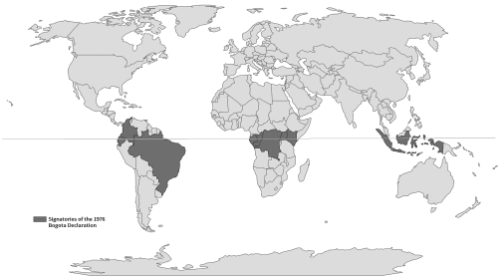
The emergence and rapid advancement of space technology during the Cold War led to heated discussions about the geopolitical and legal framework of a world expanding into the stars, as nations grappled with the implications of their newfound capabilities. During the early years of space exploration, the competition for ownership, access, and use of outer space ignited multilateral debates, involving not only the United States and the Soviet Union, but also alternative discourses, expectations, and experiences from various stakeholders. This intricate web of cosmic diplomacy significantly contributed to the formation of a legal order for outer space. This chapter analyses the political, legal, and technoscientific arguments put forward by African, Southeast Asian, and Latin American representatives in international fora regarding the regulation of activities in a particular strip of outer space. It uses the development of a regulatory framework for the geostationary orbit (GEO) as a case study in which to explore this alternative perspective. It shows how equatorial countries pushed for a regulatory regime in space that accounted for the vertical dimension of national sovereignty. Drawing upon principles of decolonization, internationalism, and scientific cooperation, their central argument advocated equal access to outer space for non-spacefaring countries. The analysis follows these negotiations by examining the records of the United Nations, the proceedings of its Committee on the Peaceful Uses of Outer Space (COPUOS), and the first and second declarations of the equatorial countries (1976 and 1982), which staked their sovereignty claims over the GEO.
Full text loading...