


oa New Sciences and Old Diseases. Seventeenth-Century Readings of the Causes of the Plague
- By: Mariangela Priarolo
- Publication: Epidemics and Pandemics , pp 167-188
- Publisher: Brepols
- Publication Date: January 2024
- DOI: https://doi.org/10.1484/M.STPH-EB.5.136410


New Sciences and Old Diseases. Seventeenth-Century Readings of the Causes of the Plague, Page 1 of 1
< Previous page | Next page > /docserver/preview/fulltext/10.1484/M.STPH-EB.5.127756/M.STPH-EB.5.136410-1.gif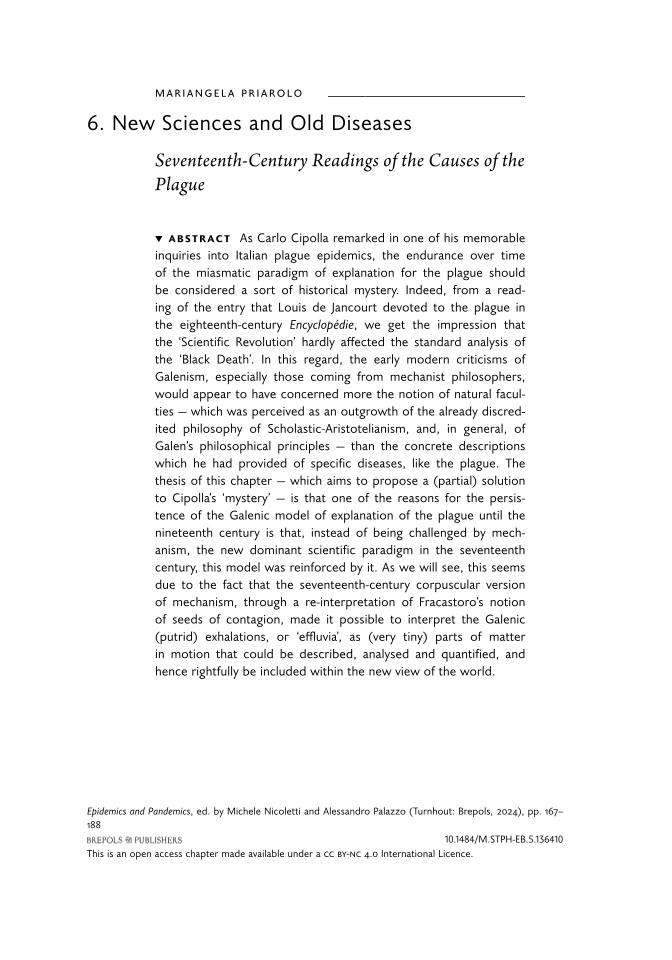
Abstract
As Carlo Cipolla remarked in one of his memorable inquiries into Italian plague epidemics, the endurance over time of the miasmatic paradigm of explanation for the plague should be considered a sort of historical mystery. Indeed, from a reading of the entry that Louis de Jancourt devoted to the plague in the eighteenth-century Encyclopédie, we get the impression that the ‘Scientific Revolution’ hardly affected the standard analysis of the ‘Black Death’. In this regard, the early modern criticisms of Galenism, especially those coming from mechanist philosophers, would appear to have concerned more the notion of natural faculties — which was perceived as an outgrowth of the already discredited philosophy of Scholastic-Aristotelianism, and, in general, of Galen’s philosophical principles — than the concrete descriptions which he had provided of specific diseases, like the plague. The thesis of this chapter — which aims to propose a (partial) solution to Cipolla’s ‘mystery’ — is that one of the reasons for the persistence of the Galenic model of explanation of the plague until the nineteenth century is that, instead of being challenged by mechanism, the new dominant scientific paradigm in the seventeenth century, this model was reinforced by it. As we will see, this seems due to the fact that the seventeenth-century corpuscular version of mechanism, through a re-interpretation of Fracastoro’s notion of seeds of contagion, made it possible to interpret the Galenic (putrid) exhalations, or ‘effluvia’, as (very tiny) parts of matter in motion that could be described, analysed and quantified, and hence rightfully be included within the new view of the world.

Full text loading...
References
-
BibliographyAgricola, Georg, De Peste. Libri tres (s.l. [but Basel]: Hyeronimus Froben, 1554).
-
Boyle, Robert, Cosmical Suspicions [Subjoyned as an Appendix to the Discourse of the Cosmical Qualities of Things], in The Works of the Honourable Robert Boyle, edited by Thomas Birch, 6 vols (London: 1744), vol. 3.
-
Boyle, Robert, Essay on the Great Efficacy of Effluviums, in, The Works of the Honourable Robert Boyle, edited by Thomas Birch, 6 vols (London: 1744), vol. 3.
-
Boyle, Robert, On the Strange Subtlity of Effluviums, in The Works of the Honourable Robert Boyle, edited by Thomas Birch, 6 vols (London: 1744), vol. 3.
-
Boyle, Robert, Essay on the Porousness of Animal Bodies, in The Works of the Honourable Robert Boyle, edited by Thomas Birch, 6 vols (London: 1744), vol. 4.
-
Boyle, Robert, An Experimental Discourse on Some Unheeded Causes of the Insalubrity and Salubrity of the Air, in The Works of the Honourable Robert Boyle, edited by Thomas Birch, 6 vols (London: 1744), vol. 5.
-
Chauvin, Lettre à Madame la Marquise de Senozan, sur les moyens dont on s’est servy pour découvrir les Complices d’un assassinat commis à Lyon, le 5eme de Juillet 1692 (Lyon: chez Jean Baptiste et Nicolas De Ville, 1692).
-
Diderot, Denis, and D’Alembert, Jean-Baptiste Le Rond (ed.), Encyclopédie, ou dictionnaire raisonné des sciences, des arts et des métiers, etc., 17 vols (Lucques: Giuntini, 2nd edition, 1758–71), vol. 13.
-
Fracastoro, Girolamo, De sympatia et antipathia rerum liber unus. De contagione, contagiosis morbis et curatione libri tres (Venetiis: apud heredes Lucaeantonii Iuntae Florentini, 1546).
-
Furètiere, Antoine, Dictionaire universel, contenant généralement tous les mots françois tant vieux que modernes et les termes de toutes les sciences et des arts (La Haye-Rotterdam: Arnout et Reinier Leers, 1690), vol. 1.
-
Garnier, Pierre, Dissertation physique en forme de lettre à Monsieur de Seve… dans laquelle il est prouvé que les talens extraordinaires qu’à Jacques Aymar de suivre avece une Baguette les Meurtries et les Voleurs à la piste, de trouver de l’eau, l’argent chaché, les bornes transplantées, etc. dépendent d’une cause tres-naturelle et tres ordinaire [Lyon: chez Jean-Baptiste de Ville, 1692].
-
Harvey, Gideon, Discourse of the Plague containing the Nature, Causes, Signs, and Presages of the Pestilence in general. Together with the state of the present Contagion. Also most rational Preservatives for Families, and choiche Curative Medicines both for Rich and Poor. With several waies for purifying the air in houses, streets, etc. (London: Angel, 1665).
-
Hering, Francis, Certaine Rules, Directions, or Advertisments for This Time of Pestilentiall Contagion with a Caveat to Those That Weare about Their Neckes Impoisoned Amulets as a Preservative from the Plague (London: William Iones, 1625).
-
Milton, John, The Latin Poems, ed. by W. Mackellar (New Haven: Yale University Press, 1930).
-
Traicté de la peste, de la petite Verolle et Rougeolle. Avec une brefue description de la Lepre par Ambroise Paré premier Chirurgien du Roy et Iuré à Paris (Paris: André Wechel, 1568).
-
Trattato della peste di Ambrosio Pare de Laval al Mene … diviso in LII. capitoli ne’ quali tra le altre cose si leggono i presaggi, le cause divine o umane, e le sementi generali della peste … Tradotto dal francese nell’italiano da Gio. Michele Du’ Bois e dato in luce … con l’aggionta di alcune ricette… (Bologna: Benacci’s heirs, 1720).
-
A Treatise of the Plague contayining Causes, Signes, Symptomes, Prognosticksm and Cure thereof. Together with sundry other remarkable passages (for the prevention of, and preservation from the Pestilence) never yet published by anie man. Collected out of the Workes of the no lesse learned than experimented and renowned Chirurgian Ambrose Parey (London: Michael Parke, 1630).
-
***Alfani, Guido, ‘Plague in Seventeenth-Century Europe and the Decline of Italy: an Epidemiological Hypothesis’, European Review of Economic History, 17 (2013), pp. 408–30.
-
Anstey, Peter, The Philosophy of Robert Boyle (London-New York: Routledge, 2000).
-
Baldwin, Martha, ‘Toads and Plague: Amulet Therapy in Seventeenth-Century Medicine’, Bulletin of the History of Medicine, 67. 2 (1993), pp. 227–47.
-
Banchetti-Robino, M. Paola, The Chemical Philosophy of Robert Boyle: Mechanicism, Chymical Atoms, and Emergence (Oxford: Oxford University Press, 2020).
-
Biraben, Jean-Noël, Les hommes et la peste en France et dans les pays Europeéens et Méditerranées (Paris-La Haye: Mouton, 1975).
-
Ceccarelli, Andrea, ‘Neve Lucretius a me indefensus maneat: Girolamo Mercuriale, il De rerum natura e la medicina nel Rinascimento’, Lexicon philosophicon. International Journal for the History of Ideas, 5 (2017) pp. 161–88.
-
Cipolla, Carlo M., Public Health and the Medical Profession in the Renaissance (Cambridge: Cambridge University Press, 1973).
-
Cipolla, Carlo M., Miasmi ed umori. Ecologia e condizioni sanitarie in Toscana nel Seicento (Bologna: Il Mulino, 1989).
-
Clericuzio, Antonio, ‘A Redefinition of Boyle’s Chemistry and Corpuscular Philosophy’, Annals of Science, 6. 47 (1990), pp. 561–89.
-
Clericuzio, Antonio, Elements, Principles and Corpuscles. A Study of Atomism and Chemistry in the Seventeenth Century (Dordrecht: Springer, 2000).
-
Crignon, Claire, ‘Peut-on faire une histoire naturelle de l’air? Francis Bacon et Robert Boyle’, Archives de Philosophie, 84. 1 (2021), pp. 93–113.
-
Donato, Maria Pia, ‘Galen in an Age of Change (1650–1820)’, in Brill’s Companion to the Reception of Galen, ed. by Petros Bouras-Vallianatos and Barbara Zipser, (Leiden-Boston: Brill 2019), pp. 487–507.
-
Favaretti Camposampiero, Matteo, ‘Galenism in Early Modern Philosophy and Medicine’, in Encyclopedia of Early Modern Philosophy and Science, ed. by Dana Jalobeau and Charles T. Wolfe, (Cham: Springer, 2018).
-
Ferenczi, Thomas, ‘The Chevalier de Jancourt, a Soldier for the Enlightenment’, Le philosophoire, 47. 1 (2017), pp. 77–133.
-
Garber, Daniel, ‘Why the Scientific Revolution Wasn’t a Scientific Revolution, and Why It Matters’, in Kuhn’s Structure of Scientific Revolutions at Fifty. Reflections on a Science Classic, ed. by Robert J. Richards and Lorraine Daston (Chicago-London: University of Chicago Press, 2016).
-
Goddard, Charlotte, ‘Lucretius and Lucretian Science in the Works of Fracastoro’, Res Publica Litterarum, 16 (1993), pp. 185–92.
-
Hirai, Hiro, Le concept de semence dans les théories de la matière à la Renaissance. De Marsile Ficin à Pierre Gassendi (Turnhout: Brepols, 2005).
-
Jouanna, Jacques, ‘Air, miasme et contagion à l’époque d’Hippocrate et survivance de miasmes dans la médecine posthippocratique (Rufus d’Éphèse, Galien et Palladios)’, in Air, miasmes et contagion, Les épidémies dans l’Antiquité et au Moyen Âge, ed. by Sylvie Bazin-Tacchella and others (Langres: Dominique Guéniot, 2001), pp. 9–28.
-
Jouanna, Jacques, Greek Medicine from Hippocrates to Galen. Selected Papers (Leiden-Boston: Brill, 2012).
-
Kuhn, Thomas, The Structure of the Scientific Revolution (Chicago: University of Chicago Press, 1970).
-
Mannola, Simone, La ragione e l’incertezza. Filosofia e medicina nella prima età moderna (Milano: Franco Angeli, 2012), pp. 266–71.
-
Newman, William R., Atoms and Alchemy: Chymistry and the Experimental Origins of the Scientific Revolution (Chicago-London: University of Chicago Press, 2006).
-
Nutton, Vivian, ‘The Seeds of Disease. An Explanation of Contagion and Infection from the Greeks to the Renaissance’, Medical History, 27 (1983), pp. 1–34.
-
Nutton, Vivian, ‘The Reception of Fracastoro’s Theory of Contagion: The Seed That Fell among Thorns?’, Osiris, 6 (1990), pp. 196–234.
-
Pantin, Isabelle, ‘Fracastoro’s De Contagione and Medieval Reflection on ‘Action at a Distance’: Old and New Trends in Renaissance Discourse on the Plague’, in Imagining Contagion in Early Modern Europe, ed. by Claire Carlin (New York: Palgrave, 2005), pp. 3–15.
-
Parigi, Silvia, ‘Effluvia, Action at a Distance, and the Challenge of the Third Causal Model’, International Studies in the Philosophy of Science, 29. 4 (2005), pp. 351–68.
-
Pennuto, Concetta, ‘La natura dei contagi in Fracastoro’, in Girolamo Fracastoro. Fra medicina, filosofia e scienze della natura, ed. by Alessandro Pastore and Enrico Peruzzi (Florence: Leo Olschki, 2006) pp. 57–71.
-
Pennuto, Concetta, Simpatia, fantasia e contagio. Il pensiero medico e il pensiero filosofico de Girolamo Fracastoro (Roma: Edizioni di storia e letteratura, 2008).
-
Pérez, Stanis, La République des Lettres menée à la baguette? L’affaire Jacques Aymar’, XVIIe siècle, 226 (2005), pp. 145–64.
-
Prescher, Hans, ‘Georgius Agricola. Ein sächsischer Humanist ond Naturforscher von europäischer Bedeutung’, in Georgius Agricola. 500 Jahre. Wisseschaftliche Konferenz vom 25.-27.März 1994 in Chemnitz, Freistaat Sachsen, ed. by Friedrich Naumann (Basel–Boston–Berlin: Birkhäuser Verlag, 1994), pp. 11–34.
-
Priarolo, Mariangela, ‘Demoni o corpuscoli? La bacchetta divinatoria e la nuova scienza alla fine del XVII secolo’, Intersezioni, 3 (2020), pp. 333–58.
-
Renzi, Barbara Gabriella, ‘Kuhn’s Evolutionary Epistemology and Its Being Undermined by Inadequate Biological Concepts’, Philosophy of Science, 76. 2, (2009), pp. 143–59.
-
Rutkin, H. Darrel, ‘How to Accurately Account for Astrology’s Marginalization in the History of Science and Culture: The Essential Importance of an Interpretive Framework’, Early Science and Medicine, 23 (2018), pp. 217–43.
-
Stewart, Keith Andrew, Galen’s Theory of Black Bile. Hippocratic Tradition, Manipulation, Innovation (Leiden-Boston: Brill, 2018).
-
Thorndike, Lynn, A History of Magic and Experimental Science, vols 8, The Seventeenth Century (New York: Columbia University Press, 1958).
References
-
BibliographyAgricola, Georg, De Peste. Libri tres (s.l. [but Basel]: Hyeronimus Froben, 1554).
-
Boyle, Robert, Cosmical Suspicions [Subjoyned as an Appendix to the Discourse of the Cosmical Qualities of Things], in The Works of the Honourable Robert Boyle, edited by Thomas Birch, 6 vols (London: 1744), vol. 3.
-
Boyle, Robert, Essay on the Great Efficacy of Effluviums, in, The Works of the Honourable Robert Boyle, edited by Thomas Birch, 6 vols (London: 1744), vol. 3.
-
Boyle, Robert, On the Strange Subtlity of Effluviums, in The Works of the Honourable Robert Boyle, edited by Thomas Birch, 6 vols (London: 1744), vol. 3.
-
Boyle, Robert, Essay on the Porousness of Animal Bodies, in The Works of the Honourable Robert Boyle, edited by Thomas Birch, 6 vols (London: 1744), vol. 4.
-
Boyle, Robert, An Experimental Discourse on Some Unheeded Causes of the Insalubrity and Salubrity of the Air, in The Works of the Honourable Robert Boyle, edited by Thomas Birch, 6 vols (London: 1744), vol. 5.
-
Chauvin, Lettre à Madame la Marquise de Senozan, sur les moyens dont on s’est servy pour découvrir les Complices d’un assassinat commis à Lyon, le 5eme de Juillet 1692 (Lyon: chez Jean Baptiste et Nicolas De Ville, 1692).
-
Diderot, Denis, and D’Alembert, Jean-Baptiste Le Rond (ed.), Encyclopédie, ou dictionnaire raisonné des sciences, des arts et des métiers, etc., 17 vols (Lucques: Giuntini, 2nd edition, 1758–71), vol. 13.
-
Fracastoro, Girolamo, De sympatia et antipathia rerum liber unus. De contagione, contagiosis morbis et curatione libri tres (Venetiis: apud heredes Lucaeantonii Iuntae Florentini, 1546).
-
Furètiere, Antoine, Dictionaire universel, contenant généralement tous les mots françois tant vieux que modernes et les termes de toutes les sciences et des arts (La Haye-Rotterdam: Arnout et Reinier Leers, 1690), vol. 1.
-
Garnier, Pierre, Dissertation physique en forme de lettre à Monsieur de Seve… dans laquelle il est prouvé que les talens extraordinaires qu’à Jacques Aymar de suivre avece une Baguette les Meurtries et les Voleurs à la piste, de trouver de l’eau, l’argent chaché, les bornes transplantées, etc. dépendent d’une cause tres-naturelle et tres ordinaire [Lyon: chez Jean-Baptiste de Ville, 1692].
-
Harvey, Gideon, Discourse of the Plague containing the Nature, Causes, Signs, and Presages of the Pestilence in general. Together with the state of the present Contagion. Also most rational Preservatives for Families, and choiche Curative Medicines both for Rich and Poor. With several waies for purifying the air in houses, streets, etc. (London: Angel, 1665).
-
Hering, Francis, Certaine Rules, Directions, or Advertisments for This Time of Pestilentiall Contagion with a Caveat to Those That Weare about Their Neckes Impoisoned Amulets as a Preservative from the Plague (London: William Iones, 1625).
-
Milton, John, The Latin Poems, ed. by W. Mackellar (New Haven: Yale University Press, 1930).
-
Traicté de la peste, de la petite Verolle et Rougeolle. Avec une brefue description de la Lepre par Ambroise Paré premier Chirurgien du Roy et Iuré à Paris (Paris: André Wechel, 1568).
-
Trattato della peste di Ambrosio Pare de Laval al Mene … diviso in LII. capitoli ne’ quali tra le altre cose si leggono i presaggi, le cause divine o umane, e le sementi generali della peste … Tradotto dal francese nell’italiano da Gio. Michele Du’ Bois e dato in luce … con l’aggionta di alcune ricette… (Bologna: Benacci’s heirs, 1720).
-
A Treatise of the Plague contayining Causes, Signes, Symptomes, Prognosticksm and Cure thereof. Together with sundry other remarkable passages (for the prevention of, and preservation from the Pestilence) never yet published by anie man. Collected out of the Workes of the no lesse learned than experimented and renowned Chirurgian Ambrose Parey (London: Michael Parke, 1630).
-
***Alfani, Guido, ‘Plague in Seventeenth-Century Europe and the Decline of Italy: an Epidemiological Hypothesis’, European Review of Economic History, 17 (2013), pp. 408–30.
-
Anstey, Peter, The Philosophy of Robert Boyle (London-New York: Routledge, 2000).
-
Baldwin, Martha, ‘Toads and Plague: Amulet Therapy in Seventeenth-Century Medicine’, Bulletin of the History of Medicine, 67. 2 (1993), pp. 227–47.
-
Banchetti-Robino, M. Paola, The Chemical Philosophy of Robert Boyle: Mechanicism, Chymical Atoms, and Emergence (Oxford: Oxford University Press, 2020).
-
Biraben, Jean-Noël, Les hommes et la peste en France et dans les pays Europeéens et Méditerranées (Paris-La Haye: Mouton, 1975).
-
Ceccarelli, Andrea, ‘Neve Lucretius a me indefensus maneat: Girolamo Mercuriale, il De rerum natura e la medicina nel Rinascimento’, Lexicon philosophicon. International Journal for the History of Ideas, 5 (2017) pp. 161–88.
-
Cipolla, Carlo M., Public Health and the Medical Profession in the Renaissance (Cambridge: Cambridge University Press, 1973).
-
Cipolla, Carlo M., Miasmi ed umori. Ecologia e condizioni sanitarie in Toscana nel Seicento (Bologna: Il Mulino, 1989).
-
Clericuzio, Antonio, ‘A Redefinition of Boyle’s Chemistry and Corpuscular Philosophy’, Annals of Science, 6. 47 (1990), pp. 561–89.
-
Clericuzio, Antonio, Elements, Principles and Corpuscles. A Study of Atomism and Chemistry in the Seventeenth Century (Dordrecht: Springer, 2000).
-
Crignon, Claire, ‘Peut-on faire une histoire naturelle de l’air? Francis Bacon et Robert Boyle’, Archives de Philosophie, 84. 1 (2021), pp. 93–113.
-
Donato, Maria Pia, ‘Galen in an Age of Change (1650–1820)’, in Brill’s Companion to the Reception of Galen, ed. by Petros Bouras-Vallianatos and Barbara Zipser, (Leiden-Boston: Brill 2019), pp. 487–507.
-
Favaretti Camposampiero, Matteo, ‘Galenism in Early Modern Philosophy and Medicine’, in Encyclopedia of Early Modern Philosophy and Science, ed. by Dana Jalobeau and Charles T. Wolfe, (Cham: Springer, 2018).
-
Ferenczi, Thomas, ‘The Chevalier de Jancourt, a Soldier for the Enlightenment’, Le philosophoire, 47. 1 (2017), pp. 77–133.
-
Garber, Daniel, ‘Why the Scientific Revolution Wasn’t a Scientific Revolution, and Why It Matters’, in Kuhn’s Structure of Scientific Revolutions at Fifty. Reflections on a Science Classic, ed. by Robert J. Richards and Lorraine Daston (Chicago-London: University of Chicago Press, 2016).
-
Goddard, Charlotte, ‘Lucretius and Lucretian Science in the Works of Fracastoro’, Res Publica Litterarum, 16 (1993), pp. 185–92.
-
Hirai, Hiro, Le concept de semence dans les théories de la matière à la Renaissance. De Marsile Ficin à Pierre Gassendi (Turnhout: Brepols, 2005).
-
Jouanna, Jacques, ‘Air, miasme et contagion à l’époque d’Hippocrate et survivance de miasmes dans la médecine posthippocratique (Rufus d’Éphèse, Galien et Palladios)’, in Air, miasmes et contagion, Les épidémies dans l’Antiquité et au Moyen Âge, ed. by Sylvie Bazin-Tacchella and others (Langres: Dominique Guéniot, 2001), pp. 9–28.
-
Jouanna, Jacques, Greek Medicine from Hippocrates to Galen. Selected Papers (Leiden-Boston: Brill, 2012).
-
Kuhn, Thomas, The Structure of the Scientific Revolution (Chicago: University of Chicago Press, 1970).
-
Mannola, Simone, La ragione e l’incertezza. Filosofia e medicina nella prima età moderna (Milano: Franco Angeli, 2012), pp. 266–71.
-
Newman, William R., Atoms and Alchemy: Chymistry and the Experimental Origins of the Scientific Revolution (Chicago-London: University of Chicago Press, 2006).
-
Nutton, Vivian, ‘The Seeds of Disease. An Explanation of Contagion and Infection from the Greeks to the Renaissance’, Medical History, 27 (1983), pp. 1–34.
-
Nutton, Vivian, ‘The Reception of Fracastoro’s Theory of Contagion: The Seed That Fell among Thorns?’, Osiris, 6 (1990), pp. 196–234.
-
Pantin, Isabelle, ‘Fracastoro’s De Contagione and Medieval Reflection on ‘Action at a Distance’: Old and New Trends in Renaissance Discourse on the Plague’, in Imagining Contagion in Early Modern Europe, ed. by Claire Carlin (New York: Palgrave, 2005), pp. 3–15.
-
Parigi, Silvia, ‘Effluvia, Action at a Distance, and the Challenge of the Third Causal Model’, International Studies in the Philosophy of Science, 29. 4 (2005), pp. 351–68.
-
Pennuto, Concetta, ‘La natura dei contagi in Fracastoro’, in Girolamo Fracastoro. Fra medicina, filosofia e scienze della natura, ed. by Alessandro Pastore and Enrico Peruzzi (Florence: Leo Olschki, 2006) pp. 57–71.
-
Pennuto, Concetta, Simpatia, fantasia e contagio. Il pensiero medico e il pensiero filosofico de Girolamo Fracastoro (Roma: Edizioni di storia e letteratura, 2008).
-
Pérez, Stanis, La République des Lettres menée à la baguette? L’affaire Jacques Aymar’, XVIIe siècle, 226 (2005), pp. 145–64.
-
Prescher, Hans, ‘Georgius Agricola. Ein sächsischer Humanist ond Naturforscher von europäischer Bedeutung’, in Georgius Agricola. 500 Jahre. Wisseschaftliche Konferenz vom 25.-27.März 1994 in Chemnitz, Freistaat Sachsen, ed. by Friedrich Naumann (Basel–Boston–Berlin: Birkhäuser Verlag, 1994), pp. 11–34.
-
Priarolo, Mariangela, ‘Demoni o corpuscoli? La bacchetta divinatoria e la nuova scienza alla fine del XVII secolo’, Intersezioni, 3 (2020), pp. 333–58.
-
Renzi, Barbara Gabriella, ‘Kuhn’s Evolutionary Epistemology and Its Being Undermined by Inadequate Biological Concepts’, Philosophy of Science, 76. 2, (2009), pp. 143–59.
-
Rutkin, H. Darrel, ‘How to Accurately Account for Astrology’s Marginalization in the History of Science and Culture: The Essential Importance of an Interpretive Framework’, Early Science and Medicine, 23 (2018), pp. 217–43.
-
Stewart, Keith Andrew, Galen’s Theory of Black Bile. Hippocratic Tradition, Manipulation, Innovation (Leiden-Boston: Brill, 2018).
-
Thorndike, Lynn, A History of Magic and Experimental Science, vols 8, The Seventeenth Century (New York: Columbia University Press, 1958).
-
From This Site
/content/books/10.1484/M.STPH-EB.5.136410dcterms_title,dcterms_subject,pub_serialIdent,pub_author,pub_keyword-contentType:Contributor -contentType:Concept -contentType:Institution105