


Brepols
Brepols is an international academic publisher of works in the humanities, with a particular focus in history, archaeology, history of the arts, language and literature, and critical editions of source works.2881 - 2900 of 3194 results
-
-

The Sisterbook of Master Geert’s House, Deventer
The Lives and Spirituality of the Sisters, c. 1390‑c. 1460
show More to view fulltext, buy and share links for:The Sisterbook of Master Geert’s House, Deventer show Less to hide fulltext, buy and share links for: The Sisterbook of Master Geert’s House, DeventerThe Sisterbook of Master Geert’s House contains the lives of sixty-four Sisters of the Common Life who died between 1398 and 1456. Founded as an alms-house for destitute women in 1374, by the end of the fourteenth century Master Geert’s House had become a home for women desiring to live a life of humility and penitence, as well as in community of goods without vows. The Sisterbook was likely written sometime between 1460 and 1470, at a time when the religious fervour that had characterized the earlier Sisters had begun to wane. It was to incite the readers and hearers of the Sisterbook, which would have been read in the refectory during mealtimes, to imitate the earlier Sisters who are portrayed as outstanding examples of godliness and Sisters of the Common Life. The opening sentence of the Sisterbook succinctly sums up the author’s reason for writing it: ‘Here begin some edifying points about our earlier Sisters whose lives it behoves us to have before our eyes at all times, for in their ways they were truly like a candle on a candlestick’, and who, by implication, could still illumine the way for her own generation of Sisters. The first foundation of Sisters of the Common Life, Master Geert’s House became the ‘mother’ house of numerous other houses in the Low Countries and Germany directly as well as indirectly and served as an inspiration for others.
This book provides a study of the Sisterbook and its significance in the Devotio Moderna and late medieval female religiosity, while the accompanying translation introduces this important source to an English audience.
-
-
-
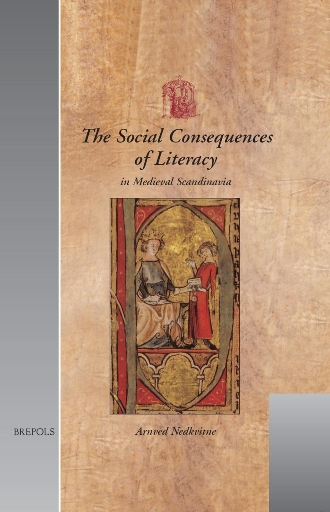
The Social Consequences of Literacy in Medieval Scandinavia
show More to view fulltext, buy and share links for:The Social Consequences of Literacy in Medieval Scandinavia show Less to hide fulltext, buy and share links for: The Social Consequences of Literacy in Medieval ScandinaviaBetween 1000 and 1536 Scandinavia was transformed from a conglomerate of largely pre-state societies to societies with state governments. The state increasingly monopolised ‘legitimate’ violence. Church and state used literacy to strengthen social control in central and important areas: jurisdiction, religion and accounting. Written laws made social norms more precise and easier to change, a necessity in an increasingly complex society. The basic social transformations of the period cannot be attributed to increasing literacy alone, but the written word rendered them more peaceful and gradual, and strengthened social conformity and cohesion. Writing in Roman letters was introduced late to Scandinavia (ca. 1000 ad); consequently the transition from orality to literacy is better documented than in many other European societies. The rich saga literature from the twelfth and thirteenth centuries emerged at the time that administrative literacy was introduced. Until the fourteenth century, literacy was mainly promoted by church and state in their efforts to pacify and control society. Then the literate elites grew, encompassing ever larger groups of officials, clerks, merchants and artisans, many of whom were now educated in town schools. The resulting elite culture prepared the ground for the development of a proto-national identity.
-
-
-
The Son is Truly Son
The Trinitarian and Christological Theology of Eusebius of Caesarea
show More to view fulltext, buy and share links for:The Son is Truly Son show Less to hide fulltext, buy and share links for: The Son is Truly SonTheology in the early fourth century was engrossed with questions about the nature of the Son of God in relation to the Father. How was he ‘from the essence’ of the Father? Was there a time when he was not? While generally treated as a minor footnote in the development of trinitarian and christological theology by most modern scholars, Eusebius of Caesarea provides a rich and original contribution to these debates about the trinity and theology in the midst of the Arian controversy. This project explores the theological framework of Eusebius, focusing specifically on his understanding of the Son of God. Therein, it proposes and employs an underutilized lens to view the bishop - according to his exegetical strategies and his explicitly theological works. In doing so, Eusebius’ primary understanding of the nature and role of the second person of the Trinity comes to the fore: the Son is truly Son. By focusing on his theology of the Son in multiple facets - trinitarianism, cosmology, soteriology, and Christology - his unique theological contribution to the church becomes clear. Eusebius is an important transmitter of Origenian theology and a foundational thinker for the later fourth and early fifth century.
-
-
-
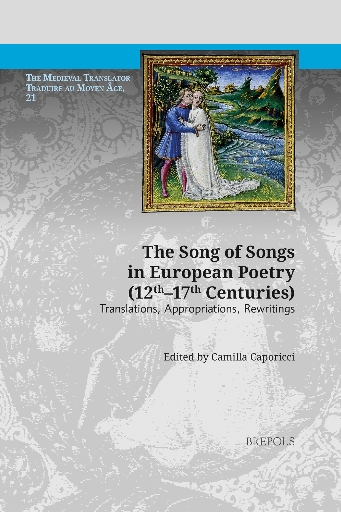
The Song of Songs in European Poetry
(Twelfth to Seventeenth Centuries)Translations, Appropriations, Rewritings
show More to view fulltext, buy and share links for:The Song of Songs in European Poetry
(Twelfth to Seventeenth Centuries) show Less to hide fulltext, buy and share links for: The Song of Songs in European Poetry
(Twelfth to Seventeenth Centuries)Traditionally attributed to King Solomon and defined by Rabbi Aqiva as the Holy of Holies among the sacred Scriptures, the Song of Songs is one of the most fascinating and controversial biblical books. Celebrated as a key to the supreme mystery of the union between God and the faithful, this ambivalent book, which combined a sensual celebration of love with a well-established tradition of allegorical interpretation, was a text crucial to both the Middle Ages and the Renaissance, and held a particular appeal for poets. Indeed, the Song of Songs played a significant role in the development of European poetry from its very beginning, creating an exceptional convergence of sacred and secular languages and horizons of meaning.
Written by a group of distinguished international scholars, this volume explores the complex and multifaceted processes through which the Song of Songs entered, influenced, and interacted with medieval and Renaissance European poetry (twelfth to seventeenth centuries). Focusing on both individual authors – including Peter Riga, Dante Alighieri, Richard Rolle, and George Herbert – and particularly relevant poetic traditions – including Hebrew liturgical poetry and the Tristan and Ysolt tradition, Middle English and Petrarchan lyric, Renaissance verse versions and seventeenth-century musical compositions, dissident and prophetic texts – the volume unveils the relevant role played by the biblical book in the development of European poetry, thought and spirituality, highlighting its ability to contribute to different poetic genres and give voice to a variety of religious, political, philosophical, and artistic intentions.
-
-
-
The Spirit, the World and the Trinity
Origen’s and Augustine’s Understanding of the Gospel of John
show More to view fulltext, buy and share links for:The Spirit, the World and the Trinity show Less to hide fulltext, buy and share links for: The Spirit, the World and the TrinityIn a renowned and controversial passage Origen writes: “Of the subsistence of the Holy Spirit, no-one could have even a suspicion, except those who profess a belief in Christ” (De Principiis, 1,3). But how come that ancient Christian authors elaborated a theology of the Holy Spirit? This innovative study tackles this question by analysing how the exegesis of the Gospel of John shaped the trinitarian and soteriological agency of the Holy Spirit in the theologies of two of the most important Christian authors of all times: Origen and Augustine. In particular, the Johannine Father-Son-Spirit relation and the dichotomy between God and the world represent the foundation on which Origen and Augustine built their pneumatologies. At a closer look, one even realises that they both conceived the God-human relationship through a Johannine lens.
The heuristic comparison proposed in this book is focused on the three large themes, towards which Origen and Augustine represent opposite approaches: the understanding of the immanent Trinity, the dualism between God and the world and the proper role of the Holy Spirit. On the one hand, Origen put forward a paradigm of participation to explain the oneness and threeness of God. On the other, Augustine understands God’s self-relation through a paradigm of identity. These two trinitarian constructions are shaped by a different understanding of the Gospel of John: while Origen’s theology mostly smooths the gospel’s dualism by interpreting God’s salvific act as a gradual spiritualisation of the world, Augustine tends to accentuate the Gospel’s dichotomies by radicalising the Johannine dualism. This study will therefore clarify the two specific paradigms in the two authors’ theologies: participation/transformation in Origen and identity/separation in Augustine, showing also how these paradigms are patterned after their different understanding of the fourth Gospel.
-
-
-
The Spread of the Scientific Revolution in the European Periphery, Latin America and East Asia
Proceedings of the XXth International Congress of History of Science (Liège, 20-26 July 1997) Vol. V
show More to view fulltext, buy and share links for:The Spread of the Scientific Revolution in the European Periphery, Latin America and East Asia show Less to hide fulltext, buy and share links for: The Spread of the Scientific Revolution in the European Periphery, Latin America and East AsiaThis volume includes papers presented during a symposium on the spreading of the scientific revolution outside Western European countries, which was held during the XXth International Congress of History of Science in Liège in 1997.
The contributions aim to answer some recent historiographical questions such as the modalities of the spreading of science in different countries, the reception of the new science by different cultures, the kind of changes this reception set in motion, the periodisation in adopting the new scientific knowledge, the structures set up for this adoption.
Three geographical areas are presented here: the European countries in the border of the "scientific center", Latin America countries and East Asian regions.
The volume constitutes the first attempt at making a synthesis at an international level on the important question of the spreading of the "new science" throughout the world.
-
-
-
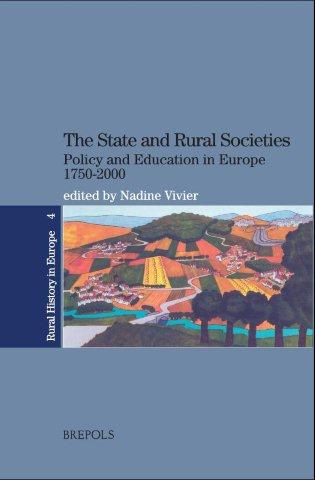
The State and Rural Societies
Policy and Education in Europe. 1750-2000
show More to view fulltext, buy and share links for:The State and Rural Societies show Less to hide fulltext, buy and share links for: The State and Rural SocietiesRural societies are conventionally thought to be bound by tradition and resistant to change. But from the 18th century onwards many countries began to see the countryside as the basis of national prosperity, with a healthy and increasing population, and rising agricultural output fostering general economic growth. It became an objective of the State to encourage the trend, but also to exert social control on this major part of the population in order to civilize the rude peasantry and acquire their electoral support.
This book deals with the various aspects of rural life in which the State intervened: economic matters, such as property rights and market regulations; social questions, from moral concerns to demographic policy; and the key issue of rural education.
From Sweden to the Iberian Peninsula, the United Kingdom to Hungary, and from the eighteenth century to the twentieth, using both broad surveys and in-depth studies, with an extensive introduction written from a comparative perspective, an international group of historians (brought together by the COST network A35) for the first time examine the rural concerns of the state, both economic and social, in a comparative European context.
Nadine Vivier is professor of social and economic history at the University of Maine (France). She has worked extensively on rural societies from 1750 to 2000 in France and in Europe.
-
-
-
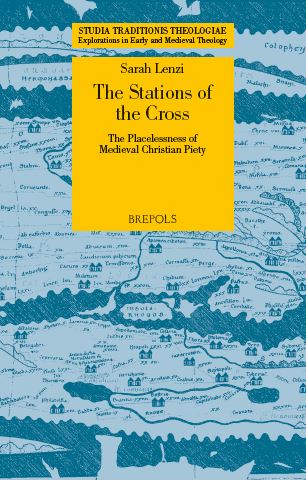
The Stations of the Cross
The Placelessness of Medieval Christian Piety
show More to view fulltext, buy and share links for:The Stations of the Cross show Less to hide fulltext, buy and share links for: The Stations of the CrossThe Christian practice of the Stations of the Cross has historically largely been the purview of devotional authors. In this academic study, the Reverend Doctor Sarah Lenzi revisits the evidence-based history of the western European development of the Stations as it was laid out at the turn of the twentieth century. She begins with a discussion of how this history is often neglected in favor of a mythic history that places the development in Jerusalem at the time of the Crusades and she then reestablishes the western origins. While the early twentieth-century authors who worked on the Stations are invaluable for the history they uncovered, there were gaps in the analyses they offered based on that history. In the chapters that follow, Rev. Dr. Lenzi works to debunk those interpretations and to offer a new understanding of the development of the Stations of the Cross. A close examination of pilgrimage texts as well as medieval meditation manuals puts this particular practice in the broader context of Medieval Christian history and ritual, and works to place it appropriately on the spectrum of pietistic behavior. With a new understanding of the development of the Stations of the Cross, Rev. Dr. Lenzi helps to explore notions of time, place, and space in Medieval Christianity, arguing for an understanding of placelessness in Christian piety that is enabled through intentional ritualized use of imagination, narrative, body, and word.
-
-
-
The Strange Death of Pagan Rome
Reflections on a Historiographical Controversy
show More to view fulltext, buy and share links for:The Strange Death of Pagan Rome show Less to hide fulltext, buy and share links for: The Strange Death of Pagan RomeThe end of paganism in antique Rome strongly involves the nature of the relations between pagans and Christians in the fourth century AD. The historical paradigm of conflict has been disseminated by scholars as the Hungarian András Alföldi, who in 1934 presented a Christian Constantine in irreconcilable conflict with a pagan Rome, and by Herbert Bloch. The latter, most notably in 1958, in a seminar conference at the Warburg Institute, consolidated the idea of a conflictual model in which the aristocracy of Rome, faced with a tightening of measures against traditional cults, realized a real ‘pagan revival’ and led against Theodosius I «the last pagan army of the ancient world». This model was subjected to a massive critique by Alan Cameron in his The Last Pagans of Rome, Oxford 2011, but in the course of less than two years Cameron’s publication has aroused a strong response, especially on the part of European scholars, and the debate has gained new, effervescent relevance.
This volume, edited by Rita Lizzi Testa, collects the reflections of some Italian scholars - Guido Clemente, R. Lizzi Testa, Giorgio Bonamente, Silvia Orlandi, Giovanni Alberto Cecconi, Lellia Cracco Ruggini, Franca Ela Consolino, Isabella Gualandri, Gianfranco Agosti, Gianluca Grassigli, Alessandra Bravi - and of the illustrious professor François Paschoud from Geneva, on the theme of the last pagans of Rome. It is not only A. Alföldi’s and H. Bloch’s model that provides the dialectic reference for their discussions, but rather, the more insidious in its paradoxical nature, Alan Cameron’s. For the English scholar the concept of conflict is a pure historiographical construction because no real pagans remained in Rome when Theodosius issued laws against paganism. They were not pagan but classical élites, people totally soaked in classical culture, who accepted Christianity when it became compatible with classical culture and the imperial institutions. In his monumental book (more than 800 pages), he argues his position through learned demonstrations and the review of a vast amount of literary, archaeological, epigraphic and even artistic documentation. Nevertheless, much of this evidence can be read again from very different perspectives, and this is what the contributors of the volume try to do.
The volume continues a collection of monographic and miscellaneous studies, now taken over by Brepols Publishers: Giornale Italiano di Filologia. BILIOTHECA (GIFBIB). This series collects studies that are intended to discuss topics on literature, exegesis and textual criticism. The publication rhythm is of one volume per year. The series is a supplement to the scholarly journal Giornale Italiano di Filologia (GIF).
-
-
-
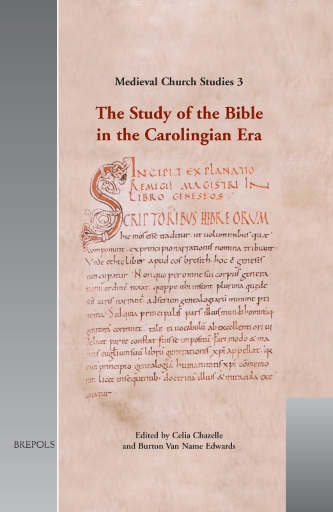
The Study of the Bible in the Carolingian Era
show More to view fulltext, buy and share links for:The Study of the Bible in the Carolingian Era show Less to hide fulltext, buy and share links for: The Study of the Bible in the Carolingian EraFrom the last quarter of the eighth until the beginning of the tenth century, Carolingian monasteries, cathedrals, and courts were the sites of a vigorous scholarship grounded in the study of sacred Scripture. The significance of Bible studies in this epoch is evident from the many extant Carolingian commentaries on virtually every book of the Old and New Testaments. More works of this kind survive from the period, often in multiple copies, than is true for any other genre of literature. Although scholars used to dismiss the Carolingian Bible commentaries as uncreative compilations of material borrowed from the Church Fathers, in recent years appreciation of these tracts’ essential creativity has grown significantly. In addition, there is now increased recognition of the degree to which the ‘exegetical’ culture nurtured within the Carolingian schools fertilized other aspects of contemporary intellectual and cultural endeavour.
The essays in this collection offer a fresh look at the range of biblical studies and their impact on diverse domains of Carolingian culture and learning. The bibliography provides a record of critical editions of Carolingian-era Bible commentaries and secondary scholarship in the field published within the last twelve years.
-
-
-
The Syriac Pseudo-Clementines
An Early Version of the First Christian Novel
show More to view fulltext, buy and share links for:The Syriac Pseudo-Clementines show Less to hide fulltext, buy and share links for: The Syriac Pseudo-ClementinesOf imperial family and eventually Peter’s heir as bishop of Rome, Clement relates here how he happened to become a Christian and how Peter instructed his companions as he refutes the arch-heretic Simon Magus in a series of debates. Clement also recounts the astonishing recovery of his long-lost family. All these events occur in the year of Christ’s death.
The Pseudo-Clementines were popular reading throughout the Middle Ages in a Latin translation and reemerged in early modern times via vernacular versions and especially the Faust-legend. Often considered the first and only ancient Christian novel, the Pseudo-Clementines originated in Syrian Jewish-Christianity in the early third century. Two ancient Syriac translations from the fourth century reflect Greek texts no longer preserved; they contain the essence of Clement’s biographical account and of Peter’s teachings and debates with Simon. Of particular interest is Peter’s detailed review of the origins of Christianity, which apparently seeks to rebut the canonical Acts of the Apostles and lays the blame for the unbelief of the Jews squarely at the feet of Paul.
This volume presents the first complete translation of the Syriac into any modern language and thereby opens the door for a new stage of historical research and literary appreciation.
-
-
-

The Tables of 1322 by John of Lignères
An Edition with Commentary
show More to view fulltext, buy and share links for:The Tables of 1322 by John of Lignères show Less to hide fulltext, buy and share links for: The Tables of 1322 by John of LignèresMedieval astronomers used tables to solve most of the problems they faced. These tables were generally assembled in sets, which constituted genuine tool-boxes aimed at facilitating the task of practitioners of astronomy. In the early fourteenth century, the set of tables compiled by the astronomers at the service of King Alfonso X of Castile and León (d. 1284), reached Paris, where several scholars linked to the university recast them and generated new tables. John of Lignères, one of the earliest Alfonsine astronomers, assembled his own set of astronomical tables, mainly building on the work of previous Muslim and Jewish astronomers in the Iberian Peninsula, especially in Toledo. Two major sets had been compiled in this town: one in Arabic, the Toledan Tables, during the second half of the eleventh century, and the Castilian Alfonsine Tables, under the patronage of King Alfonso.
This monograph provides for the first time an edition of the Tables of 1322 by John of Lignères. It is the earliest major set of astronomical tables to be compiled in Latin astronomy. It was widely distributed and is found in about fifty manuscripts. A great number of the tables were borrowed directly from the work of the Toledan astronomers, while others were adapted to the meridian of Paris, and many were later transferred to the standard version of the Parisian Alfonsine Tables. Therefore, John of Lignères’ set can be considered as an intermediary work between the Toledan Tables and the Parisian Alfonsine Tables.
-
-
-

The Teaching and Impact of the 'Doctrinale' of Thomas Netter of Walden (c. 1374-1430)
show More to view fulltext, buy and share links for:The Teaching and Impact of the 'Doctrinale' of Thomas Netter of Walden (c. 1374-1430) show Less to hide fulltext, buy and share links for: The Teaching and Impact of the 'Doctrinale' of Thomas Netter of Walden (c. 1374-1430)Thomas Netter of Walden (c. 1374-1430) was a Carmelite friar, royal confessor, diplomat, religious superior, and theologian. His only extant theological work, the Doctrinale antiquitatum fidei catholicae ecclesiae contra Wiclevistas et Hussitas, was written with the purpose of combating the errors of Wyclif and his followers. For this reason, Netter’s name and work are familiar mainly to those engaged in the study of Lollardy. Outside this field, Netter is almost unknown today, yet in his lifetime he was a highly regarded churchman who, it was said, could have had the pick of any diocese in England. From his death in 1430 until the middle of the eighteenth century Netter was a much-quoted and copied author whose exposition of Catholic teaching on subjects such as the Church, religious life, and the sacraments proved useful to many Counter-Reformation polemicists and apologists. This book is the first survey of the whole of the Doctrinale and it argues that there is more to Netter than anti-Lollard polemic. The author examines the principal topics in Netter’s work - God, humanity, Christ, the Church, religious life, prayer, the sacraments - and he makes the case that there is a definite plan which links the various parts of the Doctrinale into a whole giving it a certain theological unity.
The Very Rev. Kevin J. Alban, O. Carm. is Bursar General of the Carmelite Order. He read history at Balliol College, Oxford; he also holds degrees in philosophy and theology from the Pontifical Gregorian University and Catholic University Leuven, and a doctorate in church history from the University of London.
-
-
-
The Territories of Philosophy in Modern Historiography
show More to view fulltext, buy and share links for:The Territories of Philosophy in Modern Historiography show Less to hide fulltext, buy and share links for: The Territories of Philosophy in Modern HistoriographyIn the recent past, critical discussions concerning notions such as ‘cultural area’ and ‘area studies’ - as well as their relativization by means of conceptions that avoid splitting clearly identified areas (inter alia, ‘third space’, ‘hybridity’, ‘diaspora’, or ‘cosmopolitanism’) - have drawn attention to the long history of cultural territorialization. This book attempts to open the history of philosophy to reflexive and globalizing tendencies elaborated in the field of ‘world history’. From the seventeenth century onward, in both modern Europe and North America, historical sciences - notably philosophical historiography and cultural history - colonized both the past (or national pasts) and the ‘rest’ of the world. The contributions gathered in this volume address both phenomena to the extent that they have been linked with modern historicization of philosophy, sciences, and culture.
-
-
-
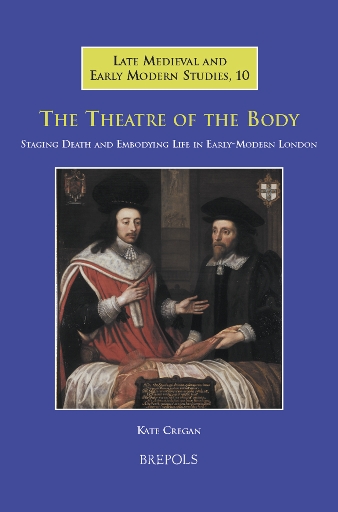
The Theatre of the Body
Staging Death and Embodying Life in Early-Modern London
show More to view fulltext, buy and share links for:The Theatre of the Body show Less to hide fulltext, buy and share links for: The Theatre of the BodyThis study is a threefold investigation of understandings of embodiment - as displayed in the playhouses, courthouses, and anatomy theatres of London between 1540 and 1696. These dates mark the waxing and waning of the Worshipful Company of Barber-Surgeons’ domination of the practice of dissection in London. In 1540 Henry VIII gave them his approval and encouragement but by 1696 Edward Ravenscroft’s The Anatomist: Or the Sham Doctor staged their loss of power. This loss of power, the book contends, is symptomatic of a major shift in the concept of embodiment. The book explains the changing understanding of the human body throughout this period by analysis of the interplay between the texts used in and the material practices of three specific public sites: the public playhouses, the Sessions House, and the Anatomy Theatre of the Worshipful Company of Barber-Surgeons of London. Using an approach which combines the socially textured understandings of fields of practice found in Bourdieu with the interpretations of progression across time found in Elias and Foucault, The Theatre of the Body demonstrates how the three fields of drama, law, and medicine are intimately inter-connected in that process.
In presenting this analysis, the author argues that the quality of embodiment begins to shift during this period from the mid-sixteenth century and throughout the course of the seventeenth century. In this shift one can observe how the earlier, ‘traditional’ interpretation of embodiment is intensified and resolidified into the beginnings of the medicalized ‘modern’ body.
-
-
-
The Theory and Practice of Translation in the Middle Ages
show More to view fulltext, buy and share links for:The Theory and Practice of Translation in the Middle Ages show Less to hide fulltext, buy and share links for: The Theory and Practice of Translation in the Middle Ages[El interés que los autores de estos trabajos demuestran por las complejidades y consecuencias de la traducción en la Edad Media, o de la traducción de textos medievales en el período moderno, ha dado como resultado un volumen diverso y estimulante intelectualmente. Los trabajos del presente volumen, escritos en inglés, francés y español, se centran en el tema de la traducción desde muchas perspectivas, ofreciendo una amplia gama de interpretaciones del concepto de traducción. El volumen contiene trabajos que abarcan en el tiempo desde el período Anglo-Sajón hasta el presente, y en temática desde libros de recetas medievales hasta argumentos a favor de que las mujeres administren la Eucaristía. Las lenguas que se estudian incluyen no sólo lenguas no europeas sino también el Latín y numerosas vernáculas europeas, ya sean como lengua origen o lengua meta. Como cualquier traductor o estudioso de la traducción puede rápidamente constatar, es imposible separar lengua de cultura. Todos los autores de este volumen han analizado en profundidad las complejidades de la traducción como hecho cultural, aún cuando el foco de atención pareciera ser específicamente lingüístico. Son estas complejidades las que dotan al estudio de la teoría y práctica de la traducción en la Edad Media de su perdurable fascinación.
,The interest of the writers of these essays in the intricacies and implications of translation in the Middle Ages, or of the translation of medieval texts in the modern period, has resulted in a diverse and intellectually stimulating volume. The papers in this volume, written in either English, French, or Spanish, approach translation from a wide variety of perspectives and offer a range of interpretations of the concept of translation. The volume contains essays ranging in time from the Anglo Saxon period to the present, and in topic from medieval recipe books to arguments in favour of women administering the sacrament. Languages studied include non-European languages as well as Latin and numerous European vernaculars as both source and target languages. As any translator or student of translation quickly becomes aware, it is impossible to divorce language from culture. All the contributors to this volume struggle with the complexities of translation as a cultural act, even when the focus would seem to be specifically linguistic. It is these complexities which lend the study of the theory and practice of translation in the Middle Ages its enduring fascination.
,Complexité et fascination: deux mots qui reviennent souvent à l’esprit au contact des textes médiévaux, au point qu’ils pourraient servir à caractériser la nature des rapports qui unissent ces textes à leurs traducteurs. Dans leur diversité, les communications entendues à Saint-Jacques-de-Compostelle illustrent, chacune à sa manière, de nombreux aspects de cette complexité, qu’il s’agisse des sujets traités ou des problèmes techniques soulevés. Le rapport au temps qu’impose le texte médiéval se double d’un rapport à la distance, car la différence culturelle se présente au traducteur comme un éloignement, ce qui, dans le travail de rapprochement que constitue alors la traduction, introduit la notion d’interprétation. A son tour cette interprétation, avec ses degrés, est étroitement dépendante des objectifs pédagogiques, culturels, politiques ou religieux que s’est fixés le traducteur, comme cela apparaîtra clairement à la lecture d’un certain nombre de ces communications. Plusieurs études de ce recueil confirment également que la traduction, loin d’être un travail de solitaire, est avant tout un acte social, une activité de mise en relations. C’est cette patiente recherche d’adaptation à des publics différents, en fonction d’époques et de goûts différents, accompagnée de choix tour à tour réjouissants et frustrants, qui constitue le travail de tout traducteur, qu’il appartienne au Moyen Âge ou au monde moderne. C’est aussi cette richesse, venue du passé mais toujours actuelle, et cette recherche sans cesse reprise d’un équilibre toujours instable, qui font que la traduction, dans sa pratique comme dans sa théorie, exerce sur tant d’esprits une réelle fascination.
]
-
-
-
The Translation of the Works of St Birgitta of Sweden into the Medieval European Vernacular
show More to view fulltext, buy and share links for:The Translation of the Works of St Birgitta of Sweden into the Medieval European Vernacular show Less to hide fulltext, buy and share links for: The Translation of the Works of St Birgitta of Sweden into the Medieval European VernacularThis volume of papers, from an international Conference held in Beverley in 1997 on the translation into the medieval European vernaculars of the works of St Birgitta of Sweden, forms volume 7 in the series The Medieval Translator. Previous volumes in the series have been based on papers heard at the Cardiff Conferences on the Theory and Practice of Translation in the Middle Ages (1987- ). While future volumes in the series will continue to provide a record of the Cardiff Conference (the next is planned for Compostella in 2001), the present volume provides a welcome development for the series, and paves the way for scholarly monographs on individual works and writers — including editions of medieval translations — and other publications more narrowly angled at the different questions raised by the study of medieval translation.
-
-
-
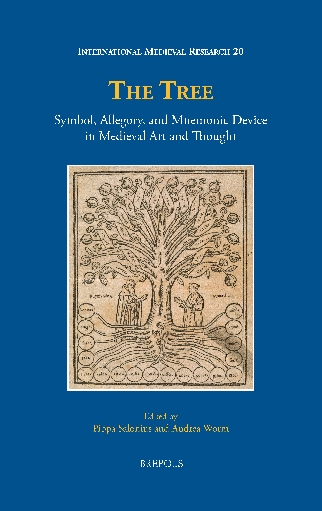
The Tree
Symbol, Allegory, and Mnemonic Device in Medieval Art and Thought
show More to view fulltext, buy and share links for:The Tree show Less to hide fulltext, buy and share links for: The TreeWith its vital character - growing, flowering, extending its roots into the ground, and its branches and leaves to the sky - the tree is a polyvalent metaphor, a suggestive symbol, and an allegorical subject. During the Middle Ages, a number of iconographic schemata were based on the image and structure of the tree, including the Tree of Jesse and the Tree of Virtues and Vices. From the late eleventh century onwards such formulae were increasingly used as devices for organizing knowledge and representing theoretical concepts. Despite the abstraction inherent in these schemata, however, the semantic qualities of trees persist in their usage.
The analysis of different manifestations of trees in the Middle Ages is highly instructive for visual, intellectual, and cultural history. Essays in this volume concentrate on the formative period for arboreal imagery in the medieval West, that is, the eleventh to fifteenth centuries. Using a range of methodological strategies and examining material from different media, ranging from illuminated manuscripts to wall painting, stained glass windows, and monumental sculpture, the articles in this volume show how different arboreal structures were conceived, employed, and appropriated by their specific contexts, how they functioned in their original framework, and how they were perceived by their audience.
-
-
-
The Tribunal of Zaragoza and Crypto-Judaism
1484-1515
show More to view fulltext, buy and share links for:The Tribunal of Zaragoza and Crypto-Judaism show Less to hide fulltext, buy and share links for: The Tribunal of Zaragoza and Crypto-JudaismSince the opening of the Inquisition's archives in Spain in the nineteenth century, historians and anthropologists alike have seized upon the institution and its remarkable archival legacy, and have scrutinized it from a multitude of political, socio-economic, and cultural angles. Perhaps one of the most contentious hypotheses to have recently emerged from the field has been Benzion Netanyahu's proposal that the inquisitors fabricated charges of Judaizing against the Spanish New Christians (Christians of Jewish descent). This book questions Netanyahu's hypothesis by turning to the extant trial records from Aragon's tribunal of Zaragoza, and employing them as a case study. This range of documents provides ample evidence of a true survival of Jewish ritual life and culture among the Aragonese conversos who were living and working in Zaragoza at the end of the fifteenth century. When the Inquisition was established in Zaragoza in 1484, members of the converso communities across Aragón, although denominationally Christian, were secretly observing the rituals of Judaism. Whether a continuing observance of the Sabbath, Yom Kippur, or Passover, enduring Jewish dietary practices or a deeply rooted prayer life, the picture of converso daily life which emerges from the trial records is essentially a Jewish one.
-
-
-
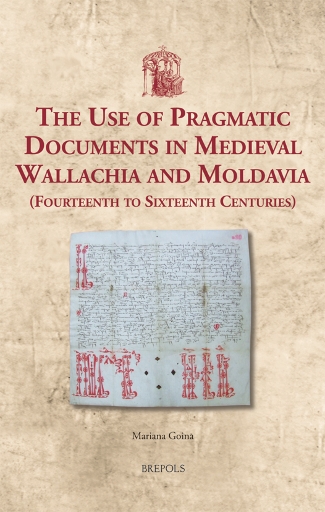
The Use of Pragmatic Documents in Medieval Wallachia and Moldavia (Fourteenth to Sixteenth Centuries)
show More to view fulltext, buy and share links for:The Use of Pragmatic Documents in Medieval Wallachia and Moldavia (Fourteenth to Sixteenth Centuries) show Less to hide fulltext, buy and share links for: The Use of Pragmatic Documents in Medieval Wallachia and Moldavia (Fourteenth to Sixteenth Centuries)In the region that was to become Moldavia and Wallachia, there are almost no traces of the use of writing for the millennium after the Roman Empire withdrew from Dacia. Written culture surfaces only by the second half of the fourteenth century, after the foundation of state institutions. This book surveys the earliest extant documents, their issuers, and the motives that triggered the development of documentary culture in Moldavia and Wallachia. By the fifteenth century, Moldavians were already accustomed to the use of charters. In Wallachia, noblemen also appealed to written records, but at that stage mainly in extraordinary circumstances. Women could not inherit land, and noblemen requested princely charters confirming a legal fiction that turned their daughters into sons. After the mid-sixteenth century, Wallachia experiences a steep growth in the number of charters issued. In this period of economic and social upheaval, charters proved an extraordinary means for the protection of landed property. Yet neither principality held secular archives - the storage of documents for later use in private hands suggests an early stage in the development of documentary culture.
By covering the ‘birth’ and spread of pragmatic literacy in medieval Moldavia and Wallachia, this book thus fills an important lacuna in what is known about the development of literacy in the later Middle Ages.
-