


Brepols
Brepols is an international academic publisher of works in the humanities, with a particular focus in history, archaeology, history of the arts, language and literature, and critical editions of source works.3181 - 3194 of 3194 results
-
-

Être bénédictin sous l’Ancien Régime
La congrégation de Saint-Maur (1618-1790)
show More to view fulltext, buy and share links for:Être bénédictin sous l’Ancien Régime show Less to hide fulltext, buy and share links for: Être bénédictin sous l’Ancien RégimeLa congrégation bénédictine de Saint-Maur est l’ultime réforme bénédictine en France sous l’Ancien Régime. Elle toucha cent quatre-vingt-dix monastères d’héritage médiéval qui furent pour la plupart reconstruits. Entre réforme catholique et Lumières, les mauristes firent de l’érudition historique et patristique un domaine de prédilection et d’expression à la fois intellectuelle et religieuse qui marqua profondément la reconstruction monastique du XIXe siècle.
-
-
-
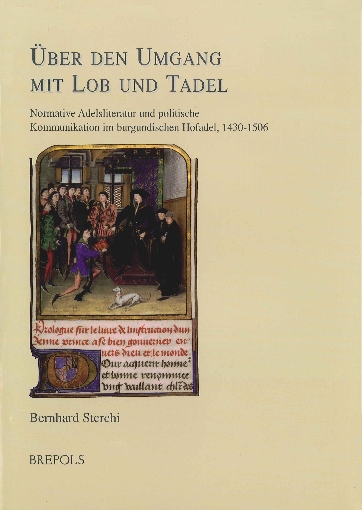
Über den Umgang mit Lob und Tadel
Normative Adelsliteratur und politische Kommunikation im burgundischen Hofadel, 1430-1506
show More to view fulltext, buy and share links for:Über den Umgang mit Lob und Tadel show Less to hide fulltext, buy and share links for: Über den Umgang mit Lob und TadelDer burgundische Hofadel des 15. Jahrhunderts kannte eine Vielzahl von Texten, die ihm von adligem Heldentum und Ruhm erzählten, ihm das Ungenügen der privilegierten Geburt vorhielten und ihn zu sittlicher Überlegenheit anspornten. Doch wie äußert sich die Wirksamkeit dieser normativen Adelsliteratur? Das vorliegende Buch verortet sie in einem bestimmten Teil des Leserverhaltens, nämlich in der persuasiven politischen Kommunikation. Diese These wird durch drei Argumente gestützt. Erstens enthält die normative Adelsliteratur nur selten konkrete Handlungsanweisungen. Vielmehr bietet sie eine Referenzordnung der Schlüsselbegriffe, Argumente, Autoritätenzitate und Anekdoten, mit deren Hilfe der Leser seine Werturteile bilden und begründen kann. Zweitens finden sich diese literarisch vermittelten Referenzwerte genau dort in der politischen Kornmunikation wieder, wo Werturteile vermittelt wurden. Dies war der Fall, wenn etwas legitimiert wurde, noch mehr aber, wenn das Ansehen von Personen gestaltet wurde. Gerade solche bewertende Kommunikationshandlungen waren drittens im burgundischen Hofadel in wesentlichen politischen und sozialen Feldern erfolgsrelevant.
Auf diese Weise gelingt ein anderer Blick auf das moralische Selbstverständnis des burgundischen Hofade1s. Die typischen Adelstraktate, die eigenen Versuche einzelner Adliger auf diesem Gebiet, das komplexe Verhältnis zur zeitgenössischen Chronistik, aber auch die politischen Verfahren im Orden vom Goldenen Vlies rücken ins Zentrum. Hier tritt der Adel im Umgang mit Wertvorstellungen und deren Zuschreibung zutage. Dieser Umgang mit Lob und Tadel- und dessen politische Relevanz - tragen zum Verständnis bei, weshalb der burgundische Hofadel seine normative Selbstvergewisserung mit solcher Hingabe inszenierte und weshalb er so streng auf moralische Konformität achtete.
-
-
-
Œuvres, 3
De archa Noe. Libellus de formatione arche
show More to view fulltext, buy and share links for:Œuvres, 3 show Less to hide fulltext, buy and share links for: Œuvres, 3Les deux oeuvres De archa Noe, Libellus de formatione archae, occupent une place singulière dans la production du maître de Saint-Victor. Ils forment d’abord une somme morale ou tropologique, tout comme le De sacramentis donnera une somme allégorique, et à ce titre livrent tous les thèmes porteurs de la spiritualité de Hugues. Ils sont ensuite comme au centre de sa carrière enseignante, mentionnant des traités déjà rédigés et en annonçant d’autres. La place de Hugues tant à Saint-Victor que dans le milieu des écoles parisiennes est déjà acquise et reconnue. Enfin nos écrits mettent en oeuvre des pédagogies visuelles qui lors d’entretiens réglés menés oralement, s’appuient sur un diagramme support des expositiones orales. La mise par écrit de ces conférences (qui donnera le De archa Noe) fut suivie de la rédaction de directives (qui seront le Libellus) par lesquelles un lecteur puisse reconstruire le diagramme que les auditeurs avaient eu sous les yeux.
-
-
-
‘Holy, Holier, Holiest’: The Sacred Topography of the Early Medieval Irish Church
show More to view fulltext, buy and share links for:‘Holy, Holier, Holiest’: The Sacred Topography of the Early Medieval Irish Church show Less to hide fulltext, buy and share links for: ‘Holy, Holier, Holiest’: The Sacred Topography of the Early Medieval Irish ChurchThis book explores the morphology of early medieval Irish religious settlement. It seeks to shift the focus of academic interest away from simply the materiality of settlement towards a greater concern for its possible theological significance. The critical literature is reviewed and the archaeological and literary evidence revisited in search of evidence for a consistent early medieval Irish schema for the layout of religious settlement.
This study suggests that the enclosure and zoning of religious space was primarily inspired by depictions of the Jerusalem Temple through the medium of a universally received scriptural ‘canon of planning’. The distinctive early Irish religious landscape is a result of the convergence of this Christian exemplar of ordered holy space with vernacular building forms. These building forms were shaped by the legacy of Ireland’s recent pagan past whose architectural leitmotif was the circular or sub-circular form, in contrast to the buildings described in Christian texts.
Some of the traditional assumptions about the possible heterodox nature of the ecclesiology of the early medieval Irish church are also challenged. Irish religious topography is set within the context of a universal Christian understanding of holy space which impacts upon the topography of religious settlement not just in Ireland but further afield in Anglo-Saxon England, Gaul and the Middle East. In this the book, like many other recent studies, challenges the presumption that there was a ‘Celtic church’ distinctive in its practices from the wider church, while documenting the local contribution to Christian architecture.
Rev. Canon Dr David Harold Jenkins is an Anglican clergyman. Presently he is a residentiary canon at Carlisle Cathedral and Director of Education for the Diocese of Carlisle.
-
-
-
‘Lest She Pollute the Sanctuary’
The Influence of the Protevangelium Iacobi on Women’s Status in Christianity
show More to view fulltext, buy and share links for:‘Lest She Pollute the Sanctuary’ show Less to hide fulltext, buy and share links for: ‘Lest She Pollute the Sanctuary’This work explores a second-century text, the Protevangelium Iacobi, and, by examining current scholarship on the subject, assesses the way it has influenced the Christian perception of women and the ordering of their lives through the centuries down to the present day. It demonstrates how Mary, as she is presented in this text with extreme and unreal emphasis on her purity, has been held up as an unattainable model for all Christian women and takes as a case study the lives of contemplative women in the Roman Catholic church, showing how the image of Mary impossibly secluded in the temple has been partly responsible for their enclosure. By exploring the way female biological processes have been allowed to intrude on the sacred, tracing this influence from the Old Testament, through this text and its connection with Mary to the present day, it argues that this has been a significant factor in the denial of presbyteral ordination to women in some Christian churches. One of the original features of this work is the tracing of art work depicting scenes from the text across the Christian world, thus demonstrating the breadth of its influence, right down to New Age writings today.
-
-
-
‘Madness’ in the Ancient World: Innate or Acquired?
From Theoretical Concepts to Daily Life
show More to view fulltext, buy and share links for:‘Madness’ in the Ancient World: Innate or Acquired? show Less to hide fulltext, buy and share links for: ‘Madness’ in the Ancient World: Innate or Acquired?This is the first book volume ever to study the ‘difficult’ subject of congenital, intellectual disability in the ancient world. The contributions cover the Ancient Near East, Egypt and the Graeco-Roman world, up to the late ancient period, China, the rabbinic tradition, Byzantium, the Islamic world, and the Middle Ages in the Latin West. The engaging and thought-provoking chapters combine careful textual analysis with attention to the material evidence and comparative perspectives, not the least those offered by disability history for recent periods in history.
-
-
-
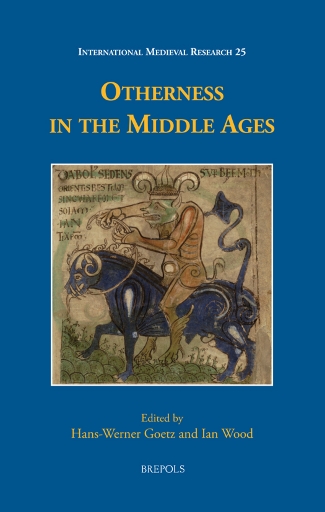
‘Otherness’ in the Middle Ages
show More to view fulltext, buy and share links for:‘Otherness’ in the Middle Ages show Less to hide fulltext, buy and share links for: ‘Otherness’ in the Middle AgesAlthough ‘Otherness’ is an extremely common phenomenon in every society, related research is still at its beginnings. ‘Otherness’ in the Middle Ages is a versatile and complex theme that covers a great number of different aspects, facets, and approaches: from non-human monsters and cultural strangers from remote places up to foreigners from another country or another town; it can refer to ethnic, cultural, political, social, sexual, or religious ‘Otherness’, inside or outside one’s own community. In any case, however, ‘Otherness’ is a subjective phenomenon depending on personal views and ascriptions, an issue of ‘imagination’ and experience rather than ‘reality’. There is neither one single model of alterity nor is ‘Otherness’ a stable phenomenon, but it changes over time and according to the cultural context. All this calls for methodological reflection and needs thorough investigation.
The methodological introduction and the 18 contributions of this volume demonstrate the great diversity of the theme and its different manifestations and perspectives. They tackle the problem from distinct angles and disciplines (history, art history, archaeology, literary history, and philology) in a wide chronological and thematic frame, using different methodological approaches, dealing with different areas (from Northern and Southern Europe to Byzantium and India), perspectives (including law, social order, the past, a sea), and diverse kinds of sources. They examine all kinds of ‘Otherness’ mentioned above, highlight demarcation and rejection, aversion or acceptance, assimilation and integration, thus relativizing a strict dichotomy between ‘the Self’ and ‘the Other’ or between inside and outside. This volume is so far the most comprehensive attempt to tackle the huge problem of ‘Otherness’ in the Middle Ages.
-
-
-
‘The Gods Have Faces’
The Biblical Epigrams and Short Poems of Hildebert of Lavardin
show More to view fulltext, buy and share links for:‘The Gods Have Faces’ show Less to hide fulltext, buy and share links for: ‘The Gods Have Faces’Hildebert of Lavardin is one of the great poets of the Middle Ages, praised for his elegant style by his contemporaries and by modern scholars alike. He occupies a seminal position in the revival of learning in the late Middle Ages known as the Twelfth Century Renaissance, and his mastery of classical Latin style was so refined that some of his works were long considered products of Antiquity. This collection of Hildebert's biblical epigrams and short poems introduces English-speaking readers to the best works of this neglected poet and places them in the context of his life and literary career. The translations attempt to bring the reader as close as possible to experiencing these poems in their original Latin while still being readable and comprehensible, facilitated by notes and commentary. Hildebert's poetry is sometimes challenging, dense and complicated, yet his rhetoric is often beautiful, even magnificent.
-
-
-
‘The loss of a minute, is just so much loss of life’
Edward Robinson and Eli Smith, Generators of Change in Holy Land
show More to view fulltext, buy and share links for:‘The loss of a minute, is just so much loss of life’ show Less to hide fulltext, buy and share links for: ‘The loss of a minute, is just so much loss of life’Perhaps no other Palestine / Holy Land explorer has received as much attention as Edward Robinson, the American philologist, theologian, and historical geographer responsible for laying the foundations for modern historic-geographical study of the Holy Land. Surprisingly, to date, almost no one has delved into Robinson’s archive to illuminate his Holy Land expeditions, the writing of his monumental Biblical Researches, and the compilation of his fine maps. Similarly, no one has conducted a detailed study of the archive of Eli Smith, American Board of Commissioners of Foreign Missions Beirut missionary and Robinson’s travel companion, for the same purposes. Fluent in Arabic and highly familiar with the region and its inhabitants, Smith’s contribution to the expedition and to the Biblical Researches was considerable as his archive reveals.
Investigating documents in both Robinson’s and Smith’s archives, the author of the present book became quickly convinced that much of the accepted narrative concerning Robinson's Holy Land studies should be re-evaluated and, consequently, rewritten. Several issues, for lack of relevant sources, have not yet been addressed by scholars. The story of Robinson and Smith’s expedition and writing of the Biblical Researches that emerges from their extensive correspondence underscores the difficulties they overcame, and the accuracy and magnitude of their scholarship in an age bereft of modern technology.
-
-
-
‘This Earthly Stage’
World and Stage in Late Medieval and Early Modern England
show More to view fulltext, buy and share links for:‘This Earthly Stage’ show Less to hide fulltext, buy and share links for: ‘This Earthly Stage’The thirteen essays collected in ‘This Earthly Stage’ explore intersections between the world as stage and the stage as world in late medieval and early modern England. The volume features studies of stages both familiar and unfamiliar, and worlds old and new - from the ritual performance of funerals for the fifteenth-century London elite to the electronic recreation of Shakespeare on the Internet. The essays engage with a variety of scholarly fields, including art and iconography, cultural and social history, digital humanities, literature, myth, philology, and philosophy. Most studies examine performative elements of Shakespeare’s works in relation to a representative selection of other plays from the dramatic genres in which he wrote, while they also analyse broader topics which traverse a number of plays, such as kingship and rites of civic performance in relation to stage drama. All of the essays consider the overarching issue of representation in late medieval and early modern English drama and culture through a range of theoretical approaches. This volume offers a valuable contribution to contemporary medieval and early modern scholarship, with a particular interest for those researching and teaching early modern English drama and culture.
-
-
-
‘With Our Backs to the Ocean’: Land, Lordship, Climate Change, and Environment in the North-West European Past
Essays in Memory of Alasdair Ross
show More to view fulltext, buy and share links for:‘With Our Backs to the Ocean’: Land, Lordship, Climate Change, and Environment in the North-West European Past show Less to hide fulltext, buy and share links for: ‘With Our Backs to the Ocean’: Land, Lordship, Climate Change, and Environment in the North-West European PastThis collection of ten essays celebrates the life and career of Dr Alasdair Ross, one of Britain’s foremost environmental historians, who died in 2017. Inspired by Ross’ own research interests, the chapters gathered here explore interlinked themes of land management and property rights, terrestrial and aquatic resource exploitation, mortality crises, and environmental change, viewed largely through the lens of the Scottish experience within the broader context of the eastern North Atlantic region and covering a chronology that spans from the sixth century ce up to the present. Including a previously unpublished paper by Ross himself, which overturns long-held perceptions of fiscal regimes in medieval Scotland, the contributors present radically revisionist or wholly new analyses of key documents and datasets, mostly through applying an interdisciplinary ‘environmental turn’ to primary record and narrative sources, or advancing new methodological approaches to systems analysis. From saintly interactions with nature to monastic exploitation of natural resources, charter records of land-ownership to the physicality of the landscapes recorded on parchment, and the human cost of subsistence and mortality crises, these papers humanize the discourse around historical climate and environmental change.
-
-
-
“Omnium Magistra Virtutum”
Studies in Honour of Danuta R. Shanzer
show More to view fulltext, buy and share links for:“Omnium Magistra Virtutum” show Less to hide fulltext, buy and share links for: “Omnium Magistra Virtutum”Danuta Shanzer is a scholar of international caliber, and this volume honors her career on the occasion of her sixtyfifth birthday (or thereabouts). Most of the contributors are current or former students, colleagues, collaborators and friends, from Oxford, Berkeley, Cornell, Illinois, the University of Vienna, and elsewhere. They have chosen topics appropriate in some way to the honoree’s scholarly interests. The volume’s center of gravity is in late antiquity and early medieval Gaul, but some contributions reach backwards to the Roman period or forward to the later Middle Ages. The contributions embrace a number of authors in whom Shanzer herself has been particularly interested (Augustine, Martianus Capella, Boethius, Avitus of Vienne, Gregory of Tours), but the range and variety of the volume is also representative of her approach to the field.
-
-
-
“The Letter Killeth”
Redeeming Time in Augustine’s Understanding of the Authority of Scripture
show More to view fulltext, buy and share links for:“The Letter Killeth” show Less to hide fulltext, buy and share links for: “The Letter Killeth”The experience of time is always momentous and stimulating to Augustine’s theological reflection. This book asserts that even Augustine’s concept of the authority of Scripture was embedded in his awareness of time. This “awareness” was rooted in the tension between the “already” and “not yet” of the “last days” that permeated the entire New Testament theological outlook.
This does not mean that it is reflections on time that is the determining feature of a particular complex debate, or the origin of a particular work in Augustine’s corpus. However, this work argues that “time” is a factor which need to be taken into greater account than scholarship heretofore has done. Accordingly, the author specifically delineates how Augustine’s experience of time as a living, ongoing and creative tension critically determined his theological stances towards scriptural authority.
The book shows how Augustine’s awareness of this temporal tension was roused by the acceptance of his own temporality and creaturehood which brings to the fore the importance of the incarnate Christ. Exploring how Augustine and his contemporaries grappled with the existential implications of this tension in time, this work asserts that the authority of Scripture is not the authority of “the Book” in the modern sense but is related to more complicated sources of authority that are linked to this specific notion of time.
-
-
-
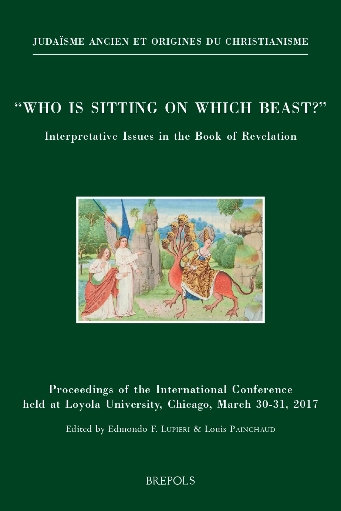
“Who is Sitting on Which Beast?” Interpretative Issues in the Book of Revelation
Proceedings of the International Conference held at Loyola University, Chicago, March 30-31, 2017
show More to view fulltext, buy and share links for:“Who is Sitting on Which Beast?” Interpretative Issues in the Book of Revelation show Less to hide fulltext, buy and share links for: “Who is Sitting on Which Beast?” Interpretative Issues in the Book of RevelationThe Revelation of Jesus Christ, better known as the Apocalypse of John, or simply the Book of Revelation, has always fascinated its readers, both religious and non-religious. Its transmission and reception in a Christian context have given rise to a wide variety of interpretations and controversies. At the heart of this revelation are the enigmatic figures of a pregnant woman appearing in heaven and then fleeing into the desert, a prostitute appearing in the desert and riding a beast, and then the bride of the Lamb, as well as a great city called Babylon, Sodom, and Egypt. Cities, beast, and prostitute are usually interpreted as thinly veiled references to Rome and its empire, and in particular to the emperor Nero.
However, this reading raises a number of interpretative problems concerning the relationship between these different female figures and their relation to the beast, which duplicates into a beast from the sea and a beast from the land, and concerning the city that lies beneath Babylon. Although they do not all share the exact same point of view on the Apocalypse of John and on the solutions to these interpretative problems, the contributions gathered in this volume all question the received ideas in one way or another. What they have in common is a regard for the Apocalypse of John as a text strongly rooted in the Judaism of its time, and they place great emphasis on interpreting the text through attention to its author’s use of the Jewish Scriptures.
-