


Brepols Online Books Medieval Miscellanea Collection 2011 - bob2011mime

Collection Contents
21 - 40 of 51 results
-
-
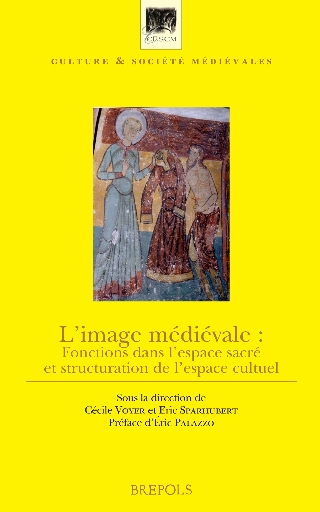
L’image médiévale: fonctions dans l’espace sacré et structuration de l’espace cultuel
show More to view fulltext, buy and share links for:L’image médiévale: fonctions dans l’espace sacré et structuration de l’espace cultuel show Less to hide fulltext, buy and share links for: L’image médiévale: fonctions dans l’espace sacré et structuration de l’espace cultuelCet ouvrage rassemble les travaux de chercheurs réunis autour du groupe IMAGO sur L’image médiévale: fonctions dans l’espace sacré et structuration de l’espace cultuel (CÉSCM). L’approche de l’image médiévale s’est considérablement enrichie ces dernières décennies suscitant de nouveaux enjeux méthodologiques. Les travaux qui lui ont été consacrés ont, en effet, montré que l’image médiévale était un objet complexe, polysémique, nouant des liens étroits avec son lieu d’inscription. S’interroger sur la définition et le fonctionnement du lieu cultuel revient à poser les bases et les cadres de l’analyse des images. La réflexion sur l’espace ecclésial permet de cerner la dialectique entre le monument – construit – et le lieu – institué symboliquement – pour mieux en comprendre l’organisation. En appréhendant l’image dans son contexte, il est alors possible de saisir les usages et les pratiques qui lui sont associés. Au-delà de l’approche iconographique, l’attention portée à la construction de l’image, à sa composition et à sa structure permet d’ouvrir de multiples champs d’investigations. Les contributions réunies dans ce recueil sont autant de regards croisés qui illustrent la diversité des approches et la richesse des problématiques liées à l’image. Ces réflexions s’inscrivent dans le cadre des activités du groupe IMAGO (CÉSCM, Poitiers) qui, depuis 1999, rassemblent dans une dynamique commune étudiants, jeunes chercheurs et chercheurs dont les recherches sont consacrées aux images médiévales.
-
-
-
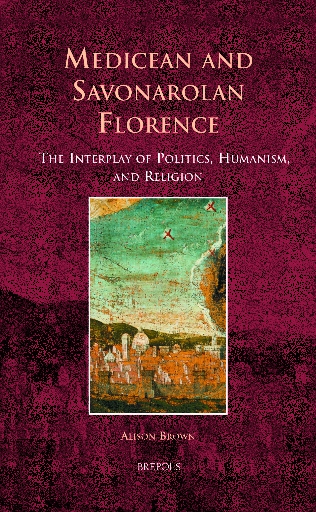
Medicean and Savonarolan Florence
show More to view fulltext, buy and share links for:Medicean and Savonarolan Florence show Less to hide fulltext, buy and share links for: Medicean and Savonarolan FlorenceThis volume examines Florentine society at crucial moments of change that are often treated separately in historical narratives: the later years of Medici government under the aegis of Lorenzo the Magnificent, the four tumultuous years of Savonarola’s religious regime from 1494 to 1498, and the unsettled early decades of the sixteenth century. Drawing upon original research conducted during the past decade, it provides important insights into the politics and conflicting ideologies in the city as experienced by different levels of society, not only by the politicians, preachers, and intellectuals whose voices are more familiar to us, but also by women and lower-class citizens. Since no single paradigm is adequate to describe these years of flux, this volume attempts to reassess the period by uncovering the debate underlying nearly all the topics it discusses. In this way, it offers a new and multifocused approach to the study of this important and influential period in Florentine history.
-
-
-
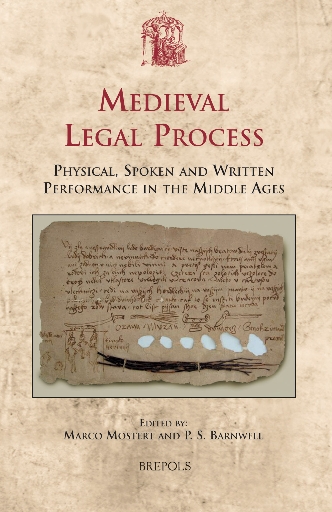
Medieval Legal Process
show More to view fulltext, buy and share links for:Medieval Legal Process show Less to hide fulltext, buy and share links for: Medieval Legal ProcessIn medieval legal transactions the use of the written word was only one of many ways of conducting business. Important roles were played by the spoken word and by the ‘action’ of ritual. The relationship between ‘rituals’ and literacy has been the focus of much recent research. Medieval societies which made extensive use of written instruments in legal transactions have been shown to employ rituals as well. This has led to investigation of the respective functions of written instruments and legal rituals. What is the nature of legal rituals? If they included oral verbalization, how did the spoken words relate to those of the written instruments that played a role in the same legal transactions? Usually, we only have the written documents to answer these questions, and they are often silent about the rituals and oral elements of the transactions they document. Furthermore, the importance attached to written instruments and rituals may not have been the same at all levels of a society, differing, for example, between princely and local courts. The contributors to this volume discuss fifteen cases, ranging from the early Middle Ages to the eighteenth century, and from England to Galician Rus’.
-
-
-
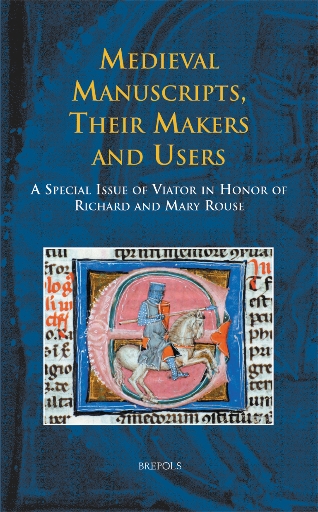
Medieval Manuscripts, Their Makers and Users
show More to view fulltext, buy and share links for:Medieval Manuscripts, Their Makers and Users show Less to hide fulltext, buy and share links for: Medieval Manuscripts, Their Makers and UsersThe essays in this collection pertain to art history, medieval Latin culture both ecclesiastic and legal, the history of vernacular literatures, and the devotional practices of the laity. They reflect the patronage of authors and manuscript painters, from the royal through the monastic to the urban middle class, and they trace the sometimes astonishing afterlife of manuscripts. The subject matter of these studies ranges chronologically from late antiquity to the later Middle Ages, adding the emergent medievalism of the eighteenth and nineteenth centuries. Its geographic breadth extends through the major Western cultures and literatures, from England to Italy, Germany, and France. Its wide range in time and space reflects the lifetime of manuscript research, teaching, and collecting by its honorees, Richard and Mary Rouse.
A particular emphasis distinguishes this volume from other such collections: its stress on the use, and usefulness, of medieval manuscripts in the teaching of most historical disciplines in Western culture, from the broad undergraduate survey (of art, literature, history) to the specialized graduate seminar. In the last half century, public colleges and universities have increasingly appreciated the pedagogical opportunities inherent in building, through gift and purchase, collections of medieval manuscripts, formerly thought to be the province only of wealthy private schools. No similar collection of manuscript studies exhibits so clearly the role of medieval manuscripts in teaching.
The specialist authors represented in this volume have displayed, over the whole of their careers, an ability to combine the highest caliber of research with an eagerness to make their subject accessible to others through teaching and writing and public lectures. The essays offer the results of new and sometimes technical research, set forth in a manner intelligible not only to the expert but to the interested amateur.
-
-
-
Meditations of the Heart: The Psalms in Early Christian Thought and Practice
show More to view fulltext, buy and share links for:Meditations of the Heart: The Psalms in Early Christian Thought and Practice show Less to hide fulltext, buy and share links for: Meditations of the Heart: The Psalms in Early Christian Thought and PracticeThe Psalms are one of the most important biblical texts in Patristic exegesis, commentary, preaching, liturgical practice and theological reflection. Their language and imagery is all-pervasive; they were not only interpreted by the fathers but a good deal of Patristic exegetical practice actually evolved from engagement with them; they directly informed Christological and Ecclesiological reflection; were central to early monasticism; inspired early Christian poetry and provided material for liturgical chant, prayers, hymns and penitential or doxological expression. This volume of essays on the Psalms in Early Christian Thought and Practice is offered with profound gratitude, admiration and respect by colleagues and friends of Professor Andrew Louth FBA, to honour his long and immensely distinguished career as priest, teacher and prolific author in almost every aspect of Greek and Latin Patristics.
-
-
-
Mots médiévaux offerts à Ruedi Imbach
show More to view fulltext, buy and share links for:Mots médiévaux offerts à Ruedi Imbach show Less to hide fulltext, buy and share links for: Mots médiévaux offerts à Ruedi ImbachCes Mots médiévaux offerts à Ruedi Imbach rendent un hommage dans les formes du lexique historique et historiographique. Plutôt que de brosser le portrait d' un professeur et d' un chercheur, ils présentent une image de son monde intellectuel et des intérêts des spécialistes qui travaillent le même champ disciplinaire que lui, la philosophie et l' histoire de la philosophie médiévale en particulier. Le lecteur circule librement à travers soixante-dix études courtes consacrées à des notions négligées, marginales ou encore mal définies de la culture médiévale; il accomplit aussi quelques excursions de l' Antiquité à la Modernité, à travers les aléas de l 'histoire de la transmission des doctrines philosophiques.
Le volume comprend des contributions de: Jan A. Aertsen, Etienne Anheim, Henryk Anzulewicz, Iñigo Atucha, Alessandra Beccarisi, Luca Bianchi, Joël Biard, Magdalena Bieniak, Serge-Thomas Bonino, Bruno-Marie Borde, Jean-Baptiste Brenet, Olivier Boulnois, Alain Boureau, Charles Burnett, Philippe Büttgen, Dragos Calma, Monica Calma, Stefano Caroti, Delphine Carron, Julie Casteigt, Laurent Cesalli, Stephen Chung, Emanuele Coccia, Valérie Cordonier, Iacopo Costa, Fernando Domínquez Reboiras, Gianfranco Fioravanti, Kurt Flasch, Frédéric Gabriel, Christophe Grellard, Barbara Hallensleben, Maarten J.F.M. Hoenen, Tobias Hoffmann, mary E. Ingham, Isabel Iribarren, Zénon Kaluza, Theo Kobusch, Catherine König-Pralong, Alfonso Maierù, John Marenbon, Jean-Luc Marion, Burkhart Mojsisch, Adriano Oliva, Dominic O' Meara, Gianfranco Pellegrino, Dominik Perler, Sylvain Piron, Dominique Poirel, Olaf Pluta, Pasquale Porro, François-Xavier Putallaz, Francis Python, Fiorella Retucci, Thomas Ricklin, Aurélien Robert, Andrea Robiglio, Anne-Sophie Robin, Irène Rosier-Catach, Jacob Schmutz, Peter Schulthess, Philibert Secrétan, Andreas Speer, Loris Sturlese, Tiziana Suarez-Nani, Christian Trottmann, Luisa Valente, Anca Vasiliu, Guido Vergauwen, Ubaldo Villani-Lubelli, Peter von Moos, Olga Weijers, Irene Zavattero.
-
-
-

Normandy and its Neighbours, 900—1250
show More to view fulltext, buy and share links for:Normandy and its Neighbours, 900—1250 show Less to hide fulltext, buy and share links for: Normandy and its Neighbours, 900—1250One of the most important aspects of David Bates’s distinguished career has been his readiness to engage — as few of his predecessors did — with the world of modern French scholarship. The outcome of this engagement and of his familiarity with French archives has been the reshaping of our understanding of the Anglo-Norman realm founded by William the Conqueror. The Norman Conquest has always been seen as a defining event in medieval English history, and David’s work has enabled us to place it in its broader European context. He has also welcomed insights from other disciplines, including archaeology, architectural history, and numismatics. His impact as a scholar has been profound. His writings have made academic debate accessible to the general public and the scholar alike, and he has conveyed his enthusiasm and commitment to both. He has brought together a generation of academics of various nationalities and from a broad range of disciplines to forge a new understanding of the relationship of England and Normandy in the central Middle Ages. This collection — offered in recognition of his contribution — acknowledges the many strands of his scholarship. It brings together specialist studies of Anglo-French culture, law, gender, and historiography.
-
-
-
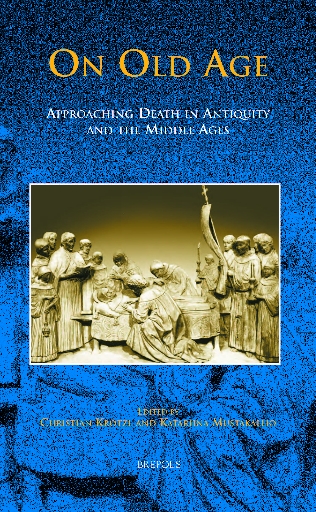
On Old Age
show More to view fulltext, buy and share links for:On Old Age show Less to hide fulltext, buy and share links for: On Old AgeRecent research into old age and dying in the premodern world has examined not only the demographic aspects of ageing populations but also the social role of aged people. Nonetheless, there has usually been a neglect of the end of life and attitudes towards death and memory. These topics have seldom been discussed in the same volume. The end of life evokes questions. What does it mean to grow old? What happens when one dies? How does one cope with old age and death? These questions were as relevant for individuals and societies in earlier periods as they are in the present. The aim of this collection of articles is to cross the boundaries that have traditionally isolated different time periods and scholarly disciplines from each other. The volume focuses on aging, old age, and death from Classical Antiquity to the Middle Ages. The purpose of this book is to approach these themes from an interdisciplinary point of view in the longue durée. Instead of concentrating solely on demographic issues it takes a much broader view, considering attitudes towards ageing, dying, death, and memory. The volume, with its diverse topics, cuts across traditional scholarly barriers and will provide valuable analytical tools for further studies on the subject.
-
-
-
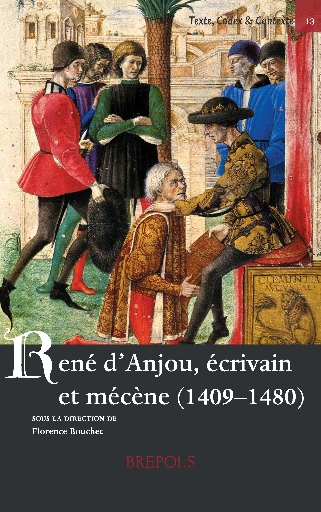
René d’Anjou, écrivain et mécène (1409-1480)
show More to view fulltext, buy and share links for:René d’Anjou, écrivain et mécène (1409-1480) show Less to hide fulltext, buy and share links for: René d’Anjou, écrivain et mécène (1409-1480)À l’occasion du 6e centenaire de la naissance de René, duc d’Anjou et comte de Provence, ce volume pluridisciplinaire propose des perspectives nouvelles sur l’action d’un prince qui, malgré ses déboires politiques, fut un écrivain subtil et un mécène curieux de tous les arts. Sont abordés l’œuvre littéraire de René d’Anjou (Livre du Cœur d’amour épris, Mortifiement de vaine plaisance, Traité et devis de la forme d’un tournoi), mais aussi sa bibliothèque, sa politique culturelle, les écrivains et artistes à son service, les spectacles curiaux, reflet de goûts littéraires et de l’imaginaire de la fin du Moyen Âge. La personnalité du prince apparaît particulièrement riche de sens, en ce qu’il se situe au carrefour de la féodalité (dont il fut l’un des derniers grands représentants, à une époque où s’affirmait le pouvoir royal) et de l’humanisme (dont René eut un avant-goût par les liens qui l’attachaient à l’Italie).
-
-
-
Resonances
show More to view fulltext, buy and share links for:Resonances show Less to hide fulltext, buy and share links for: ResonancesContinuity and change enclose a problem field that is fundamental to the interpretation of historical material. On the one hand the notions that are necessary to perceive the historical account as a narrative: continuity, tradition, constancy, consistency, identity; on the other those that provide an impetus or drive to that account: change, innovation, rupture, or discontinuity.
Resonances: Historical Essays on Continuity and Change explores the historiographical question of the modes of interrelation between these motifs in historical narratives. The essays in the collection attempt to realize theoretical consciousness through historical narrative ‘in practice’, by discussing selected historical topics from Western cultural history, within the disciplines of history, literature, visual arts, musicology, archaeology, philosophy, and theology.
The title Resonances indicates the overall perspective of the book: how connotations of past meanings may resonate through time, in new contexts, assuming new meanings without surrendering the old.
-
-
-

Scale and Scale Change in the Early Middle Ages
show More to view fulltext, buy and share links for:Scale and Scale Change in the Early Middle Ages show Less to hide fulltext, buy and share links for: Scale and Scale Change in the Early Middle AgesKings, aristocrats, peasants, and the Church are among the shared features of most early medieval societies. However, these also varied dramatically in time and space. Can petty regional kings, for instance, be compared to those in charge of a whole empire? Scale is a crucial factor in modelling, explaining, and conceptualizing the past. Furthermore, many issues that historians and archaeologists treat independently can be theorized together as processes of scale decrease or increase: the appearance of complex societies, the rise and collapse of empires, changing world-systems, and globalization. While a subject of much discussion in fields such as ecology, geography, and sociology, scale is rarely theorized by archaeologists and historians. This book highlights the potential of the concepts of scale and scale change for comparing and explaining medieval socio-spatial processes. It integrates regional and temporal variations in the fragmentation of the Roman world and the emergence of medieval polities, which are often handled separately by late antique and early medieval specialists. The result of a three-year research project, the nine case studies in this volume offer fresh insights into early medieval rural society while combining their individual subjects to generate a wider explanatory framework.
-
-
-
Settlement and Lordship in Viking and Early Medieval Scandinavia
show More to view fulltext, buy and share links for:Settlement and Lordship in Viking and Early Medieval Scandinavia show Less to hide fulltext, buy and share links for: Settlement and Lordship in Viking and Early Medieval ScandinaviaThis volume aims to define the changing nature of lordship in Viking and early medieval Scandinavia. Advances in settlement archaeology and cultural geography have revealed new aspects of social power in Viking Age and early medieval Scandinavia. The organization of settlement is increasingly well understood and gives evidence of strong social differentiation in rural settlement. Historical research, however, increasingly portrays these societies as characterized by elementary social networks at a personal level rather than at the level of formal institutions. Can these representations be reconciled? When did the possession of land, in the form of manors or large demesne farms, become an important source of power and authority? This question has generated intense debate internationally in recent years, but there is no comprehensive overview for Scandinavia. New sources and approaches allow us to question the traditional view that Scandinavian aristocrats developed from Viking raiders into Christian landlords. Seventeen thematic chapters by leading scholars survey and assess the state of research and provide a new baseline for interdisciplinary discussions. How were social ties structured? How did lordship and dependency materialize in modes of agriculture, settlement, landscape, and monuments? The book traces the power of tributary relations, forged through personal ties, gifts, duties, and feasting in great halls, and their gradual transformation into the feudal bonds of levies and land-rent.
-
-
-
The Easter Controversy of Late Antiquity and the Early Middle Ages. Its Manuscripts, Texts, and Tables
show More to view fulltext, buy and share links for:The Easter Controversy of Late Antiquity and the Early Middle Ages. Its Manuscripts, Texts, and Tables show Less to hide fulltext, buy and share links for: The Easter Controversy of Late Antiquity and the Early Middle Ages. Its Manuscripts, Texts, and Tables2010 saw the publication of the Proceedings of the 1st International Conference on the Science of Computus in Ireland and Europe, which took place in Galway, 14–16 July, 2006. That first collection, which had the sub-title Computus and its Cultural Context in the Latin West, AD 300–1200, brought together papers by ten of the leading scholars in the field, on subjects ranging from the origins of the Annus Domini to the study of computus in Ireland c. 1100. All those who participated in the Conference were unanimous that a second, follow-up event should be organized, and that duly took place (also in Galway), 18–20 July, 2008. The proceedings of that Conference are published in this current volume. The topics covered in the 2nd Galway Conference ranged from the general – but vitally important – vocabulary of computus (i.e., the technical terminology developed by computists to describe what they were doing) to the origins of the different systems used to calculate the date of Easter in Antiquity and the Early Middle Ages. In addition, there was discussion also of the great debates about Easter, epitomized by the famous Synod of Whitby in AD 664, and the role of well-known individuals in the evolution of computistical knowledge (e.g., Anatolius of Laodicea, the African Augustalis, Sulpicius Severus, Victorius of Aquitaine, Cassiodorus, Dionysius Exiguus, Willibrord, the ninth-century Irish scholar-exile, Dicuil, as well as the late-tenth century Abbo of Fleury). Immo Warntjes is lecturer in Medieval History at the University of Greifswald (Germany). Besides computistics, his main areas of research include the use of languages in Early Medieval Europe, succession to high offices, high and late medieval burial practices, and German, English, and Irish political history and culture. Dáibhí Ó Cróinín lectures in history at NUI, Galway, where he is the Director of The Foundations of Irish Culture project. His research interests are Ireland, Britain and Europe during the Early Middle Ages, computistics, Medieval Latin Palaeography and Irish traditional music and song.
-
-
-
The Regular Canons in the Medieval British Isles
show More to view fulltext, buy and share links for:The Regular Canons in the Medieval British Isles show Less to hide fulltext, buy and share links for: The Regular Canons in the Medieval British IslesOf all the new monastic and religious groups to settle in the British Isles in the course of the twelfth century the regular canons were the most prolific. At the heart of their existence was the vita apostolica, but even more than other such groups the regular canons became involved in active spiritual care of their communities. Perhaps as a result of this feature they also enjoyed sustained support from founders, patrons, and benefactors, and new foundations continued to be made long after the main force of the expansion of the monastic orders had declined. This interdisciplinary volume brings together scholars from Scotland, Ireland, Wales, and England who work on aspects of the history, culture, art history, and archaeology of the regular canons in the medieval British Isles. Between them, the chapters of this book consider the regular canons in their wider historical and historiographical context, assessing their role in the religious, social, cultural, economic, and political world of the medieval British Isles, and introducing new and recent research on this important religious group.
Medieval Church Studies is a series of monographs and, sometimes, collections devoted to the history of the Western Church from, approximately, the Carolingian reform to the Council of Trent. It builds on Brepols’ longstanding interest in editions of texts and primary sources, and presents studies that are founded on a traditional close analysis of primary sources but which confront current research issues and adopt contemporary methodological approaches.
-
-
-
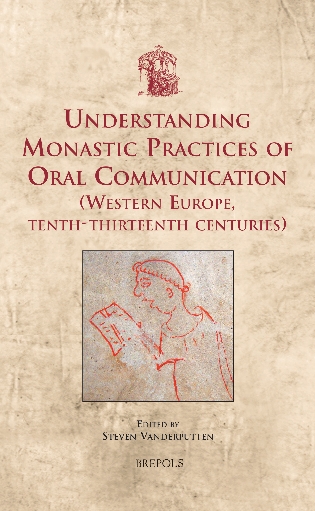
Understanding Monastic Practices of Oral Communication
show More to view fulltext, buy and share links for:Understanding Monastic Practices of Oral Communication show Less to hide fulltext, buy and share links for: Understanding Monastic Practices of Oral CommunicationAlthough traditionally defined as a literate environment, Western monastic culture depended on a range of communicative practices which was just as large, and in some ways more sophisticated in its diversity, than that of other groups of society. Monks and nuns exchanged considerable amounts of information for which no written media were deemed necessary or which did not make a complete or immediate transition into written sources. Grouped in five thematic chapters, the papers in this volume aim to provide inroads into a useable interpretation of the various contexts in which monks and nuns in the central Middle Ages considered the spoken word as a vital complementary medium to other forms of communication.
-
-
-

Vernacularity in England and Wales, c. 1300-1550
show More to view fulltext, buy and share links for:Vernacularity in England and Wales, c. 1300-1550 show Less to hide fulltext, buy and share links for: Vernacularity in England and Wales, c. 1300-1550Studies of the vernacular in the period 1300-1550 have tended to focus exclusively upon language, to the exception of the wider vernacular culture within which this was located. In a period when the status of English and ideas of Englishness were transforming in response to a variety of social, political, cultural and economic factors, the changing nature and perception of the vernacular deserves to be explored comprehensively and in detail. Vernacularity in England and Wales examines the vernacular in and across literature, art, and architecture to reach a more inclusive understanding of the nature of late medieval vernacularity.
The essays in this collection draw upon a wide range of source material, including buildings, devotional and educational literature, and parliamentary and civic records, in order to expand and elaborate our idea of the vernacular. Each contributor addresses central ideas about the nature and identity of the vernacular and how we appraise it, involving questions about nationhood, popularity, the commonalty, and the conflict and conjunction of the vernacular with the non-vernacular. These notions of vernacularity are situated within studies of reading practices, heresy, translation, gentry identity, seditious speech, and language politics. By considering the nature of vernacularity, these essays explore whether it is possible to perceive a common theory of vernacular use and practice at this time.
-
-
-
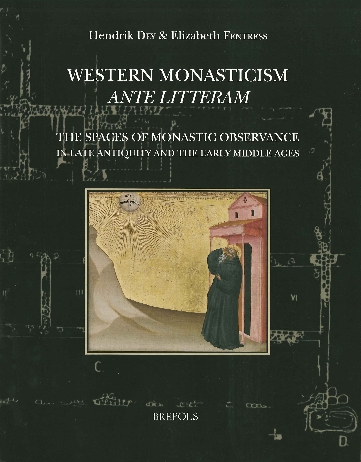
Western Monasticism ante litteram
show More to view fulltext, buy and share links for:Western Monasticism ante litteram show Less to hide fulltext, buy and share links for: Western Monasticism ante litteramSpace has always played a crucial part in defining the place that monks and nuns occupy in the world. Even during the first centuries of the monastic phenomenon, when the possible varieties of monastic practice were nearly infinite, there was a common thread in the need to differentiate the monk from the rest: whatever else they were supposed to be, monks were beings apart, unique, in some sense separate from the mainstream. The physical contours of monastic topographies, natural and constructed, are thus fundamental to an understanding of how early monks went about defining the parameters of their everyday lives, their modes of religious observance, and their interactions with the larger world around them. The group of eminent historians and archaeologists present at the American Academy in Rome in March, 2007 for the conference ‘Western monasticism ante litteram. The spaces of early monastic observance’, whose contributions comprise the bulk of this volume, have sought to reconsider the theory, the practice and above all the spaces of early monasticism in the West, in the hope of creating a more complete picture of that seminal period, from the fourth century until the ninth, when notions of what it meant to be a monk were as numerous as they were varied and (often) conflicting.
-
-
-
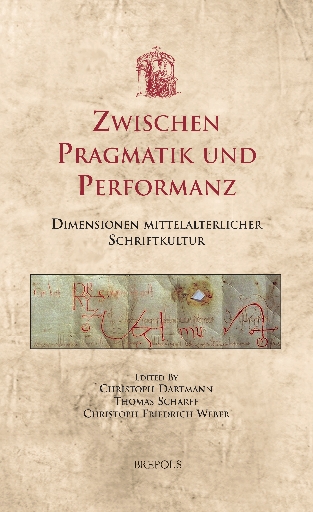
Zwischen Pragmatik und Performanz
show More to view fulltext, buy and share links for:Zwischen Pragmatik und Performanz show Less to hide fulltext, buy and share links for: Zwischen Pragmatik und PerformanzResearch on the practices and impacts of literacy has revolutionized the study of medieval history and culture. After initially having focused on investigating the modernising aspects of the development of literacy during the Middle Ages, the discussion now involves a large variety of topics, such as the performance of writing and reading, the use of the written word in political ritual and, on a general level, the ‘otherness’ of medieval communication. The volume presents essays dealing with a wide range of social and political uses of the written word during the Middle Ages, from the Carolingian era to late medieval Italy, Switzerland, Germany and Burgundy. It presents a panorama of the current state of the research and also offers new insights into the current conceptual debates about the history of communication in premodern Europe.
-
-
-
Échanges, communications et réseaux dans le Haut Moyen Âge
show More to view fulltext, buy and share links for:Échanges, communications et réseaux dans le Haut Moyen Âge show Less to hide fulltext, buy and share links for: Échanges, communications et réseaux dans le Haut Moyen ÂgeStéphane Lebecq a pris sa retraite en juin 2009. Pour lui rendre hommage, ses amis et collègues ont voulu faire écho à ses travaux sur le haut Moyen Âge en s’inspirant de ses domaines de recherche. Si la majorité des seize contributions de ce volume se situe dans l’Europe du Nord-Ouest, aire géographique d’élection de son travail scientifique, plusieurs étendent ses questionnements à des parties méridionales de l’Occident, voire à l’Orient byzantin. On peut répartir l’ensemble en deux grands volets qui rejoignent les thèmes de prédilection de Stéphane Lebecq. Le premier est la mer, envisagée comme un milieu de vie ou comme le cadre d’échanges à travers la navigation, singulièrement la navigation commerciale. Le second s’attache aux personnes qui animent ces échanges et entretiennent ainsi des réseaux fondant leur pouvoir : puissants de tous ordres, ambassadeurs, missionnaires.
-
-
-

Agrosystems and Labour Relations in European Rural Societies
show More to view fulltext, buy and share links for:Agrosystems and Labour Relations in European Rural Societies show Less to hide fulltext, buy and share links for: Agrosystems and Labour Relations in European Rural SocietiesIt goes without saying that agriculture is a form of colonisation of nature by society. In the course of history the articulation of natural and societal features gave rise to a wide variety of agrosystems within the boundaries of Europe which were embedded in supra-regional political and economic contexts at least from the High Middle Ages onwards. By following an integrative approach, this volume defines agrosystems as production systems based on the ecological and socioeconomic relations involved in the reproduction of rural societies at multiple levels. The authors explore the articulation of natural and societal factors through the prism of labour relations. The structural and practical organization of labour is seen as the crucial link between rural production and reproduction. Accordingly, the contributions focus on the rural household as the basic unit of production and reproduction in different temporal and spatial contexts. Therefore, the question arises if the changes in ecosystems and social systems have so fundamentally altered European agriculture up to now that peasant family farming will disappear (if it is no longer sustained by state intervention).
-