


Giornale storico della letteratura italiana
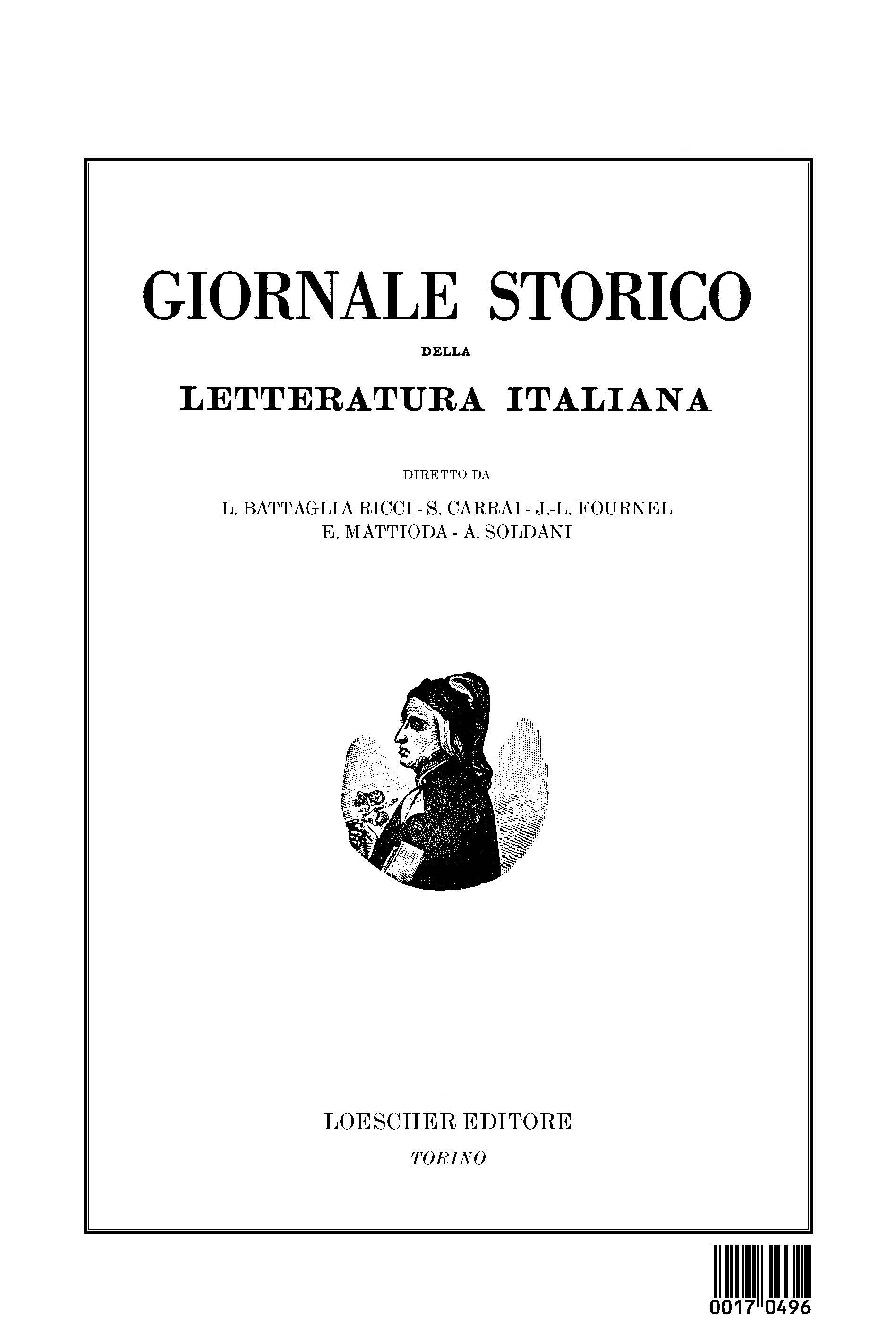
Volume 200, Issue 672, 2023
-
-
Le «liete e preste cortesie» di messer Torello e Adalieta (‘Decameron’ X 9)
show More to view fulltext, buy and share links for:Le «liete e preste cortesie» di messer Torello e Adalieta (‘Decameron’ X 9) show Less to hide fulltext, buy and share links for: Le «liete e preste cortesie» di messer Torello e Adalieta (‘Decameron’ X 9)By: Roberto GalbiatiAbstractThis article analyses the penultimate novella in the Decameron (the story of Saladin and Messer Torello), showing how the main theme is the noble and courteous behaviour displayed by Torello and his wife Adalieta. The tale marks the culmination of Boccaccio’s reflections on courteous behaviour, present throughout the work. For him, courtesy is the modern virtue that most closely resembles Seneca’s beneficium, and it emerges not so much in love as in everyday life, e.g. in Cisti the baker’s noble gesture and in the generous hospitality that the couple from Lombardy show to the foreigner. Boccaccio takes leave of his readers proposing an exemplary couple and a model of behaviour well within their reach.
-
-
-
Il carteggio inedito Mussafia-Novati (1886-1902) tra erudizione e filologia
show More to view fulltext, buy and share links for:Il carteggio inedito Mussafia-Novati (1886-1902) tra erudizione e filologia show Less to hide fulltext, buy and share links for: Il carteggio inedito Mussafia-Novati (1886-1902) tra erudizione e filologiaBy: Davide ColomboAbstractBetween the second half of the 19th century and the early 20th century, the Dalmatian philologist Adolfo Mussafia represented an essential bridge between the new German Wissenschaft movement and the Italian cultural and academic spheres. This article publishes and contextualizes for the first time the ten letters and three postcards that he sent to Francesco Novati, cofounder of the Giornale storico della letteratura italiana (Milan, Biblioteca nazionale Braidense, Novati correspondence; Milan, Biblioteca della Società Storica Lombarda, Novati file) and Novati’s replies (nine letters and one postcard) (Florence, Biblioteca Umanistica dell’Università degli Studi, Mussafia file). An analysis of this unpublished correspondence makes it possible to add further (and at times surprising) details to the biographies of these two scholars and their scholarly endeavours, as well as to shed further light on European political and intellectual life at the turn of the century.
-
- Varietà
-
-
-
Un nuovo volgarizzamento dei Disticha Catonis (Paris, Bibliothèque nationale de France, it. 557)
show More to view fulltext, buy and share links for:Un nuovo volgarizzamento dei Disticha Catonis (Paris, Bibliothèque nationale de France, it. 557) show Less to hide fulltext, buy and share links for: Un nuovo volgarizzamento dei Disticha Catonis (Paris, Bibliothèque nationale de France, it. 557)By: Paolo DiviziaAbstractThe manuscript Paris, Bibliothèque nationale de France, it. 557 is an interesting 15th-century miscellany that has been the subject of a number of significant structural philological studies. However, the final section of the manuscript contains a vernacular edition of Disticha Catonis [The Distichs of Cato], most likely of Florentine origins, which to date has been overlooked by scholars, apart from some references in Tommaseo-Bellini’s dictionary citations, whose exact sources remain unclear. The article complements yet another study which I have conducted on the manuscript and offers an analysis and a critical edition of the vernacular work
-
-
-
-
Onomastica manzoniana: don Rodrigo
show More to view fulltext, buy and share links for:Onomastica manzoniana: don Rodrigo show Less to hide fulltext, buy and share links for: Onomastica manzoniana: don RodrigoAbstractNumerous studies have dealt with onomastics in Promessi sposi [The Betrothed], but little attention has been dedicated to the name of Don Rodrigo. The only literary precedent that has thus far been considered is Don Rodrigue in Corneille’s Le Cid. However, there are other figures in literature who bear this same name. This article focuses in particular on Giambattista Fagiuoli’s rendering of Machiavelli’s Favola in a short poem in tercets, in which the name Belfagor in the original is replaced by Rodrigo/Don Rodrigo.
-
-
-
Nell’orecchio di chi le ascolta. Leopardi e Tommaseo di fronte al canto popolare femminile
show More to view fulltext, buy and share links for:Nell’orecchio di chi le ascolta. Leopardi e Tommaseo di fronte al canto popolare femminile show Less to hide fulltext, buy and share links for: Nell’orecchio di chi le ascolta. Leopardi e Tommaseo di fronte al canto popolare femminileAbstractThis article compares the ways in which Tommaseo and Leopardi considered folk traditions, in particular the specific case of female weavers’ songs and poems. Though stemming from different premises and aimed at equally unrelated endeavours, the attention that they both paid to the daily rhythms of the community transformed into poetry, represents a strong junction point between two parallel literary experiences.
-
- Note e discussioni
-
-
-
Biografia, filologia e storia delle idee. Intorno a un libro su Aldo Manuzio
show More to view fulltext, buy and share links for:Biografia, filologia e storia delle idee. Intorno a un libro su Aldo Manuzio show Less to hide fulltext, buy and share links for: Biografia, filologia e storia delle idee. Intorno a un libro su Aldo ManuzioBy: Roberto Norbedo
-
-
-
-
Bollettino biliografico
show More to view fulltext, buy and share links for:Bollettino biliografico show Less to hide fulltext, buy and share links for: Bollettino biliograficoAbstractNiccolò Machiavelli, Lettere, a cura di Francesco Bausi et alii (Jean-Louis Fournel), p. 622 – Gabriele Bucchi, Il grido del pavone. Alessandro Tassoni tra fascinazione eroica e demistificazione scettica. (Luca Ferraro), p. 625.
-
-
-
Annunzi
show More to view fulltext, buy and share links for:Annunzi show Less to hide fulltext, buy and share links for: AnnunziAuthors: Maria Luisa Doglio, Roberto Galbiati and Enrico MattiodaAbstractSi parla di: Dante. – L. B. Alberti. – F. Baricci. – «Schede Umanistiche /Antichi e Moderni». – M. Capriotti. – F. Galiani. – E. Bufacchi
-
-
-
Back Matter (“Abstracts”, “Indice alfabetico delle Rassegne, del Bollettino e degli Annunzi”, “Indice delle materie”)
show More to view fulltext, buy and share links for:Back Matter (“Abstracts”, “Indice alfabetico delle Rassegne, del Bollettino e degli Annunzi”, “Indice delle materie”) show Less to hide fulltext, buy and share links for: Back Matter (“Abstracts”, “Indice alfabetico delle Rassegne, del Bollettino e degli Annunzi”, “Indice delle materie”)
-
Volumes & issues
Most Read This Month
