


Liber Annuus
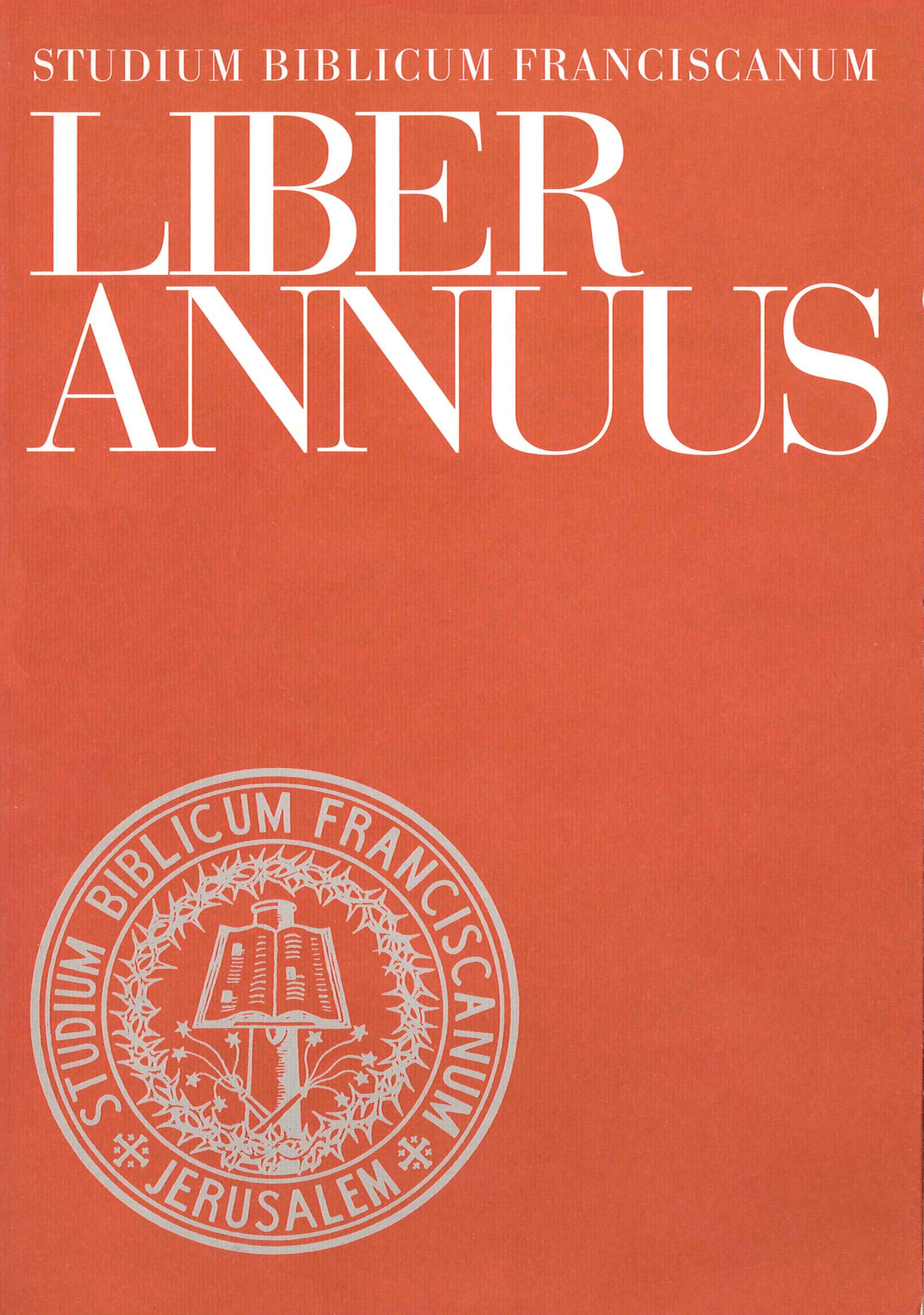
Volume 53, Issue 1, 2003
-
-
Die Mosetora als Schrift
show More to view fulltext, buy and share links for:Die Mosetora als Schrift show Less to hide fulltext, buy and share links for: Die Mosetora als SchriftBy: D. VolggerAbstractThis study deals with the Mosaic Torah as a text in its received form. Whoever announces the sacred Torah speaks firstly with heavenly authority. In Israel many people claimed this. The recording of their words lends the message permanent authority. In the corpus Ex-Dtn we read many times that Moses put into writing or read out the instructions of Yhwh, but the extent and content of the Torah are not exactly determined. Even the Torah quotations in Jos. 8,32.35 (24,26), 2Kgs 22f., and Neh 8 cannot be directly related to the model text of Ex-Dtn. Current analyses of the Mosaic Torah are mostly based on the Leningrad Codex of the 11th century. Its text, however, deviates in many ways from the relevant Qumran fragments. Moreover, the critical edition and the translations of the Mosaic Torah confirm its textual polymorphism. Hence, any document that claims to be the Mosaic Torah must firstly be individually analysed. This applies to the model text of Gen-Dtn as also to the Book of Jubilees and the Temple Scroll. The Qumran texts confirm that the Mosaic Torah in the form of Gen-Dtn enjoyed a special status, as nearly all the Torah citations correspond with it. Thus the authorship and the recipients determine the kind of written Mosaic Torah that is chosen and transmitted in the process of Yhwh's continuing revelation to Israel.
-
-
-
Marco e il genere letterario degli annunci (o Vangeli)
show More to view fulltext, buy and share links for:Marco e il genere letterario degli annunci (o Vangeli) show Less to hide fulltext, buy and share links for: Marco e il genere letterario degli annunci (o Vangeli)By: N. CasaliniAbstractThe article confirms the common opinion that Mark was the first to write down a “Story of Jesus” and to call it eujagge÷lion, or “announcement”. In this way, he gave origin to a specific genre of text for the Christian propaganda concerning the origins of Christianity. As for the origin of that name, I suppose that, while the word is Greek, the concept comes from Isaiah 40-66 (LXX). The common Greek language prefers the form eujagge÷lion to eujaggeli÷zomai, especially the use of the name eujagge÷lion in the absolute, without any specification as we find it in Mark (8,35 and 10,29; 13,10; 14,9) and Paul (cf. Rm 1,16).
-
-
-
“Metron”-misura in Mt 7,2, Lc 6,38 e Mc 4,24 alla luce della letteratura rabbinica
show More to view fulltext, buy and share links for:“Metron”-misura in Mt 7,2, Lc 6,38 e Mc 4,24 alla luce della letteratura rabbinica show Less to hide fulltext, buy and share links for: “Metron”-misura in Mt 7,2, Lc 6,38 e Mc 4,24 alla luce della letteratura rabbinicaBy: G. BissoliAbstractAncient Judaism developed from the Bible a profound reflection on the Divine qualities and epitomized them in the expressions of “measure-judgment” and “measure-mercy”. Starting with the Synoptic saying on “metron-measure”, the author finds a mention of Godʼs retributive justice in Mark/Matthew. As for Luke, he expands the concept of “measure-mercyʼ and adapts it to the life situation of his communities.
-
-
-
«Fate questo in memoria di me» (Lc 22,19b; 1Cor 11,24.25): Ma fare che cosa esattamente? Storia, teologia e prassi a confronto
show More to view fulltext, buy and share links for:«Fate questo in memoria di me» (Lc 22,19b; 1Cor 11,24.25): Ma fare che cosa esattamente? Storia, teologia e prassi a confronto show Less to hide fulltext, buy and share links for: «Fate questo in memoria di me» (Lc 22,19b; 1Cor 11,24.25): Ma fare che cosa esattamente? Storia, teologia e prassi a confrontoBy: L.D. ChrupcałaAbstractThe first part of the article is dedicated to the historical-critical analysis of the commemorative phrase of Jesus addressed to his disciples “Do this in memory of me” (Lk 22:19b; 1Cor 11:24,25). After describing the liturgical provenance of the texts of the Last Supper (Luke-Paul), a literary study of the terms (poiei√te, touvto, ei˙ß th\n e˙mh\n aÓna¿mnhsin) follows with a discussion of its historicity and, finally, a presentation of the immediate context (the farewell supper) and the remote context (the death of Jesus) of the command to repeat the action. In the second part, the words of Jesus are studied in the light of the liturgical background of the Jewish Passover (Ex 12:1-14) and a reflection of the eucharistic parenesis of Paul (1Cor 11:17-34). Interpreting the command of Jesus (v. 26), the Apostle makes known to the community at Corinth that the memorial of the Lord does not consist only of the ritual repetition of gestures and the words of the Last Supper, but demands above all an immersion into the dynamic rapport with the event of Jesusʼ death. His atoning love, celebrated in a cultic meal, is a critical moment that judges, corrects, purifies, and forms the Christian memory of Jesus in an ever more intense way.
-
-
-
Les pseudo-clémentines (Homélies et Reconnaissances). Etat de la question
show More to view fulltext, buy and share links for:Les pseudo-clémentines (Homélies et Reconnaissances). Etat de la question show Less to hide fulltext, buy and share links for: Les pseudo-clémentines (Homélies et Reconnaissances). Etat de la questionBy: F. MannsAbstractThe Pseudo-Clementines witness to an ancient Christian novel that narrates Clement of Romeʼs conversion, his travels with Peter, and the recovery of his lost family. The novel has been preserved in two versions: the “Recognitions” and the “Homilies”. This study provides a status quaestionis of many current studies. Since the Pseudo-Clementines are an important source for the study of early Christianity in its various manifestations, they cannot be ignored by scholars, even if their origin remains debated.
-
-
-
I libri di Amos e di Giona secondo la versione siriaca (Peshitto)
show More to view fulltext, buy and share links for:I libri di Amos e di Giona secondo la versione siriaca (Peshitto) show Less to hide fulltext, buy and share links for: I libri di Amos e di Giona secondo la versione siriaca (Peshitto)Authors: M. Pazzini and R. PierriAbstractEvery attempt to vocalize the Aramaic Bible is a challenging task, yet at the same time stimulating. In this article, the Syriac texts of both Amos and Jonah are presented here fully vocalized according to the western system and with the indications of rukkökhö and quååöyö within the context itself. It is forseen, moreover, that the publication of the Syriac texts of the Minor Prophets will soon follow in the near future.
-
-
-
Il simbolismo zoomorfo degli angeli in De coelesti hierarchia 15,8 di Dionigi l'Areopagita
show More to view fulltext, buy and share links for:Il simbolismo zoomorfo degli angeli in De coelesti hierarchia 15,8 di Dionigi l'Areopagita show Less to hide fulltext, buy and share links for: Il simbolismo zoomorfo degli angeli in De coelesti hierarchia 15,8 di Dionigi l'AreopagitaBy: M. AdinolfiAbstractBy means of the symbols of the lion, the ox, the eagle, and the horse, Dionysius explains some prerogatives of the angels. According to the Areopagite, the angels are mysterious beings, guardians, and messengers of the arcane. On the one side, being among the most noble of creatures, they welcome Godʼs revelation and enjoy perfectly and unrestrainedly His vision. On the other side, being the protectors of humans, the angels are present everywhere and work to make connections between persons and inaccessible reality, whether they are opposed to each other or not.
-
-
-
Il simbolo della croce tra giudeo-cristianesimo e tarda antichità: un elemento della translatio Hierosolymae
show More to view fulltext, buy and share links for:Il simbolo della croce tra giudeo-cristianesimo e tarda antichità: un elemento della translatio Hierosolymae show Less to hide fulltext, buy and share links for: Il simbolo della croce tra giudeo-cristianesimo e tarda antichità: un elemento della translatio HierosolymaeBy: M. LoconsoleAbstractThe cross, seen and exalted in a great many biblical or natural types and figures, entered the sacramental, cultic, and private lives of Christians already in the sub-apostolic period as a seal of God, a sign of Divine Presence, as salvation and protection. The early Christians prayed before the cross as a seal of God in the sacraments and a sign of eschatological salvation, possibly turned towards the east. They also placed the cross in their homes, in cultic places, and in cemeteries. Contrary to what is commonly held, the origin of the cross and its adoration are pre-Constantinian. Both are attested in the works of Minucius Felix and Tertullian, and confirmed by numerous testimonies from monuments. With Constantine, the honour and veneration of the cross became more noted and public. However the turning point of the cross from a sign of ignominy to a sign of glory cannot be attributed to the vision of the emperor. The cross was used by Christians already in the first years of the life of the Church, and the veneration of the cross goes back at least to the end of the 2nd century. It is an important confirmation that the cross was not an instrument of torture, but was venerated for its unique link with the life, mission and work of the Redeemer of humanity.
-
-
-
La Chiesa della Tabula Ansata a Umm al-Rasas – Kastron Mefaa
show More to view fulltext, buy and share links for:La Chiesa della Tabula Ansata a Umm al-Rasas – Kastron Mefaa show Less to hide fulltext, buy and share links for: La Chiesa della Tabula Ansata a Umm al-Rasas – Kastron MefaaBy: M. PiccirilloAbstractThe small church, which we later named “of the Priest Waʼil”, was among the first sacred Christian edifices identified among the ruins of Umm al-Rasas by explorers. On closer examination of the ruins on the south-western edge of the area beyond the walls of the castrum, we realized that the small church was part of an ecclesiastical complex comprising, to the south east, a larger church partly hidden by a modern house built by a family of the Salyata Bedouins. The main edifice, which we named the “Church of the Tabula Ansata”, from an inscription in Greek framed in a tabula incised on a stone slab of the presbytery, was built in the 6th century and has been restored in the first half of the 7th century. In the first phase, the church was paved with mosaics, which were later covered by stone slabs on an upper level in the presbytery and transferred to the nave. Traces of the original mosaic floor in the nave below the stone slabs of the upper floor and the stone elements of an arch fallen in a north south direction leads us to the hypothesis that the sacred area originally reserved for the liturgical celebration was limited to the eastern sector of the church.
-
-
-
A Byzantine Burial Cave in the vicinity of Shepherds' Field
show More to view fulltext, buy and share links for:A Byzantine Burial Cave in the vicinity of Shepherds' Field show Less to hide fulltext, buy and share links for: A Byzantine Burial Cave in the vicinity of Shepherds' FieldBy: Sh. BatzAbstractA Byzantine burial cave was unearthed in the vicinity of Shepherdsʼ Field, the traditional place where angels announced the birth of Christ to the shepherds (Luke 2:8-11). The area is rich with monasteries from the Byzantine period. The present paper describes the cave and findings, and suggests that the tomb may have belonged to a monastic community.
-
-
-
The Hadrianic Inscription from Southern Samaria (?) – A Palinode
show More to view fulltext, buy and share links for:The Hadrianic Inscription from Southern Samaria (?) – A Palinode show Less to hide fulltext, buy and share links for: The Hadrianic Inscription from Southern Samaria (?) – A PalinodeBy: L. Di SegniAbstractThe Greek dedication of a village to the Olympian gods in honour of Hadrian, allegedly found in the vicinity of Kafr ed-Dik and published from a copy in Liber Annuus 1994 has now re-emerged. An examination of the stone permitted to restore the toponym as Kaparbanaia. The village is not identified, but a location in the area of Kafr ed-Dik seems now unlikely; rather, the spelling of the name may point to a location in southern Judaea.
-
-
-
La collezione numismatica del Santuario di Santa Maria dell'Oriente (L'Aquila)
show More to view fulltext, buy and share links for:La collezione numismatica del Santuario di Santa Maria dell'Oriente (L'Aquila) show Less to hide fulltext, buy and share links for: La collezione numismatica del Santuario di Santa Maria dell'Oriente (L'Aquila)By: F. SpadoliniAbstractThe numismatic collection of the Museum of Santa Maria dellʼOriente a Tagliacozzo (Italy) is part of a larger collection comprising archeological discoveries of clay, glass, and metal articrafts. It is the result of the passionate research of Fr. Gabriele Giamberardini who had lived for many years in Egypt and was interested in Coptic Studies as well as in Near and Middle Eastern antiquities. The collection is notable for its variety in typology and chronology, as the numismatic section consists of 346 coins, 62 of which are illegible because of their poor state of preservation. The rest are from the Roman provinces and are inscribed with legends in Greek (178) and Latin (106) dated between the 3rd and 7th centuries A.D. Most numerous are the tetradrachmas of Probus (71), of Claudius (38), of Cornelius Salonina (21), and of Aurelius (21). Unique to this collection, which mainly consists of bronze coins, are two silver denari from the mid-1st century A.D.
-
-
-
Melchior de Vogüé en Galilée. Fragment inédit de son premier voyage en Orient (1853)
show More to view fulltext, buy and share links for:Melchior de Vogüé en Galilée. Fragment inédit de son premier voyage en Orient (1853) show Less to hide fulltext, buy and share links for: Melchior de Vogüé en Galilée. Fragment inédit de son premier voyage en Orient (1853)By: L. BonatoAbstractIn May 1853, Melchior de Vogüé left for his first sojourn to the Orient. He was in Greece, Syria, Palestine, and Egypt. The opening of the Vogüé family archives to the public has occasioned the discovery of an unedited manuscript retracing his voyage of ten days from Haifa to Jerusalem, between the 9th and 18th of November. Without being artistic, the text abounds in anecdotes. It also provides descriptions and archeological analysis, mixed with references to the Sacred Scripture and Christian zeal.
-
-
-
Burial in the Holy Land and Jerusalem according to Muslim Tradition
show More to view fulltext, buy and share links for:Burial in the Holy Land and Jerusalem according to Muslim Tradition show Less to hide fulltext, buy and share links for: Burial in the Holy Land and Jerusalem according to Muslim TraditionBy: O. Livne-KafriAbstractMuslim ideas and customs concerning burial in the Holy Land and Jerusalem were borrowed probably from Jewish sources. However, they already reflect the reality and the value-system of the Muslim community, mainly during the 7th and 8th centuries. Most of them seem to follow the Jewish heritage in this respect, but there are also signs of polemic and cautiousness, most probably from foreign influences. This comes within the general discussion of borrowing ideas and customs from non-Muslims, but also as a part of the inner debate over the sanctity of Jerusalem.
-
Volumes & issues
-
Volume 74 (2024)
-
Volume 73 (2023)
-
Volume 72 (2022)
-
Volume 71 (2021)
-
Volume 70 (2020)
-
Volume 69 (2019)
-
Volume 68 (2018)
-
Volume 67 (2017)
-
Volume 66 (2016)
-
Volume 65 (2015)
-
Volume 64 (2014)
-
Volume 63 (2013)
-
Volume 62 (2012)
-
Volume 61 (2011)
-
Volume 60 (2010)
-
Volume 59 (2009)
-
Volume 58 (2008)
-
Volume 57 (2007)
-
Volume 56 (2006)
-
Volume 55 (2005)
-
Volume 54 (2004)
-
Volume 53 (2003)
-
Volume 52 (2002)
-
Volume 51 (2001)
-
Volume 50 (2000)
Most Read This Month
