


Contact and Transmission
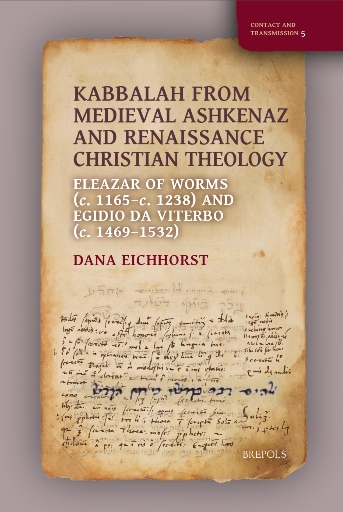
Kabbalah from Medieval Ashkenaz and Renaissance Christian Theology
Eleazar of Worms (c. 1165–c. 1238) and Egidio da Viterbo (c. 1469–1532)
The preoccupation of Christian theologians and scholars with the Hebrew language and sources at the dawn of the sixteenth century resulted in the transfer of a vast corpus of medieval Hebrew texts into Christian intellectual discourse and networks. These Hebrew sources were meticulously collected copied translated and subjected to rigorous study. These collections include texts that originate from medieval Ashkenaz the majority of which can be attributed to Eleazar ben Yehuda of Worms (c. 1165–c. 1238). Rabbi Eleazar was a prominent Jewish scholar of his time and a member of one of the most prestigious families in Jewish communities of the German Rhineland and Palatinate.
However the history of medieval Ashkenazic writings has been neglected in scholarship which has favoured other Jewish (primarily Sephardic) sources in tracing the infl uence of medieval Jewish mysticism on Christian theology and Kabbalah. This book takes the hitherto disregarded Ashkenazi Hebrew sources as its point of departure. It focuses on the work of Eleazar as a main representative of the Ḥaside Ashkenaz and on his mag num opus Sode Razayya which discusses all matter of the divine and the mundane sphere. The book explores how Eleazar’s work was a potentially interesting source for a Renaissance Christian Kabbalist like Egidio (Giles) da Viterbo. Kabbalah from Ashkenaz is distinguished by its emphasis on the Hebrew letters and language along with the divine word and divine speech (dibur). This central motif of the Ashkenazi sources found resonance with certain Christian theologians and Kabbalists in the context of Christian logos theology which is similarly anchored in the divine word (verbum).

Mastering Nature in the Medieval Arabic and Latin Worlds
Studies in Heritage and Transfer of Arabic Science in Honour of Charles Burnett
Understanding and influencing nature were preeminent aims of medieval Arabic science and attracted European fascination with its accomplishments. This volume draws together studies on central themes presenting a world of enquiry into the earth and the heavens and ways to harness this information for divination and the occult sciences. It gives examples of how Arabic science travelled to Latin Europe through texts and instruments and how it underwent transformation there as diverse fields were put to use and reinterpreted. The studies introduce a range of learning and perspectives: astrology conducted with planetary lots; a geography where features of the earth's surface move over time; knowledge of the elements and climates which Adelard of Bath learned from Arab masters; Avicenna’s meteorology explaining the extremes of fire storms and catastrophic floods; debates about the eternity or creation of the world; evaluations of magic as a rational intellectual discipline or alternatively a danger needing censorship and linked to female witchcraft; and a precious astrolabe which in the Renaissance was reused and inspired new theoretical writings. Together these studies sketch a landscape of medieval Arabic science and Latin European engagement with this new frontier.
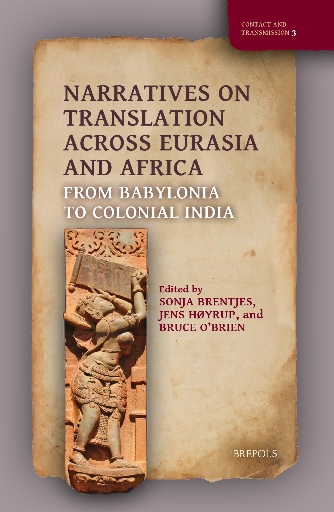
Narratives on Translation across Eurasia and Africa
From Babylonia to Colonial India
What has driven acts of translation in the past and what were the conditions that shaped the results? In this volume scholars from across the humanities interrogate narratives on the process of translation: by historical translators ranging from ancient Babylonia to early modern Japan and the British Empire and by academics from the nineteenth to the twentieth centuries who interpreted these translators’ practices.
In Part 1 the volume authors reflect on the history of the approaches to the phenomenon of translation in their specific fields of competence in order to learn what shaped the academic questions asked what theoretical and practical tools were deployed which arguments were privileged and why certain kinds of evidence (but not others) were thought to be the basis for understanding the function and purpose of all translation performed in a given culture. Part II explores how translators and authors from antiquity to modern times described their own motivations and the circumstances in which they chose to translate. In both parts the contributors disentangle histories of translation from the specialized intellectual fields (such as science religion law or literature) with which they have been bound in order to make the case that we understand translation best when we take into account all cultural practices and translation activities cutting synchronically and diachronically through the entire societal fabric.

Premodern Translation
Comparative Approaches to Cross-Cultural Transformations
This edited collection offers six essays on translations and their producers and users in premodern societies which explore possibilities for contextualizing and questioning the well-established narratives of translations and translating in history of science and philosophy. To enable such explorations the editors decided to go beyond a conventional focus on Latin and Arabic medieval cultures. Thus a discussion of translation in East Asia that asks questions about the technologies of translation invites readers familiar with Western contexts to reflect on shared cross-cultural practices. Other authors ask new questions concerning mathematical medical or philosophical translations such as the character and the role of ‘submerged’ translations that never made it into any of the traditional histories of translation in medieval societies. A third group of authors offer perspectives on early modern professionals which open up the traditional research on translations to other fields of study and allow us to reflect on changed practices and purposes of translation.
Featuring studies on Old Uyghur translations of Buddhist texts on the fortune of a Latin translation of Arabic mathematics from al-Andalus on Arabic philosophy and the division of the sciences in thirteenth-century Paris and Naples on Albert the Great’s concept of interpretatio as an epistemic practice that combines translation and explanation on translation between classical Arabic and Humanist traditions in early modern Spain and on astronomy in early modern German scholarship this volume offers a unique survey of premodern translations across a variety of languages and disciplines exploring both their technical commonalities and cultural specificities while also addressing the reception of the ideas they transmit.

Excerptum de Talmud
Study and Edition of a Thirteenth-Century Latin Translation
In 1239 the Christian convert Nicholas Donin submitted thirty-five articles to Pope Gregory IX that decried the indecency blasphemy and heresy in the Talmud. As a result the pope triggered a campaign across Europe that gave rise to a trial of the Talmud in Paris in 1240. The Latin translation of the Talmud - namely the 1245 Extractiones de Talmud and later versions such as the Excerptum de Talmud - emerged from these events.
This volume offers the first critical edition along with an English translation of the Excerptum de Talmud. Drawing on the substantial translation of the Babylonian Talmud known as the Extractiones de Talmud (Paris 1245) the Excerptum provided a selection of passages from the Talmud which its compiler organized according to controversial topics.
This book consists of two principal parts. The first contains a study of the Excerptum its textual source (the Extractiones de Talmud) and an overview of the historical background which prompted this translation. The second part consists of an edition and translation of the text as well as an edition of the passages from the Extractiones which served as the basis for the Excerptum.
These texts mark a significant chapter in Christian anti-Jewish disputations and Latin polemical works in the Middle Ages. This volume will thus prove useful to scholars interested in Latin philology religious disputation medieval translation and transmission of knowledge and the history of Christian-Jewish relations.