


Rural economy and society in north-western Europe, 500-2000
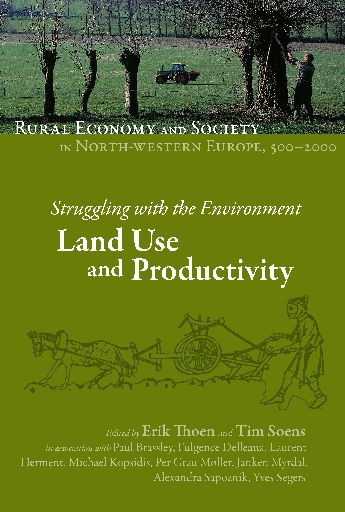
Struggling with the Environment: Land Use and Productivity
Agriculture is always a struggle with the environment since agricultural production is in fact applied ecology. However in the past the struggle with the environment was to a large extent determined by the social organisation which was regionally very diverse. The aim of this volume is to find out how when and within which structural boundaries land was made useful for agriculture. In the first part of each chapter this is studied in general focusing on the evolution of land use: how and why was land reclaimed and by whom? How intensively was this land used? Which actors played a part in this process? What were the environmental and social limits? In the second part the production techniques and production systems are scrutinized: crop choices crop rotations the importance of fallow and cattle crop yields etc. All this is examined in light of different farming strategies and social conditions. The comparative approach of this volume in the Rural Economy and Society Series also enables a new and innovating perspective on the occurrence and impact of ‘agricultural’ and ‘green’ revolutions in the past.
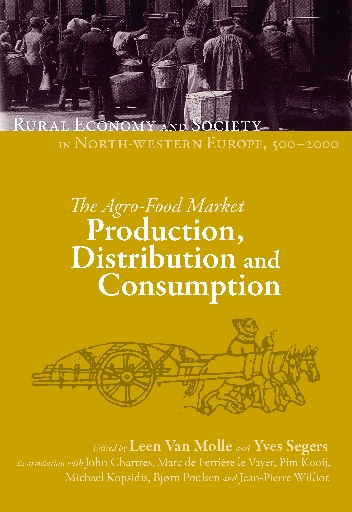
The Agro-Food Market: Production, Distribution and Consumption
Volume editorial board:
Leen Van Molle (University of Leuven Belgium) Yves Segers (University of Leuven Belgium) (directors)
John Chartres (University of LeedsUK) Marc de Ferrière le Vayer (University of Tours France) Pim Kooij (Wageningen University Netherlands) Michael Kopsidis (IAMO Halle (Saale) Bjørn Poulsen (Aarhus University Denmark) Jean-Pierre Williot (University of Tours France)
Agriculture and alimentation have from early times always been crucial elements in the development of market systems. Shortage and surplus gave shape to different forms of exchange and sale to the dynamics of supply and demand and to expanding interconnections between both regions and social groups. Farmers learned to adapt their production to market conditions and to the shifting needs and tastes of a growing and demanding public. But the path from a self-supporting way of life to the present forms of market integration in the complex global world was far from uniform and linear. Food production market structures and market mechanisms changed over time and differed between regions and countries of the North Sea area. This volume aims at exploring and unravelling the complexity of the agro-food market from the field to the table.
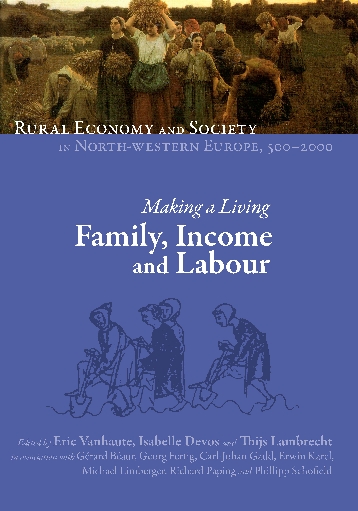
Making a Living: Family, Income and Labour
Volume editorial board
Eric Vanhaute (Ghent University Belgium) Isabelle Devos (Ghent University Belgium) Thijs Lambrecht (Ghent University Belgium) (directors)
Gérard Béaur (CNRS/EHESS France) Georg Fertig (University of Münster Germany) Carl-Johan Gadd (University of Gothenburg Sweden) Erwin Karel (University of Groningen The Netherlands) Michael Limberger (Ghent University Belgium) Richard Paping (University of Groningen The Netherlands) Phillipp Schofield (Aberystwyth University Wales UK).
The central issue in this volume is the relation and the interaction between production reproduction and labour in rural societies. The main questions concern the way in which resources became available to the rural family and to its members and the strategies which were employed to generate these resources. The goal is to interpret household formation and the economic behaviour of its members within the context of the structural features of the regional social agro-system. Two sets of research questions structure the chapters in this book. The first set evaluates the impact of these processes on the family as a unit (of reproduction and production) and the relationships between its members (internal family relations). These issues are essentially dealt with from a socio-demographic perspective. The second set of questions aims to understand how families adapted their behaviour to changing social and economic circumstances. These topics are studied from a predominantly socio-economic perspective.
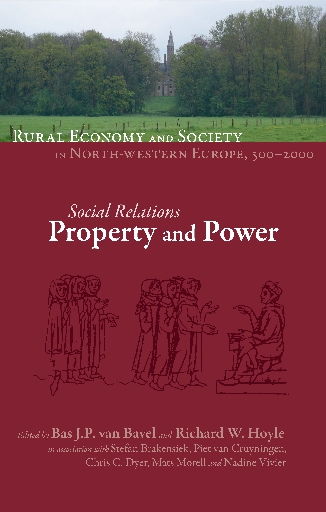
Social Relations: Property and Power
The organization of society formed a crucial element in the remarkable development of the countryside in the North Sea area in the last 1500 years. Vital questions are: who owned the land? Who gained the profits from its exploitation? How was the use of rural resources controlled and changed? These questions have no simple answers because the land has been subjected to competing claims varying from region to region. In early times peasants mostly possessed and worked their holdings but lords took much of the produce and had the ultimate control over the land. In more recent times the occupiers and cultivators gained stronger rights over their farms. Neither lords nor peasants were free agents because communities governed the use of common lands. In the highly urbanized North Sea region towns and townspeople had considerable and increasing influence over the countryside. Change came from within society for example from the tension and negotiation between lords and peasants and the growing importance of the state and its policies. This volume also looks at the interaction between society and external changes such as the rise and fall of the market trends in population and European integration.
Bas J.P. van Bavel is professor of Economic and Social History of the Middle Ages at Utrecht University the Netherlands
Richard W. Hoyle is professor of Rural History at the University of Reading United Kingdom