
Full text loading...





Hercules’ Wives: Broken Marriages, Revenge and Death in Seneca’s Hercules Furens and in the Hercules Oetaeus, Page 1 of 1
< Previous page | Next page > /docserver/preview/fulltext/10.1484/M.GIFBIB-EB.5.124622/M.GIFBIB-EB.5.126217-1.gif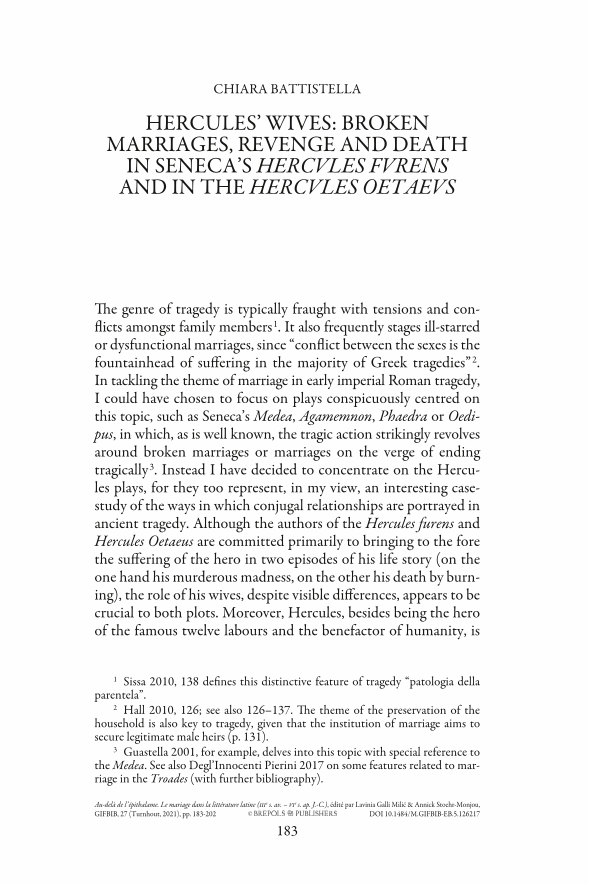
The paper sets out to look, from a unified perspective, at the theme of marriage or, rather, dysfunctional marriage in two plays revolving around the character of Hercules and his wives Megara and Deianira, Seneca’s Hercules furens and the Hercules Oetaeus, which is generally thought to be by an imitator. It seems clear that both Seneca and the author of the Herc. O. do not follow slavishly their Greek models, Euripides’ Heracles and Sophocles’ Trachiniae respectively, despite maintaining the basic storyline. The most conspicuous difference lies in the construction of the characters, who undergo quite substantial changes also with reference to the topic of marriage. Seneca, for his part, gives special prominence to the motif of Juno’s jealousy as the reason for Hercules’ madness, which has marginal relevance in Euripides; he also expands on the Lycus episode, turning it into a scene of violent courtship (in line, perhaps, with the aesthetic tastes of the age), and endows Hercules with features that make him appear even more ‘monstrous’, not only as a hero but also as a husband. The author of the Herc. O. ‘responds’, in turn, to Seneca’s enhanced violence by depicting Deianira as a vicious character, seemingly better suited, in her ‘monstrosity’, to the Senecan hero-villain than her Sophoclean counterpart. Interestingly, her new ethos results from the combination of several female models, with Seneca’s Juno and Medea standing out in particular.
Full text loading...