


European Medieval Drama
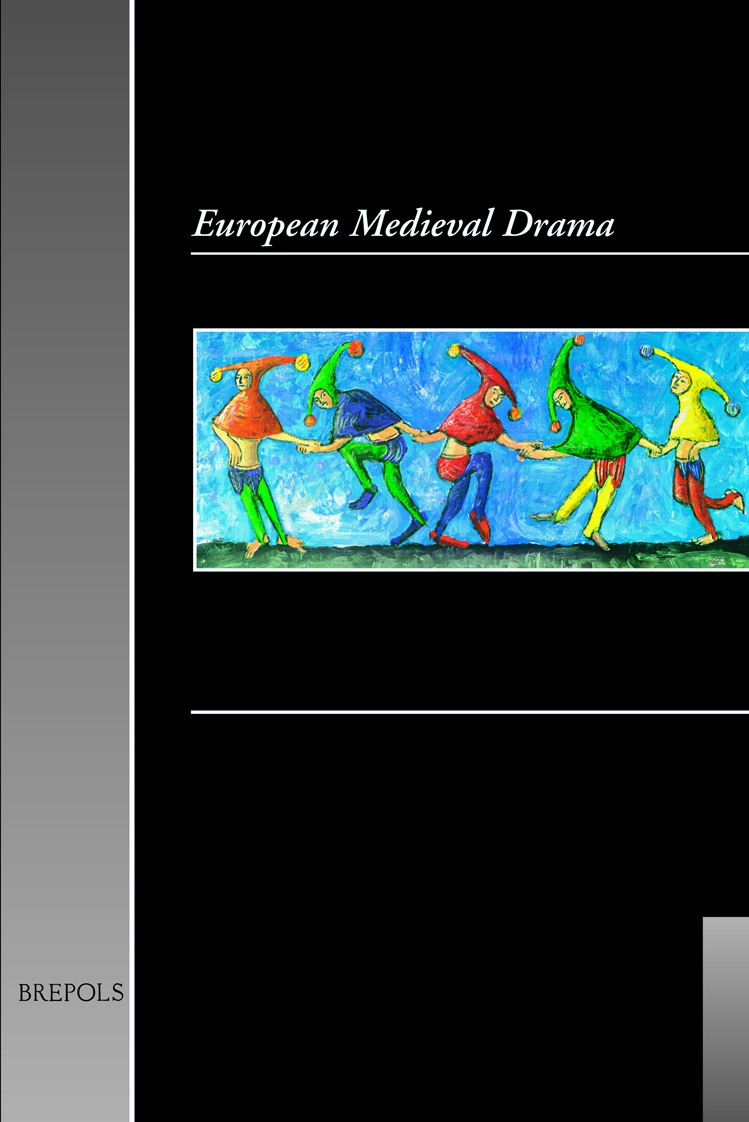
Volume 27, Issue 1, 2023
-
-
The Spiritual Dimension of the Majorcan Play Texts: MS 1139, Biblioteca de Catalunya
show More to view fulltext, buy and share links for:The Spiritual Dimension of the Majorcan Play Texts: MS 1139, Biblioteca de Catalunya show Less to hide fulltext, buy and share links for: The Spiritual Dimension of the Majorcan Play Texts: MS 1139, Biblioteca de CatalunyaBy: Lenke KovácsAbstractIn our analysis of the spiritual dimension of the Majorcan play manuscript (MS 1139, Catalan National Library, Barcelona), we focus our attention on the image of God and the faithful that these texts convey and on how these plays aim at enhancing the audience’s disposition and the longing to be transformed by participating in the religious experience imparted by the church. We show how as a whole the late medieval plays, objects of our study, were conceived as media intended to increase the spiritual progress of the members of the community who created and witnessed throughout the liturgical year the scenic representation of the main subjects of the history of the Salvation.
-
-
-
‘Reality Effect’ in Religious Performances of the Passion: Depositio Crucis, Planctus Mariae, St Vitus Passion Play from Bohemia
show More to view fulltext, buy and share links for:‘Reality Effect’ in Religious Performances of the Passion: Depositio Crucis, Planctus Mariae, St Vitus Passion Play from Bohemia show Less to hide fulltext, buy and share links for: ‘Reality Effect’ in Religious Performances of the Passion: Depositio Crucis, Planctus Mariae, St Vitus Passion Play from BohemiaBy: Eliška KubartováAbstractThis paper addresses the late medieval Passion devotion through the prism of phenomenology and cognitive theory. The concepts of visceral seeing, kinaesthetic empathy, and embodied schema are employed to explain the specific type of mimetic and emotional realism exhibited by various Passion media (texts, images, and performances). The argument is demonstrated on the examples of Marian lament, animated sculptures of Christus Patiens, a Bohemian fragment of the St Vitus Passion Play, and textual and visual representations of the arma Christi.
-
-
-
Singen und Wiegen: Das Weihnachtslied ‘Ecce mundi gaudia’ im Wienhäuser Liederbuch
show More to view fulltext, buy and share links for:Singen und Wiegen: Das Weihnachtslied ‘Ecce mundi gaudia’ im Wienhäuser Liederbuch show Less to hide fulltext, buy and share links for: Singen und Wiegen: Das Weihnachtslied ‘Ecce mundi gaudia’ im Wienhäuser LiederbuchBy: Clara StrijboschAbstractThis article discusses the song ‘Ecce mundi gaudia’ in the Wienhäuser Song Book (c. 1500) in its literary and cultural context. The song derives from a group of Christmas carols found in manuscripts belonging to women connected with the Devotio Moderna movement in the triangle Zwolle (The Netherlands)–Cologne–Wienhausen (Germany). In all instances well-known material about Jesus’s infancy or youth is embedded within an existing Latin frame. Unlike similar songs, the Wienhäuser song ‘Ecce mundi gaudia’ has a second refrain containing words typically found in lullabies, which might indicate a Christmas cradling tradition. Several sources witness that cradling could end up in a dance around the Christmas cradle, even in church. Probably the Wienhäuser song ‘Ecce mundi gaudia’ accompanied a tradition of cradling at Christmas in Wienhausen.
-
-
-
Gesang auf dem Sinai: Dynamische Räume und Signale der Transgression im Mühlhäuser (thüringischen) Katharinenspiel
show More to view fulltext, buy and share links for:Gesang auf dem Sinai: Dynamische Räume und Signale der Transgression im Mühlhäuser (thüringischen) Katharinenspiel show Less to hide fulltext, buy and share links for: Gesang auf dem Sinai: Dynamische Räume und Signale der Transgression im Mühlhäuser (thüringischen) KatharinenspielBy: Angelika KemperAbstractThe Thuringian Play of St Catherine, dating from the middle of the fourteenth century, deals with the martyrdom of the saint herself and the martyrdom of several other figures. Their appearances are not only accompanied by heavenly figures, but are also acoustically emphasized by chants. The play thus shows an intense tonal design, its numerous liturgical chants have a commentary effect and mark the figures’ passage into transcendence. The play also reveals a complex use of space and adds dynamic spaces, which are created performatively, to its fixed stage locations. Based on the play’s spatial and sound direction, the contribution examines how spatial and acoustic means are used, how ‘this world’ and ‘the next world’ are marked and what effects can be achieved with this, especially in a hagiographic context.
-
-
-
Du Moyen Âge à aujourd’hui: Sainte Barbe en scène
show More to view fulltext, buy and share links for:Du Moyen Âge à aujourd’hui: Sainte Barbe en scène show Less to hide fulltext, buy and share links for: Du Moyen Âge à aujourd’hui: Sainte Barbe en scèneBy: Susanna ScavelloAbstractWe will consider two levels of the character of the martyred saint — her body and her word — while questioning the contradiction between these two dimensions from a performative point of view, if we imagine the saint Barbe mysteries coming to life on stage. Furthermore, we will try to make distinctions between image, narrative, and dramatization of late medieval female martyrdom in terms of reception. We will first question the presumed passivity and sexualization of the heroine’s body that has been proposed by contemporary readings that see the martyr primarily as an object of male desire and gaze. We will discuss the reaction of the character’s body to the violence suffered in the theatre. Then we will examine the manifestation of the speech of Barbe, between joy, provocation and ‘implacable decision’, thus showing the paradoxical presence of the saint on the scene. We will conclude by wondering why we should revive these medieval plays on today’s stages.
-
-
-
Catechism and Miracles as Arguments in Religious Debate: Hanns Wagner’s Play of St Ursus
show More to view fulltext, buy and share links for:Catechism and Miracles as Arguments in Religious Debate: Hanns Wagner’s Play of St Ursus show Less to hide fulltext, buy and share links for: Catechism and Miracles as Arguments in Religious Debate: Hanns Wagner’s Play of St UrsusBy: Cora DietlAbstractThe paper suggests a confessional reading of Hanns Wagner’s play about St Maurice and St Ursus, staged for the 100th anniversary of Solothurn’s admission to the Swiss Confederation in 1581. Wagner uses diverse verbal and theatrical methods of religious persuasion, addressing an audience of mixed confession, who are given the role of ‘the people’. By contrast with the ruler, who is the most negatively portrayed, the ‘people’ are shown to be convinced by words that visibly come true and by miracles, accepting the major Catholic prayers, and the Catholic understanding of baptism and of sainthood.
-
-
-
George Buchanan, Dramatic Strategies, and Polemics in the Scottish Reformation
show More to view fulltext, buy and share links for:George Buchanan, Dramatic Strategies, and Polemics in the Scottish Reformation show Less to hide fulltext, buy and share links for: George Buchanan, Dramatic Strategies, and Polemics in the Scottish ReformationBy: Pamela M. KingAbstractThe paper reads George Buchanan’s tragedy Baptistes (in the printed version, which is a palimpsest of the original version written in exile) as a companion-piece to his polemic dialogue De Jure Regni apud Scotos. Both texts are directed against contemporary ‘tyrants’ and false councillors, and the latter explicitly against the royal secretary William Maitland. The paper discusses the tensions between Calvinist critique against theatre and Buchanan’s play that reveals an aggressive rhetoric far beyond the expectations of a school play. The fact that the Calvinist Reformation remained vitally adept in the deployment of dramatic device is finally realized in the highly dramatic dialogue De Iure Regni apud Scotos.
-
-
-
Staging Enmity: Performance Strategies in Wartime
show More to view fulltext, buy and share links for:Staging Enmity: Performance Strategies in Wartime show Less to hide fulltext, buy and share links for: Staging Enmity: Performance Strategies in WartimeBy: Susannah CrowderAbstractThis article explores local traditions of public performance during a period of political polarization, focusing on the independent francophone city of Metz, in what is now northeastern France. It examines a collection of contemporary texts created during the early fourteenth-century Guerre des Quatre Seigneurs, a war in which Metz faced devastating attacks from regional powers as well as an internal uprising of its own citizens. These works, when studied within their early, performed context, reveal a shared framework of performance practice within the city and an oral and embodied approach to public debate. This article details the distinct performance characteristics and conventions of the Metz pieces, and argues that theatre and drama scholars are well-positioned to illuminate the understudied performance aspects of urban environments and medieval urban history more generally.
-
-
-
MS Bodley 175, William Bedford’s 1604 Copy and the Antiquarian Afterlife of the Chester Plays
show More to view fulltext, buy and share links for:MS Bodley 175, William Bedford’s 1604 Copy and the Antiquarian Afterlife of the Chester Plays show Less to hide fulltext, buy and share links for: MS Bodley 175, William Bedford’s 1604 Copy and the Antiquarian Afterlife of the Chester PlaysAbstractThis essay takes as its topic the late, post-performance copying of the manuscripts of the Chester plays, arguing that, in particular, William Bedford’s apparently hastily-copied 1604 version (MS Bodley 175) is neither a production text nor a clandestine exercise in Catholic recusancy, but instead a contribution to the larger movement in antiquarianism and historiography prevalent in the early seventeenth century. Taking as a point of departure David Mills’ assessment of the Bedford manuscript as a ‘personal copy’, the essay argues, that the purpose of the hurried copy was almost certainly to preserve the manuscript for later refinement and bestowal (for potential remuneration) on some wealthy Cestrian patron with an interest in drama and a developing library. A likely candidate for such a presentation copy would be Lord William Stanley, the sixth Earl of Derby (1594–1642).
-
-
-
Reviews
show More to view fulltext, buy and share links for:Reviews show Less to hide fulltext, buy and share links for: ReviewsAbstractBarbara Sasse, Zwischen Tugend und Laster. Weibliche Rollenbilder in den Tragedi und Comedi des Hans Sachs, Imagines medii aevi, 50 (Wiesbaden: Reichert, 2020), 409 pp. ISBN: 978-3-95490-403-7, reviewed by Cora Dietl
Neidhartspiele. Edition und Kommentar, ed. by Meike Katharina Gallina, Editio Bavarica, 9 (Regensburg: Pustet, 2021), 889 pp. ISBN 978-3-7917-3271-8, reviewed by Cora Dietl
Carlotta Posth, Persuasionsstrategien im vormodernen Theater (14.–16. Jh.). Eine semiotische Analyse religiöser Spiele im deutschen und französischen Sprachraum, Trends in Medieval Philology, 41 (Berlin: De Gruyter, 2022), 419 pp. ISBN 978-3-11-073727-5, reviewed by Cora Dietl
-
Volumes & issues
-
Volume 28 (2024)
-
Volume 27 (2023)
-
Volume 26 (2022)
-
Volume 25 (2021)
-
Volume 24 (2020)
-
Volume 23 (2019)
-
Volume 22 (2018)
-
Volume 21 (2017)
-
Volume 20 (2016)
-
Volume 19 (2015)
-
Volume 18 (2014)
-
Volume 17 (2013)
-
Volume 16 (2012)
-
Volume 15 (2011)
-
Volume 14 (2010)
-
Volume 13 (2009)
-
Volume 12 (2008)
-
Volume 11 (2007)
-
Volume 10 (2006)
-
Volume 9 (2005)
-
Volume 8 (2004)
-
Volume 7 (2003)
-
Volume 6 (2003)
-
Volume 5 (2002)
-
Volume 4 (2001)
-
Volume 3 (2000)
-
Volume 2 (1998)
-
Volume 1 (1997)
Most Read This Month
