


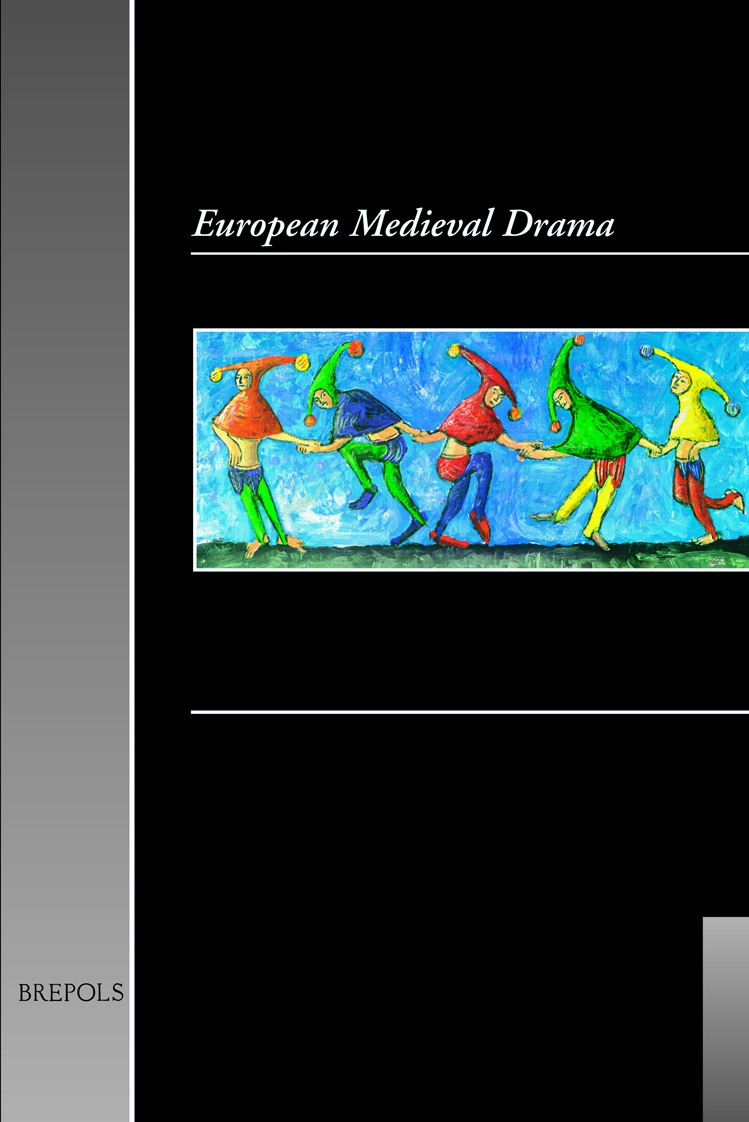
European Medieval Drama
Volume 28, Issue 1, 2024
-
-
‘Man for man, tre for tre, Madyn for madyn, thus shal it be’: The Dramaturgical Work of Typology in Medieval English Drama
show More to view fulltext, buy and share links for:‘Man for man, tre for tre, Madyn for madyn, thus shal it be’: The Dramaturgical Work of Typology in Medieval English Drama show Less to hide fulltext, buy and share links for: ‘Man for man, tre for tre, Madyn for madyn, thus shal it be’: The Dramaturgical Work of Typology in Medieval English DramaBy: Mark ChambersAbstractThe medieval English biblical drama uses prophecy and reiteration in order to tie together a number of distinct plays played seriatim. Whilst all forms of medieval Christian drama draw on biblical typology to a degree, the so-called ‘mystery’ plays rely on it for their overall narrative cohesion. This article examines some of those instances where Old-to-New-Testament typology serves a clear and recurring dramaturgical function in the medieval English drama — where particular images, properties, characters, or mises-en-scène are redeployed for particular dramatic ends. It argues, ultimately, that the ‘Harrowing of Hell’ episode marks the dramatic crux or turning point of the long-form biblical drama collections, the place where an overarching dramatic narrative is felt most acutely.
-
-
-
Old Testament Drama in Haarlem
show More to view fulltext, buy and share links for:Old Testament Drama in Haarlem show Less to hide fulltext, buy and share links for: Old Testament Drama in HaarlemBy: Wim HüskenAbstractDating back to the period between c. 1480 and c. 1620 are some ninety plays in the Low Countries dealing with biblical topics. Twenty-six of them figure in the play collection assembled, by the turn of the seventeenth century, by members of the two Haarlem Chambers of Rhetoric, Trou Moet Blijcken (Loyalty Needs to be Proven) and Lieft Boven Al (Love Above All). Plays staging New Testament topics, including parable plays, dominate this collection with no less than twenty items. Only six plays stage stories taken from the Old Testament: Abraham’s Sacrifice, Saul and David, The Prophet Elisha, The Prophet Jonah, Old Tobias (or Tobit), and The Maccabees, the latter two based on apocryphal writings. In this essay I will attempt to answer the question why a late sixteenth- or early seventeenth-century audience took an interest in these topics.
-
-
-
Musik für den König: Raum und Raumidee in Andreas Pfeilschmidts Esther
show More to view fulltext, buy and share links for:Musik für den König: Raum und Raumidee in Andreas Pfeilschmidts Esther show Less to hide fulltext, buy and share links for: Musik für den König: Raum und Raumidee in Andreas Pfeilschmidts EstherBy: Cora DietlAbstractThe paper collects hints in Andreas Pfeilschmidt’s Esther about the space used for performance. It suggests that the performance took place in Korbach’s market square, possibly facing the old townhall, on a stage with two levels: the ground level for scenes playing in town, the higher level for court scenes. Each act uses two indoor-rooms at court, and thus the rooms need a changing definition — by props and by music. At the beginning of the play, the music used is courtly music, including city pipes, and indicates representative and festive acts, as well as rooms of royal representation. The queen’s rooms, however, are marked by silence, symbolizing her humility. At the end, when Esther has managed to change Asverus’s rule, Lutheran hymns and psalms replace the courtly music, and illustrate a new style of rulership.
-
-
-
The Archaeology of Byzantine Liturgical Performativity: The Service of Footwashing on Patmos Island
show More to view fulltext, buy and share links for:The Archaeology of Byzantine Liturgical Performativity: The Service of Footwashing on Patmos Island show Less to hide fulltext, buy and share links for: The Archaeology of Byzantine Liturgical Performativity: The Service of Footwashing on Patmos IslandBy: Alena SarkissianAbstractThe paper examines the specific performative features of the Service of Washing of the Feet as it is performed today on the island of Patmos. The ceremony itself was recorded in a post-Byzantine manuscript, likely dating to the seventeenth or eighteenth century. Its performance at the monastery of St John the Theologian has been documented since the monastery’s foundation in the eleventh century. It can therefore be assumed that the written record was made only after the service’s form had become more or less established. The distinctive traits of Orthodox liturgical performativity observed throughout the Byzantine rite are exceptionally developed in this specific and perhaps most spectacular service still celebrated. These performative aspects can also be discerned in other Byzantine material (textual and visual), making the service a valuable ‘archaeological’ example for studying Byzantine performativity.
-
-
-
The Descent from the Cross as a Marker of Medieval Catalan Cultural Influence
show More to view fulltext, buy and share links for:The Descent from the Cross as a Marker of Medieval Catalan Cultural Influence show Less to hide fulltext, buy and share links for: The Descent from the Cross as a Marker of Medieval Catalan Cultural InfluenceBy: Lenke KovácsAbstractOne of the earliest surviving theatrical texts in Catalan is an early fourteenth-century fragment featuring the role of Nicodemus in a Descent from the Cross scene, now held in the Arxiu Capitular de Barcelona (MS 178). This article explores the significance of such performances across the Catalan cultural area, examining a wide range of late medieval Good Friday practices. These include the Depositio Crucis (the ritual laying down of the cross), documented Passion play performances both inside churches and in public spaces, evidence of Descent from the Cross enactments, sculptural groups representing the scene, and contemporary reenactments. The study spans the entire territory of the medieval Crown of Aragon, offering a comprehensive view of this multifaceted devotional and theatrical tradition.
-
-
-
Reviews
show More to view fulltext, buy and share links for:Reviews show Less to hide fulltext, buy and share links for: ReviewsAbstractThomas Balling, Die Bibel in Szene gesetzt. Gattungs- transformationen im frühneuzeitlichen Johannesspiel, Spolia Berolinensia, 42 (Hildesheim: Weidmann, 2021), XII+354 pp. ISBN: 978-3-615-00446-5, reviewed by Cora Dietl
Medieval English Theatre, 44 (2022), ed. by Meg Twycross, Sarah Carpenter, Elisabeth Dutton, and Gordon Kipling (Cambridge: Boydell & Brewer, 2023), 160 pp. ISBN: 978-1-84384-6499, reviewed by Charlotte Steenbrugge
Good Friday Ceremonies with Articulated Figures in Medieval and Early Modern Europe, ed. by Christophe Chaguinian, Rencontres, 606, Civilisation médiévale, 57 (Paris: Classiques Garnier, 2023), 432 pp. ISBN 978-2-406-15761-8, reviewed by Lenke Kovács
Dominique Goy-Blanquet, From the Domesday Book to Shakespeare’s Globe: The Legal and Political Heritage of Elizabethan Drama, Warwick Studies in Renaissance Thought and Culture 1 (Turnhout, Belgium: Brepols, 2023), 456 pp. ISBN: 978-2-503-60131-1, reviewed by Elisabeth Dutton
Marie Bouhaïk-Gironès, Le mystère de Romans: 1509, une cité en spectacle (Paris: EHESS, 2023), 234 pp.-, ISBN: 978-2-713-22999-2, reviewed by Dylan Reid
A Spectacle for a Spanish Princess: The Festive Entry of Joanna of Castile into Brussels (1496), ed. by Dagmar H. Eichberger (Turnhout: Brepols, 2023), 440 pp., ISBN: 978-2-503-59443-9, reviewed by Nadia van Pelt
-
Volumes & issues
-
Volume 28 (2024)
-
Volume 27 (2023)
-
Volume 26 (2022)
-
Volume 25 (2021)
-
Volume 24 (2020)
-
Volume 23 (2019)
-
Volume 22 (2018)
-
Volume 21 (2017)
-
Volume 20 (2016)
-
Volume 19 (2015)
-
Volume 18 (2014)
-
Volume 17 (2013)
-
Volume 16 (2012)
-
Volume 15 (2011)
-
Volume 14 (2010)
-
Volume 13 (2009)
-
Volume 12 (2008)
-
Volume 11 (2007)
-
Volume 10 (2006)
-
Volume 9 (2005)
-
Volume 8 (2004)
-
Volume 7 (2003)
-
Volume 6 (2003)
-
Volume 5 (2002)
-
Volume 4 (2001)
-
Volume 3 (2000)
-
Volume 2 (1998)
-
Volume 1 (1997)
Most Read This Month Most Read RSS feed
