


Liber Annuus
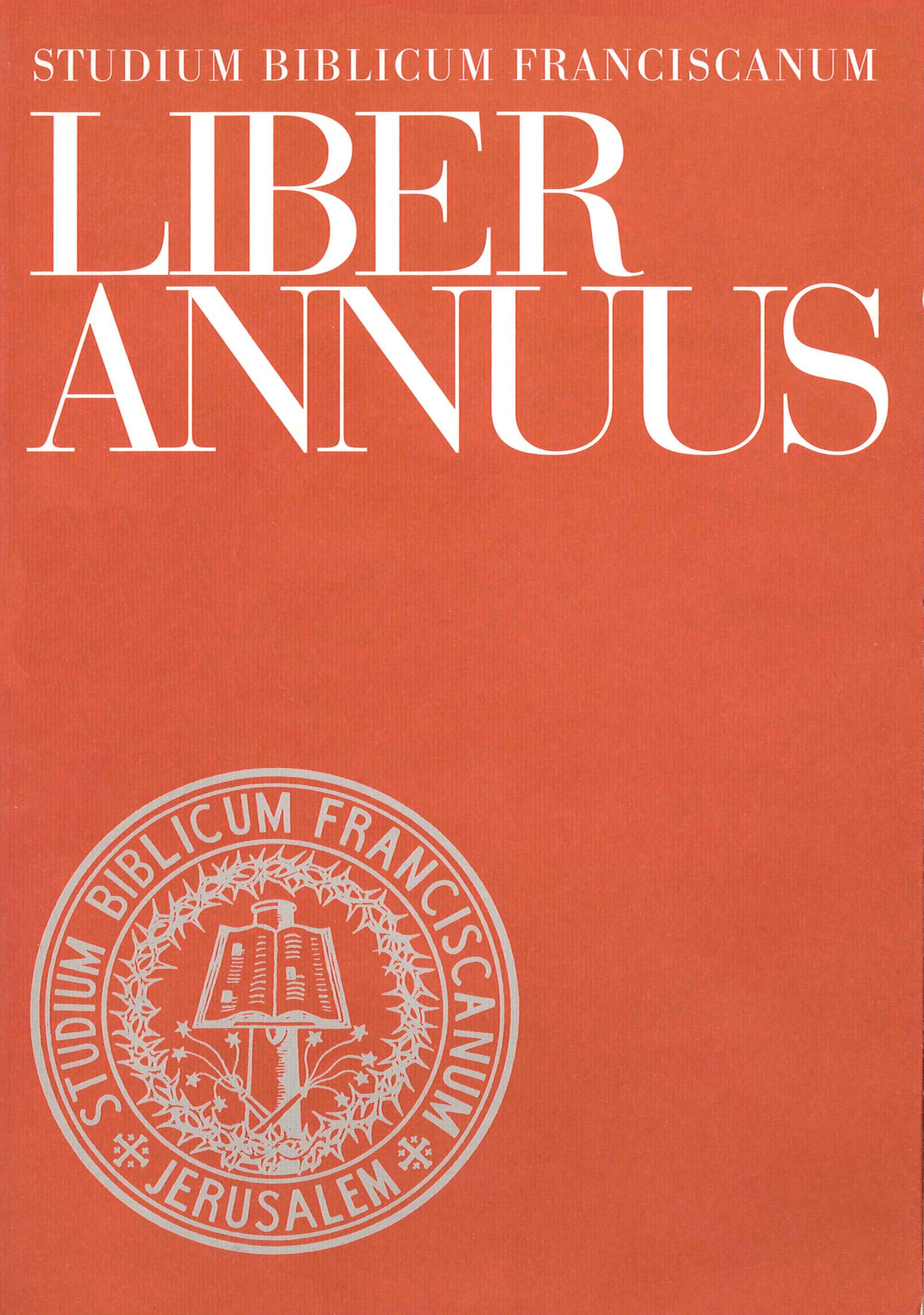
Volume 71, Issue 1, 2021
-
-
Il compito, il permesso, il divieto e la punizione (Gen 2,15-17)
show More to view fulltext, buy and share links for:Il compito, il permesso, il divieto e la punizione (Gen 2,15-17) show Less to hide fulltext, buy and share links for: Il compito, il permesso, il divieto e la punizione (Gen 2,15-17)By: Anto PopovićAbstractThis article analyses four themes in the three verses of Gen 2:15-17. The first theme is the mission God entrusted to man (2:15). The second theme is the broad, divine permission regarding the nourishment/food of man (2:16). The thrid theme is the limitative prohibition to eat from the Tree of the Knowledge of Good and Evil (2:17a). The fourth theme is the pronouncement of mortal punishment (2:17b) for the transgression of the preceding prohibition. The analysis of the first theme - mission - concentrates on the four verbs in 2:15, with particular attention to the verbs ʽabad and šamar. The analysis of the second theme - permission (2:16) - highlights God’s attentive care for man and defines this broad permission as the first part of a double command. The analysis of the third theme - prohibition (2:17a) - tries to discover the motive/sense and function of this prohibition in relation to the liberty of man. The analysis of the fourth theme - punishment (2:17b) - studies the two key expressions (mot tamut, bǝyom) and considers the meaning of these expressions from the point of view of its successive non-execution.
-
-
-
Die Dynamik des werdenden Volkes Abrahams in Gen 12-25
show More to view fulltext, buy and share links for:Die Dynamik des werdenden Volkes Abrahams in Gen 12-25 show Less to hide fulltext, buy and share links for: Die Dynamik des werdenden Volkes Abrahams in Gen 12-25By: David VolggerAbstractThe text analyzes the development of the people of Abraham in Gen 11:27- 25:18 (without Gen 24), concentrating on the question: Do the three sources use different concepts or are they similar? I will argue that the three sources use very similar criteria when they speak of the Israelites becoming a people, and consequently were formulated in comparable social milieus. In addition, I will support the thesis that the final editor intervened only marginally in the sources. With Gen 12:1-3, I will make an initial attempt to identify four criteria for the origin of the people of Abraham. I will then trace the basic dynamics in all three sources and compare them with the four criteria found in Gen 12:1-3.
-
-
-
La calunnia di Miriam: rilievi su Numeri 12
show More to view fulltext, buy and share links for:La calunnia di Miriam: rilievi su Numeri 12 show Less to hide fulltext, buy and share links for: La calunnia di Miriam: rilievi su Numeri 12AbstractIn the dispute between Moses, Miriam and Aaron, Moses’ sister is the image of prophecy, and Moses is the personification of the Law and principal authority in Israel. He is defended from the accusation of welcoming a foreign wisdom of which his wife is the image. Bold in her denunciation, Miriam is punished as is appropriate for the crime of slander. The play on words between “slander” and “fetus” explains the curious expression of Num 12:12.
-
-
-
La beauté poético-musicale des psaumes au service de la théologie : le cas du Ps 85
show More to view fulltext, buy and share links for:La beauté poético-musicale des psaumes au service de la théologie : le cas du Ps 85 show Less to hide fulltext, buy and share links for: La beauté poético-musicale des psaumes au service de la théologie : le cas du Ps 85AbstractThis article deals with the poetic-musical beauty of the psalms with Psalm 85 as a paradigm. It essentially shows that the theological valence of the psalms largely depends on their poetic composition. The phenomenon of semantic, grammatical, lexical and sonorous parallelisms that is evident in these texts imposes a certain musicality, the content of which inspires and imprints in the mind of the informed reader a religious message that refers to the incomparable God. The poetic analysis of Psalm 85 which is made in this article sufficiently proves the inseparability of the two essential dimensions of the psalms, poetry and prayer.
-
-
-
The verbless sentence of Biblical Hebrew: a grammatical and a text-linguistic reading
show More to view fulltext, buy and share links for:The verbless sentence of Biblical Hebrew: a grammatical and a text-linguistic reading show Less to hide fulltext, buy and share links for: The verbless sentence of Biblical Hebrew: a grammatical and a text-linguistic readingAbstractAlong with the verbal sentence (where a subject accomplishes an action), Lucien Tesnière argues that there is an attributive sentence - where a subject receives an attribute. Two attributive relations exist: (1) sentences with ‘to be’, and (2) verbless sentences. Focusing on the verbless sentence of Biblical Hebrew, this paper explains that the absence of the verb has a linguistic consequence: following Harald Weinrich, the verbless sentence is dependent on its ‘linguistic context’. That is, its syntactic value is provided by its syntactic VSO or SVO ‘head’.
This paper begins with a discussion on methodology drawing on Tesnière and Weinrich, and proceeds with a grammatical and a text-linguistic analysis of the verbless sentence as found in the indirect speech of 1Samuel. With regard to the claim of Zewi 1994 (‘the subject and predicate of the nominal sentence are indistinguishable from … “theme” and “rheme” ’), this paper explains that her position is methodologically unconvincing and invalidated by several examples.
-
-
-
Perfetti o misericordiosi? (Mt 5,48 // Lc 6,36)
show More to view fulltext, buy and share links for:Perfetti o misericordiosi? (Mt 5,48 // Lc 6,36) show Less to hide fulltext, buy and share links for: Perfetti o misericordiosi? (Mt 5,48 // Lc 6,36)By: Matteo MunariAbstractMany exegetes are convinced that the oldest formulation of the logion on the imitatio Dei (cf. Matt 5:48 // Luke 6:36) is found in the third gospel and that Matthew replaced the call to be merciful with the ideal of evangelical perfection. In fact, Luke had more reasons to change the Matthean form of the saying than vice versa. The adjective τέλειος “perfect” (Matt 5:48), when referring to a deity, could take on an ambiguous meaning, especially in an audience coming from a pagan background. For this reason, Luke preferred to substitute τέλειος with οἰκτίρμων “merciful”, thus avoiding any kind of misunderstanding. The original formulation of the logion is thus in Matthew, while in Luke we find a sort of cultural translation of it. This is one of the many cases in which Luke’s dependence on Matthew seems plausible.
-
-
-
Eine notwendige Alternative? Eine »inklusive« Interpretation von ὡς παιδίον (Mk 10,15)
show More to view fulltext, buy and share links for:Eine notwendige Alternative? Eine »inklusive« Interpretation von ὡς παιδίον (Mk 10,15) show Less to hide fulltext, buy and share links for: Eine notwendige Alternative? Eine »inklusive« Interpretation von ὡς παιδίον (Mk 10,15)AbstractIn the history of the interpretation of Mark’s version of the so-called Kinderevangelium (Mark 10:13-16) the meaning of the syntagm ὡς παιδίον (Mark 10:15) is a debated question. The difficulty is due to the term παιδίον, which can be understood both as a nominative as well as an accusative. Generally, the scholars intend these two possibilities as alternatives. This article proposes to read in this phrase an ambiguity sought by Mark. In Mark 10:15 Jesus urges his disciples to welcome the Kingdom as a child welcomes it (nominative) and to welcome the Kingdom as one welcomes a child (accusative). The article shows the coherence of these readings with the Markan narrative and, particularly, with the section about the discipleship (Mark 8:27-10:52).
-
-
-
Luke’s Skillful Account of the Unsuccessful Inaugural Speech in Nazareth: A Narrative Study of Luke 4:16-30
show More to view fulltext, buy and share links for:Luke’s Skillful Account of the Unsuccessful Inaugural Speech in Nazareth: A Narrative Study of Luke 4:16-30 show Less to hide fulltext, buy and share links for: Luke’s Skillful Account of the Unsuccessful Inaugural Speech in Nazareth: A Narrative Study of Luke 4:16-30By: Piotr BlajerAbstractJesus’ inaugural speech in the synagogue in Nazareth opens an important part of the Gospel of Luke, i.e., the ministry of Jesus in Galilee (Luke 4:14-9:50). It serves as a temporal marker that opens a new part of the gospel that sets into motion a chain of events. It also functions as the exposé of the program which Jesus will carry out during his mission starting in Galilee and leading him up to the cross on Calvary. The present study contends that inaugural speech in the synagogue of Nazareth gives also a glimpse into Luke’s own writing skills and his intention to present an orderly account of “what happened among us” (Luke 1:1-4). Thus, the story in the synagogue of Nazareth not only presents the program of Jesus’ mission, it also familiarizes the reader with different kind of rhetorical strategies and techniques employed by the author of the Third Gospel aiming to persuade the implied reader / listener of the solidity and certainty of the teaching received.
-
-
-
Function and Purpose of the Five Major Travel Notices in Luke: The Structure of the Lukan Journey Section Reconsidered
show More to view fulltext, buy and share links for:Function and Purpose of the Five Major Travel Notices in Luke: The Structure of the Lukan Journey Section Reconsidered show Less to hide fulltext, buy and share links for: Function and Purpose of the Five Major Travel Notices in Luke: The Structure of the Lukan Journey Section ReconsideredBy: Piotr BlajerAbstractThe limits of the Lukan journey section are not the only predicament for the central part of the Gospel of Luke. For decades scholars have tried to outline what seems to be a collage of heterogeneous episodes and find a reason behind the so-called major travel notices. The present study argues that the placement of five major travel notices in the Gospel of Luke (9:51; 13:22; 17:11; 18:31; 19:28) in their current context is deliberate and has a purpose. Their connection to passages which highlight the universal aspect of salvation reveals Luke’s editorial intentions. Therefore, the purpose of these travel notices is more than a simple reminder of Jesus’ journey to Jerusalem. They serve to highlight the universal dimension of salvation and the imminence of the events that will take place in Jerusalem. For this reason, the five travel notices can be considered major turning points in the gospel and can help to outline the whole journey section.
-
-
-
1Ts 2,1-3,13: una periautologia paracletica
show More to view fulltext, buy and share links for:1Ts 2,1-3,13: una periautologia paracletica show Less to hide fulltext, buy and share links for: 1Ts 2,1-3,13: una periautologia paracleticaAbstractThis article examines the “periautologia” of 1 Thess 2:1-3:13 from the perspective of Plutarch’s views on self-praise. In his work De laude ipsius, Plutarch lists several circumstances/occasions (540C-541E) and purposes in which boasting is acceptable and persuasive (544C-546B), without arousing indignation and annoying the public. Self-praise is accompanied by “antidotes” (541F- 544C): they are argumentative techniques against its potential offensiveness. In 1 Thess 2:1-3:13, the “periautologia” does not end in the benefit of Paul, but serves as an encouraging function to the Thessalonians. Paul was forced to leave the community of believers because of his opponents (cf. 1 Thess 2:15-16; Acts 17:10). He did not complete his mission. Paul fears that the believers in Thessalonica will not be able to resist sufferings. These are the “antidotes”: 1. the “change of person” (cf. 1 Thess 2:1, 5, 10, 14) and the use of the first person plural instead of the first singular; 2. the litotes (“it was not in vain” in 1 Thess 2:1); 3. the use of antithesis and the σύγκρισις/comparison (1 Thess 2: 3-7); 4. the praise of recipients (cf. 1 Thess 2:14, 19-20; 3:6-8); 5. The praise of someone other than oneself with whom one has some affinity / similarity (1 Thess 2:14); 6. the reference to the “dangers” and outrages suffered at Philippi and the persecution in Thessalonica (1 Thess 2:2, 14-16; see also Acts 17:10), the sufferings/ difficulties, and the use of the agonistic metaphor (cf. 1 Thess 2:2, 9; 3:3, 4, 5, 7, 8); 7. by assigning God the merits of one’s “successes”. In particular, Paul recognizes in God the origin of audacity/courage to preach the Gospel (cf. 1 Thess 2:2), his call-mission (1 Thess 2:4), and the thanksgiving and the “joy” (1 Thess 3:9). The sufferings and afflictions of the recipients are proof that the gospel they have received is “the word of God/Lord” and not of men.
-
-
-
La Scrittura parla forse per invidia? Gc 4,5 e l’esigenza dell’amore di Dio
show More to view fulltext, buy and share links for:La Scrittura parla forse per invidia? Gc 4,5 e l’esigenza dell’amore di Dio show Less to hide fulltext, buy and share links for: La Scrittura parla forse per invidia? Gc 4,5 e l’esigenza dell’amore di DioBy: Elisa ChiorriniAbstractThe punctuation commonly inserted in Jas 4:5-6a by editors and commentators separates λέγει from πρὸς φθόνον ἐπιποθεῖ. This paper argues in favour of punctuating in a way that connects the prepositional phrase πρὸς φθόνον to λέγει. This division finds authoritative confirmation in the arrangement of the text in Codex Alexandrinus and in the punctuation of some minuscules. It also agrees with the translation of the Sahidic and Bohairic Coptic versions and is supported by the interpretations of the commentators of late antiquity and the middle ages, interpretations which offer solutions, albeit partial, to the many problems raised by the passage. The new interpretation proposed is mainly based on the analysis of the various meanings of ἐπιποθέω and πρὸς φθόνον, and it throws light upon the function of vv. 5-6a within the exhortation in 4:1-10.
-
-
-
The so-called Syrian clay mortars with stamp inscriptions: general classification and first edition or re-edition of some exemplars
show More to view fulltext, buy and share links for:The so-called Syrian clay mortars with stamp inscriptions: general classification and first edition or re-edition of some exemplars show Less to hide fulltext, buy and share links for: The so-called Syrian clay mortars with stamp inscriptions: general classification and first edition or re-edition of some exemplarsBy: Tomislav VukAbstractThe article is a research paper concerning stamp inscriptions on the so-called Syrian mortars, a type of pottery spread in the Late Roman period throughout the Ancient Near East and further West (Europe and North Africa), with probable provenance from the north-west region of the ancient Syria. In the first part, an attempt is made to produce a classification and categorization of those inscriptions on the basis of a list of published exemplars compiled by others (J.W. Hayes), restricting the choice to those found mostly in “Biblical Lands”. As a result, a list of types and variants of those inscriptions is produced. The second and main part of the article contains a critical edition of mostly unpublished fragments of such mortars kept now in Studium Biblicum Franciscanum Archaeological Collections, since 2015 part of Terra Sancta Museum but previously known as Studium Biblicum Franciscanum Museum or Flagellation Museum. Some of them were formerly kept in small collections (G. Kloetzly, T. Vuk). At first each exemplar is presented under its archaeological aspects, including photos and drawings by the author, and then a critical edition of its inscription is added. All the exemplars published until now received their new register number CTS-SB-#####, in addition to the notification of their old museum number FS####, if they had one, and excavation number, if they have been excavated by the SBF members (Bethany, Nazareth, Capernaum, Machaerus). This is a useful concordance for their identification and study, especially with regards to older bibliography.
-
-
-
Base di un ambone d’epoca bizantina con iscrizione nel Terra Sancta Museum
show More to view fulltext, buy and share links for:Base di un ambone d’epoca bizantina con iscrizione nel Terra Sancta Museum show Less to hide fulltext, buy and share links for: Base di un ambone d’epoca bizantina con iscrizione nel Terra Sancta MuseumBy: Rosario PierriAbstractThe article presents the hexagonal Proconnesian marble platform of a Byzantine ambo. The find, which is part of the archaeological-artistic heritage of the Terra Sancta Museum, bears an inscription on four sides where the names Στέφανος, Οὐάλης, Ἀρροβεβη and Ζηνόβιος appear. The author describes the find, compares it with what remains of 15 hexagonal ambos found in Byzantine churches excavated in Jordan (8) and Israel (7), and studies the inscription. Based on some clues, the author hypothesizes that the platform may have come from Nessana and probably from the church of Saints Sergius and Bacchus.
-
-
-
A new reconstruction of the church at Ḥorbat Ḥanot in the Judean Shephelah
show More to view fulltext, buy and share links for:A new reconstruction of the church at Ḥorbat Ḥanot in the Judean Shephelah show Less to hide fulltext, buy and share links for: A new reconstruction of the church at Ḥorbat Ḥanot in the Judean ShephelahAuthors: Benyamin Storchan and Roy AlbagAbstractDuring the Byzantine period, the Judean Shephelah region of the Holy Land boasted numerous churches and monasteries. Some of these churches were erected at sanctified sites (loca sancta) or developed along the main pilgrimage routes to provide various support services. The church at Ḥorbat Ḥanot is unique as it was erected upon a venerated tomb ideally located along the ancient Jerusalem- Eleutheropolis road. Excavations at the site began nearly 50 years ago and uncovered colorful mosaic floors of a basilical church, built during the Byzantine period. Researchers have associated the site with the tomb of Goliath, which was visited and recorded by ancient pilgrims. Recent archeological fieldwork at the site exposed additional remains of the church yet, a comprehensive report has not been published. This article presents a cohesive and updated description of the architectural layout and present a reconstruction of the church.
-
-
-
The Roman Villa in Eretz Israel: A Solution for Agrarian and Historical Problems
show More to view fulltext, buy and share links for:The Roman Villa in Eretz Israel: A Solution for Agrarian and Historical Problems show Less to hide fulltext, buy and share links for: The Roman Villa in Eretz Israel: A Solution for Agrarian and Historical ProblemsBy: Shimon DarAbstractFor many years the problem of the Roman Villa in the Land of Israel was an enigma. In 1987 the late Prof. Shimon Applebaum wrote a paper asking the question: If the Villa was a sign of Roman culture in the provinces, why is the evidence in the Land of Israel so meager?
The Roman Villa is well known in Italy and especially in the Western Provinces, from historical sources and Archaeology. In Eretz Israel the local farmhouse was abundant, dating from Iron Age 2 till the Byzantine Period. But the Roman style Villa was very rarely discovered in Archaeological excavations. No example was comparable to the typical Roman Villa. After many years of field work in Western Samaria, we concluded that in Eretz Iarael the local farmhouse was different from the Roman Villa, but the reasons were not then clear. New excavations in the last generation solved the enigma: After the two revolts against Rome (67-73 AD; 132-136 AD) and especially after the Bar Kokhba revolt, the Roman empire confiscated the Jewish territory and leased it, probably to gentiles (Josephus, War 7,6,6). The Jewish farmers and their farmhouses which took part in the revolts, were destroyed. In this paper we count many sites, stretching from lower Galilee, Mount Carmel, the Jerusalem and Hebron mountains from which we have evidence for the phenomena. The Roman Imperial Administration established some military veterans’ settlements, but most of the Jewish farms were deserted for a couple of generations, until loyal Roman settlers were granted the farms and the lands. Those farms, settled by gentiles, existed until the Byzantine period.
-
-
-
Four New Burial Inscriptions and a Survey of the Nessana Necropolis
show More to view fulltext, buy and share links for:Four New Burial Inscriptions and a Survey of the Nessana Necropolis show Less to hide fulltext, buy and share links for: Four New Burial Inscriptions and a Survey of the Nessana NecropolisAuthors: Avner Ecker, Pablo Betzer and Leah Di SegniAbstractWorkers of the Israel Nature and Parks Authority discovered two Byzantine Period, Christian, tombstones written in Greek on limestone slabs south east of the mound of the ancient city of Nessana. One of the stone slabs is a nearly complete top of an anthropomorphic stele bearing the epitaph of a woman named Maria dated to the last decade of the 6th century. This discovery led P. Betzer at the head of a team of IAA archaeologists to conduct a drone based aerial survey and a subsequent foot survey of all the necropoleis surrounding Nessana. During the survey two additional, fragmentary, Christian epitaphs were discovered. We present here the four newly discovered inscriptions, and the preliminary results of the survey.
-
-
-
The Changing Fashion of Belt Accessories in the Southern Levant: Sixth- to Seventh-Century Belt Accessories from Shivta
show More to view fulltext, buy and share links for:The Changing Fashion of Belt Accessories in the Southern Levant: Sixth- to Seventh-Century Belt Accessories from Shivta show Less to hide fulltext, buy and share links for: The Changing Fashion of Belt Accessories in the Southern Levant: Sixth- to Seventh-Century Belt Accessories from ShivtaAuthors: Ádám Bollók and Yotam TepperAbstractDescribed and discussed in the present paper are eight belt buckles and belt ornaments as well as a possible die of the later 6th to 7th centuries and the Early Islamic period discovered at Shivta. Four of them belong to the large family of Byzantine openwork belt accessories of the later 6th and early 7th centuries, four date from the earlier 7th century, while one piece can be assigned to the Umayyad or early ‘Abbāsid period. In addition to the detailed scrutiny of individual pieces, their place in the evolution of Eastern Roman belt fashion and their assumed association with the military are also discussed. The paper concludes that on the strength of the formal traits of the Shivta buckles, a number of them were in all likelihood manufactured in the village. These buckles also allow a glimpse into the process of Christianisation among Shivta’s residents.
-
-
-
Asklepios, Helios, Hygieia and Sarapis in the Decapolis
show More to view fulltext, buy and share links for:Asklepios, Helios, Hygieia and Sarapis in the Decapolis show Less to hide fulltext, buy and share links for: Asklepios, Helios, Hygieia and Sarapis in the DecapolisAuthors: Asher Ovadiah and Sonia MucznikAbstractThe present study engages with four deities, whose veneration and worship were prevalent in the Decapolis in the Roman period: Asklepios, Helios, Hygieia and Sarapis. The discussion is based on the architectural, sculptural, epigraphic and numismatic evidence, as well as on small finds (gems).
Evidence for the veneration and cult of Asklepios has not been found so far in half of the cities of the Decapolis. The evidence available to date, seems to be limited to architectural, sculptural, epigraphic, numismatic and glyptic findings. Helios was venerated and worshipped, on his own or merging with other deities, only in a few cities of the Decapolis, based on the sculptural, epigraphic and glyptic evidence. The appearance of Hygieia in the cities of the Decapolis is very scanty, despite her role as goddess of health. Consequently, her veneration and worship do not appear to have been widespread. The data for the veneration and cult of Sarapis in the cities of the Decapolis is insufficient. The god was syncretised with Helios Megas, Zeus and perhaps with Hades / Pluto in some cities of the Decapolis. Nevertheless, it may be assumed that this syncretistic process was also disseminated in other cities of the Decapolis, in spite of the absence of any sort of evidence. Finally, despite the limited veneration of these deities, the various artistic media suggest that their cult existed in both the public (urban) and the private spheres in the Decapolis.
-
-
-
Between Rulers and Rebels: The Glass Finds from the Mountain Palace-Fortress at Herodium
show More to view fulltext, buy and share links for:Between Rulers and Rebels: The Glass Finds from the Mountain Palace-Fortress at Herodium show Less to hide fulltext, buy and share links for: Between Rulers and Rebels: The Glass Finds from the Mountain Palace-Fortress at HerodiumAuthors: Ruth E. Jackson-Tal, Rachel Chachy, Yakov Kalman, Ehud Netzer, Gideon Foerster and Roi PoratAbstractHerodium is located some 12 km from Jerusalem on the border between Judea and Idumea. It is the final resting place of King Herod the Great but also served as a royal palace, centre of government, defensive structure, and monument. This paper aims at presenting the glass finds from the excavations at the mountain palace-fortress conducted at the site by the late Gideon Foerster and especially by the late Ehud Netzer and, after his demise, by the Ehud Netzer expedition to Herodium. The glass finds reflect chronological, typological and social transformations from royal to common use, from rare luxury objects produced by complex production techniques, to more daily used, efficiently produced affordable commodities during the period of Early Roman Judaea at the time of King Herod’s reign, the reign of his successors and the two Jewish revolts.
-
Volumes & issues
-
Volume 74 (2024)
-
Volume 73 (2023)
-
Volume 72 (2022)
-
Volume 71 (2021)
-
Volume 70 (2020)
-
Volume 69 (2019)
-
Volume 68 (2018)
-
Volume 67 (2017)
-
Volume 66 (2016)
-
Volume 65 (2015)
-
Volume 64 (2014)
-
Volume 63 (2013)
-
Volume 62 (2012)
-
Volume 61 (2011)
-
Volume 60 (2010)
-
Volume 59 (2009)
-
Volume 58 (2008)
-
Volume 57 (2007)
-
Volume 56 (2006)
-
Volume 55 (2005)
-
Volume 54 (2004)
-
Volume 53 (2003)
-
Volume 52 (2002)
-
Volume 51 (2001)
-
Volume 50 (2000)
Most Read This Month
