


Le village de Kafr ʿAqāb
Étude monographique d’un site du ğebel Waṣṭāni (Massif calcaire de la Syrie du Nord). Topographie et architecture
Abstract
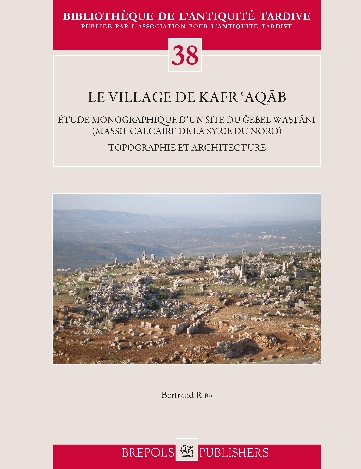
The new monographic study of the village of Kafr ʿAqāb is a contribution to broadening the field of research into the western part of the Limestone Massif in Northern Syria which, until now, had been the subject of only limited interest. The ruins of the site are mainly spread out over a vast rocky headland which is strategically situated at the northern extremity of the ğebel Waṣṭāni near the Orontes valley in the inland region of Antioch. These ruins reveal the existence of an ancient village with over 80 homes, various communal constructions, a monastery, two ecclesiastic complexes and a fortified building.
The study is based on a detailed analysis of surface ruins and has enabled the evolution of the village to be precisely determined from its first phase of occupation between the IInd and IIIrd century until it was abandoned during the medieval period. Most of the constructions date from the Roman and Proto-Byzantine periods. Each architectural group (houses, tombs, churches, agricultural buildings, etc.) is studied separately then resituated in the context of the village and the region thus enabling the author to determine this peasant community’s economic, demographic, social and religious history.
Mechanisms linked to the growth of the locality are examined in the light of strategies implemented in the appropriation and enhancement of the surrounding land such as controlling water and the diversification of crops which reveals the inhabitants’ extraordinary capacity to adapt to their natural environment. Discussion also covers the question of the interactions between the villagers and their relationships with other towns. Kafr ʿAqāb also owed its prosperity to the road network which was ingeniously woven between towns as well as to its proximity to major urban areas in Antioche and Apamea. The ruins reveal this highly favourable location for trade and the circulation of various cultural and artistic movements. Finally, numerous archaeological signs allow the study of the occupation of the village after it was invaded by VIIth century Arab conquerors. The author thus aims to reconstruct the history of this ancient site following a long and fascinating field study.
