


oa Art from the Borders? Wolfgang Fritz Volbach and the Localization of a Group of Early Christian Ivory Pyxides in the Caucasus
- By: Ruben Campini
- Publication: Re-Thinking Late Antique Armenia: Historiography, Material Culture, and Heritage , pp 152-167
- Publisher: Brepols
- Publication Date: January 2023
- DOI: https://doi.org/10.1484/M.CONVISUP-EB.5.135381


Art from the Borders? Wolfgang Fritz Volbach and the Localization of a Group of Early Christian Ivory Pyxides in the Caucasus, Page 1 of 1
< Previous page | Next page > /docserver/preview/fulltext/10.1484/M.CONVISUP-EB.5.135265/M.CONVISUP-EB.5.135381-1.gif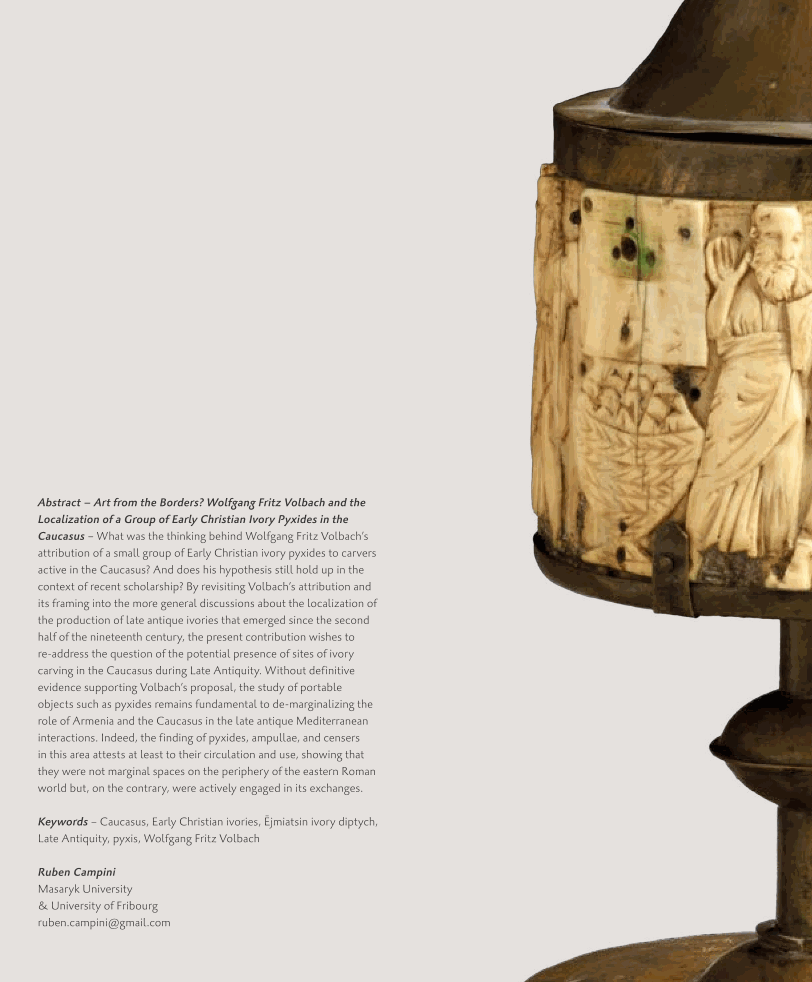
What was the thinking behind Wolfgang Fritz Volbach’s attribution of a small group of Early Christian ivory pyxides to carvers active in the Caucasus? And does his hypothesis still hold up in the context of recent scholarship? By revisiting Volbach’s attribution and its framing into the more general discussions about the localization of the production of late antique ivories that emerged since the second half of the nineteenth century, the present contribution wishes to re-address the question of the potential presence of sites of ivory carving in the Caucasus during Late Antiquity. Without definitive evidence supporting Volbach’s proposal, the study of portable objects such as pyxides remains fundamental to de-marginalizing the role of Armenia and the Caucasus in the late antique Mediterranean interactions. Indeed, the finding of pyxides, ampullae, and censers in this area attests at least to their circulation and use, showing that they were not marginal spaces on the periphery of the eastern Roman world but, on the contrary, were actively engaged in its exchanges.

Full text loading...
-
From This Site
/content/books/10.1484/M.CONVISUP-EB.5.135381dcterms_title,dcterms_subject,pub_serialIdent,pub_author,pub_keyword-contentType:Contributor -contentType:Concept -contentType:Institution105