
Full text loading...





Reconsidering Langobards’ Latinity from a socio-historical viewpoint, Page 1 of 1
< Previous page | Next page > /docserver/preview/fulltext/10.1484/M.LVLT-EB.5.142508/M.LVLT-EB.5.143322-1.gif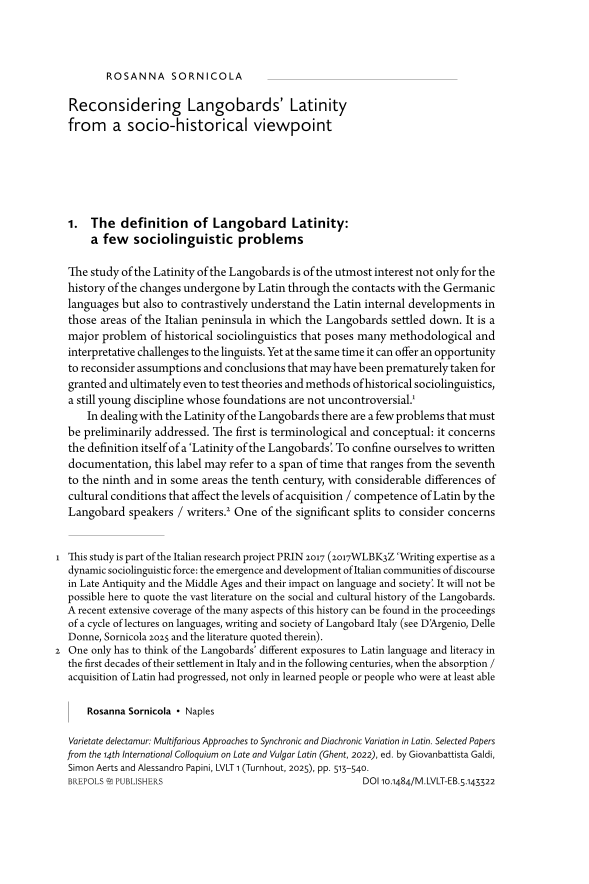
This contribution investigates the linguistic features of Langobard Latinity. The perspective adopted here combines the analysis of structures occurring in the documentary and literary texts written in Langobard cultural contexts and a consideration of the socio-historical factors of the Langobards’ complex ethnogenesis. The contribution debates the sociolinguistic implications of the Langobards’ imperfect learning of Latin during the early migration periods and the early settlements in the Balkans as well as the impact of their later settlements in Italy and their consequent language and culture contact to the Roman populations. A starting problem posed by the linguistic analysis is the possible existence of differences of the Langobard Latinity with respect to the Late Latinity of other parts of the post-Roman world. On the base of a comparison of structures from Late Latin texts, especially but not only documentary, of various areas of the Romania, two groups of structural phenomena are identified as possibly typical of Langobard Latinity, i.e. the vacillation and confusion of the genitive / dative inflectional endings and the accusative subjects with intransitive and passive verbs. The first group of phenomena has parallels in the Balkan Latinity, the second in the Late and vulgar Latin of some Romano-Germanic areas.
Full text loading...