
Full text loading...





Aspects of juridical language in Benedict’s Rule, Page 1 of 1
< Previous page | Next page > /docserver/preview/fulltext/10.1484/M.LVLT-EB.5.142508/M.LVLT-EB.5.143334-1.gif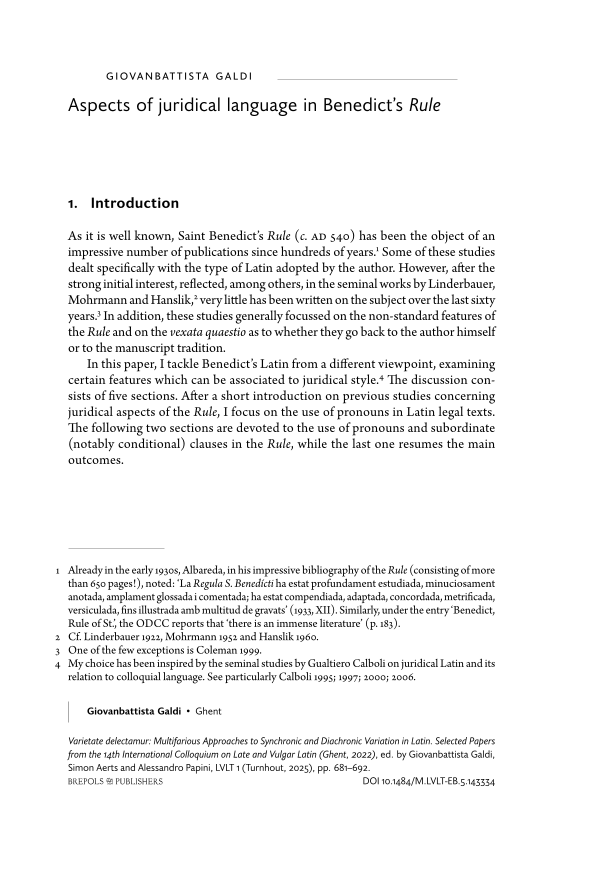
The language of Saint Benedict’s Rule has attracted notice among various scholars who generally focused on the manuscript tradition and on the presence of sub-standard features. However, the studies by Dom Chapman and Jacobs, which went totally unnoticed among philologists and linguists, convincingly argued that Benedict’s work was conceived as a ‘Verfassungsdokument’ and, accordingly that it can be analysed, also from the linguistic point of view, as a juridical text, namely as the ‘Grundgesetz’ of Monte Cassino’s monastery. In my paper, I discuss some features of the Rule that seem to reveal the deliberate adoption of a juridical style. Notably, inspired by the seminal studies by Gualtiero Calboli, I deal on the one hand with the use of the demonstrative pronouns, the ‘metalinguistic’ participles (suprascriptus, supra memoratus, etc.) and the linking relative, and, on the other hand, with the frequency and distribution of subordinate clauses, focussing on conditional sentences. My results confirm Dom Chapman’s and Jacob’s intuition that Benedict’s Latin displays several features that were widespread in juridical language, already since the classical period.
Full text loading...