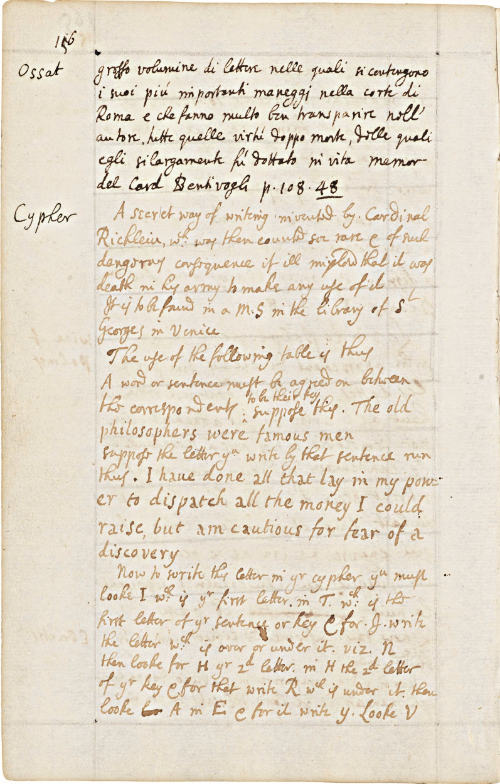
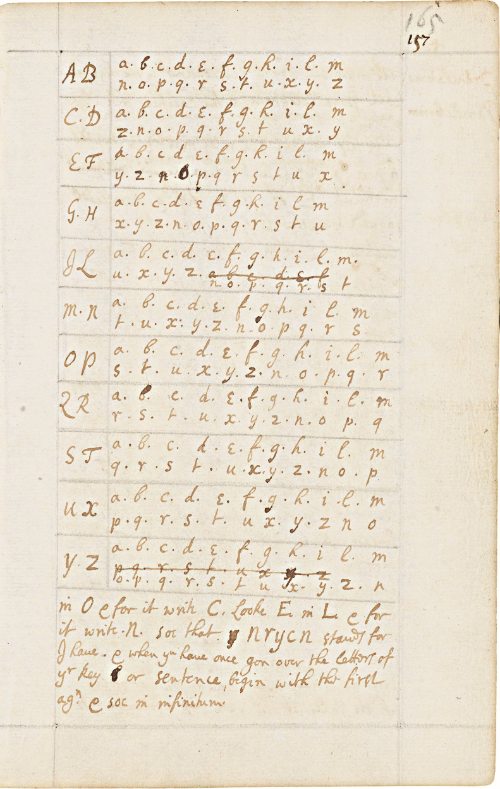
Bacon, Francis, Of the advancement and proficience of learning; or, The partitions of sciences, IX bookes. Written in Latin by the most eminent illustrious Lord Francis Bacon. Translated by Wats, Gilbert (Oxford: L. Lichfield, for R. Young & E. Forrest, 1640 [colophon 1639]).
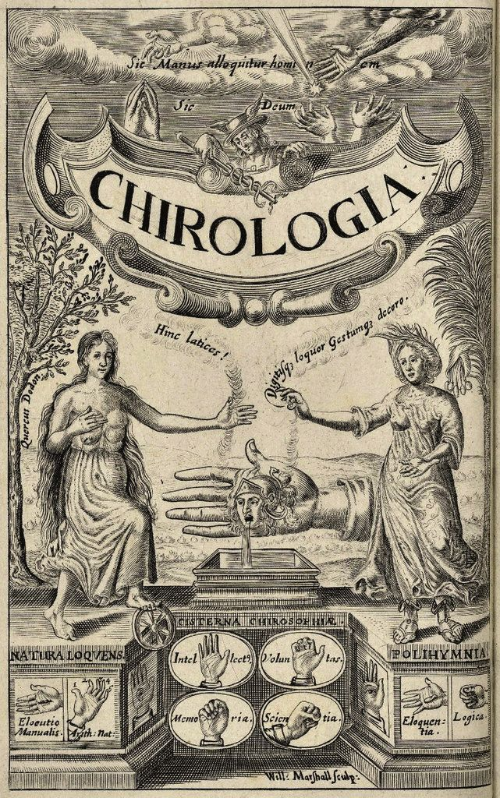
Bulwer, John, Chirologia, or, The naturall language of the hand: composed of the speaking motions, and discoursing gestures thereof: whereunto is added, Chironomia, or, The art of manual rhetoricke, consisting of the naturall expressions, digested by art in the hand …: with types, or chyrograms, a long-wish’d for illustration of this argument (London: Tho. Harper, and R. Whitaker, 1644).
De La Fin, Charles, Sermo mirabilis: or the silent language: Whereby one may learn perfectly in the space of six hours, how to impart his mind to his friend in any language, English, Latin, French, Dutch, &c. tho never so deep and dangerous a secret, without the least noise, word or voice; and without the knowledge of any in company. Being a wonderful art kept secret for several ages, in Padua, and now published only to the wise and prudent, who will not expose it, as a prostitute, to every foolish and ignorant fellow. / By Monsieur La Fin, once secretary to his eminence, the Cardinal of Richelieu. Licensed and entred according to order (London: Tho. Salusbury and Randal Taylor, 1692.
Locke, John, An Essay concerning Human Understanding, ed. by Peter H. Nidditch, 1st ed. 1975 (Oxford: Clarendon Press, 1984).
Locke, John, Discourses: translated from Nicole’s Essays, by John Locke, with important variations from the original French. 1. On the existence of a God. 2. On the weakness of man. 3. On the way of preserving peace. Now first printed from the autograph of the translator, in the possession of Thomas, Hancock (London: 1828).
Locke, John, Drafts for the ‘Essay concerning human understanding’, and other philosophical writings, ed. by Nidditch, Peter Harold, Rogers, G. A. J. (Oxford: Clarendon Press, 1990).
Locke, John, Drafts for the Essay concerning human understanding. Volume II, Draft C, ed. by John R. Milton, and Graham Alan John Rogers (Oxford: Clarendon Press, 2021).
Locke, John, Essays on the Law of Nature, and Associated Writings, ed. by W. von Leyden (Oxford: Clarendon Press, 1954).
Locke, John, Political essays, Mark Goldie, ed., (Cambridge: Cambridge University Press, 1997).
Locke, John, Some thoughts concerning education, ed. by Yolton, John W. and Yolton, Jean S. (Oxford: Clarendon Press, 1989).
Locke, John, The correspondence of John Locke, ed. by E. S. de Beer, and Nidditch, Peter Harold, 8 vols (Oxford: Clarendon Press, 1976–1989).
Montaigne, Michelde, The Essayes, or Morall, Politike, and Millitarie Discourses…Now done into English by… John Florio (London: Val. Sims for Edward Blount, 1603).
[Nye, Stephen], The life of Mr Thomas Firmin, late citizen of London written by one of his most intimate acquaintance; with a sermon on Luke X. 36, 37 preach’d on the occasion of his death; together with An account of his religion, and of the present state of the Unitarian controversy (London: A. Baldwin, 1698).
Rich, Jeremiah, Charactery, or a most easie and exact Method of Short and Swift Writing (London: 1646).
Rich, Jeremiah, Semography, or, Short and swift writing invented and composed for the benefit of others by the author hereof, William Cartwright, (London: [n.p.], 1642).
Rich, Jeremiah, The Pen’s Dexterity; or, the ingenious and useful art of writing short-hand. Containing twenty copper-plates … (London: [1660?]).
Rich, Jeremiah, The Pen’s Dexterity compleated, or Mr Riches Short-hand now perfectly Taught, Which in his life-time by his Table was never done. The Third Edition, with many Additions (London: Henry Eversden, 1674).
Shelton, Thomas, Tachygraphy, the most exact and compendious methode of short and swift writing that hath ever yet beene published, etc. (London: S. Cartwright, 1641).
Shelton, Thomas, Zeiglographia, or, a New Art of Short-writing never before published, etc. (London: E. Tracy, [1649]).
Wilkins, John, An Essay Towards a Real Character, and a Philosophical Language (London: for Sa. Gellibrand, and for Iohn Martyn printer to the Royal Society, 1668).
Vigenère, Blaisede, Traicté des chiffres, ou Secrètes manières d’escrire (Paris: L’Angelier, 1586).
Yolton, Jean S., John Locke as translator: three of the Essais of Pierre Nicole in French and English (Oxford: Voltaire Foundation, 2000).
Secondary Studies
Arnaud, Sabine, ‘Fingerspelling and the Appropriation of Language: The Shifting Stakes of a Practice of Signs’, Sign Language Studies, 19 (summer 2019), pp. 565–605.
Balibar, Etienne, ‘Conscience’, in Cassin Barbara, ed., Vocabulaire européen des philosophies. Dictionnaire des intraduisibles (Paris: Le Robert-Seuil, 2004), pp. 260–74.
Cagnolati, Antonella, ‘Comenius et le débat sur la langue universelle’, 291–300, in Le masque de l’écriture. Philosophie et traduction de la Renaissance aux Lumières, C. Le Blanc et L. Simonutti, eds (Geneva: CNR, 2015), pp. 201–300.
Cassin, Barbara, Plus d’une langue. Le paradigme de la traduction (Paris: Fondation Calouste Gulbenkian, 2014).
Cram, David, ‘Universal language schemes in 17th-century Britain’, Histoire Épistémologie Langage, 7.2 (1985). La réflexion linguistique en Grande-Bretagne — 17e–18e siècles, pp. 35–44.
Dawson, Hannah, ‘A ridiculous plan: Locke and the universal language movement’, Locke studies, 7 (2007), pp. 137–58.
Dawson, Hannah, Locke, Language and Early-Modern Philosophy (Cambridge: Cambridge University Press, 2007).
Duncan, Dennis, Harrison, Stephen, Kohl, Katrin and Reynolds, Matthew, eds, Babel. Adventures in Translation (Oxford: Bodleian Library, 2019).
Encrevé, Florence, ed., Traductologie et langue des signes (Paris: Classiques Garnier, 2021).
Gregory, Tullio, Origini della terminologia filosofica moderna (Florence: Olschki, 2006).
Gregory, Tullio, Translatio linguarum. Traduzioni e storia della cultura (Florence: Olschki, 2016).
Harrison, John R., Laslett, Peter, The Library of John Locke (Oxford: Clarendon Press, 1971).
Knowlson, James, Universal Language Schemes in England and France 1600–1800 (Toronto: University of Toronto Press, 1975).
Land, K. Stephen, ‘Universalism and Relativism: A Philosophical Problem of Translation in the Eighteenth Century’, Journal of the History of Ideas, 35. 4, (Oct-Dec 1974), pp. 597–610.
McCay, Kelly Minot, ‘“All the World Writes Short Hand”: The Phenomenon of Shorthand in Seventeenth-Century England’, Book History, 24.1 (2021), pp. 1––36.
Osimo, Bruno, Manuale del traduttore (Milan: Hoepli, 2006).
Prato, Alessandro, ‘Why is Locke’s Linguistic Theory Still Current and Interesting Today?’, European Journal (July-December 2022) ISSN 2411–4103 (Online) Language and Literature Studies 8.2, pp. 72–84.
Rooryck, Guy and Jooken, Lieve, ‘Locke ou la traduction de l’entendement’, in Event or Incident. On the Role of Translations in the Dynamics of Cultural Exchange, T. Naaijkens, ed. (Bern: Peter Lang, 2010), pp. 211–46.
Simonutti, Luisa, ‘An Innocent diversion. Locke traducteur’, in John Locke: les idées et les choses. Avec le manuscrit inédit “Notes upon Mr John Lock’s Essay Concerning Human Understanding” de William Whiston fils, L. Simonutti, ed. (Milan: Mimésis, 2019), pp. 105–21.
Simonutti, Luisa, ‘Locke traducteur de Nicole: The Weaknesse of Man’, in Le masque de l’écriture. Philosophie et traduction de la Renaissance aux Lumières, C. Le Blanc et L. Simonutti, eds (Geneva: CNR, 2015), pp. 627–39.
Simonutti, Luisa, ‘Inspirational Journeys and Trunks of Books: Initial Notes on Locke the Traveller’, Studi lockiani. Ricerche sull’età moderna, 1 (2020), pp. 131–62.
Simonutti, Luisa, ‘Traduzione’, in Il lessico della modernità. Continuità e mutamenti dal XVI al XVIII secolo, S. Bassi, ed., 2 vols (Rome: Carocci, 2022), II, pp. 1209–1223.
Thompson, James, ‘Wilkins, Locke and restoration concepts of language’, Interpretations, 12, 1 (1980), pp. 76––91.
Bacon, Francis, Of the advancement and proficience of learning; or, The partitions of sciences, IX bookes. Written in Latin by the most eminent illustrious Lord Francis Bacon. Translated by Wats, Gilbert (Oxford: L. Lichfield, for R. Young & E. Forrest, 1640 [colophon 1639]).
Bulwer, John, Chirologia, or, The naturall language of the hand: composed of the speaking motions, and discoursing gestures thereof: whereunto is added, Chironomia, or, The art of manual rhetoricke, consisting of the naturall expressions, digested by art in the hand …: with types, or chyrograms, a long-wish’d for illustration of this argument (London: Tho. Harper, and R. Whitaker, 1644).
De La Fin, Charles, Sermo mirabilis: or the silent language: Whereby one may learn perfectly in the space of six hours, how to impart his mind to his friend in any language, English, Latin, French, Dutch, &c. tho never so deep and dangerous a secret, without the least noise, word or voice; and without the knowledge of any in company. Being a wonderful art kept secret for several ages, in Padua, and now published only to the wise and prudent, who will not expose it, as a prostitute, to every foolish and ignorant fellow. / By Monsieur La Fin, once secretary to his eminence, the Cardinal of Richelieu. Licensed and entred according to order (London: Tho. Salusbury and Randal Taylor, 1692.
Locke, John, An Essay concerning Human Understanding, ed. by Peter H. Nidditch, 1st ed. 1975 (Oxford: Clarendon Press, 1984).
Locke, John, Discourses: translated from Nicole’s Essays, by John Locke, with important variations from the original French. 1. On the existence of a God. 2. On the weakness of man. 3. On the way of preserving peace. Now first printed from the autograph of the translator, in the possession of Thomas, Hancock (London: 1828).
Locke, John, Drafts for the ‘Essay concerning human understanding’, and other philosophical writings, ed. by Nidditch, Peter Harold, Rogers, G. A. J. (Oxford: Clarendon Press, 1990).
Locke, John, Drafts for the Essay concerning human understanding. Volume II, Draft C, ed. by John R. Milton, and Graham Alan John Rogers (Oxford: Clarendon Press, 2021).
Locke, John, Essays on the Law of Nature, and Associated Writings, ed. by W. von Leyden (Oxford: Clarendon Press, 1954).
Locke, John, Political essays, Mark Goldie, ed., (Cambridge: Cambridge University Press, 1997).
Locke, John, Some thoughts concerning education, ed. by Yolton, John W. and Yolton, Jean S. (Oxford: Clarendon Press, 1989).
Locke, John, The correspondence of John Locke, ed. by E. S. de Beer, and Nidditch, Peter Harold, 8 vols (Oxford: Clarendon Press, 1976–1989).
Montaigne, Michelde, The Essayes, or Morall, Politike, and Millitarie Discourses…Now done into English by… John Florio (London: Val. Sims for Edward Blount, 1603).
[Nye, Stephen], The life of Mr Thomas Firmin, late citizen of London written by one of his most intimate acquaintance; with a sermon on Luke X. 36, 37 preach’d on the occasion of his death; together with An account of his religion, and of the present state of the Unitarian controversy (London: A. Baldwin, 1698).
Rich, Jeremiah, Charactery, or a most easie and exact Method of Short and Swift Writing (London: 1646).
Rich, Jeremiah, Semography, or, Short and swift writing invented and composed for the benefit of others by the author hereof, William Cartwright, (London: [n.p.], 1642).
Rich, Jeremiah, The Pen’s Dexterity; or, the ingenious and useful art of writing short-hand. Containing twenty copper-plates … (London: [1660?]).
Rich, Jeremiah, The Pen’s Dexterity compleated, or Mr Riches Short-hand now perfectly Taught, Which in his life-time by his Table was never done. The Third Edition, with many Additions (London: Henry Eversden, 1674).
Shelton, Thomas, Tachygraphy, the most exact and compendious methode of short and swift writing that hath ever yet beene published, etc. (London: S. Cartwright, 1641).
Shelton, Thomas, Zeiglographia, or, a New Art of Short-writing never before published, etc. (London: E. Tracy, [1649]).
Wilkins, John, An Essay Towards a Real Character, and a Philosophical Language (London: for Sa. Gellibrand, and for Iohn Martyn printer to the Royal Society, 1668).
Vigenère, Blaisede, Traicté des chiffres, ou Secrètes manières d’escrire (Paris: L’Angelier, 1586).
Yolton, Jean S., John Locke as translator: three of the Essais of Pierre Nicole in French and English (Oxford: Voltaire Foundation, 2000).
Secondary Studies
Arnaud, Sabine, ‘Fingerspelling and the Appropriation of Language: The Shifting Stakes of a Practice of Signs’, Sign Language Studies, 19 (summer 2019), pp. 565–605.
Balibar, Etienne, ‘Conscience’, in Cassin Barbara, ed., Vocabulaire européen des philosophies. Dictionnaire des intraduisibles (Paris: Le Robert-Seuil, 2004), pp. 260–74.
Cagnolati, Antonella, ‘Comenius et le débat sur la langue universelle’, 291–300, in Le masque de l’écriture. Philosophie et traduction de la Renaissance aux Lumières, C. Le Blanc et L. Simonutti, eds (Geneva: CNR, 2015), pp. 201–300.
Cassin, Barbara, Plus d’une langue. Le paradigme de la traduction (Paris: Fondation Calouste Gulbenkian, 2014).
Cram, David, ‘Universal language schemes in 17th-century Britain’, Histoire Épistémologie Langage, 7.2 (1985). La réflexion linguistique en Grande-Bretagne — 17e–18e siècles, pp. 35–44.
Dawson, Hannah, ‘A ridiculous plan: Locke and the universal language movement’, Locke studies, 7 (2007), pp. 137–58.
Dawson, Hannah, Locke, Language and Early-Modern Philosophy (Cambridge: Cambridge University Press, 2007).
Duncan, Dennis, Harrison, Stephen, Kohl, Katrin and Reynolds, Matthew, eds, Babel. Adventures in Translation (Oxford: Bodleian Library, 2019).
Encrevé, Florence, ed., Traductologie et langue des signes (Paris: Classiques Garnier, 2021).
Gregory, Tullio, Origini della terminologia filosofica moderna (Florence: Olschki, 2006).
Gregory, Tullio, Translatio linguarum. Traduzioni e storia della cultura (Florence: Olschki, 2016).
Harrison, John R., Laslett, Peter, The Library of John Locke (Oxford: Clarendon Press, 1971).
Knowlson, James, Universal Language Schemes in England and France 1600–1800 (Toronto: University of Toronto Press, 1975).
Land, K. Stephen, ‘Universalism and Relativism: A Philosophical Problem of Translation in the Eighteenth Century’, Journal of the History of Ideas, 35. 4, (Oct-Dec 1974), pp. 597–610.
McCay, Kelly Minot, ‘“All the World Writes Short Hand”: The Phenomenon of Shorthand in Seventeenth-Century England’, Book History, 24.1 (2021), pp. 1––36.
Osimo, Bruno, Manuale del traduttore (Milan: Hoepli, 2006).
Prato, Alessandro, ‘Why is Locke’s Linguistic Theory Still Current and Interesting Today?’, European Journal (July-December 2022) ISSN 2411–4103 (Online) Language and Literature Studies 8.2, pp. 72–84.
Rooryck, Guy and Jooken, Lieve, ‘Locke ou la traduction de l’entendement’, in Event or Incident. On the Role of Translations in the Dynamics of Cultural Exchange, T. Naaijkens, ed. (Bern: Peter Lang, 2010), pp. 211–46.
Simonutti, Luisa, ‘An Innocent diversion. Locke traducteur’, in John Locke: les idées et les choses. Avec le manuscrit inédit “Notes upon Mr John Lock’s Essay Concerning Human Understanding” de William Whiston fils, L. Simonutti, ed. (Milan: Mimésis, 2019), pp. 105–21.
Simonutti, Luisa, ‘Locke traducteur de Nicole: The Weaknesse of Man’, in Le masque de l’écriture. Philosophie et traduction de la Renaissance aux Lumières, C. Le Blanc et L. Simonutti, eds (Geneva: CNR, 2015), pp. 627–39.
Simonutti, Luisa, ‘Inspirational Journeys and Trunks of Books: Initial Notes on Locke the Traveller’, Studi lockiani. Ricerche sull’età moderna, 1 (2020), pp. 131–62.
Simonutti, Luisa, ‘Traduzione’, in Il lessico della modernità. Continuità e mutamenti dal XVI al XVIII secolo, S. Bassi, ed., 2 vols (Rome: Carocci, 2022), II, pp. 1209–1223.
Thompson, James, ‘Wilkins, Locke and restoration concepts of language’, Interpretations, 12, 1 (1980), pp. 76––91.