


The Ottoman Silk Textiles of the Royal Museum of Art and History in Brussels
Abstract
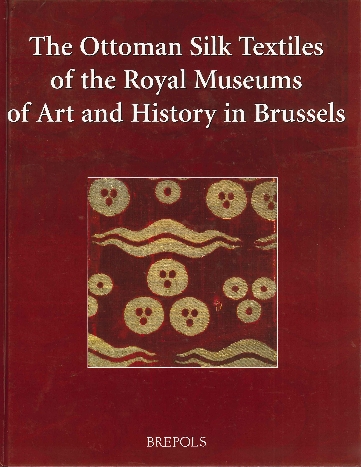
The Royal Museums of Art and History in Brussels, commonly known as the Cinquantenaire, possess a collection of about 1200 pieces of Islamic Art (not including some 1.000 potsherds from Fustat in Egypt). They originate from countries located between Spain and India, and date from the 7th to the beginning of the 20th century. The emphasis is on silk textiles. This we owe to Isabella Errera (Florence 1869 - Brussels 1929), who collected, published and eventually donated or bequeathed no less than 764 textiles to the museum, about three hundred of which are Islamic. The 43 Ottoman items in this collection form the subject of this study.
Except two, for which we cannot be certain, these Ottoman textiles were woven in the major metropolitan weaving centres of the Ottoman Empire, namely Bursa, Istanbul and their surroundings. They all date from the period between the second half of the 15th and the early 19th century. Two types of weaves are represented: velvets and kemha or lampas fabrics. One of the velvets, of which the collection numbers 25 examples, is an important çatma, probably the earliest preserved in the world. Six kemha or lampas fabrics, of which we possess 16 specimens, bear inscriptions; the others are decorated with various patterns. The third main type of Ottoman weave, the serâser or cloth of gold and silver, which is rare in Western collections, is not represented. Finally, the collection contains two silks in a distinctive weave, an extended tabby, of which one is a military banner. Although these fall slightly outside of the otherwise homogeneous group, they where included in this study because they were definitely produced within the Ottoman realm.
This catalogue is the result of a collaboration between different specialists. The technological study of the textiles was executed by Daniël De Jonghe, textile engineer, and Chris Verhecken-Lammens, both independent scientific collaborators at the Royal Museums of Art and History. Mieke Van Raemdonck, curator of the Islamic Collection and editor of the present publication, described the textiles and traced their origin. For the natural dye analysis and conservation treatment, the museum appealed to the Royal Institute for the Cultural Heritage, located in the same Cinquantenaire-complex. The study and report of the natural dyes were performed by Ina Vanden Berghe, textile engineer, and Dr Jan Wouters, chemist, Head of the Laboratory of Materials and Techniques, with the practical assistance of Marie-Christine Maquoi, lab technician. The conservation treatment took place under the responsibility of Vera Vereecken, Head of the Textile workshop, who also wrote the reports and comments on this aspect.
The aim of this catalogue is to present a status quaestionis of knowledge that was gathered the past ten years regarding this group of silks and to put it at the disposal of other museum curators and researchers. Since the scrutiny of the weaving technology and of the natural dyes can lead to a better understanding of the silk industry, special focus is laid on these aspects. They may indeed yield concrete information allowing us to delimit groups of textiles and - why not - workshops and production centres.
