Brepols
Brepols is an international academic publisher of works in the humanities, with a particular focus in history, archaeology, history of the arts, language and literature, and critical editions of source works.3061 - 3080 of 3194 results
-
-
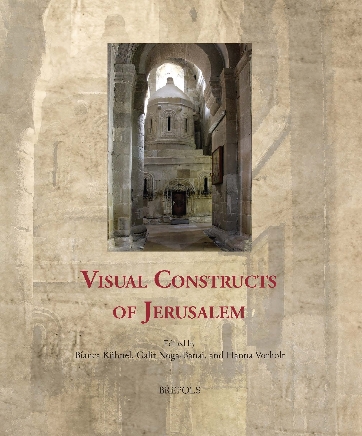
Visual Constructs of Jerusalem
show More to view fulltext, buy and share links for:Visual Constructs of Jerusalem show Less to hide fulltext, buy and share links for: Visual Constructs of JerusalemThe special position of Jerusalem among the cities of the world stems from a long history shared by the three Abrahamic religions, and the belief that the city reflected a heavenly counterpart. Because of this unique combination, Jerusalem is generally seen as extending along a vertical axis stretching between past, present, and future. However, through its many ‘earthly’ representations, Jerusalem has an equally important horizontal dimension: it is represented elsewhere in all media, from two-dimensional maps to monumental renderings of the architecture and topography of the city’s loca sancta.
In documenting the increasing emphasis on studying the earthly proliferations of the city, the current book witnesses a shift in theoretical and methodological insights since the publication of The Real and Ideal Jerusalem in Jewish, Christian, and Islamic Art in 1998. Its main focus is on European translations of Jerusalem in images, objects, places, and spaces that evoke the city through some physical similarity or by denomination and cult - all visual and material aids to commemoration and worship from afar. The book discusses both well-known and long-neglected examples, the forms of cult they generate and the virtual pilgrimages they serve, and calls attention to their written and visual equivalents and companions. In so doing, it opens a whole new vista onto the summa of representations of Jerusalem.
-
-
-
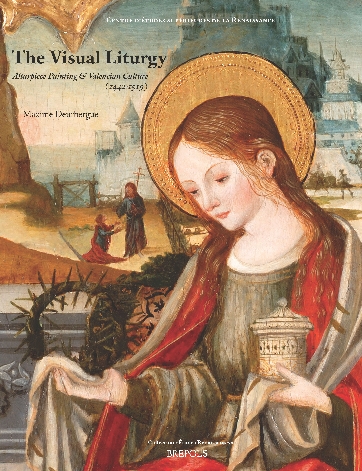
Visual Liturgy: Altarpiece Painting and Valencian Culture (1442-1519)
show More to view fulltext, buy and share links for:Visual Liturgy: Altarpiece Painting and Valencian Culture (1442-1519) show Less to hide fulltext, buy and share links for: Visual Liturgy: Altarpiece Painting and Valencian Culture (1442-1519)In the introduction to his Early Netherlandish Painting, Erwin Panofsky characterised 15th-century European painting with an opposition between the art of Italy and that of Flanders, and significantly, he recalled that in the eyes of a Luther or of a Michelangelo, no other School deserved attention. Six centuries later, Spanish art of this period remains little known outside the Iberian Peninsula. The fact that a large number of the works of art are still kept in their original location surely plays a part in this, but there is also a lasting prejudice that this art is aesthetically and intellectually little exciting. Retables were then the utmost artistic expression. At first sight, they mostly look the same. Because this art seems changeless, its exegesis has been routine and vague.
The Visual Liturgy challenges this situation. Focusing on the Aragonese city of Valencia, then at the height of its pride and glory, it examines a school of painters, which reflects a wider scene, namely the civic and religious preoccupations of a whole culture. Not only does it provide a comprehensive view of current research on Valencian painting, it connects it to the wider context of Valencian piety and tackles the dialectics at work in civic culture: how the monarchy took hold of the municipality; how foreign influences challenged local tradition; how sophisticated altarpieces emerged from the standard stock of artistic production; how, finally, the liturgy prevented ruptures between the religion of the learned and more popular, even at times slightly unorthodox, expressions of the faith.
The Visual Liturgy thus provides a better understanding of 15th-century Spanish art. It sheds important new light on the birth of an artistic school in a context of competing foreign influences, and on the reception of such influences into a radically different culture; finally, it is the first attempt to explore the meaning of Valencian altarpieces with reference to their cultural, spiritual and liturgical context of creation.
-
-
-
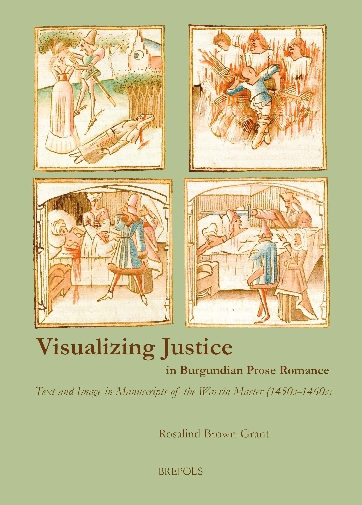
Visualizing Justice in Burgundian Prose Romance
Text and Image in Manuscripts of the Wavrin Master (1450s–1460s)
show More to view fulltext, buy and share links for:Visualizing Justice in Burgundian Prose Romance show Less to hide fulltext, buy and share links for: Visualizing Justice in Burgundian Prose RomanceThis is the first monograph devoted to manuscripts illuminated by the mid-fifteenth-century artist known as the Wavrin Master, so-called after his chief patron, Jean de Wavrin, chronicler and councillor at the court of Philip the Good of Burgundy. Specializing in the production of pseudo-historical prose romances featuring the putative ancestors of actual Burgundian families, the artist was an attentive interpreter of these texts which were designed to commemorate the chivalric feats of past heroes and to foster their emulation by noble readers of the day. Integral to these heroes’ deeds is the notion of justice, their worth being measured by their ability to remedy criminal acts such as adultery, murder, rape, and usurpation. In a corpus of 10 paper manuscripts containing the texts of 15 romances and over 650 watercolour miniatures, the stylized, expressive images of the Wavrin Master bring out with particular clarity the lessons in justice which these works offered their contemporary audience, many of whom, from the Burgundian dukes downwards, would have been responsible for upholding the law in their territories. Chapters are devoted to issues such as the nature of just war and how it is linked to good rulership; what forms of legal redress the heroines of these tales are able to obtain with or without the help of a male champion; and what responses are available in law to a spouse betrayed by an adulterous partner. The book will be of interest to scholars of medieval art, literature, legal and cultural history, and gender studies.
-
-
-
Vivarium. I libri, il destino
show More to view fulltext, buy and share links for:Vivarium. I libri, il destino show Less to hide fulltext, buy and share links for: Vivarium. I libri, il destinoIn its understated way, this work establishes several theses each one of which, taken separately, could reasonably be considered sensational. First we have the discovery of the autograph of Cassiodorus. In shorthand, as one would expect from a busy man with a strong sense of time management, it testifies that Cassiodorus reviewed (Cassiodorus legi), or verified (perlegi Cassiodorus) a text. The signature occurs in codices that had already, through other considerations, been associated with Vivarium, and becomes in turn a strong criterion for the identification of works not previously associated with the Calabrian foundation. In some manuscripts a hand already known as 'manus prima', can now be identified with those of scribes active at Vivarium. These hands were not simply copying orthodox texts, but critically examining those written by authors of different persuasions: we know now that a codex well-known for its Arian scholia was studied and annotated at Vivarium. Cassiodorus and his team of writers/translators were squirreling away on texts by Church Fathers and heretics, analysing them, taking from them what could be suitable, reading everything. So, Vivarium was a militantly Chalcedonian monastery, but also one where the alternatives, dubbed by modern scholars 'Arian scholia' were duly studied and annotated. These essays by Fabio Troncarelli are an example of 'integral palaeography' in the sense of the definition, by now a classic, of Leonard E. Boyle (Medieval Latin Palaeography, Author's Preface, p. xv). Through the highly specialised technique of demanding discipline, the author succeeds in reconstructing the intellectual climate and the historical setting of Vivarium.
-
-
-
Vocabulaire des collèges universitaires (XIIIe - XVIe siècles)
Actes du colloque, Leuven 9-11 avril 1992
-
-
-
Vocabulaire des écoles et des méthodes d'enseignement au moyen âge
Actes du colloque, Rome 21-22 octobre 1989
-
-
-
Vocabulaire du livre et de l'écriture au moyen âge
Actes de la table ronde, Paris 24-26 septembre 1987
-
-
-
Vocabulary of Teaching and Research Between Middle Ages and Renaissance
Proceedings of the Colloquium London, Warburg Institute, 11-12 March 1994
-
-
-
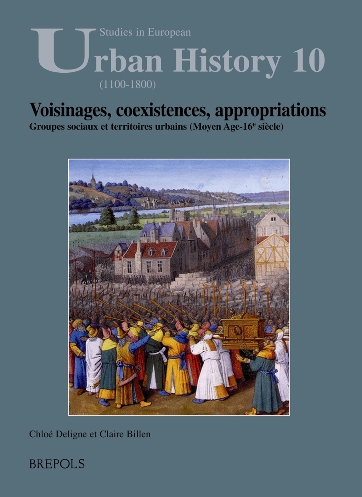
Voisinages, coexistences, appropriations
Groupes sociaux et territoires urbains (Moyen Age-16e siècle)
show More to view fulltext, buy and share links for:Voisinages, coexistences, appropriations show Less to hide fulltext, buy and share links for: Voisinages, coexistences, appropriationsFruit des travaux du colloque intitulé «Groupes sociaux et territoires urbains (Moyen Age-16e siècle)» organisé en décembre 2004 à l’Université Libre de Bruxelles, cet ouvrage rassemble douze contributions originales consacrées aux dynamiques sociales de l’espace urbain en Europe de l’ouest durant le bas Moyen Âge.
Dans sa première partie, l’ouvrage montre la structuration à long terme de l’espace urbain par les stratégies d’occupation de groupes dominants: chapitres canoniaux, élites scabinales, métiers (Tours, Namur, Trévise). Il confronte ce processus d’appropriation à la capacité de réagencement matériel ou symbolique déployée par certains acteurs urbains. Accident aléatoire (Tortosa), circonstances politiques (Bruges), modulation des rapports à la ville (Ratisbonne) redessinent les territoires respectifs, rallument sans cesse la lutte pour la maîtrise de l’espace et de ses éléments signifiants.
Dans sa seconde partie, l’ouvrage donne à penser la société urbaine dans ses relations avec des horizons plus lointains. Dans un premier temps sont abordées les relations des villes avec leur arrière-pays, sur lequel les groupes citadins dominants réinventent sans cesse les modalités économiques et juridiques de leur contrôle (Bruxelles, Chieri, Dijon). Dans un second temps, sont considérées les armatures urbaines de certains territoires (Brabant, Hainaut, Saint-Empire) dont la vivacité économique dépend de l’intensité des relations marchandes.
Les articles réunis ici éclairent, souvent d’un jour nouveau, non seulement l’histoire singulière des villes concernées mais plus fondamentalement les processus et les logiques à l’œuvre dans l’agencement et le réagencement permanent des espaces urbains.
-
-
-
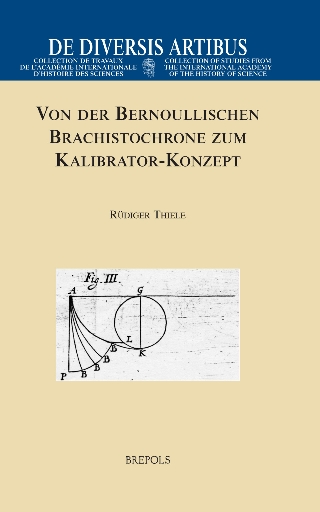
Von der Bernoullischen Brachistochrone zum Kalibrator-Konzept
Ein historischer Abriß zur Entstehung der Feldtheorie in der Variationsrechnung (hinreichende Bedingungen in der Variationsrechnung)
show More to view fulltext, buy and share links for:Von der Bernoullischen Brachistochrone zum Kalibrator-Konzept show Less to hide fulltext, buy and share links for: Von der Bernoullischen Brachistochrone zum Kalibrator-KonzeptDie Aufgabe der klassischen Variationsrechnung besteht darin, Kurven oder Funktionen zu bestimmen, denen im Vergleich mit anderen eine bestimmte Eigenschaft im größten oder kleinsten Maße zukommt. Die Art des Vergleichens bestimmt dabei den Charakter des Extremums. In dieser Studie wird die Frage untersucht, wie für starke Extrema (in der Norm des C 0) hinreichende Kriterien (sogenannten Feldtheorie) entstanden, entwickelt und eingesetzt worden sind. Diese Untersuchungen sind mit Namen wie Joh. Bernoulli, Jacobi, Weierstraß, Schwarz, Darboux, Hilbert, Kneser, Carathéodory, Lepage und anderen verbunden. Der Zeitraum reicht von Brachistochronenproblem 1696 bis in die Mitte des vorigen Jahrhunderts, betrachtet werden sowohl einfache als auch mehrdimensionale Variationsprobleme mit mehreren gesuchten Funktionen. Neben den entsprechenden gedruckten Arbeiten sind in die Untersuchungen in einem Maße, wie es in der Geschichte der Variationsrechnung bisher noch nicht erfolgt ist, ungedruckte Quellen wie einschlägige Briefe, Notizbücher, Vorlesungskonzepte, -mitschriften und -ausarbeitungen einbezogen worden, wodurch selbst in manchen Fragen auf die allgemeine Entwicklung der Variationsrechnung neues Licht geworfen wird.
-
-
-
Vérité et apparence
Mélanges en l’honneur de Carlos Lévy, offerts par ses amis et ses disciples
show More to view fulltext, buy and share links for:Vérité et apparence show Less to hide fulltext, buy and share links for: Vérité et apparenceBien qu’il soit encore bien trop tôt pour dresser un bilan critique de l’activité scientifique de Carlos Lévy, qui demeure en pleine évolution et qui promet toujours de nouvelles contributions à nos études, il est déjà évident qu’il a laissé une empreinte très importante dans les disciplines classiques au moins à deux égards : du point de vue de la méthode, Carlos Lévy a enseigné combien il est important, à une époque où la recherche se spécialise toujours plus, de ne pas perdre au contraire la capacité de « penser sans frontières », en joignant la sensibilité de l’intuition géniale à la rigueur des principes philologiques et à une compétence dans la discipline aussi solide qu’étendue et complète. C’est dans cette perspective que s’épanouit sa surprenante capacité de travailler à la fois comme historien de la philosophie, spécialiste de la pensée politique classique, expert en rhétorique et en éloquence, autant qu’en linguistique et en sémantique historique ; dans cette perspective encore que se comprend sa volonté d’étudier textes grecs comme textes latins, appartenant à toutes les écoles philosophique de l’Antiquité, et aussi ceux d’auteurs éloignés du domaine de la philosophie ; dans cette perspective enfin que se dessine son ouverture vers la modernité, la permanence de l’époque classique, le dialogue avec la philosophie contemporaine. Du point de vue des contenus, d’autre part, il est évident que l’activité scientifique de Carlos Lévy s’est concentrée surtout - mais certainement pas seulement - sur le sujet fascinant et toujours actuel du rapport entre vérité et apparence, entre dogme et incertitude, entre ontologie et gnoséologie. C’est donc autour du binôme vérité et apparence, envisagé autant d’un point de vue philosophique que d’un point de vue plus proprement rhétorique ou poétique, à travers l’étude d’auteurs de l’Antiquité à la Renaissance, que s’est construit ce volume d’amitié.
Perrine Galand, normalienne, ancien membre junior de l’Institut Universitaire de France, directeur d’études à l’École pratique des Hautes Études, est spécialiste de la poétique de la Renaissance européenne.
Ermanno Malaspina, professeur d’histoire de la langue latine à Turin, s’occupe de Cicéron, de Sénèque et du paysage littéraire en latin.
-
-
-
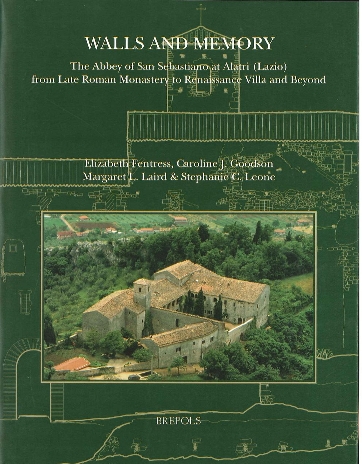
Walls and Memory: The Abbey of San Sebastiano at Alatri (Lazio), from Late Roman Monastery to Renaissance Villa and Beyond
show More to view fulltext, buy and share links for:Walls and Memory: The Abbey of San Sebastiano at Alatri (Lazio), from Late Roman Monastery to Renaissance Villa and Beyond show Less to hide fulltext, buy and share links for: Walls and Memory: The Abbey of San Sebastiano at Alatri (Lazio), from Late Roman Monastery to Renaissance Villa and BeyondThe abbey of San Sebastiano, which lies not far from the town of Alatri in Southern Lazio, preserves within its walls almost fifteen hundred years of history. This history is unusually bound to a number of important figures, from Saint Benedict to Pope Nicholas V and his circle of humanists. For the past four years a small team has been investigating the extant structures of the abbey, analyzing the stratigraphy of the standing walls and tracing the various building phases. The study has produced some startling discoveries: the plan and preserved walls of one of the oldest monasteries in Europe, and one of the earliest Renaissance villas. The book gives an account of the architecture and the history of the building, showing how each phase relates to the last both structurally and thematically.
The project was initiated at the American Academy in Rome, where Elizabeth Fentress was Andrew Mellon Professor, and Caroline Goodson, Margaret L. Laird and Stephanie C. Leone were Fellows. Margaret Laird and Stephanie Leone are now assistant professors at the University of Washington, Seattle and at Boston College. Other contributors include Caroline Bruzelius, Professor of the History of Art at Duke University, Antonio Manfredi, Vatican Library, Serena Romano, Professor of the History of Art at the University of Lausanne, Marco Rossi, director of the Museum of Alatri, and Ingrid Rowland, Andrew Mellon Professor at the American Academy in Rome.
-
-
-
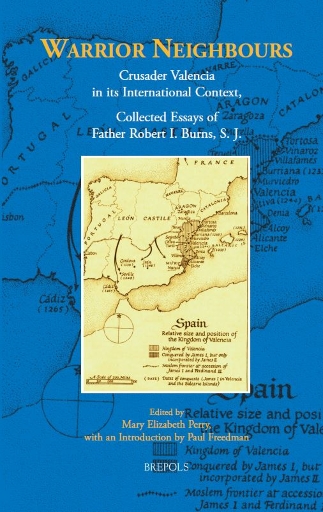
Warrior Neighbours
Crusader Valencia in its International Context, Collected Essays of Father Robert I. Burns, S. J.
show More to view fulltext, buy and share links for:Warrior Neighbours show Less to hide fulltext, buy and share links for: Warrior NeighboursThis volume presents the impressive corpus of studies by Robert I. Burns, SJ, on the topic that he has spent a half-century exploring in meticulous detail: the Crusader Kingdom of Valencia. These studies focus on one of Europe’s greatest medieval monarchs, James the Conqueror of Aragon-Catalonia, who made an enduring contribution to Western civilization.
James I ‘the Conqueror’ conquered Mediterranean Spain from Islam during fifty crusading years (1225-1276). Not only did he contend with ‘infidel’ powers around him, he frequently vied with warring Christian neighbours. This book presents a rich depiction of King James’s warrior neighbours, Muslim and Christian, from the king who was his greatest ally and greatest rival, Alfonso X the Learned (1212-1284), to the redoubtable and resourceful al-Azraq, a Muslim adventurer, rebel, and leader of one of the most formidable Islamic countercrusades in Spain. These studies illuminate such themes as cultural conflict and interchange, border tensions and frontier relations, medieval warfare and crusading, piracy, brigandage and reprisals, grievance management, medieval queenship and papal relations, the role of Jews in a pluri-ethnic kingdom, Mudejars and Moriscos, and the warrior heroes of Islam. King James presided over a society more complex than any in Christendom, and these studies unlock the details of this stunning achievement.
Robert I. Burns, SJ, Ph.D. (Johns Hopkins University), Doc. es Sc. Hist. (Fribourg University, Switzerland), was Professor Emeritus of History at UCLA and Director of the Institute of Medieval Mediterranean Spain. He was an elected Fellow of the Medieval Academy of America, and of the Hispanic Society of America, and a Guggenheim Fellow. His distinctions include the Haskins gold medal of the Medieval Academy of America, seven national book awards, eight honorary doctorates, and the Order of the Cross of St George.
-
-
-
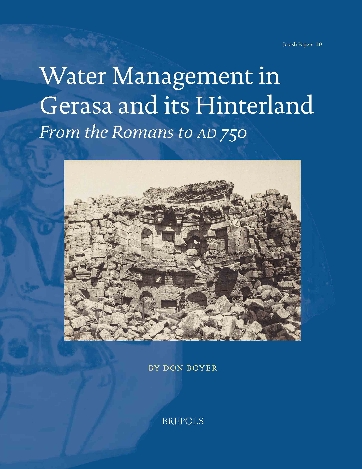
Water Management in Gerasa and its Hinterland
From the Romans to ad 750
show More to view fulltext, buy and share links for:Water Management in Gerasa and its Hinterland show Less to hide fulltext, buy and share links for: Water Management in Gerasa and its HinterlandThe Decapolis city of Gerasa has seen occupation since the Bronze Age but reached its zenith in the Roman to early Islamic period as a population centre and trading hub. Located in a fertile valley in the limestone foothills of the Ajlun mountains, the city benefitted from a benign climate and an excellent local water supply from karstic springs and perennial streams. By the Roman-Early Byzantine period, these water sources were harnessed and managed by extensive aqueduct and distribution networks that satisfied the broad range of water needs of both urban and rural dwellers.
This volume offers an up-to-date, comprehensive, and multidisciplinary analysis of the water management system employed in both Gerasa and its hinterland from the time of Roman occupation to the devastating earthquakes that struck the city at the end of the Umayyad period. Drawing on archaeological evidence from the author’s field research, together with a critical and detailed analysis of the evidence of water installations and the results of a radiocarbon dating study, this insightful book offers the first diachronic interpretation of Gerasa’s water distribution, setting the city in its geoarchaeological, historical, and landscape contexts, and contributing to the broader understanding of its archaeological history.
-
-
-
Water in Medieval Intellectual Culture
Case Studies from Twelfth-Century Monasticism
show More to view fulltext, buy and share links for:Water in Medieval Intellectual Culture show Less to hide fulltext, buy and share links for: Water in Medieval Intellectual CultureThis volume provides a new contribution to the understanding of twelfth-century monasticism and medieval intellectual culture by exploring the relationship between water and the composition of thought. It provides a fresh insight into twelfth-century monastic philosophies by studying the use of water as an abstract entity in medieval thought to frame and discuss topics such as spirituality, the natural order, knowledge visualization, and metaphysics in various high medieval texts, including Godfrey of Saint-Victor’s Fons Philosophiae, Peter of Celle’s letter corpus, and the Description of Clairvaux.
Through case studies of water in poetry, landscape narrative, and epistolary communication, this work traces the role of water as a uniquely medieval instrument of thought. Theoretical chapters of this book use water to explore the shaping of the medieval metaphor. Further case studies examine the differing and complex uses of water as a metaphor in various monastic texts. Focussing on the changeable power and material properties of water, this volume assesses the significance and deployment of environmental imagery in the composition, narration, and recollection of organized thought within the twelfth-century monastic community.
-
-
-
Wealth and Poverty in European Rural Societies from the Sixteenth to Nineteenth Century
show More to view fulltext, buy and share links for:Wealth and Poverty in European Rural Societies from the Sixteenth to Nineteenth Century show Less to hide fulltext, buy and share links for: Wealth and Poverty in European Rural Societies from the Sixteenth to Nineteenth CenturyThis book sheds new light on old problems of wealth, poverty and material culture in rural societies. Much of the debate has concentrated on north-west Europe and the Atlantic world. This volume widens the geographic range to compare less well known areas, with case studies on the Mediterranean world (Catalonia and Greece), from central Europe (Bohemia and Hungary), and from the Nordic countries (Denmark). Methodologically, several papers link the possession of goods to the use of room space, while others highlight the importance of the channels for the circulation of goods, problems of stocks and flows of goods, and the complexities of urban/rural difference. Finally, this book seeks to stimulate new comparative studies in living standards and lifestyles by providing an overview of achievements up till now.
John Broad is visiting academic at the Cambridge Group for the History of Population and Social Structure, University of Cambridge. He has published on rural society and poverty in England, and his current research interests include a book on English rural housing, and large-scale surveys of population, religion, and landholding in England in the eighteenth century.
Anton Schuurman is associate professor of Rural History at Wageningen University. He has published on the history of material culture and rural transformations in the Netherlands. Currently he is writing a book on the processes of modernisation and democratisation in the Dutch countryside from 1840 till 1920.
-
-
-
Weaving, Veiling, and Dressing
Textiles and their Metaphors in the Late Middle Ages
show More to view fulltext, buy and share links for:Weaving, Veiling, and Dressing show Less to hide fulltext, buy and share links for: Weaving, Veiling, and DressingChristianity is a religion of clothing. To become a priest or a nun is to take the cloth. The Christian liturgy is intimately bound with veiling objects and revealing them. Cloths hide the altar, making it all the more spectacular when it is revealed. Fragments of imported silk cradle the relic, thereby giving identity to the dessicated bone. Much of that silk came from the east, meaning that a material of Islamic origin was a primary signifier of sanctity in Christianity. Weaving, Veiling, and Dressing brings together twelve essays about text and textile, about silk and wool, about the formation of identity through fibre. The essays bring to light hitherto unseen material, and for the first time, establish the function of textiles as a culturally rich way to approach the Middle Ages. Textiles were omnipresent in the medieval church, but have not survived well. To uncover their uses, presence, and meanings in the Middle Ages is to reconsider the period spun, draped, clothed, shrouded, and dressed. Textiles in particular were essential to the performance of devotion and of the liturgy. Brightly dyed cloth was a highly visible maker of meaning. While some aspects of culture have been studied, namely the important tapestry industry, as well as some of the repercussions and activities of cloth guilds, other areas of textile studies in the period are yet to be studied. This book brings an interdisciplinary approach to new material, drawing on art history, anthropology, medieval text history, theology, and gender and performance studies. It makes a compelling miscellany exploring the nature of Christianity in the largely uninvestigated field of text and textile interplay.
-