


Brepols
Brepols is an international academic publisher of works in the humanities, with a particular focus in history, archaeology, history of the arts, language and literature, and critical editions of source works.2351 - 2400 of 3194 results
-
-
Resonances
Historical Essays on Continuity and Change
show More to view fulltext, buy and share links for:Resonances show Less to hide fulltext, buy and share links for: ResonancesContinuity and change enclose a problem field that is fundamental to the interpretation of historical material. On the one hand the notions that are necessary to perceive the historical account as a narrative: continuity, tradition, constancy, consistency, identity; on the other those that provide an impetus or drive to that account: change, innovation, rupture, or discontinuity.
Resonances: Historical Essays on Continuity and Change explores the historiographical question of the modes of interrelation between these motifs in historical narratives. The essays in the collection attempt to realize theoretical consciousness through historical narrative ‘in practice’, by discussing selected historical topics from Western cultural history, within the disciplines of history, literature, visual arts, musicology, archaeology, philosophy, and theology.
The title Resonances indicates the overall perspective of the book: how connotations of past meanings may resonate through time, in new contexts, assuming new meanings without surrendering the old.
-
-
-
Resounding Images
Medieval Intersections of Art, Music, and Sound
show More to view fulltext, buy and share links for:Resounding Images show Less to hide fulltext, buy and share links for: Resounding ImagesWhile sound is probably the most difficult component of the past to reconstruct, it was also the most pervasive, whether planned or unplanned, instrumental or vocal, occasional or ambient. Acoustics were central to the perception of performance; images in liturgical manuscripts were embedded in a context of song and ritual actions; and architecture provided both visual and spatial frameworks for music and sound. Resounding Images brings together specialists in the history of art, architecture, and music to explore the manifold roles of sound in the experience of medieval art. Moving beyond the field of musical iconography, the contributors reconsider the relationship between sound, space and image in the long Middle Ages.
-
-
-
Resourcescape and Human Impact in Southwest Asia
show More to view fulltext, buy and share links for:Resourcescape and Human Impact in Southwest Asia show Less to hide fulltext, buy and share links for: Resourcescape and Human Impact in Southwest AsiaLandscape archaeology has, in recent years, expanded as a discipline to include various aspects of human-environment interactions in the past. In line with this trend, this volume offers a comprehensive perspective on three topics: theoretical and textual approaches to landscape, which provides an important framework for interdisciplinary research; the use of land and resources, which, while a popular topic in Southwest Asian archaeology, remains relatively understudied in connection to ancient technologies; and human impact on the highlands. The contributions gathered in this volume cover topics as diverse as agricultural practices, metallurgy, trade, and environmental research, and draw together evidence from both textual and material evidence to shed light on different places and periods from the Bronze Age through to the Roman era. Together, these varied case studies offer new insights into how different methods can be utilized to assess unique patterns in human-environment interactions in Southwest Asia.
-
-
-
Ressembler au monde
Etude sur le microcosme et le macrocosme dans l'Antiquité orientale
show More to view fulltext, buy and share links for:Ressembler au monde show Less to hide fulltext, buy and share links for: Ressembler au mondeLa théorie du micro-macrocosme qui établit des similitudes de toutes sortes entre les éléments du monde et ceux qui composent l'homme, a constitué dans les civilisations orientales l'une des grandes représentations de l'être humain face au cosmos.Elle a perduré dans toutes les écoles de pensée de l'Antiqué au Moyen Age. L'étude de ce thème dans différentes cultures religieuses de la Méditerranée Orientale à l'Inde peut permettre une approche comparative à partir du présent volume. Aux innombrables homologies que les brahmanes se sont appliqués à construire, répondent les spéculations que les Odes de Salomon, les psaumes manichéens ou les nouveaux documents sur le marcionisme fournissentsur ce même thème, aussi bien qu'un poème syriaque jusqu'ici inédit d'un auteur du 13ème siècle, G. Wardâ. Sans doute la Chine ou le Tibet, comme la Grèce ou la culture arabe, pourraient nous apporter bien d'autres éléments de comparaison, mais un seul volume ne pouvait contenir un ensemble de représentations religieuses aussi riche de sens.
-
-
-
Rethinking Virtue, Reforming Society
New Directions in Renaissance Ethics, c.1350 - c.1650
show More to view fulltext, buy and share links for:Rethinking Virtue, Reforming Society show Less to hide fulltext, buy and share links for: Rethinking Virtue, Reforming SocietyMoral philosophy, and particularly ethics, was among the most contested disciplines in the Renaissance, as philosophers, theologians, and literary scholars all laid claim to it, while an expanding canon of sources made the ground shift under their feet. In this volume, eleven specialists drawn from literature, intellectual history, philosophy, and religious studies examine the configuration of ethics and how it changed in the period from Petrarch to Descartes. They show that the contexts in which ethics was explored, the approaches taken to it, and the conclusions it reached make Renaissance ethics something worthy of exploration in its own right, in distinction to both medieval and early modern ethics. Particular attention is given to the development of new audiences, settings, genres (essays, dialogues, commonplace books, biographies, short fiction), and mediums (especially the vernacular) in ethical discussions, as well as the continuities with the formal exploration of ethics through commentaries. Renaissance ethics emerges as a highly eclectic product, which combined Christian insights with the Aristotelian and Platonic traditions while increasingly incorporating elements from Stoicism and Epicureanism. This volume will be of particular interest to students and researchers who wish to gain an overall view of how ethics developed throughout Europe in response to the cultural, historical, and religious changes between 1350 and 1650.
-
-
-

Rethinking and Recontextualizing Glosses : New Perspectives in the Study of Late Anglo-Saxon Glossography
show More to view fulltext, buy and share links for:Rethinking and Recontextualizing Glosses : New Perspectives in the Study of Late Anglo-Saxon Glossography show Less to hide fulltext, buy and share links for: Rethinking and Recontextualizing Glosses : New Perspectives in the Study of Late Anglo-Saxon GlossographyGlossing was a scribal practice in use since antiquity, but it was in the Middle Ages that it acquired a wider meaning and a different role, becoming one of the most widespread forms of literacy in the Germanic West, including the British Isles.
Most of the essays collected in this volume focus on the late Anglo-Saxon period, that is a well-identified time-frame spanning from the Benedictine Reform to the eleventh century. As recent scholarship has convincingly established, the second half of the tenth century and the beginning of the eleventh saw the blooming of Anglo-Saxon scholarship and a remarkable advance in educational practices. Within this cultural resurgence, glossing undoubtedly played no small role and was particularly vital in centres such as Abingdon, Canterbury, and Winchester.
In the contributions to the present volume, the relationship between glosses and the text they accompany is always explored on the basis of their manuscript context. The essays are devoted to both Latin and Old English apparatuses of glosses as well as to specific items of the Old Norse and Old Saxon glossarial production.
Contributors: Filippa Alcamesi, Maria Amalia D’Aronco, Giuseppe D. De Bonis, Maria Caterina De Bonis, Maria Rita Digilio, Claudia Di Sciacca, Concetta Giliberto, Malcolm Godden, Antonette diPaolo Healey, Joyce Hill, Rohini Jayatilaka, Loredana Lazzari, Patrizia Lendinara, David Porter, Fabrizio D. Raschellà, Philip Rusche, Rebecca Rushforth, Mariken Teeuwen, Loredana Teresi, Paolo Vaciago, Alessandro Zironi.
-
-
-
Revealing Women
Feminine Imagery in Gnostic Christian Texts
show More to view fulltext, buy and share links for:Revealing Women show Less to hide fulltext, buy and share links for: Revealing WomenRevealing Women offers a detailed and textually oriented investigation of the roles and functions of female characters in Gnostic Christian mythologies. It answers questions such as: to what end did Gnostic Christian theologians employ feminine imagery in their theology? What did they want to convey through it?
This book shows that feminine imagery was a genuine concern for Gnostic theologians, and it enquires about how it was employed to describe the divine through a contextual reading of Gnostic Christian texts presenting Ophite, Sethian, Barbeloite and Valentinian mythologoumena and theologoumena. Overall, it argues that feminine imagery ought to be acknowledged as an important theological framework to investigate and contextualize Gnostic works by showing that these theologians used feminine imagery to exemplify those aspects of the Godhead which they considered paradoxical and, yet, essential. The claims made in the first chapters are later substantiated by an in-depth investigation of understudied Gnostic texts, such as the so-called Simonian Gnostic works, the Book of Baruch of the Gnostic teacher Justin and the Nag Hammadi treatise known as Exegesis of the Soul.
-
-
-

Revue Bénédictine
show More to view fulltext, buy and share links for:Revue Bénédictine show Less to hide fulltext, buy and share links for: Revue BénédictineThe Revue Bénédictine is an academic journal of ecclesiastical history and literature published since 1884 by the monks of the Abbey of Maredsous. It is published twice a year (in June and December) and features unedited texts and original studies, mainly in the fields of patristics, liturgics, and monastic history. The Revue Bénédictine also includes book reviews and two bibliographical bulletins: the Bulletin d’Histoire Bénédictine (two issues per year, separate from the Revue) and the Bulletin de la Bible Latine.
More information about this journal on Brepols.net
-
-
-
Revue Mabillon
Revue Internationale d'Histoire et de Littérature Religieuses
show More to view fulltext, buy and share links for:Revue Mabillon show Less to hide fulltext, buy and share links for: Revue MabillonThis journal is an international periodical on the history of religious life and spirituality in both medieval and modern eras. The Revue Mabillon is specifically dedicated to the publication and analysis of new source material related to the monastic and canonical orders, covering all of Western Christendom. Each issue of the journal contains about 350 pages, and each article is summarized in English, French and German.
More information about this journal on Brepols.net
-
-
-
Revue d'Etudes Augustiniennes et Patristiques
show More to view fulltext, buy and share links for:Revue d'Etudes Augustiniennes et Patristiques show Less to hide fulltext, buy and share links for: Revue d'Etudes Augustiniennes et PatristiquesThe Revue d’Études Augustiniennes et Patristiques highlights new research on early Christianity and the early Middle Ages. Its scope spans history, literature, philology, biblical exegesis, archaeology, iconography, philosophy, and theology, with a particular focus on the works of Augustine, their sources, and their subsequent influence. Each year, the journal also publishes a systematic list of critical reviews on Augustine. The Revue is also open to studies on other Latin and Greek Church Fathers, as well as research on movements such as Gnosticism and Manichaeism. Since 1995, each article is summarized in both English and French.
More information about this journal on Brepols.net
-
-
-
Revue d'Histoire Ecclésiastique
show More to view fulltext, buy and share links for:Revue d'Histoire Ecclésiastique show Less to hide fulltext, buy and share links for: Revue d'Histoire EcclésiastiqueFondée en 1900, la Revue d’histoire ecclésiastique présente des articles couvrant la totalité de l’histoire du christianisme. Tous ces articles sont basés sur une recherche originale à partir de sources et développent souvent des aspects novateurs en matière de méthodologie historique. Ils sont publiés essentiellement en français et en anglais, exceptionnellement en allemand. Outre ces articles, la Revue propose au lecteur des recensions de livres récents traitant d’histoire de l’Église au sens large sous forme de comptes rendus critiques ou de notices brèves descriptives. Ces recensions ambitionnent de couvrir les plus importantes publications de ce secteur. S’y ajoute une chronique décrivant par pays les colloques, distinctions, thèses de doctorat, etc.
More information about this journal on Brepols.net
-
-
-
Revue d'Histoire de l'Eglise de France
show More to view fulltext, buy and share links for:Revue d'Histoire de l'Eglise de France show Less to hide fulltext, buy and share links for: Revue d'Histoire de l'Eglise de FranceLa Revue d'Histoire de l'Église de France, fondée en 1910, s'efforce de tenir ses lecteurs au courant de tout ce qui concerne le passé religieux de la France, depuis les débuts du christianisme jusqu'à nos jours. Elle contient des articles de fond d'auteurs français et étrangers, des projets de recherches ou d'enquêtes, un bulletin critique sur un secteur de l'histoire religieuse, des comptes rendus critiques des ouvrages récents et la recension des périodiques régionaux et locaux se rapportant à l'histoire religieuse de la France. La RHEF paraît en deux fascicules annuels, de 250 à 300 pages chacun. Les articles sont rédigés en français mais sont accompagnés d’un résumé en anglais ou allemand.
More information about this journal on Brepols.net
-
-
-
Revue d'Histoire des Textes
show More to view fulltext, buy and share links for:Revue d'Histoire des Textes show Less to hide fulltext, buy and share links for: Revue d'Histoire des TextesThe Revue d’Histoire des Textes is published by the Institut de recherche et d’histoire des textes in Paris. It covers a vast chronological and geographic scope, focusing on texts composed before 1500 from the Latin, Greek, Romance and oriental linguistic domains. The Revue publishes preliminary materials for critical editions, as well as studies encompassing the entirety of a given textual tradition, illustrated as necessary by the edition of short texts and previously unpublished fragments. An index of all the manuscripts cited makes each volume a valuable tool for authors of catalogues, cultural historians and all those interested in the transmission of intellectual heritage.
More information about this journal on Brepols.net
-
-
-
Rewriting History in the Central Middle Ages, 900–1300
show More to view fulltext, buy and share links for:Rewriting History in the Central Middle Ages, 900–1300 show Less to hide fulltext, buy and share links for: Rewriting History in the Central Middle Ages, 900–1300In the Middle Ages, rewriting history was a distinct activity within the larger sphere of historical writing. Rewriting started with existing historical accounts, recasting them into new forms as new stories about the past. Changes in circumstances drove rewriting, encouraging historically literate writers and their patrons to examine their histories anew, to jettison what no longer made sense or was useful, and to supply new material to fill gaps or expand ideas. Writers rewrote not only for the present and future, but also for the past. They curated the past and reorganized its intellectual artifacts, thereby revealing new facets of old history to future eyes.
Rewriting was a defining characteristic of the central Middle Ages (900-1300), distinct both from earlier traditions of universal history and from later traditions of making continuations which left the narrative core intact. Reimagining the past by rewriting happened across genres, in the vernaculars as well as the universal languages of Latin and Greek, and across Europe, west and east. The chapters in this book explore the reasons and methods for rewriting, ranging across the Anglo-Norman realm, France and Flanders, Christian Iberia, Norman Italy and the Mediterranean, Byzantium, and Georgia and Armenia. Together, they show a set of rewriters who made themselves the authorities for their own age.
-
-
-
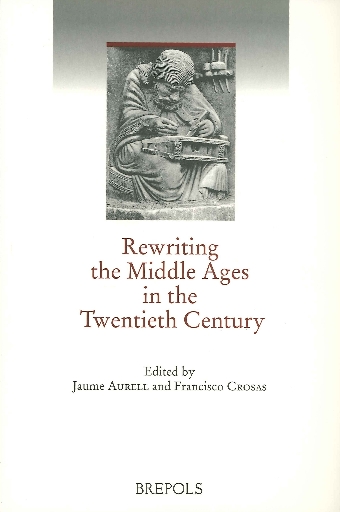
Rewriting the Middle Ages in the Twentieth Century
show More to view fulltext, buy and share links for:Rewriting the Middle Ages in the Twentieth Century show Less to hide fulltext, buy and share links for: Rewriting the Middle Ages in the Twentieth CenturyRewriting the Middle Ages in the Twentieth Century offers analytical introductions to the biographical and academic trajectories as well as the scholarly contributions of the most important medievalists of the 20th century, privileging the contexts in which their influential texts in modern medieval studies were articulated and their effect on subsequent approaches to the field. The volume pays tribute to the medievalists-historians, philologists, literary critics, philosophers, historians of art and science, and theologians-whose work effectively forged contemporary academics and acknowledges a debt of gratitude for the trail they blazed in the twentieth century. An introductory essay provides a comprehensive examination of the development of historiographical perspectives on medieval studies as shaped by the subjects of the volume, contextualizing the individual chapters and offering a critical reconsideration of the manifold ways in which medievalism has been inscribed. The chapters in the book develop from interdisciplinary and transversal strategies which reflect the kind of originative work enacted by both the subjects of the volume and the scholars who write about them. A concluding essay summarizes the place of the medievalists in relation to their professional identity, to the time in which they worked, and to the national spaces that marked their scholarly production.
-
-
-
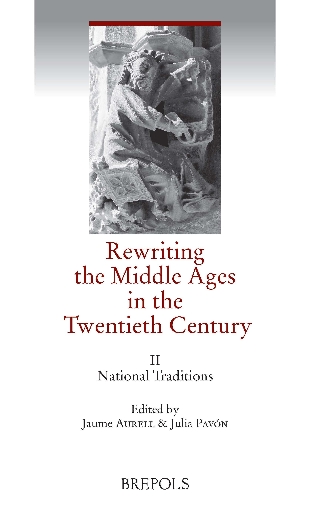
Rewriting the Middle Ages in the Twentieth Century
II, National Traditions.
show More to view fulltext, buy and share links for:Rewriting the Middle Ages in the Twentieth Century show Less to hide fulltext, buy and share links for: Rewriting the Middle Ages in the Twentieth CenturyThe first volume of Rewriting the Middle Ages in the Twentieth Century, published in 2005 by Brepols, gathered twenty profiles of key medievalists of the 20th century, and was preceded by an introduction on the evolution and current situation of medieval studies written by Jaume Aurell. Because of the excellent international reception of that volume, we continue this historiographical task by collecting in future volumes profiles of other 20th century medievalists.
The second volume of the collection, centred on “National Traditions”, is focused on eighteen medievalists who have been significant in diverse countries in the development of both medievalism and national identity. Medievalism has been closely united to national traditions since its beginning, and this book contributes to our understanding of this phenomenon. Romantic intellectuals’ attraction to the medieval period largely explains the influence of medievalism in the formation of contemporary national identities, as from the 19th century, medievalists have also functioned as intellectuals present in the public debate. In the 20th century, important scholars of the Middle Ages, some of whom are studied in this volume, had already become authentic “national chroniclers”, consolidators of the identities of the countries to which they felt closely linked both intellectually and emotionally. They actively participated in debates that exceeded strictly academic limits, delving into a wide range of political and cultural issues.
The range of the cultural and geographical origins of the medievalists profiled in this volume — from England, Spain, France, Germany, Russia, Portugal, Romania, Poland, Argentina, Bulgaria, United States, Belgium, Holland, and Turkey — best illustrates the global influence of medievalism in the construction, invention, and consolidation of national traditions. This focus, which perhaps (and apparently) contravenes the actual strength of the process of globalisation, is especially fascinating in the field of medievalism, because most of the modern nations — specially those in Europe and Asia — have found their justification, inspiration, and legendary and historical foundations in the Middle Ages. By reading the lives of these medievalists, we can better understand the development of intellectual history and our notions of developing cultural traditions.
-
-
-
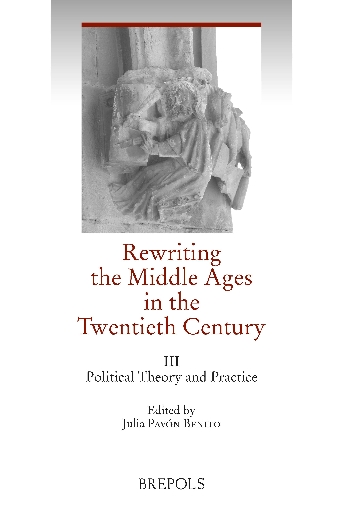
Rewriting the Middle Ages in the Twentieth Century
III. Political Theory and Practice
show More to view fulltext, buy and share links for:Rewriting the Middle Ages in the Twentieth Century show Less to hide fulltext, buy and share links for: Rewriting the Middle Ages in the Twentieth CenturyThis is the third volume of the series “Rewriting the Middle Ages in the Twentieth Century”, focused this time on the medieval political thought.
This book offers an overview of the national and transnational traditions of the historiography and studies the main questions and the background of this discipline in the last century.
Essays for this new volume focus on the subject’s life, intellectual and academic training; discuss major works and historiographical heritage; and locate the medievalists who have contributed to the better understanding of medieval political thought, through their work in medieval studies. This interdisciplinary resource aims to include medievalists from different fields: history, art, literature, theology, among others.
-
-
-

Rhetoric and Reckoning in the Ninth Century
The Vademecum of Walahfrid Strabo
show More to view fulltext, buy and share links for:Rhetoric and Reckoning in the Ninth Century show Less to hide fulltext, buy and share links for: Rhetoric and Reckoning in the Ninth CenturyA modest man of great accomplishments, Walahfrid Strabo was a fine poet, teacher, abbot, gardener, liturgist, and diplomat. His personal notebook reveals that he loved arithmetic and astronomy. For a decade, he tutored Carolus iunior, youngest son of Judith and Ludwig der Fromme, who became emperor Charles the Bald. On two occasions, Walahfrid found and transcribed formulae and explanations of time series, often correcting them.
By identifying Walahfrid's sources and scripts, Professor Stevens is able to trace his life and scholarship, as they relate to Carolingian politics and schools in the first half of ninth-century Europe.
-
-
-
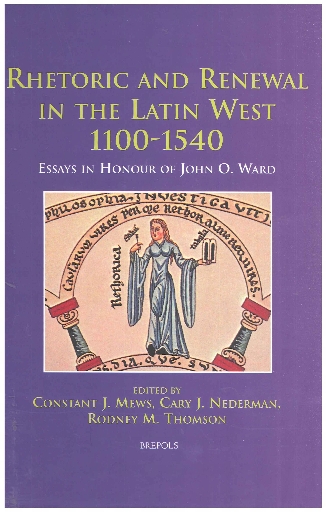
Rhetoric and Renewal in the Latin West 1100-1540
Essays in Honour of John O. Ward
show More to view fulltext, buy and share links for:Rhetoric and Renewal in the Latin West 1100-1540 show Less to hide fulltext, buy and share links for: Rhetoric and Renewal in the Latin West 1100-1540The essays in this volume, presented in honour of John O. Ward, explore the role of rhetoric in promoting reform and renewal in the Latin West from Peter Abelard (1079-1142) to Juan Luis Vives (1492-1540). Ward, who has taught for many years at the University of Sydney, has been an influential and creative force in medieval and renaissance studies both in Australia and internationally. This volume opens with a personal memoir and bibliography of Ward’s publications, as well as an overview of the study of medieval rhetoric. The first of the three sections, ‘Abelard and Rhetoric’, relates Abelard’s rhetoric to his logic, his theology, and his relationship to Heloise. A second section, ‘Voices of Reform’, considers various writers (William of Malmesbury, John of Salisbury, Richard FitzNigel, and William of Ockham) who bring rhetorical techniques to bear upon analysis of social conditions. A third section, ‘Rhetoric in Transition’, deals with the evolution of rhetorical theory between the late fourteenth and early sixteenth centuries. The volume will be of interest not just to specialists in rhetoric, but to all concerned with issues of reform and renewal in European culture during the period 1100-1540.
-
-
-

Rhetoric, Persuasion, and Teaching the Emotions in the Early Modern English Sermon, 1600–1642
show More to view fulltext, buy and share links for:Rhetoric, Persuasion, and Teaching the Emotions in the Early Modern English Sermon, 1600–1642 show Less to hide fulltext, buy and share links for: Rhetoric, Persuasion, and Teaching the Emotions in the Early Modern English Sermon, 1600–1642The early seventeenth-century English sermon was the bestselling print genre of its time, and church preaching was more widely attended than any play. Jennifer Clement argues here that a major aim of these sermons was to teach people how to feel the right emotions — or, as preachers would have said at the time, the passions or affections — to lead a good Christian life. In the process, preachers took a primarily rhetorical approach to the emotions; that is, they used their sermons to define emotions and to encourage their listeners and readers actively to cultivate and shape their emotions in line with Scripture.
This study offers an overview of five key emotions — love, fear, anger, grief, and joy – in the sermons of key preachers such as John Donne, Richard Sibbes, Joseph Hall, Launcelot Andrewes, and others. It shows how these preachers engaged with contemporary treatises on the emotions as well as treatises on preaching to highlight the importance of the rhetorical, as opposed to the humoral, approach to understanding the emotions in a religious context. In addition, Clement reads sermons next to early seventeenth-century religious poetry by writers such as Donne, George Herbert, Amelia Lanyer, and Henry Vaughan to show how the emotional concerns of the sermons also appear in the poetry, reverberating beyond the pulpit.
Bringing together rhetorical theory, sermon studies, and the history of the emotions, Clement shows how the early seventeenth-century English sermon needs to inform our thinking about literature and its engagement with emotion in this period.
-
-
-
Rhétorique et Thérapeutique dans le De Medicina de Celse
show More to view fulltext, buy and share links for:Rhétorique et Thérapeutique dans le De Medicina de Celse show Less to hide fulltext, buy and share links for: Rhétorique et Thérapeutique dans le De Medicina de CelseThe present book aims at analysing the relationship between rhetorics and the various therapeutics as exposed by Celsus, a Roman encyclopaedist of the 1st century A.D., in his treatise De medicina, or On Medicine. It’s a matter of offering an original global approach of the Celsian work, taking account of all of his aspects, from its publishing by its author to its potential practical use by a healer, either professional or not.
This study appears as a work in two parts. Indeed, the first concerns Celsus’ project and its realisation, i.e. the writing and reading of the De medicina. In the second part, Gautherie studies the practical use of the De medicina, both from an ethical and a technical point of view.
-
-
-
Rhétorique et littérature en Europe de la fin du Moyen Âge au XVIIe siècle
show More to view fulltext, buy and share links for:Rhétorique et littérature en Europe de la fin du Moyen Âge au XVIIe siècle show Less to hide fulltext, buy and share links for: Rhétorique et littérature en Europe de la fin du Moyen Âge au XVIIe siècleDuring the Renaissance and at the beginning of the early modern times, with the origin of philology and the advent of a new knowledge linked to the development of print and the discovery of the New World, the art of dialectic, in the traditional Aristotelian sense, changes and finds new applications.
The creation of a public arena for discussions is linked to the development of the rhetorical resources as an appropriation of a history and a language inside a specific community of some authors with their own cultural and social characteristics. Meanwhile they don’t stop to insert their own works in the continuity or in the remains of the Antiquity.Because of the great events shaping the whole European history from the end of the Middle Ages until the 17th century, rhetoric is not separated from religion: every rhetorical practice is based upon the representation of the truth, the evaluation of the principles and the profession of faith.
Dominique de Courcelles is a research director at the French Center for scientific research (CNRS), UMR 5037 CERPHI
-
-
-
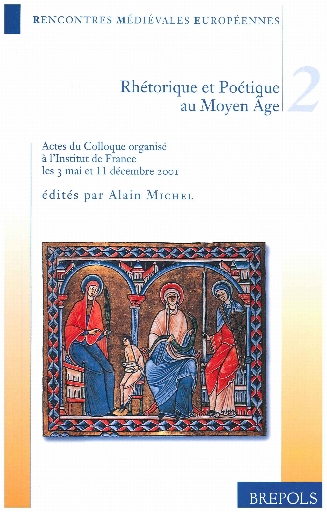
Rhétorique et poétique au Moyen Âge
show More to view fulltext, buy and share links for:Rhétorique et poétique au Moyen Âge show Less to hide fulltext, buy and share links for: Rhétorique et poétique au Moyen ÂgeLe présent Colloque, organisé par les Rencontres médiévales européennes, tend d’abord, ici comme dans d’autres recherches analogues qui ont déjà intéressé la même association, à mettre en lumière, par une démarche pluridisciplinaire, certains aspects de la culture médiévale qui manifestent à la fois sa complexité, sa profondeur et sa beauté. Il s’agit ici de la parole et de la beauté où s’accordent et s’unissent l’art littéraire et la sagesse, philosophique et même théologique.
Il est en effet possible de répondre aujourd’hui à certaines objections qui s’adressent communément au Moyen Âge lui-même et plus largement aux formes d’expression qu’il met en lumière. On lui reproche à la fois d’avoir abusé de la rhétorique et de l’avoir méconnue. Mais les chercheurs savent depuis quelques années que la rhétorique ne se réduit ni à l’abstraction scolastique ni à la sophistique. Dans la forme qu’elle prend jusqu’au xiv e siècle, en se référant à l’Antiquité et en préparant plus qu’on ne croit la Renaissance, elle suscite et reconnaît le progrès du langage, de sa justesse et de ses grâces. Pour cela, elle s’appuie à la fois sur la beauté de l’idéal et sur la rigueur de la pensée, sur la transcendance platonicienne et sur le bon-sens aristotélicien combiné avec l’étendue du savoir. Elle s’accorde aussi avec la poétique, latine ou profane, simplement lyrique, ou tournée vers la liturgie. Nous savons encore aujourd’hui que l’usage positif de l’intelligence peut s’associer avec la naïveté mystique dans un divino-humanisme.
Nous avons voulu montrer dans la tradition qui mène jusqu’à la modernité cette présence constante du coeur: dans la parole la plus fine chacun peut trouver l’amour le plus pur.
-
-
-
Rhétorique et poétique de Macrobe dans les 'Saturnales'
show More to view fulltext, buy and share links for:Rhétorique et poétique de Macrobe dans les 'Saturnales' show Less to hide fulltext, buy and share links for: Rhétorique et poétique de Macrobe dans les 'Saturnales'Although Macrobius’ work has been understood as a source likely to engage erudite interest, above all in the area of ancient Roman religion, the absence of studies emphasizing the Saturnalia’s (written c. 430 AD) literary and rhetorical aspects is unfortunate. Macrobius elaborates an innovative project for the writing of this carefully fashioned banquet. At the origin of this silence, Quellenforschung clearly ignored that the author had taken up the challenge of collecting the vast multiplicity of knowledge into an organic whole through coherent construction. Thanks to the system of readings allotted to the twelve specialized speakers who are present, Macrobius creates a living encyclopedia of ancient times. The terms of reference in which each person undertakes a speech, composes it and eventually passes it along to his neighbor, who in turn offers his own contribution to the knowledge that takes shape, inform us about the idea of discourse which the work authorizes, and which obviously constitutes a singular advancement in the definition of sermo doctus.
A former student of the Ecole Normale Supérieure de la rue d’Ulm, Paris, and an Agrégé de lettres classiques, Benjamin Goldlust is Associate Professor at the University of Lyon 3 - Jean Moulin. His research work focuses mainly on Late Latin Literature.
-
-
-
Rhétorique, poétique, spiritualité: La technique épique de Corippe dans la "Johannide"
show More to view fulltext, buy and share links for:Rhétorique, poétique, spiritualité: La technique épique de Corippe dans la "Johannide" show Less to hide fulltext, buy and share links for: Rhétorique, poétique, spiritualité: La technique épique de Corippe dans la "Johannide"In the Iohannis the African poet Corippus, circa A.D. 550, celebrates the recent triumph of John Troglita, a Byzantine general, over insurgent Moors : an event which he regards as a victory of the Roman world over barbarians and of Christians over pagans. This study demonstrates that the poem belongs simultaneously to the panegyrical and epic genres. Then follows a survey of the neo-classical principles governing such a composition and an analysis of the epic style of Corippus (narrative, descriptions, catalogues, speeches, narrator’s intrusion), of the world view and of the spirituality pervading the poem. Corippus was aware that he might produce merely an impoverished classical epic : this is why he made of the Iohannis an original Christian epic.
-
-
-
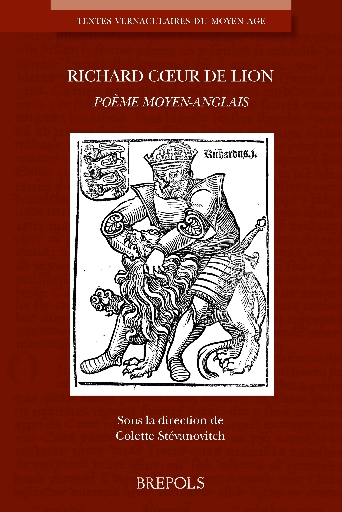
Richard Cœur de Lion
Poème moyen-anglais
show More to view fulltext, buy and share links for:Richard Cœur de Lion show Less to hide fulltext, buy and share links for: Richard Cœur de LionCe poème moyen-anglais relate les exploits du roi Richard Coeur de Lion lors de la troisième croisade. Il occupe une place à part dans le corpus des romans moyen-anglais du fait que son héros est un roi anglais et que les événements racontés sont historiques. Cependant, au fil des réécritures, la vérité historique est progressivement déformée et le roi Richard devient un héros de roman. Sous sa forme définitive ce texte se singularise par la présence d’éléments macabres et en particulier de scènes de cannibalisme. Très célèbre de son temps, encore édité au xvi e siècle, le poème est redécouvert au xix e siècle et notamment exploité par Walter Scott.
Ce volume présente, à côté du texte moyen-anglais dans l’édition de Larkin (2015), la première traduction française du poème. Les notes et l’introduction attachent une importance toute particulière à l’étude des sources et à l’élaboration du texte version après version.
-
-
-
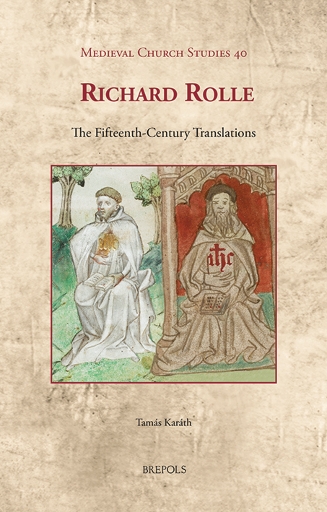
Richard Rolle
The Fifteenth-Century Translations
show More to view fulltext, buy and share links for:Richard Rolle show Less to hide fulltext, buy and share links for: Richard RolleThis book explores the fifteenth-century translations of Richard Rolle’s Latin and English writings into English and Latin, respectively, raising questions about the impact of translation on an author’s legacy through the editorial activity of his translators. The volume also discusses Rolle’s sensory mysticism - which was criticized by the ensuing generation of mystics - whilst looking into the ways in which translations of his work create a fifteenth-century version of Rolle. While the fifteenth-century translations did not represent the standard means of shaping Rolle’s authority, this study illustrates individual encounters with Rolle’s writings in which interpretation was much more overt than in the devotional reuse of untranslated Rollean material. The volume asks if alternative and perhaps controversial portraits of the same author arise from the translations.
Richard Rolle has received many, often conflicting, labels in scholarship: the father of English prose, the first medieval English author, the first known mystic of English literature, the runaway Oxford man, the non-conformist hermit, and the misogynist. This book is located in the context of the late medieval censorship culture which inevitably impacted the translators’ treatment of authority, revelatory writing, and theological speculations. The analysis of Rolle in translation highlights the various meanings, practices, and implications of translation in the fifteenth century.
-
-
-
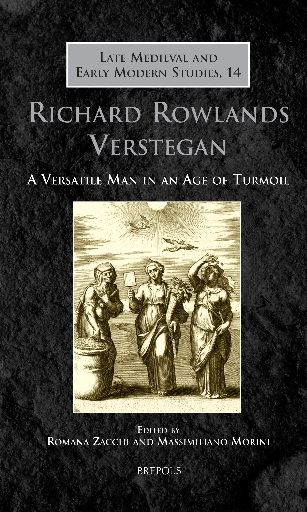
Richard Rowlands Verstegan
A Versatile Man in an Age of Turmoil
show More to view fulltext, buy and share links for:Richard Rowlands Verstegan show Less to hide fulltext, buy and share links for: Richard Rowlands VersteganEmploying a blend of historical, philological, literary, and linguistic methods, Richard Rowlands Verstegan: A Versatile Man in an Age of Turmoil paints a full-bodied portrait of Richard Rowlands Verstegan (or Verstegen, 1550?-1640) - a man whose multiple and variously spelled name reflects a multifaceted public personality. English by birth and upbringing, Dutch by fatherly descent, Verstegan spent most of his life on the Continent, employed intermittently as a Catholic spy, poet, religious translator, polemicist, and philologist. While this many-sidedness is typical of the Renaissance period, some of Verstegan’s interests and positions were innovative or extravagant - witness his familiarization of the epigram in the Netherlands (1617), or his description of Teutonic England in the Restitution of Decayed Intelligence (1605). In this collection of essays, Verstegan’s life and works are both explored in themselves and as mirrors of his times. As each contributor investigates one or more aspects of Verstegan’s careers, a wider perspective is created of English and Dutch religious politics, of the prevailing literary modes and fashions of the period, and of the picture that Europe was beginning to paint for itself. Conversely, this all-encompassing view demonstrates the centrality of a figure who has long been relegated to the margins of English, Dutch, and European history.
-
-
-
Richard of Saint-Victor, On the Trinity
Prologue and Six Books
show More to view fulltext, buy and share links for:Richard of Saint-Victor, On the Trinity show Less to hide fulltext, buy and share links for: Richard of Saint-Victor, On the TrinityRichard of Saint-Victor’s On The Trinity from the 12th century is a main source for our understanding of a leading intellectual tradition of the Western world in which love was regarded the highest and the best in the human world and therefore also was the reality in which the highest and the best, God, was to be seen. Richard understands human love as interpersonal so that love must be realized between two persons, but for being the highest love that excludes any private and selfish love, both loving persons must share their love with a third person.
-
-
-
Riches Beyond the Horizon
Long-distance Trade in Early Medieval Landscapes (ca. 6th-12th centuries)
show More to view fulltext, buy and share links for:Riches Beyond the Horizon show Less to hide fulltext, buy and share links for: Riches Beyond the HorizonThis book offers new and innovative perspectives on long-distance trade between Europe, the Mediterranean area, the Middle East, Africa, India and China during the Early Medieval period. The archaeological data and historical insights presented in this volume are without exception of great interest, often exciting, and more than once astonishing. The goods which travelled between the continents in the timespan under discussion (ca. 6th to 12th centuries) include pottery in all shapes and forms, textiles, coins, metal, lava millstones, glass, marble columns, rock-crystal beads, and also plants used for incense. The scope of the contributions includes the wide-ranging economic contacts of a Viking community, the changing patterns of long-distance trade in the Byzantine Empire, the spread of Chinese pottery to Africa, the Near East and Europe, the information on maritime routes provided by shipwrecks in the Java Sea, the reconstruction of an incense trade network, and the production and distribution of textiles as well as stone objects in the Middle East and beyond. The varied approaches in this volume underline that the movement of objects in Early Medieval times over vast distances not only reflect mechanisms of exchange, but also imply social networks and the transfer of ideas. Thus, Riches Beyond the Horizon sheds compelling light on a world which was much more complex and much more interconnected than has often been assumed.
-
-
-
Richesse, terre et valeur dans l'occident médiéval
Économie politique et économie chrétienne
show More to view fulltext, buy and share links for:Richesse, terre et valeur dans l'occident médiéval show Less to hide fulltext, buy and share links for: Richesse, terre et valeur dans l'occident médiévalQuelles sont les conséquences de l’encastrement de l’économique dans le social ? Posée dès les années 1940 par Karl Polanyi à propos des sociétés qui se situent de l’autre côté du « grand partage », cette question est déterminante pour comprendre les conditions autant culturelles que matérielles du développement au sein de l’Occident médiéval. Sans renoncer à un certain nombre d’interrogations de l’économie politique, l’ouvrage de Laurent Feller intègre les méthodes et les résultats des sciences sociales afin de parvenir à une description du réel qui rend compte de l’action des hommes sur les choses et de ce que font les agents, dans la société chrétienne du Moyen Âge, lorsqu’ils produisent, échangent et consomment. Il s’intéresse notamment à l’attitude des élites à l’égard de la terre, à la fois outil de production et vecteur de prestige, aux instruments cognitifs des moines, des évêques et des aristocrates laïcs qui manipulent les richesses, aux modes d’évaluation et aux façons de solder les échanges.
-
-
-
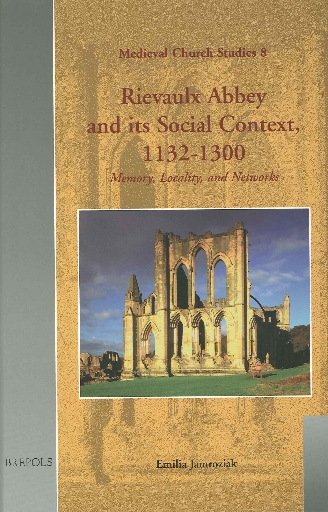
Rievaulx Abbey and its Social Context, 1132-1300
Memory, Locality, and Networks
show More to view fulltext, buy and share links for:Rievaulx Abbey and its Social Context, 1132-1300 show Less to hide fulltext, buy and share links for: Rievaulx Abbey and its Social Context, 1132-1300Rievaulx abbey was one of the most prominent houses of white monks (Cistercians) in England, and became in the course of the twelfth and thirteenth centuries an important feature of the ecclesiastical and social landscape of Yorkshire. The present work is the first in-depth study devoted to Rievaulx's social history. The abbey's once extensive archives were largely destroyed after the Dissolution, but the surviving late-twelfth-century cartulary provides a fascinating insight into the process of creating institutional memory, preserving and shaping information about various neighbours of the abbey, and creating a 'map' of social networks that developed around Rievaulx. The complex picture of building and sustaining connections between the abbey and its lay patrons, benefactors and neighbours forms a core to this book. This study also examines how Rievaulx co-existed with other religious institutions in the area, and particularly the practical dimension of friendships between abbots, declarations of mutual support between monastic communities, and how these were reconciled with a fierce competition for land and donations. Contacts between Rievaulx abbey and the nearby archbishops of York and bishops of Durham were intense and these contacts demonstrate how important these prelates were as potential supporters, and how broader ecclesiastical issues influenced their relationships with Rievaulx. Whilst exploring the case of one particular monastery this book is an important contribution to the current debate on the shaping of Cistercian practice, and particularly the mechanisms for the interaction between laity and monastic communities, during the High Middle Ages.
-
-
-
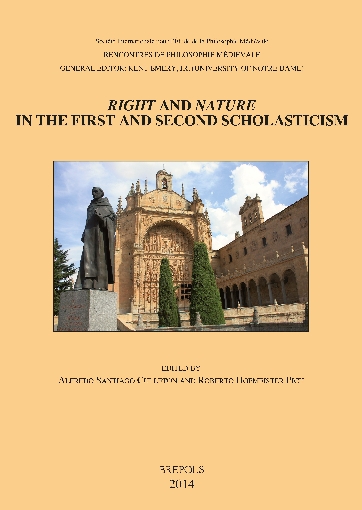
Right and Nature in the First and Second Scholasticism. Derecho y Naturaleza en la primera y segunda escolástica
Derecho y Naturaleza en la primera y segunda escolástica
show More to view fulltext, buy and share links for:Right and Nature in the First and Second Scholasticism. Derecho y Naturaleza en la primera y segunda escolástica show Less to hide fulltext, buy and share links for: Right and Nature in the First and Second Scholasticism. Derecho y Naturaleza en la primera y segunda escolásticaAuthors of the ‘Second Scholasticism’ (as discussed in this volume, at least, mainly Iberian philosophers and theologians of the sixteenth and seventeenth centuries) not only commented on the works and updated the teachings of medieval Scholastic masters, but also introduced many new ideas in all areas of philosophy, namely logic, natural philosophy, metaphysics, moral philosophy, political philosophy and the philosophy of law. In particular, issues arising from the “discovery” of the New World presented new challenges to these thinkers, provoking various reactions among them and causing them to develop new interpretations and theories, especially in practical philosophy and theology. In this volume, scholars from Europe, North America and South America identify and describe some of the main topics and central lines of thought in this still quite unknown chapter in the history of philosophical ideas. The contributors focus on the reception and development of Aristotelian-Thomistic and (to a lesser extent) Scotistic political theory, natural law, positive law and the law of nations in the sixteenth and seventeenth centuries; some authors, moreover, address issues in the development of metaphysics during the same period. For the most part, the studies presented here concern the writings and thought of masters from the Universities of Salamanca, Alcalá, Évora and Coimbra, who responded to new questions and conceived new theories in political philosophy, law and moral philosophy closely related to the issues pertaining to the Spanish and Portuguese colonies in the New World.
-
-
-
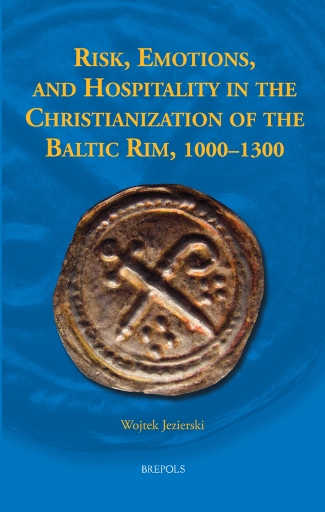
Risk, Emotions, and Hospitality in the Christianization of the Baltic Rim, 1000–1300
show More to view fulltext, buy and share links for:Risk, Emotions, and Hospitality in the Christianization of the Baltic Rim, 1000–1300 show Less to hide fulltext, buy and share links for: Risk, Emotions, and Hospitality in the Christianization of the Baltic Rim, 1000–1300What anxieties did medieval missionaries and crusaders face and what role did the sense of risk play in their community-building? To what extent did crusaders and Christian colonists empathize with the local populations they set out to conquer? Who were the hosts and who were the guests during the confrontations with the pagan societies on the Baltic Rim? And how were the uncertainties of the conversion process addressed in concrete encounters and in the accounts of Christian authors?
This book explores emotional bonding as well as practices and discourses of hospitality as uncertain means of evangelization, interaction, and socialization across cultural divides on the Baltic Rim, c. 1000-1300. It focuses on interactions between local populations and missionary communities, as well as crusader frontier societies. By applying tools of historical anthropology to the study of host-guest relations, spaces of hospitality, emotional communities, and empathy on the fronts of Christianization, this book offers fresh insights and approaches to the manner in which missionaries and crusaders reflexively engaged with the groups targeted by Christianization in terms of practice, ethics, and identity.
-
-
-
Ritorno alla Flat Tax
Un itinerario di Atene antica fra VII e IV secolo?
show More to view fulltext, buy and share links for:Ritorno alla Flat Tax show Less to hide fulltext, buy and share links for: Ritorno alla Flat TaxProporzionale o progressiva? Un problema di imposta oggi come in Atene antica. La ricerca muove da un’ipotesi di interpretazione di un lemma di Polluce relativo all’imposizione fiscale, non sempre oggetto di adeguato interesse; essa procede in funzione della verifica dell’ipotesi, sia attraverso una accurata lettura dei testi, particolarmente attenta ai valori lessicali e ai problemi di natura critica-testuale, sia attraverso il confronto con vari dati forniti dalla tradizione o desumibili da essa, attinenti soprattutto all’ambito demografico e fiscale. In relazione a tale ordine di temi, che costituiscono la linea dominante dell’indagine, assume un interesse di notevole rilievo il carattere specifico delle cifre che sono elemento essenziale della discussione, soprattutto le ‘cifre tonde’, e un ruolo determinante acquisiscono le coincidenze che emergono fra i dati attestati e quelli che risultano dalle premesse ipotetiche (coincidenze esatte, o, a volte, non esatte, ma con differenze generalmente irrilevanti). Di conseguenza non appaiono trascurabili gli indizi che potesse esistere un disegno preordinato allo sviluppo della città nelle sue diverse componenti: un disegno di cui le cifre sembrano conservare il riflesso.
-
-
-
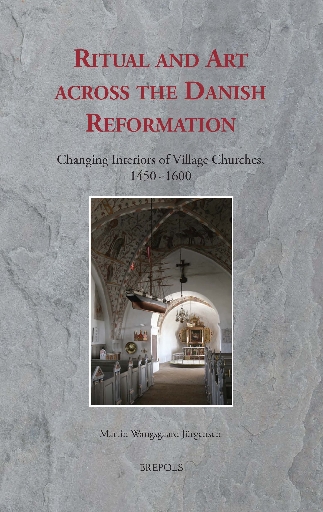
Ritual and Art across the Danish Reformation
Changing Interiors of Village Churches, 1450-1600
show More to view fulltext, buy and share links for:Ritual and Art across the Danish Reformation show Less to hide fulltext, buy and share links for: Ritual and Art across the Danish ReformationThis volume presents a thorough study of the more than a thousand preserved Danish medieval rural parish churches. It traces the transformations of church interiors from c. 1450 to 1600 (thus covering both the emergence and impact of the Danish Reformation) by interpreting material changes within a broad historical perspective that highlights changes in religious practices and liturgy. The book explores the spatial and artistic implications of liturgy as well as the role of the congregation, the donor, and the clergy both in shaping and disrupting these interiors. It sets out to answer four basic questions: What did these rural churches look like by the middle of the fifteenth century? How did they change from the middle of the fifteenth century to the end of the sixteenth? How were they used and integrated into public as well as private ceremonies? And how may these churches have been perceived and experienced by the congregation and clergy?
This study seeks to establish a methodological framework that incorporates the disciplines of archaeology, art history, history, and theology, in order to facilitate an overall understanding of the architectural setting, embracing spatial, material, and artistic elements within the church through liturgy.
-
-
-
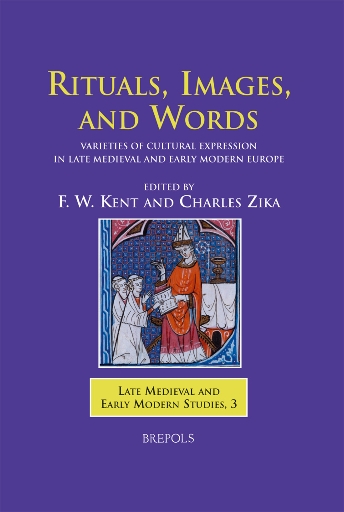
Rituals, Images, and Words
Varieties of Cultural Expression in Late Medieval and Early Modern Europe
show More to view fulltext, buy and share links for:Rituals, Images, and Words show Less to hide fulltext, buy and share links for: Rituals, Images, and WordsThis collection of essays by Australian scholars offers a wealth of contemporary perspectives on cultural communication amongst men and women in late medieval and early modern Europe. Essays dealing with Florence and Venice, with Rome, Lucca, Ferrara, and Bologna, as well as with Germany, England, and Lorraine, draw attention to the array of cultural expressions which competed for space and influence across European societies of the period.
These rich studies demonstrate the vitality of cultural production during a period of rapid and often violent transition. Variously focused on formal religious rites, on painting, sculpture, and woodcuts, on sermons, poetry, and letters, the contributors pursue cultural meaning as a matter of social identity and social context - as a performance that can be shown to affirm and also exclude particular topical values. Rituals, Images, and Words highlights the complex and subtle power of rhetorical forms in the history and historiography of late medieval and early modern Europe.
-
-
-
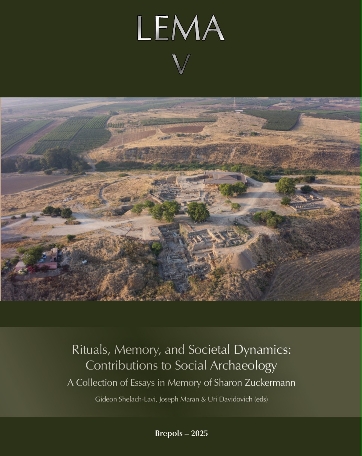
Rituals, Memory, and Societal Dynamics: Contributions to Social Archaeology
A Collection of Essays in Memory of Sharon Zuckerman
show More to view fulltext, buy and share links for:Rituals, Memory, and Societal Dynamics: Contributions to Social Archaeology show Less to hide fulltext, buy and share links for: Rituals, Memory, and Societal Dynamics: Contributions to Social ArchaeologyThanks largely to the introduction of new methods of recovery and analysis, archaeology is increasingly treated as a science. Yet, it should continue to ask questions that are founded in the humanities. This is especially true of social archaeology, which forms the core of this volume. Being based on the notion that ‘the social’ permeates all areas of life, the chapters gathered here give priority to archaeological data and contexts, which in turn form the prerequisite for analyzing how, at particular times and places, people negotiated or reaffirmed the society around them. Case studies from the Levant and the Eastern Mediterranean sit alongside selected comparative cases from other parts of the world and assess issues such as the development of cultural characteristics of societies, societal continuity and collapse, religious beliefs and rituals, and the role of social memory, as well as interactions within and between societies. The volume is dedicated to the memory of our colleague and friend, Dr. Sharon Zuckerman, who embraced the quest for ‘the social’ throughout her career.
-
-
-
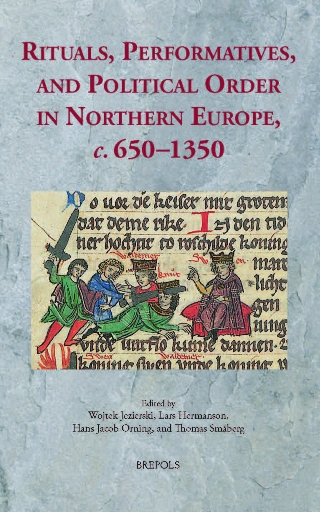
Rituals, Performatives, and Political Order in Northern Europe, c. 650–1350
show More to view fulltext, buy and share links for:Rituals, Performatives, and Political Order in Northern Europe, c. 650–1350 show Less to hide fulltext, buy and share links for: Rituals, Performatives, and Political Order in Northern Europe, c. 650–1350This multidisciplinary volume draws together contributions from history, archaeology, and the history of religion to offer an in-depth examination of political ritual and its performative and transformative potential across Continental Europe and Scandinavia. Covering the period between c. 650 and 1350, this work takes a theoretical, textual, and practical approach to the study of political ritual, and explores the connections between, and changing functions of, key rituals such as assemblies, feasts, and religious confrontations between pagans and Christians.
Taking as a central premise the fact that rituals were not only successful political instruments used to create and maintain order, but were also a hazardous game in which intended strategies could fail, the papers within this volume demonstrate that the outcomes of feasts or court meetings were often highly unpredictable, and a friendly atmosphere could quickly change into a violent clash. By emphasising the conflict-ridden and unpredictable nature of ritual acts, the articles add crucial insights into the meanings, (ab)uses, and interpretations of performances in the Middle Ages. In doing so, they demonstrate that rituals, far from being mere representations of power, also constituted an important mechanism through which the political and religious order could be challenged and transformed.
-
-
-
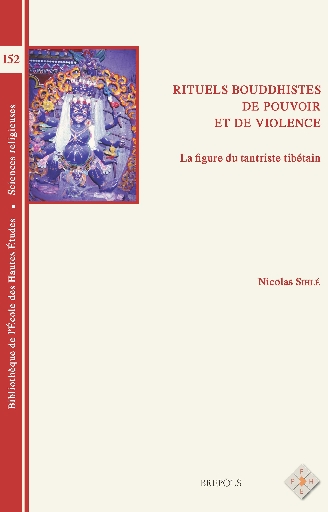
Rituels bouddhistes de pouvoir et de violence
La figure du tantriste tibétain
show More to view fulltext, buy and share links for:Rituels bouddhistes de pouvoir et de violence show Less to hide fulltext, buy and share links for: Rituels bouddhistes de pouvoir et de violenceLa violence occupe une place paradoxale dans le bouddhisme tantrique tibétain. Alors que l’impératif éthique de ne pas nuire aux êtres est absolument central, l’activité rituelle comporte une face beaucoup plus sombre, une face de pouvoir et de violence : celle du repoussement et de la destruction du mal. Toute une machinerie rituelle est déployée pour écarter ou tuer des démons hostiles, voire des « ennemis » aux contours vagues - la magie noire n’est pas absente. De terribles divinités protectrices sont incitées à tuer, à battre, à réduire en morceaux… Comment comprendre l’importance de cette modalité violente dans le contexte bouddhique ?
La question est d’autant plus intrigante qu’il existe un type de spécialiste religieux tibétain fortement associé à ce versant problématique du domaine rituel : le ngakpa, ou tantriste. Contrairement au moine, ce religieux spécialisé dans les rituels tantriques ne prononce pas de voeux monastiques. Qui sont les tantristes, et comment comprendre qu’un spécialiste bouddhique soit associé à l’exercice de rituels violents ? Pour répondre à cette interrogation, l’auteur nous fait découvrir une communauté villageoise de tantristes située dans la bordure himalayenne du monde tibétain, dans une haute vallée du nord du Népal. Le regard anthropologique porté sur ces religieux et leur société, sur leurs rituels et leurs questionnements éthiques permet de faire émerger des éléments de cohérence qui sous-tendent l’association des tantristes à des rituels de violence. Cette contribution importante à l’anthropologie du bouddhisme tibétain apporte un éclairage nouveau pour penser la violence de l’exorcisme et, à travers la dualité du moine et du tantriste, les champs religieux marqués par la présence de différentes formes de spécialisation religieuse.
-
-
-
Rivista di Filologia e di Istruzione Classica
show More to view fulltext, buy and share links for:Rivista di Filologia e di Istruzione Classica show Less to hide fulltext, buy and share links for: Rivista di Filologia e di Istruzione ClassicaFounded in 1872, the Rivista di Filologia e di Istruzione Classica (RFIC) has become one of the most important and prestigious periodicals in the field of ancient Greek and Roman studies. With its well-established tradition, commitment to meeting evolving expectations, sensitivity to changing trends, and use of the latest research tools, the RFIC strives to remain a solid reference point in classical studies at an international level. The journal publishes high-quality research and reviews, with contributions focusing on the philological, literary, historical, or archaeological aspects of the ancient Greek and Roman worlds, as well as Late Antiquity.
More information about this journal on Brepols.net
-
-
-
Robert Grosseteste: New Perspectives on his Thought and scholarship
show More to view fulltext, buy and share links for:Robert Grosseteste: New Perspectives on his Thought and scholarship show Less to hide fulltext, buy and share links for: Robert Grosseteste: New Perspectives on his Thought and scholarshipIn Grosseteste we have on our hands a figure, not only of great complexity in himself, but of even greater complexity in the kind of evidence which we are required to use. It is worth remembering that, despite all efforts of the last half century, quite half of his works are still unpublished. When we turn to Grosseteste, we find a situation which is as different from this as it could well be. He presents a quite unique combination of problems. The range of subjects he studied, the way in which he studied them, and the order in which he studied them, seem to be - to a much greater extent than any of the great scholastic thinkers - to be an expression, not of any normal programme of university studies, but of his personality and of the obscure and varied background and circumstances of his life. His thoughts on the subjects which he chose to elaborate are markedly his own. In a word uniqueness of circumstances and personality.
-
-
-
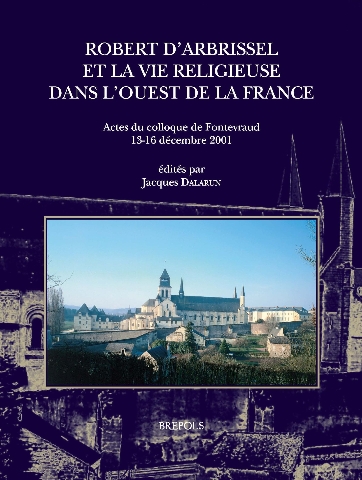
Robert d’Arbrissel et la vie religieuse dans l’Ouest de la France
Actes du Colloque de Fontevraud, 13-16 décembre 2001
show More to view fulltext, buy and share links for:Robert d’Arbrissel et la vie religieuse dans l’Ouest de la France show Less to hide fulltext, buy and share links for: Robert d’Arbrissel et la vie religieuse dans l’Ouest de la FranceFontevraud: 1101-2001. Fontevraud: à la fois monastère et congrégation, communauté mixte où, par la singulière volonté du fondateur, les hommes en ce temps féodal étaient soumis au pouvoir des femmes. Célébrer le neuvième centenaire de la fondation de Robert d’Arbrissel s’imposait; ce qui fut fait du 13 au 16 décembre 2001, dans l’enceinte même de la somptueuse abbaye ligérienne.
Le présent volume témoigne de ces denses journées d’étude; il intègre aussi des contributions supplémentaires, pour gagner encore en richesse et en cohérence. Volontairement déroutant, il nous entraîne d’abord bien loin du Val de Loire, dans les solitudes boisées des Apennins, où le ressourcement monastique surgi du haut Moyen Âge inaugure ce Moyen Âge que nous disons central. Les organisateurs scientifiques de la rencontre n’ont en effet pas souhaité la focaliser d’emblée sur l’originalité de Fontevraud et les étranges comportements de son fondateur. Ils ont au contraire voulu donner à lire l’accident de 1101 dans le vaste élan qui ouvre une ère nouvelle pour la Chrétienté et pour notre monde en ce qu’il en procède: cette réforme de l’Église qu’on dit «grégorienne», qui repense en fait toute l’architecture ecclésiale et sociale, des plus hauts aux plus infimes pouvoirs, des institutions aux individus et du sacré au profane.
-
-
-
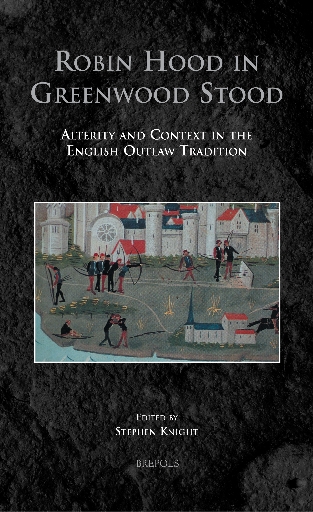
Robin Hood in Greenwood Stood
Alterity and Context in the English Outlaw Tradition
-
-
-
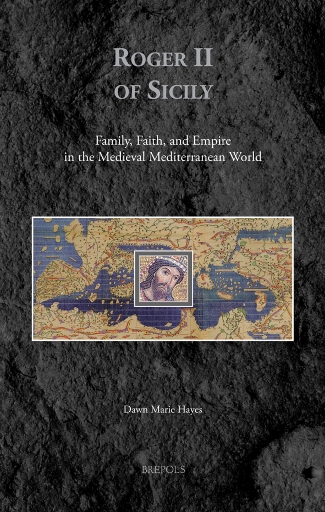
Roger II of Sicily: Family, Faith and Empire in the Medieval Mediterranean World
show More to view fulltext, buy and share links for:Roger II of Sicily: Family, Faith and Empire in the Medieval Mediterranean World show Less to hide fulltext, buy and share links for: Roger II of Sicily: Family, Faith and Empire in the Medieval Mediterranean WorldRoger II (c. 1095-1154), Sicily’s first king, was an anomaly for his time. An ambitious new ruler who lacked the distinguished lineage so prized by the nobility, and a leader of an extraordinarily diverse population on the fringes of Europe, he occupied a Roger II (c. 1095-1154), Sicily’s first king, was an anomaly for his time. An ambitious new ruler who lacked the distinguished lineage so prized by the nobility, and a leader of an extraordinarily diverse population on the fringes of Europe, he occupied a unique space in the continent’s charged political landscape. This interdisciplinary study examines the strategies that Roger used to legitimize his authority, including his relationships with contemporary rulers, the familial connections that he established through no less than three marriages, and his devotion to the Church and Saint Nicholas of Myra/Bari. Yet while Roger and his family made the most of their geographic and cultural contexts, it is convincingly argued here that they nonetheless retained a strong western focus, and that behind the diverse mélange of Norman Sicily were very occidental interests.
Drawing together sources of political, social, and religious history from locations as disparate as Spain and the Byzantine Empire, as well as evidence from the magnificent churches and elaborate mosaics constructed during his reign, this volume offers a fascinating portrait of a figure whose rule was characterized both by great potential and devastating tragedy. Indeed, had Roger been able to accomplish his ambitious agenda, the history of the medieval Mediterranean world would have unfolded very
-
-
-
Rois, reines et évêques. L'Allemagne aux Xe et XIe siècles
Recueil de textes traduits
show More to view fulltext, buy and share links for:Rois, reines et évêques. L'Allemagne aux Xe et XIe siècles show Less to hide fulltext, buy and share links for: Rois, reines et évêques. L'Allemagne aux Xe et XIe sièclesL’Allemagne médiévale reste peu connue de nos jours. Pourtant, c’est une grande période de l’histoire germanique, marquée par la naissance de l’Empire, les particularités de l’Eglise impériale, la place des principautés au sein du royaume… La période ottonienne et salienne en particulier (Xe-XIe siècles) est un âge d’or pour le pouvoir des souverains et des évêques.
Le présent recueil propose d’introduire le lecteur dans la compréhension de cette époque en lui permettant de lire en traduction française (généralement pour la première fois) les Gestes des Saxons de Widukind de Corvey (livres 2 et 3), la plus ancienne vie de la reine Mathilde, la Chronique de Thietmar de Mersebourg (livres 3 et 4), la vie d’Henri II par Adalbold d’Utrecht, la vie de Conrad II par Wipo, les Gestes des évêques d’Eichstätt et une sélection de chartes germaniques de cette période.
-
-
-
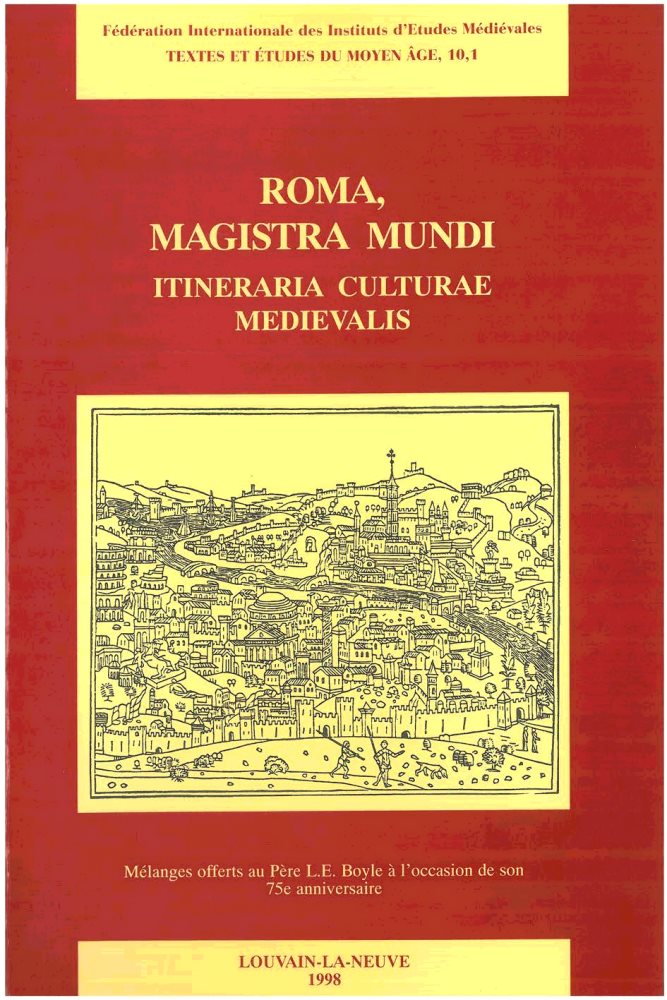
Roma, magistra mundi. Itineraria culturae medievalis
Mélanges offerts au Père L.E. Boyle à l'occasion de son 75e anniversaire
-
-
-
Roman Identity
Between Ideal and Performance
show More to view fulltext, buy and share links for:Roman Identity show Less to hide fulltext, buy and share links for: Roman IdentityRecent years have seen a significant increase in migration and displacement. Due to economic, political, and climatic pressures, large numbers of individuals are leaving their countries of origin and settling in new environments and societies. As a result, national identity has increasingly come to the fore in public discourse. Shaping and reshaping national agendas, debates surrounding national identity are affecting policies and influencing voting behaviours. Discourse on this issue is often centred on the idea of autochthony and nativism. Yet we do not encounter such anxieties in ancient Rome, one of the longest-lasting political orders in history. Unlike among the Greeks, the idea of autochthony did not take root among the Romans. Instead, Rome’s identity tended to be fluid, accommodating the development of highly variegated and multi-ethnic groups and societies.
The purpose of this volume is to understand how the Romans represented themselves and how others defined and regarded them. It aims to identify the various narratives that contributed to the construction of Roman self-representation by raising the following questions: What stories did Romans tell about themselves? How did they enact and perform their selfhood in biographic and autobiographical sources? How did Greek and Judean sources understand and define Roman identity? And, taken together, how did these narratives influence Roman self-perception?
Rather than arguing for a monolithic or coherent understanding of Romanitas, this volume explores a variety of performances and manifestations of Roman identity. It focuses both on sources where the self or individual is the primary focus, alongside more general texts dealing with specific elements of Roman identity.
-
