Brepols
Brepols is an international academic publisher of works in the humanities, with a particular focus in history, archaeology, history of the arts, language and literature, and critical editions of source works.101 - 120 of 3194 results
-
-
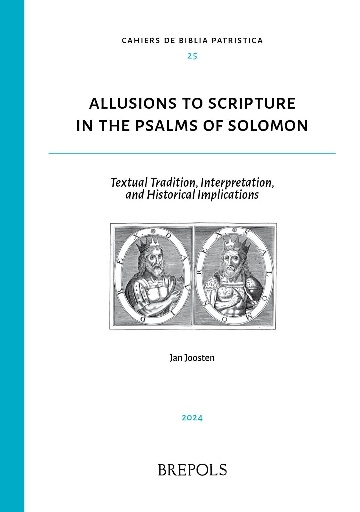
Allusions to Scripture in the Psalms of Solomon
Textual Tradition, Interpretation, and Historical Implications
show More to view fulltext, buy and share links for:Allusions to Scripture in the Psalms of Solomon show Less to hide fulltext, buy and share links for: Allusions to Scripture in the Psalms of SolomonLike other Jewish works from the late Second Temple period, Psalms of Solomon alludes constantly to passages in Scripture—particularly the Pentateuch, the Prophetic books and Psalms. Gathering all passages where the Psalms of Solomon refer to a specific verse in Scripture, the present monograph ventures to analyze the authors’ use of Scripture and to identify the textual tradition underlying the allusions. The conclusion this leads to is that the authors used a Greek version, close to the Septuagint but sporadically revised on the basis of the proto-Masoretic Hebrew text. This conclusion agrees with recent research on revisionary work on the Septuagint, which must have begun in the first century BCE, long before the named recensions of the second century CE (Aquila, Symmachus, Theodotion).
The textual analysis casts a new light on the Psalms of Solomon. Although they came into being in Jerusalem in the aftermath of Pompey’s conquest of the city in 63 BCE, they were not composed in Hebrew, but in Greek. The identity of the Greek-speaking group that produced the Psalms of Solomon, and their religious views, are discussed in the final chapter of this monograph.
-
-
-
Almagest
Journal for the Transnational History of Technoscience
show More to view fulltext, buy and share links for:Almagest show Less to hide fulltext, buy and share links for: AlmagestThe journal Almagest transitioned from an International Journal for the History of Scientific Ideas into a Journal for the Transnational History of Technoscience. The shift signifies that the journal will place a new emphasis on the rich histories of not just scientific ideas but also of experiments, people, objects, images, devices, instruments, and epistemic ‘things’ as they cross multiple national and/or institutional boundaries. This change is intended to reflect a prolific disciplinary (dis)order, in which science is seen as deeply entangled with technology, diplomacy as strongly related to science, and knowledge as inherently political.
More information about this journal on Brepols.net
-
-
-
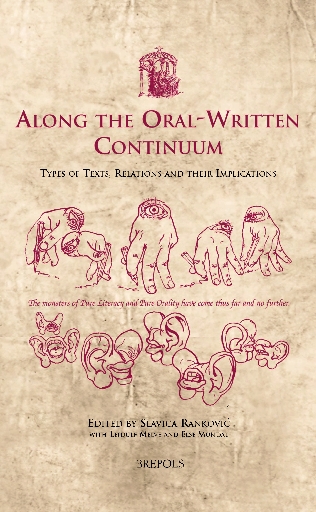
Along the Oral-Written Continuum
Types of Texts, Relations and their Implications
show More to view fulltext, buy and share links for:Along the Oral-Written Continuum show Less to hide fulltext, buy and share links for: Along the Oral-Written ContinuumEver since its introduction in the 1970s, Ruth Finnegan’s notion of the oral-written, or the oral-literate, continuum has served as one of the most effective means of dispelling the dichotomous understanding of the two principal media of communication in the Middle Ages. However, while often casually invoked, the concept has never been made a focus of study in its own right. The present volume is an attempt to place the oral-written continuum at the heart of discussion as an object of a head-on theoretical investigation, as a backdrop to distinct processes of acquisition of literacy in different European regions, and, indeed, as a tool for navigating the rugged landscape of verbal forms, exploring the complexity of oral-literary interrelationships that they manifest. The articles probe the concept with a variety of theoretical and methodological approaches, span diverse texts and genres, and involve a range of European cultural contexts, with special emphasis on Scandinavia and Northern Europe, but also reaching out to various other corners of the continent: from France, the Netherlands and England in the West, over Germany, Bohemia and Poland in the central region, to Serbia and Bosnia in the Southeast.
-
-
-
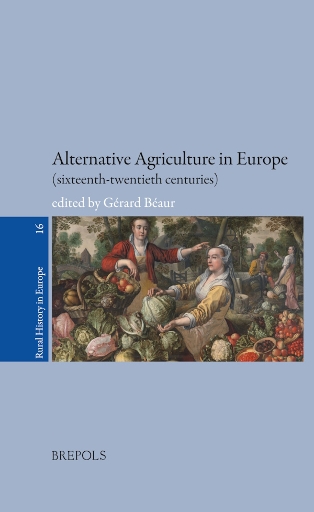
Alternative Agriculture in Europe (sixteenth-twentieth centuries)
show More to view fulltext, buy and share links for:Alternative Agriculture in Europe (sixteenth-twentieth centuries) show Less to hide fulltext, buy and share links for: Alternative Agriculture in Europe (sixteenth-twentieth centuries)The treatment of long-term agricultural transformation remains a lively topic for historians. Much debate arose when agricultural development patterns were discovered that did without a dominant, production-oriented cereal crop, even when it was accompanied by livestock farming. Joan Thirsk hoped to conclude this debate by putting forward the hypothesis that such “alternative agriculture” was the farmers’ way of responding to the difficulties caused by periods of low agricultural prices. This theory stirred up controversy and arguments both for and against.
The contributions to this volume take this hypothesis seriously and attempt to assess its validity. Examining a large number of “alternative agricultures” over the long term, from the fifteenth to the twentieth century, they discuss the issues encountered in tracing the links between the spread of alternative crops, such as fruits and vegetables, flowers, and industrial crops, and the general economic environment, across a vast swathe of territory stretching from Flanders to Spain and from France, through Italy and Switzerland, as far as Russia.
-
-
-
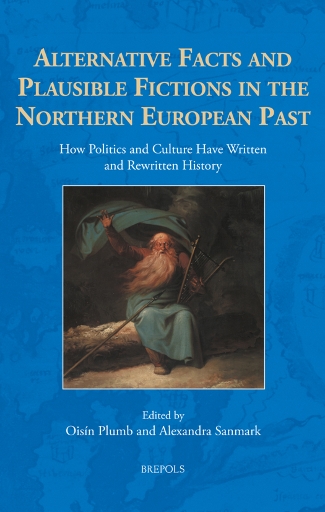
Alternative Facts and Plausible Fictions in the Northern European Past
How Politics and Culture Have Written and Rewritten History
show More to view fulltext, buy and share links for:Alternative Facts and Plausible Fictions in the Northern European Past show Less to hide fulltext, buy and share links for: Alternative Facts and Plausible Fictions in the Northern European PastThe use of the past for contemporary purposes has been a feature of historical and archaeological investigation from ancient times. This ‘politicization of the past’ is often associated with, at best, an inadvertent detachment from an objective use of evidence, and at worst, its wilful misuse. Such use of the past is perhaps most evident in the construction of narratives of nations and ethnic groups — particularly in relation to origins or the perceived ‘golden ages’ of peoples.
This book seeks to assess the role played by different ideologies in the shaping of the past, from early times up until the present day, in the interpretation of the history and archaeology of Northern Europe, whether in Northern Europe itself or further afield. It also considers how those who research, interpret, and present the Northern European past should respond to such uses. The chapters drawn together here explore key questions, asking how contemporary ideologies of identity have shaped the past, what measures should be taken to discourage an inaccurate understanding of the past, and if scholars should draw on the past in order to counter racism and xenophobia, or if this can itself lead to potentially dangerous misunderstandings of history.
-
-
-
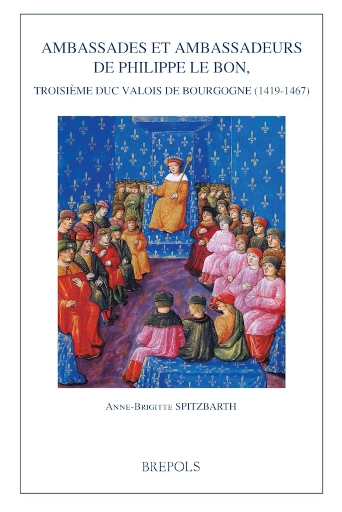
Ambassades et ambassadeurs de Philippe le Bon, troisième duc Valois de Bourgogne (1419-1467)
show More to view fulltext, buy and share links for:Ambassades et ambassadeurs de Philippe le Bon, troisième duc Valois de Bourgogne (1419-1467) show Less to hide fulltext, buy and share links for: Ambassades et ambassadeurs de Philippe le Bon, troisième duc Valois de Bourgogne (1419-1467)De 1419 à 1467, l’Etat bourguignon connut une expansion sans précédent, en partie servie par la politique diplomatique du duc de Bourgogne. Acteur central du mémorable congrès d’Arras de 1435, Philippe le Bon se posa en arbitre de l’Europe, grâce à ses alliances successives avec l’Angleterre et la France, mais aussi aux liens tissés dans toute la chrétienté.
L’enjeu de cette recherche, grâce à l’étude des moyens conceptuels, humains et matériels mobilisés par la diplomatie bourguignonne, est de resituer la place de la diplomatie dans la politique globale de Philippe le Bon.
L’étude des quelque 1412 ambassades et 621 ambassadeurs dépêchés par le duc durant son règne, la mise à jour de tactiques de négociation, de stratégies d’expertise, ainsi que la puissance financière mobilisée permettent d’éclairer un modèle de diplomatie ambitieuse, à l’heure où l’ambassadeur n’était encore qu’un « artisan de paix », où les ambassades permanentes n’existaient guère et où les concepts et le droit des gens étaient encore en pleine fixation.
Anne-Brigitte Spitzbarth est normalienne, agrégée et docteur en histoire de l’Université Lille 3 où elle a enseigné l’histoire médiévale. Elle est membre du CRHEN-O et d’IRENE. Ses recherches portent sur la diplomatie et la négociation.
-
-
-
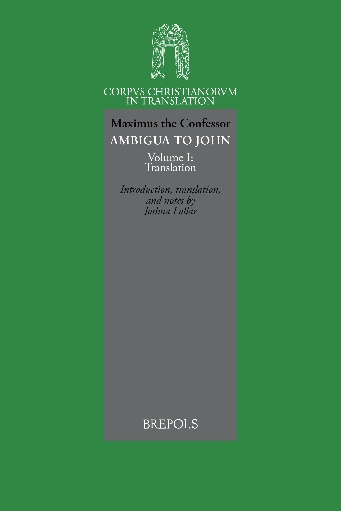
Ambigua to John
Volume I: Translation
show More to view fulltext, buy and share links for:Ambigua to John show Less to hide fulltext, buy and share links for: Ambigua to JohnIn the Ambigua to John, the great early Byzantine monastic theologian and philosopher Maximus the Confessor (580–662) is at work in his most creative and expansive mode. Using difficult passages in Gregory Nazianzen as starting points for his thinking, Maximus draws together various strands of the theological and philosophical traditions he inherited and shapes an ever-moving, kaleidoscopic vision of the journey through the world of place, time, and materiality to final dynamic repose in eternity. Throughout the text, Maximus takes his readers along the many paths his own mind traveled to clarify this breathtaking reflection of the teachings of Scripture and the patristic tradition. In this translation of the first fully critical edition of Maximus’s text, the streams of the Confessor’s divine philosophy are revealed in their own right. This translation will be followed with the first full commentary on the Ambigua to John in English, to appear in Corpus Christianorum in Translation.
The source text of this volume will appear in Corpus Christianorum, Series Graeca, vol. 84.
-
-
-
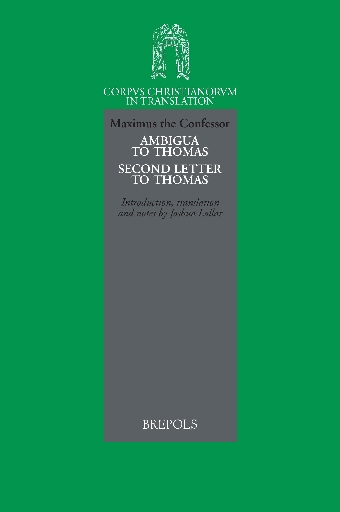
Ambigua to Thomas and Second Letter to Thomas
show More to view fulltext, buy and share links for:Ambigua to Thomas and Second Letter to Thomas show Less to hide fulltext, buy and share links for: Ambigua to Thomas and Second Letter to ThomasMaximus the Confessor, a monk and theologian of the seventh century, was a transmitter and creative interpreter of the dogmatic and ascetical traditions of the Greek-speaking Church, and an innovative mind in his own right. An important figure on the theological landscape of his day, he became deeply involved in the post-Chalcedonian Christological controversies concerning the natures, activities (energies), and wills in Christ, eventually suffering at the hands of the imperial authorities for his rejection of certain imperial dogmatic decrees. These decrees in his view denied the principle of the salvation of the cosmos: the perfect communion of divinity and humanity - as preserved in their own proper natures - in the one Christ. He died in exile on the Black Sea coast, soon after his trial in Constantinople, in 662.
The Ambigua to Thomas are a collection of chapters devoted to the exposition of passages from Gregory Nazianzen and Ps. Denys the Areopagite. Maximus uses the texts as a means of expounding the meaning of the perfect union of divinity and humanity in the one Christ, arriving ultimately at an interpretation of the phrase from Denys, which affirmed that Christ “conducted his life among us according to a certain new theandric activity.”
The source text of this volume appeared in Corpus Christianorum Series Graeca as Maximus Confessor - Ambigua ad Thomam una cum epistula secunda ad eundem (CCSG 48). References to the corresponding pages of the Corpus Christianorum edition are provided in the margins of this translation.
Joshua Lollar is currently conducting research at the Theology Department of the University of Notre Dame (USA).
-
-
-
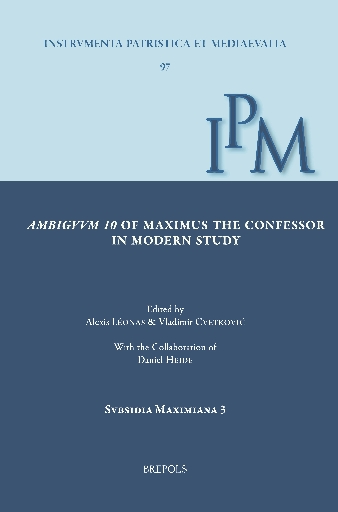
Ambiguum 10 of Maximus the Confessor in Modern Study
Papers Collected on the Occasion of the Budapest Colloquium on Saint Maximus, 3–4 February 2021
show More to view fulltext, buy and share links for:Ambiguum 10 of Maximus the Confessor in Modern Study show Less to hide fulltext, buy and share links for: Ambiguum 10 of Maximus the Confessor in Modern StudyAmbiguum 10 is an important sample of Maximus the Confessor’s philosophical exegesis, which has not received concentrated scholarly attention so far. This volume includes a new critical text edition by Prof. Carl Laga and a new English translation by Dr. Joshua Lollar. It also offers a unique insight into the universe of the great Christian thinker, showcasing his extensive knowledge of Aristotelian, Platonic and Neoplatonic philosophy and offering possible parallels with the Corpus Hermeticum and Ps-Dionysius the Areopagite. The present volume is the first attempt to bring together scholars from different traditions to understand the message and the reception of this seminal work.
-
-
-
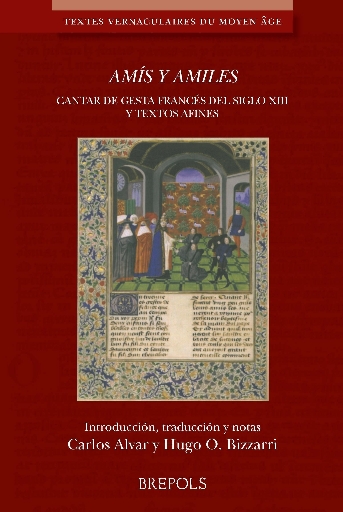
Amís y Amiles
Cantar de gesta francés del siglo XIII y textos afines
show More to view fulltext, buy and share links for:Amís y Amiles show Less to hide fulltext, buy and share links for: Amís y AmilesAmís y Amiles son los protagonistas de una serie de obras que se difunden por todo el occidente europeo desde el siglo XII, dando lugar a una epístola en latín, un cantar de gesta en francés, un relato hagiográfico en latín, varios exempla, una pieza teatral... La huella del tema de la amistad fraternal se encuentra también en catalán y en castellano.
Este libro, preparado por los profesores Carlos Alvar (Université de Genève) y Hugo O. Bizzarri (Université de Fribourg), presenta en edición bilingüe los principales textos en los que aparece el motivo de “los dos hermanos” o “los dos amigos”.
-
-
-

An Anonymous Dialogue with a Jew
show More to view fulltext, buy and share links for:An Anonymous Dialogue with a Jew show Less to hide fulltext, buy and share links for: An Anonymous Dialogue with a JewThe work is a translation of the Greek text entitled Anonymus dialogus cum Iudaeis, edited by José Declerck in CCSG 30. The introduction covers the textual history, historical setting, literary setting, and other matters. The translation is divided into thirteen chapters following the original structure of the book and the edition by Declerck. Brief footnotes accompany the text in order to clarify matters of translation. Indexes of Scripture, ancient documents, names, and subjects complete the work.
The source text of this volume appeared in Corpus Christianorum Series Graeca as Anonymus - Dialogus cum Iudaeis saeculi ut videtur sexti (CCSG 30). References to the corresponding pages of the Corpus Christianorum edition are provided in the margins of this translation.
Lee M. Fields holds a Ph.D. in Hebraic and Cognate Studies from Hebrew Union College-Jewish Institute of Religion with an emphasis in Judaic Studies in the Greco-Roman Period and is currently Chair of the Department of Biblical Studies at Mid-Atlantic Christian University (Elizabeth City, North Carolina, United States).
-
-
-
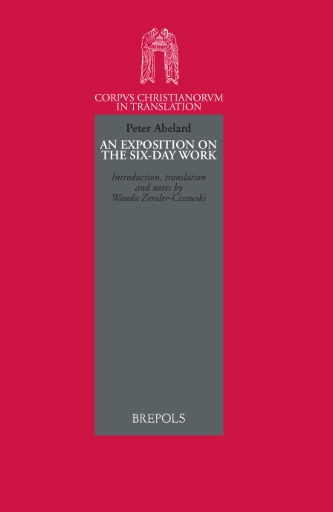
An Exposition on the Six-day Work
show More to view fulltext, buy and share links for:An Exposition on the Six-day Work show Less to hide fulltext, buy and share links for: An Exposition on the Six-day WorkPeter Abelard's Expositio in hexaemeron, or interpretation of the six-day work of creation, was commissioned by Heloise for the community of the Paraclete. The work is unusual in that it gives priority to the historical over the allegorical sense, and bears strong affinities to the writings of Thierry of Chartres and other twelfth century students of the natural sciences. As such, it is evidence both for the general state of twelfth century knowledge of cosmology, and for the quality of scholarship available in particular to a community of women religious.
The source text of this volume appeared in Corpus Christianorum Continuatio Mediaeualis as Expositio in Hexameron (CCCM 15). References to the corresponding pages of the Corpus Christianorum edition are provided in the margins of this translation.
Wanda Zemler-Cizewski is Associate Professor of historical theology in the Department of Theology at Marquette University in Milwaukee, Wisconsin. She received her doctorate in Medieval Studies at the University of Toronto in 1983, and is the author of numerous articles on early scholastic biblical interpretation and theology.
-
-
-
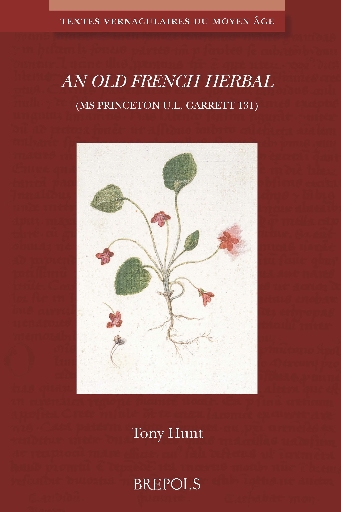
An Old French Herbal (Ms Princeton U.L. Garrett 131)
show More to view fulltext, buy and share links for:An Old French Herbal (Ms Princeton U.L. Garrett 131) show Less to hide fulltext, buy and share links for: An Old French Herbal (Ms Princeton U.L. Garrett 131)The earliest Old French herbal in verse, here edited for the first time, is a surprisingly comprehensive work (3188 octosyllables), based on an eleventh-century Latin treatise 'De viribus herbarum' attributed to a certain 'Macer'. It occupies a significant place in the development of herbals and is an interesting witness to writing in Western France in the thirteenth century and to the unusual syntax and concentrated style of its author. Some one hundred and twenty-five plants are described together with their medicinal uses, which cover a remarkable range of ailments. For ease of recognition the sections of text which do not seem to be based on the received text of 'Macer' are printed in italics. Quotations from the principal source and from parallels are given in the notes. This work will be of great value to all those interested in Old French, in medieval translation, the vernacular transmission of learning, and the history of medicine.
-
-
-
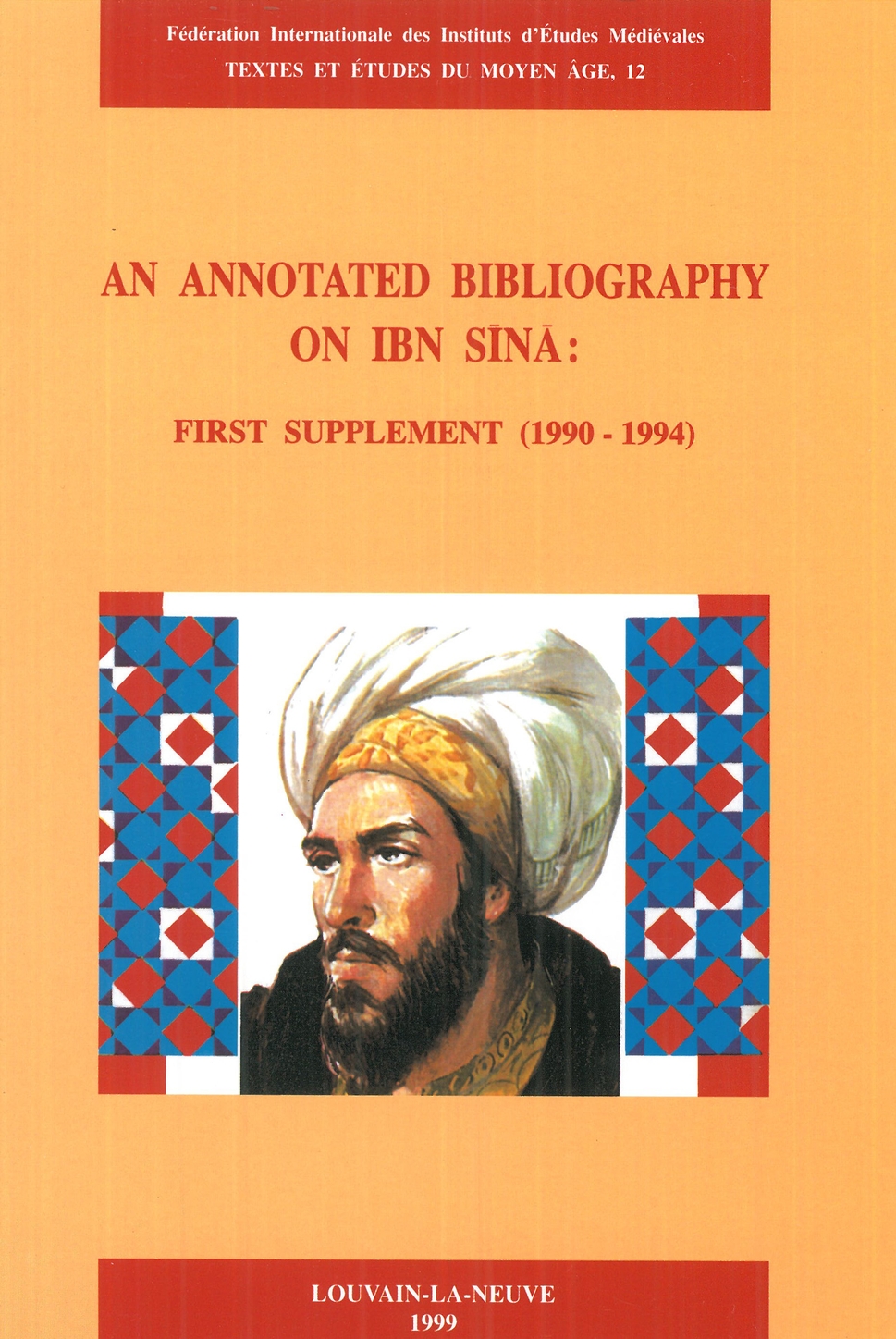
An annotated bibliography on Ibn Sina. First supplement (1990-1994)
show More to view fulltext, buy and share links for:An annotated bibliography on Ibn Sina. First supplement (1990-1994) show Less to hide fulltext, buy and share links for: An annotated bibliography on Ibn Sina. First supplement (1990-1994)This first supplement to my An Annotated Bibliography on Ibn Sînâ (1979-1989), published in 1991, informs the reader about all new studies on Ibn Sînâ (Avicenna) published in the period 1990-1994, and also offers corrigenda and addenda to the former bibliography. Also in the supplement, attention is paid to Western, and to non-Western publications. Moreover, it has been tried to be even more exhaustive by including publications, which have not Ibn Sînâ (Avincenna) in the title, but which nevertheless are offering important and innovative information about his life or thought.
First, an overview is given of the new editions and/or translations of Ibn Sînâ's works, which are once more identified according to the classic bibliographies of G.C. Anawati and M.Mehdavî. Hereafter, separate chapters are dedicated to studies of a biographical and a bibliographical nature. No less than ten chapters are devoted to materials dealing with Ibn Sînâ's philosophical thought (e.g., logic, psychology, metaphysics, religious thought, sources, influences both in the East and the West). Finally, materials dealing with Ibn Sînâ's scientific and medical contributions, are treated within two separate chapters. It has to be noted that almost all publications are annotated with a summary of their most original points and a short critical evaluation. An index, which includes the names of all authors, ancient, medieval and contemporary, has been added.
In sum, this work aims at providing a clear, concise and comprehensive work- instrument for all future Avicenna research. It is not only of great interest for all scholars working in Arabic-Islamic philosophy, science and medicine, but also for historians of philosophy and mediaevalists.
-
-
-
Analecta Bollandiana
show More to view fulltext, buy and share links for:Analecta Bollandiana show Less to hide fulltext, buy and share links for: Analecta BollandianaThe journal Analecta Bollandiana was launched in 1882, initially as a complement to the Acta Sanctorum series, but it soon acquired a life of its own, featuring articles by Bollandists and other scholars, text editions, book reviews, and more. After 140 years, it still remains the main reference in the field of critical hagiography.
Since the very beginning, this journal was intended to provide continuous updates to the Acta Sanctorum series, and to serve as an entirely new instrument devoted to hagiographical research. Every issue contains both critical editions of hagiographical texts (Greek, Latin, Oriental) and fundamental research on hagiography. The articles are published in modern international languages (English, French, German, Italian, and Spanish), and are accompanied by summaries in both English and French. A large section of each issue is devoted to book reviews and bibliography, making the Analecta Bollandiana indispensable for any department of medieval, Byzantine, Slavonic and Christian Oriental studies, as well as Church history, comparative religion, ethnology, and folklore.
More information about this journal on Brepols.net
-
-
-

Analogical Identities: The Creation of the Christian Self
Beyond Spirituality and Mysticism in the Patristic Era
show More to view fulltext, buy and share links for:Analogical Identities: The Creation of the Christian Self show Less to hide fulltext, buy and share links for: Analogical Identities: The Creation of the Christian SelfIs it possible for nihilism and an ontology of personhood as will to power to be incubated in the womb of Christian Mysticism? Is it possible that the modern ontology of power, which constitutes the core of the Greek-Western metaphysics, has a theological grounding? Has Nietszche reversed Plato or, more likely, Augustine and Origen, re-fashioning in a secular framework the very essence of their ontology? Do we have any alternative Patristic anthropological sources of the Greek-Western Self, beyond what has been traditionally called "Spirituality" or "Mysticism"? Patristic theology seems to ultimately provide us with a different understanding of selfhood, beyond any Ancient or modern, Platonic or not, Transcendentalism. This book strives to decipher, retrieve, and re-embody the underlying mature Patristic concept of selfhood, beyond the dichotomies of mind and body, essence and existence, transcendence and immanence, inner and outer, conscious and unconscious, person and nature, freedom and necessity: the Analogical Identityof this Self needs to be explored.
-
-
-
Analogical Identities: The Creation of the Christian Self
Volume 2: Self-Catholicization, Meta-Narcissism, and Christian Theology
show More to view fulltext, buy and share links for:Analogical Identities: The Creation of the Christian Self show Less to hide fulltext, buy and share links for: Analogical Identities: The Creation of the Christian SelfFollowing the first volume entitled Analogical Identities: The Creation of the Christian Self of a trilogy dedicated to Christian anthropology in a modern re-assessment, the present second volume deals with the specific content of this concept of “Analogical Identity” as a new hermeneutic retrieval of Christian anthropology in its relation with its historical roots and in the light of modern Philosophical and Psychological thought, to which we thus introduce some new conceptual tools. At the same time, a theological criticism of modern Philosophy and Psychology is initiated, and some new anthropological concepts of theological provenance are proposed.
-
-
-
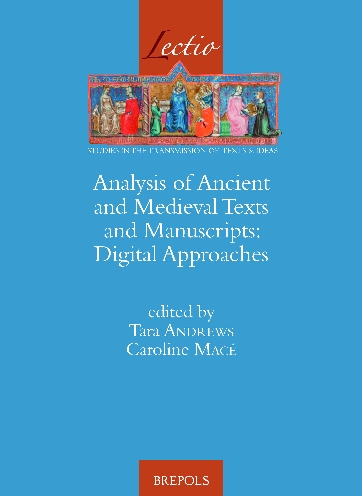
Analysis of Ancient and Medieval Texts and Manuscripts: Digital Approaches
show More to view fulltext, buy and share links for:Analysis of Ancient and Medieval Texts and Manuscripts: Digital Approaches show Less to hide fulltext, buy and share links for: Analysis of Ancient and Medieval Texts and Manuscripts: Digital ApproachesHow has the digital turn truly changed the nature of our research, particularly in the field of medieval scholarship where our collections are almost never large enough to justify the term 'big data'? All kind of new avenues of research are emerging, thanks to the creativity of scholars and to their interest in what digital means can offer. This collection of articles aims to give an up-to-date overview of the use of computer-assisted methods in several fields of scholarship dealing with ancient and medieval texts and manuscripts (from codicology and palaeography to textual criticism and literary or historical studies), across the boundaries of language and period. In moving away from theoretical debates about what the field of digital humanities is or should be, we present here a clearer picture of what textual scholars can achieve when they use computers for their research needs and purposes, and what their expectations may be in terms of the technology and developments in computational methodology.
List of contributors: T. Andrews, P. Andrist, F. Cafiero, J.-B. Camps, A. Cantera, A. Castro Correa, T. Heikkilä, A. Hoenen, A. Jordanous, E. R. Luján, C. Macé, E. Orduña, I. Rabin, P. Roelli, M. Romanov, S. Rubenson, L. Spinazzè, F. Stella, C. Tupman, K. Van Dalen-Oskam, J. van Zundert.
-