


EMISCS13

Collection Contents
6 results
-
-
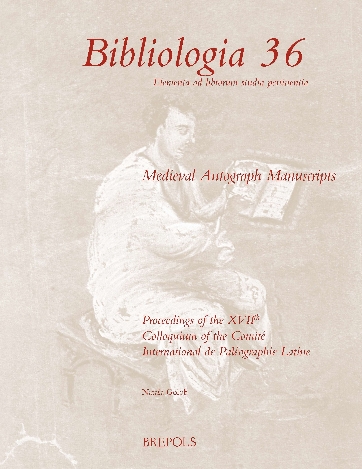
Medieval Autograph Manuscripts
show More to view fulltext, buy and share links for:Medieval Autograph Manuscripts show Less to hide fulltext, buy and share links for: Medieval Autograph ManuscriptsWhat is an autograph? How is it possible to define it? And how can we distinguish the hand of the writer, scientist, or translator - that is, of the learned person setting down his thoughts - from the hand of a pupil or copyist trained in the same style? Autographs have long been an especially challenging area of research into medieval manuscripts, for the finished product is intimately linked to both the author’s thought and his hand. Many well-known medieval authors had already been accorded scientific representations and became known as a result of these. They were joined by new names, a fact which widens the scope of research in the field of autographs and invites new questions. The XVIIth Colloquium of the Comité International de Paléographie Latine, which was held in Ljubljana between 7th and 10th September, 2010, was dedicated to autographs. In addition to scientific contributions by established paleographers, historians, literary and art historians, there were also inspiring papers by younger researchers. The colloquium was receptive to the presentation of new methods and processes of research into medieval manuscripts in general. These Proceedings of the XVIIth Colloquium contain 37 scientific papers documented with 239 illustrations as well as with further graphic elements.
-
-
-
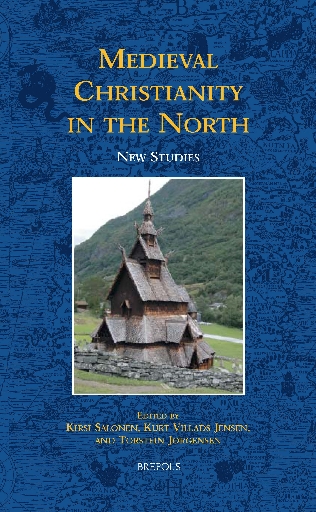
Medieval Christianity in the North
show More to view fulltext, buy and share links for:Medieval Christianity in the North show Less to hide fulltext, buy and share links for: Medieval Christianity in the NorthAll those barbarious peoples who in far-distant islands frequent the ice-bound Ocean, living as they do like beasts - who could call them Christians?
Pope Urban II, 1095
Such condescending impressions about the peoples living at the ‘end of the world’ have been adapted by Scandinavian historians who, until recently, have stressed the isolation and the otherness of the North, and ignored the many similarities to the ‘culturally more developed’ Europe. This collection of articles by Nordic scholars is truly interdisciplinary, covering philology, history, archaeology, theology, and other approaches. It is divided into two parts, the first of which addresses conversion from a broad perspective, while the second is devoted to the consolidation of Christianity and ecclesiastical structures. The book investigates from a fresh viewpoint important aspects of Nordic Christianity in the Middle Ages and discusses to what extent ideas and institutions were adapted to local circumstances. It includes a variety of topics, such as the remnants of paganism, medieval saints’ cults, law, and church, to religious warfare, and the use of beer in cult and memory.
-
-
-
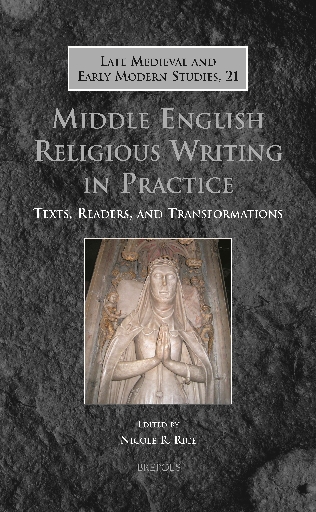
Middle English Religious Writing in Practice
show More to view fulltext, buy and share links for:Middle English Religious Writing in Practice show Less to hide fulltext, buy and share links for: Middle English Religious Writing in PracticeAlthough the Middle English texts broadly categorized as ‘devotional literature’ have received considerable scholarly attention in recent years, much work remains to be done on the cultural meanings and textual transformations of vernacular religious writing during the later medieval period and into the sixteenth century. During these years, popular (but still little-studied) late medieval works such as the Pore Caitif circulated in varied forms amid changing circumstances: the expansion of audiences for Middle English texts, the emergence and persecution of Lollardy, attempts at ecclesiastical censorship, the advent of printing, and the Henrician Reformation. How did Middle English religious texts answer changing cultural and practical needs and the requirements of orthodoxy? How did older texts find new readers; how did these readers alter and deploy them? This collection capitalizes on widespread current interest in these questions, gathering original essays that analyse the many forms, meanings, and legacies of Middle English religious writing.
-
-
-
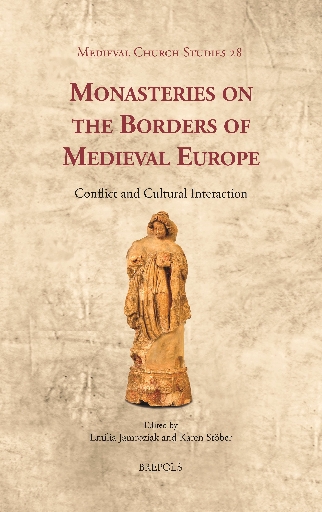
Monasteries on the Borders of Medieval Europe
show More to view fulltext, buy and share links for:Monasteries on the Borders of Medieval Europe show Less to hide fulltext, buy and share links for: Monasteries on the Borders of Medieval EuropeAs a historical and cultural phenomenon, monasticism always had a close connection with frontiers. The earliest monasteries were believed to be founded in wildernesses and deserts, thus existing beyond society and the inhabited world in general. As intercessors praying for their patrons and benefactors, monastic communities also existed on the border between the earthly and the spiritual worlds.
In medieval Europe, however, the frontier nature of monasticism had specific manifestations in addition to the founding myths of monastic wilderness. In the twelfth and thirteenth centuries the expansion of Latin Europe in East-Central Europe, the Iberian Peninsula, Scandinavia, and into the Holy Land and Greece opened possibilities for extending monastic networks and establishing new houses. One of the most important parts of this process was the interaction between these new religious communities and the social world around them - an interaction that was characterised by various shades of hostility, cooperation, and adaptation to the local social and cultural framework.
This is the first collection to consider the phenomenon of monastic frontiers in a cross-disciplinary manner. The book’s ten chapters explore the role of monasteries in maintaining political and cultural borders, in breaking and sustaining linguistic boundaries in late medieval Europe, as well as in building and stabilizing Latin Christian cultural identities on the northern and southern frontiers of Europe. Using a wide range of textual, archaeological, and material evidence, an international group of authors examines the expansion of monastic and mendicant networks in Scandinavia, Iberia, East-Central Europe, the British Isles, northern France, the Balkans, and Frankish Greece.
-
-
-
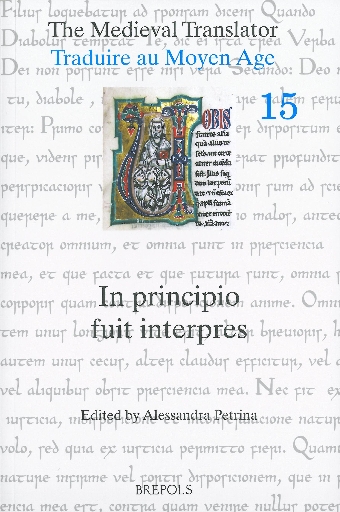
The Medieval Translator. Traduire au Moyen Age
show More to view fulltext, buy and share links for:The Medieval Translator. Traduire au Moyen Age show Less to hide fulltext, buy and share links for: The Medieval Translator. Traduire au Moyen AgeTranslation studies centering on medieval texts have prompted new ways to look at the texts themselves, but also at the exchange and transmission of culture in the European Middle Ages, inside and outside Europe. The present volume reflects, in the range and scope of its essays, the itinerant nature of the Medieval Translator Conference, at the same time inviting readers to reflect on the geography of medieval translation. By dividing the essays presented here into four groups, the volume highlights lines of communication and shifts in areas of interest, connecting the migrating nature of the translated texts to the cultural, political and linguistic factors underlying the translation process. Translation was, in each case under discussion, the result or the by-product of a transnational movement that prompted the circulation of ideas and texts within religious and/or political discussion and exchange.
Thus the volume opens with a group of contributions discussing the cultural exchange between Western Europe and the Middle East, identifying the pivotal role of Church councils, aristocratic courts, and monasteries in the production of translation. The following section concentrates on the literary exchanges between three close geographical and cultural areas, today identifiable with France, Italy and England, allowing us to re-think traditional hypotheses on sites of literary production, and to reflect on the triangulation of language and manuscript exchange. From this triangulation the book moves into a closer discussion of translations produced in England, showing in the variety and chronological span covered by the contributions the development of a rich cultural tradition in constant dialogue with Latin as well as contemporary vernaculars. The final essays offer a liminal view, considering texts translated into non-literary forms, or the role played by the onset of printing in the dissemination of translation, thus highlighting the continuity and closeness of medieval translation with the Renaissance.
Alessandra Petrina is Associate Professor of English Literature at the Università degli Studi di Padova, Italy. She has published extensively on late-medieval and Renaissance literature and intellectual history, as well as on modern children’s literature, and edited a number of volumes on early modern English culture.
-
-
-
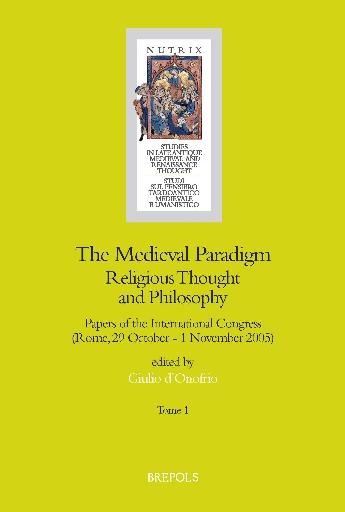
The Medieval Paradigm
show More to view fulltext, buy and share links for:The Medieval Paradigm show Less to hide fulltext, buy and share links for: The Medieval ParadigmMedieval culture is marked by a general acceptance of the mental attitude which both recognized and accepted the truths of the dominant religion. This is, then, the ‘general paradigm’ that programmatically directs the paths and results of intellectual activity in the Middle Ages. In the various fields of scientific research, in the different epochs and in the manifold social and institutional situations, there are also produced - based on the ‘general paradigm’ - many ‘particular paradigms’, which carry out some specified and graduated effects of the general one.
The idea pursued during the Congress is an attempt to determine, describe and evaluate the general and particular results the ‘paradigm’ had on the maturation of medieval philosophical and scientific thought with regard to the relationship - that was a dynamic and reciprocal one, and was not necessarily reduced to a theological understanding -between rational inquiry and religious belief.
List of Contributors: G. Alliney, M. Bartoli, A. Bisogno, A. Cacciotti, S. Carletto, C. Casagrande, A. Conti, G. d’Onofrio, P.F. De Feo, C. Erismann, G. Fioravanti, F. Fiorentino, A. Galonnier, R. Gatti, J. Gavin, M. Geoffroy, A. Guidi, M. Laffranchi, R. Lambertini, M. Lenzi, E. Mainoldi, C. Martello, C. Mews, A. Morelli, P. Müller, F. Paparella, M. Parodi, G. Perillo, I. Peta, A. Petagine, P. Porro, F. Seller, K. Tachau, Ch. Trottmann, S. Vecchio, M. Vittorini, J. Ziegler
-