


EMISCS13

Collection Contents
7 results
-
-
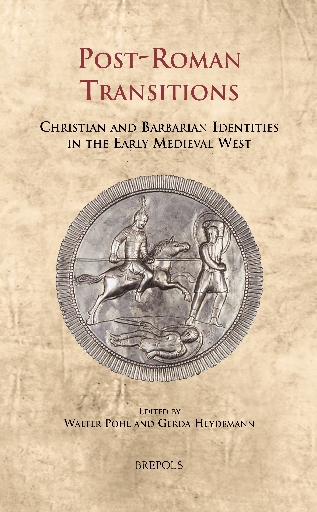
Post-Roman Transitions
show More to view fulltext, buy and share links for:Post-Roman Transitions show Less to hide fulltext, buy and share links for: Post-Roman TransitionsThis volume looks at changing identities during the transition from the Roman empire to a political world defined by a different kingdoms and peoples in western Europe. It addresses 'ethnicity' in the context of alternative modes of identification, mainly Christianity and Romanness. To widen the horizon of current debates, it shows that the ancient dichotomy between barbarians and Romans is hardly helpful in understanding the complex transitions to a post-imperial age in the West. In a broad sweep of regional examples, from Spain and North Africa to Dalmatia and the British Isles, the book follows the unfolding of Christian and barbarian identities: How were both the Roman and the barbarian past used for the formation and legitimation of new identities?
The ‘scripts of Romanness’ changed in the early Middle Ages, and so did the significance of othering pagans, heretics, or barbarians. The contributions trace the tenacity and the ambiguity of traditional narratives and signs of distinction: manuscripts and material remains, costume and epigraphy, historiography and hagiography were used in creative ways to shape civic, local, or religious communities. Many of the contributions show the fundamental importance of Christian 'strategies of identification' for creating a stronger political role for ethnicity in the post-Roman kingdoms. As such, they follow a line of argument that has also been explored in the book’s companion volume in this series, Strategies of Identification: Ethnicity and Religion in Early Medieval Europe (CELAMA 13).
-
-
-

Preaching and Political Society
show More to view fulltext, buy and share links for:Preaching and Political Society show Less to hide fulltext, buy and share links for: Preaching and Political Society[The connections between preaching, politics, and society have been manifold yet varied in the period from Late Antiquity to the end of the Middle Ages. In this multi-lingual volume, these associations are studied within their historical context over twelve new contributions, addressing a wide range of geographical areas and opening up a series of sources which have previously been neglected. Special attention is paid to the cultural and geographical circumstances in which the complex relationship between political thought and preaching should be explored. These contributions reveal the circumstances and the procedures that inspire various preachers to reflect upon political topics, which are often of a sensitive nature. In this way, the powerful and the general public of believers have access to an array of political ideas, allowing opinion-making and political discussion. Furthermore, the collection also shows news ways in which political thought and preaching can be explored, revealing new methods and lines of inquiry allowing insights into the complexities of medieval societies. The international cast of contributors provides a broad perspective on the subject, through six articles in French, and six in English.
,Depuis au moins l’Antiquité tardive, les relations entre prédication et société politique ont été nombreuses et variées. Dans le présent volume ont été réunies douze contributions qui, en mettant en œuvre une documentation le plus souvent encore inédite, étudient comment, dans des contextes historiques, culturels et géographiques différents, ces relations complexes se sont déployées. Les contributions permettent ainsi de mieux apprécier dans quelles circonstances et selon quelles modalités plusieurs prédicateurs ont été amenés à proposer dans leurs sermons une réflexion de nature politique censée contribuer à la formation de l’opinion des puissants et des fidèles en général. Elles montrent aussi quelques-unes des voies qui permettent d’explorer un domaine de recherche qui n’a suscité jusqu’ici qu’un nombre limités de travaux, mais dont la connaissance est sans aucun doute indispensable pour mieux comprendre la complexité des sociétés médiévales.
]
-
-
-
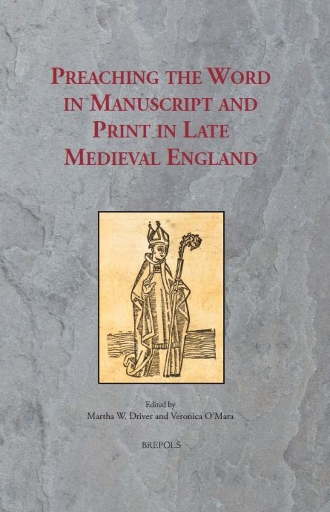
Preaching the Word in Manuscript and Print in Late Medieval England
show More to view fulltext, buy and share links for:Preaching the Word in Manuscript and Print in Late Medieval England show Less to hide fulltext, buy and share links for: Preaching the Word in Manuscript and Print in Late Medieval EnglandThe focus of this volume, on Middle English and Latin material in prose and verse, concerns the preaching of the word of God in an expansive sense in late medieval England. This collection of essays explores the multiple ways in which the sermon in England in the later Middle Ages both influenced and was influenced by other devotional and didactic material, both implicitly and explicitly. The essays pay special attention to examples of textual complexity in the sermon as manifested in the manuscript and early printed traditions. By examining sermon technique and methodology contributors present related material that either travels alongside sermons or shares the same preaching or teaching milieu. While analysing sermons and other homiletic material, the essays also explore areas, such as the dating and illustration of incunabula, which have an important bearing on the sermons and devotional literature of the period, but are normally studied in an isolated fashion. These fit in well with the particular emphasis in the collection on the sermon in the early printed period. In addition, attention is paid to some of the ways in which sermon-study was first brought to the fore by late nineteenth-century editors and early twentieth-century commentators. In this way various threads are brought together, new texts and ideas presented, and potential future avenues for research suggested that will continue to be important for an understanding of sermons and related religious literature in late medieval England.
-
-
-

Probable Truth
show More to view fulltext, buy and share links for:Probable Truth show Less to hide fulltext, buy and share links for: Probable TruthEditing as an academic mode of work has had a variable ‘press’ - it is often seen as just plumbing. But without editions no historian of whatever critical persuasion could operate. Texts that are not edited are effectively invisible.
The advent of electronic means of text production has also raised new possibilities and new problems that need to be openly considered rather than ignored. The papers in this volume reflect those concerns, and explore the ways forward. How do the best editorial procedures of the past get transmitted to the future? A distinguished line-up of experienced editors and younger scholars actively grappling with these issues reflect on their engagement with the challenges of textual theory and editorial practice.
No single solution emerges as applicable to all texts and for all editions; the individual characteristics of each text and its transmission, together with the intended audience of each edition, emerge as primary areas for consideration.
-
-
-
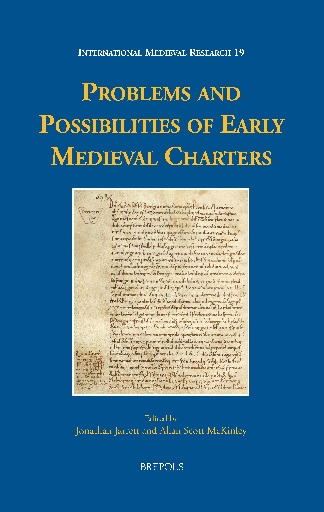
Problems and Possibilities of Early Medieval Charters
show More to view fulltext, buy and share links for:Problems and Possibilities of Early Medieval Charters show Less to hide fulltext, buy and share links for: Problems and Possibilities of Early Medieval ChartersAlthough historical work on the early Middle Ages relies to an enormous extent on the evidence provided by charters and other such documents, the paradigms within which such documents are interpreted have changed relatively slowly and unevenly. The critical turn, the increasing availability of digital tools and corpora for study, and the acceptance among charter specialists that their discipline can inform a wider field all encourage rethinking. From 2006 to 2011 a series of sessions at the Leeds International Medieval Congress addressed this by applying new critiques and technologies to early medieval diplomatic material from all over Europe. This volume collects some of the best of these papers by new and young scholars and adds related work from another session. The subjects range from reinterpretations of Carolingian or Anglo-Saxon political history, through the production and use of charters by all ranks of society and their subsequent preservation from Spain to Germany and England to Italy, to explorations of new media leading to new kinds of results from such evidence. The result is an array of new perspectives which makes an important contribution to recent reconsiderations of charter studies. It will inform a wide audience from all walks of medieval historical studies.
-
-
-
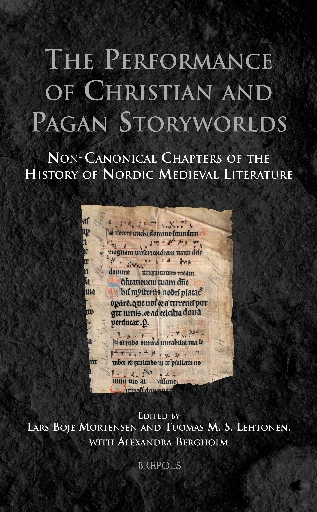
The Performance of Christian and Pagan Storyworlds
show More to view fulltext, buy and share links for:The Performance of Christian and Pagan Storyworlds show Less to hide fulltext, buy and share links for: The Performance of Christian and Pagan StoryworldsThe present collection explores a hitherto understudied body of Nordic medieval literature which, although overlooked in traditional, language-based narratives, was in fact crucial in shaping social and religious identities.
By drawing on the ‘performance turn’ in cultural studies, the volume identifies a number of minor and peripheral literary forms and texts that had a vital connection to ritual and ritualized speech. These neglected traditions therefore offer an alternative insight into Nordic literary life and the sets of cultural expression, or storyworlds, underlying Nordic culture.
The collected studies explore different aspects of verbal performances as a primary vehicle for the Nordic storyworlds, with a preference for the Christian over the pagan traditions. Emphasis is placed on Latin, Old Norse, and Finnish traditions that were retold and reproduced over time. These ‘living’ literary forms highlight the importance of non-canonical texts for the interpretation of contact between the peripheries and centres of Nordic culture. Through the focus on the interaction between Latin and the vernacular, between eastern Baltic and western Latin influences, and between ritual and speech in religious practice, this collection demonstrates the importance of ‘minor’ texts for the re-construction of medieval Nordic culture and history.
-
-
-
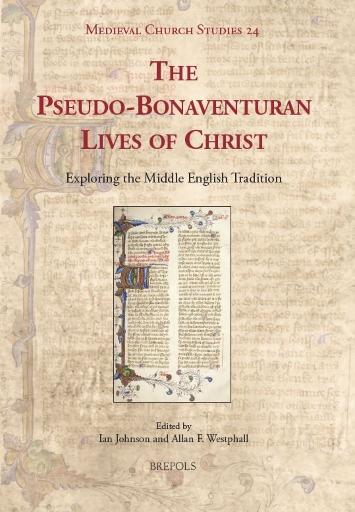
The Pseudo-Bonaventuran Lives of Christ
show More to view fulltext, buy and share links for:The Pseudo-Bonaventuran Lives of Christ show Less to hide fulltext, buy and share links for: The Pseudo-Bonaventuran Lives of ChristThis is a collection of pioneering studies by a distinguished transatlantic team of scholars on a neglected yet canonical tradition of medieval English literature. From the fourteenth to the sixteenth centuries and beyond, the remarkable ‘pseudo-Bonaventuran’ tradition, flowing from the Latin Meditationes vitae Christi (and thought, wrongly, to have been composed by St Bonaventure), gave Europe orthodox models for how to represent, know, and follow Jesus Christ. The Meditationes, in a huge variety of Latin and vernacular versions, invite their readers and listeners to imagine themselves present within the Gospel narrative. How to live, what to believe, how to feel, and how to be saved: this eloquent mainstream tradition had an impact on the public and private lives of English people more profound and lasting than any text save the Bible itself. For many, it even did the Bible’s work. The tradition of the Meditationes provides us with a gauge of lived religious sensibility without equal in the English later Middle Ages.
Deriving from the Queen’s Belfast-St Andrews AHRC-funded research project, Geographies of Orthodoxy: Mapping the English Pseudo-Bonaventuran Lives of Christ, c. 1350-1550, this volume questions and revises previous descriptions of the devotional, cultural, and political contexts in which pseudo-Bonaventuran Lives of Christ were produced, circulated, read, and understood. The period spanning the rise and repression of Lollardy, the ostensibly ‘orthodox’ fifeenth century, and the Tudor Reformations will never look quite the same again.
-