


Bulletin de Philosophie Médiévale
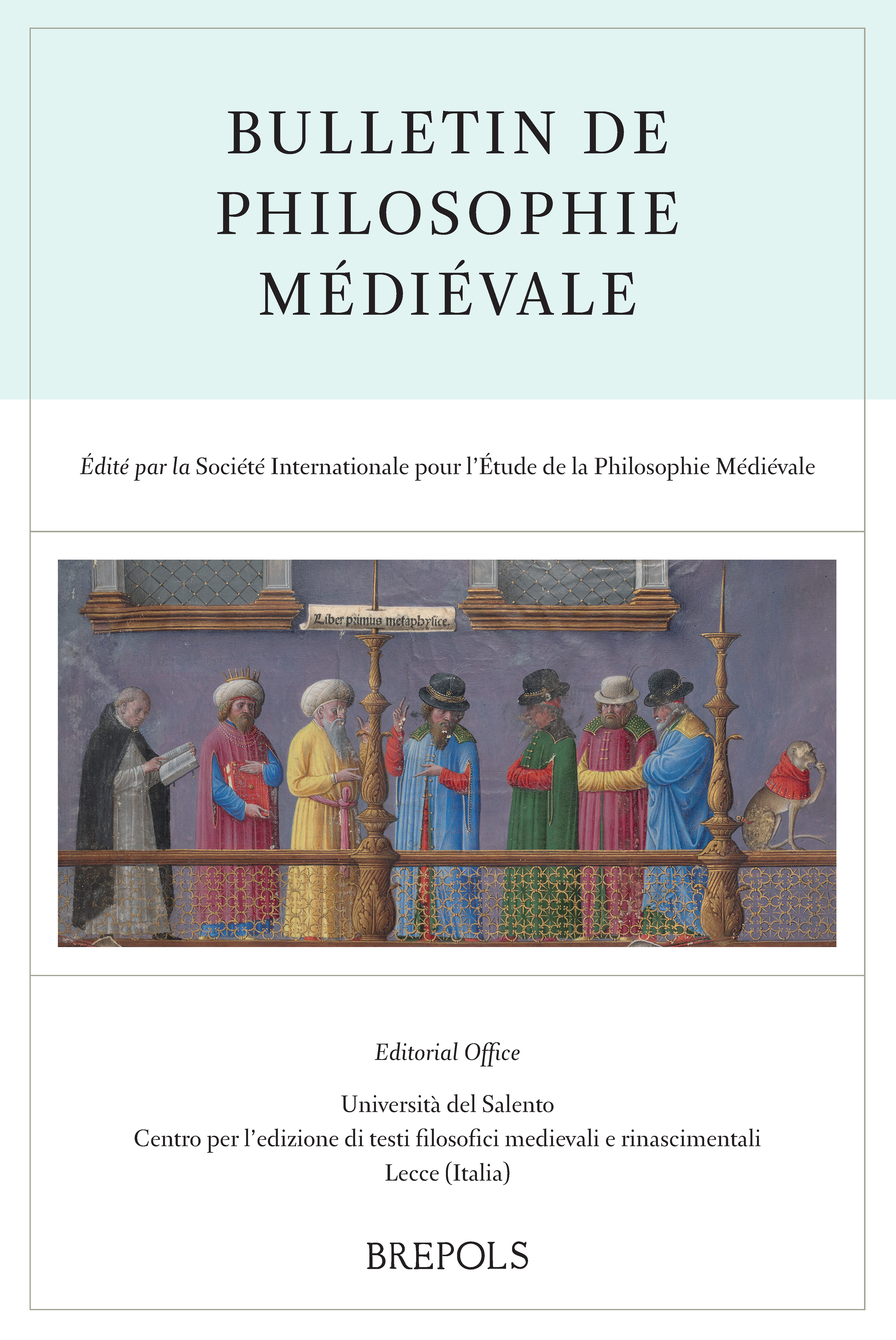
Volume 52, Issue 1, 2010
-
-
Front Matter (“Title page”, “Copyright page”, “In memoriam John E. Murdoch”, “Editorial information”)
show More to view fulltext, buy and share links for:Front Matter (“Title page”, “Copyright page”, “In memoriam John E. Murdoch”, “Editorial information”) show Less to hide fulltext, buy and share links for: Front Matter (“Title page”, “Copyright page”, “In memoriam John E. Murdoch”, “Editorial information”)
-
-
-
Commission II: The Latin Aristotle and Medieval Latin Commentaries on Aristotle
show More to view fulltext, buy and share links for:Commission II: The Latin Aristotle and Medieval Latin Commentaries on Aristotle show Less to hide fulltext, buy and share links for: Commission II: The Latin Aristotle and Medieval Latin Commentaries on AristotleAuthors: P. De Leemans and C. TrifogliAbstractIn this report we provide information concerning the work of the Commission in the three-year period from September 2007 (Congress of Palermo) to the end of 2010. We give a list and short descriptions of the publications that appeared in this period and of the new projects proposed. The report is divided into two main parts. The first concers the Aristoteles Latinus stricte loquendo, that is, the editions of the Latin translations of Aristotle’s works. The second part treats editions of Latin commentaries on the works of Aristotle. The second part is followed by an Appendix, in which we list some studies related to the commentaries that have been or are being prepared.
-
-
-
Commission VI: The Trivium
show More to view fulltext, buy and share links for:Commission VI: The Trivium show Less to hide fulltext, buy and share links for: Commission VI: The TriviumBy: S. EbbesenAbstractThis report chronicles for the period 2002-2007 important results obtained and developments that have taken place in the study of the Trivium during the Greek and Latin Middle Ages. It highlights important research projects such as the French-led project concerning the Glosule in Priscianum, important studies and editions, and trends such as that concentrating symposia and collective volumes on works related to one authoritative text.
-
-
-
SIEPM Project “Second Scholasticism”: Scholastica colonialis
show More to view fulltext, buy and share links for:SIEPM Project “Second Scholasticism”: Scholastica colonialis show Less to hide fulltext, buy and share links for: SIEPM Project “Second Scholasticism”: Scholastica colonialisBy: R.H. PichAbstractThis article presents the research project “Scholastica colonialis: Reception and Development of Baroque Scholasticism in Latin America in the Sixteenth to Eighteenth Centuries.” Scholastica colonialis is an integrated project of international co-operation among five research groups in Brazil, Peru, Chile, Portugal and Spain. The project has recently been awarded financial support by CAPES, one of the most important Brazilian agencies supporting research. The scholars in the project intend to catalogue the early-modern Scholastic materials in Latin American libraries, which will be the foundation of a long-term and exhaustive investigation of the development of Baroque Scholastic philosophy in Latin America during the colonial period.
-
-
-
What is Medieval Logic After All? Towards a Scientific Use of Natural Language
show More to view fulltext, buy and share links for:What is Medieval Logic After All? Towards a Scientific Use of Natural Language show Less to hide fulltext, buy and share links for: What is Medieval Logic After All? Towards a Scientific Use of Natural LanguageBy: L. CesalliAbstractThe puzzle sketched in this short introduction pinpoints the difficulty experienced by historians of medieval logic to define the very discipline that they are studying. Thus, in spite of all the work done during the last 60 years, the question: “What is medieval logic after all?” remains actual. A general perspective of investigation is suggested, namely the farreaching consequences of the attempt to cope with what one could call the formal and material constraints of medieval logic (i.e., aiming at the elaboration of a scientific language as distinct from dealing with natural language).
-
-
-
Speech Act and Intentional Meaning in the Medieval Philosophy of Language
show More to view fulltext, buy and share links for:Speech Act and Intentional Meaning in the Medieval Philosophy of Language show Less to hide fulltext, buy and share links for: Speech Act and Intentional Meaning in the Medieval Philosophy of LanguageBy: I. Rosier-CatachAbstractImportant developments in logic and semantics were realized by the Arts Masters in the Middle Ages. Besides their interests in truth-conditions and the well-formedness of canonical sentences, they were also interested in semantic questions that require one to take into account the context of semantic usage, the moral and social dimensions of these uses, and the interplay between speaker and hearer. Such questions were also asked by theologians, who had a good knowledge of the disciplines of grammar and logic. In this essay I study examples that can be compared to modern speech act theory, namely deviant sentences in grammar, syncategorematic words in logic, and examples of sacramental formulas, promises, oaths, lies and perjuries in theology and law. An especially interesting issue is the discrepancy between intentional meaning and conventional meaning. Although for a modern reader the different of examples would be part of a theory of speech act as a whole, they were never merged in the medieval period.
-
-
-
From Natural Thinking to Scientific Reasoning: Concepts of logica naturalis and logica artificialis in Late-Medieval and Early-Modern Thought
show More to view fulltext, buy and share links for:From Natural Thinking to Scientific Reasoning: Concepts of logica naturalis and logica artificialis in Late-Medieval and Early-Modern Thought show Less to hide fulltext, buy and share links for: From Natural Thinking to Scientific Reasoning: Concepts of logica naturalis and logica artificialis in Late-Medieval and Early-Modern ThoughtBy: M.J.F.M. HoenenAbstractThis article investigates the late-medieval and early-modern use of the concepts of natural and artifical logic. Natural logic is the inborn capacity to argue, common to all human beings, whereas artifical logic is the expression and description of this ability through formal rules that were codified in logical handbooks. According to most authors until the time of Kant, artificial logic must take its starting point from natural thinking and natural speech, since the organizational patterns of the human mind reveal themselves only in speaking about and discussing extra-mental reality. For these medieval and early-modern logicians, therefore, natural arguing is the object of artifical logic, which they developed in their logical treatises and taught in schools and universities.
-
-
-
Postscript: Medieval Logic as Sprachphilosophie
show More to view fulltext, buy and share links for:Postscript: Medieval Logic as Sprachphilosophie show Less to hide fulltext, buy and share links for: Postscript: Medieval Logic as SprachphilosophieBy: L. CesalliAbstractTo the question “What is medieval logic after all?”, this postscript suggests the following answer: medieval logic is Sprachphilosophie, that is, philosophy of language as it developed in the early twentieth century in the Austro-German tradition. This claim is based on the fact that: (1) medieval logic textbooks often deal with topics which would not qualify as belonging to logic (e.g., questions pertaining to grammar, semantics, philosophy of mind and metaphysics); and (2) this location at the crossroads of those philosophical domains is precisely a characteristic feature of Sprachphilosophie. In addition, one of the first attempts to grasp the specificity of medieval linguistic theogy (Grabmann’s Sprachlogik, 1920) explicitly derives from the Sprachphilosophie of the Austro-German tradition.
-
-
-
The Sapientiale of Thomas of York, OFM: The Fortunes and Misfortunes of a Critical Edition
show More to view fulltext, buy and share links for:The Sapientiale of Thomas of York, OFM: The Fortunes and Misfortunes of a Critical Edition show Less to hide fulltext, buy and share links for: The Sapientiale of Thomas of York, OFM: The Fortunes and Misfortunes of a Critical EditionAuthors: F. Retucci and J. GoeringAbstractThe absence of a critical edition of the Sapientiale by Thomas of York (composed in the mid-thirteenth century) yields a lacuna in our knowledge of the history of medieval philosophy. This article traces the history of scholarship concerning the text by specialists on the early Franciscan school at Oxford and by teachers and students at the Pontifical Institute of Mediaeval Studies in Toronto, and presents the status quaestionis concerning the life, career and writings of Thomas of York. Finally, the article announces the plan for a forthcoming edition of the Sapientiale under the supervision of an International Advisory Board centered at the Thomas-Institut der Universität zu Köln. An Appendix by Joseph Goering records the preliminary work on the text of the Sapientiale done at Toronto.
-
-
-
Bibliotheca manuscripta Petri Thomae
show More to view fulltext, buy and share links for:Bibliotheca manuscripta Petri Thomae show Less to hide fulltext, buy and share links for: Bibliotheca manuscripta Petri ThomaeBy: G.R. SmithAbstractPetrus Thomae was a fourteenth-century Spanish philosopher who taught in Barcelona. Although he did not hear John Duns Scotus lecture personally, he was familiar with Scotus’ autograph material and thus is a useful source in reconstructing his thought. This article collects and supplements the available information on the life of Petrus Thomae, and presents an inventory of the surviving manuscripts of his works.
-
-
-
The Commentary on Aristotle’s De anima by Alphonsus Vargas Toletanus, OESA
show More to view fulltext, buy and share links for:The Commentary on Aristotle’s De anima by Alphonsus Vargas Toletanus, OESA show Less to hide fulltext, buy and share links for: The Commentary on Aristotle’s De anima by Alphonsus Vargas Toletanus, OESAAuthors: P.J.J.M. Bakker and J.H.L. van den BerckenAbstractThis article examines the commentary on Aristotle’s De anima by Alphonsus Vargas Toletanus, OESA († 1366). The commentary has been preserved in one manuscript, Cremona, Biblioteca Statale, Ms. 113 (Nl-12193), written in Bologna in 1475, and in at least five editions printed between 1477 and 1609. The article presents a detailed overview of the commentary by listing its quaestiones and conclusiones and by focusing on the sources used by Vargas. It argues that the general objective of the work was to provide an overview of opinions on essential issues concerning the soul, to be used by students of the Augustinian Order.
-
-
-
Two New Heuristic Instruments and the Ideal Order of Research in Medieval Philosophy
show More to view fulltext, buy and share links for:Two New Heuristic Instruments and the Ideal Order of Research in Medieval Philosophy show Less to hide fulltext, buy and share links for: Two New Heuristic Instruments and the Ideal Order of Research in Medieval PhilosophyBy: K. EmeryAbstractThis essay proposes an ideal order of research in medieval philosophy and theology, historically exemplified, which progresses from heuristic works to critical editions to interpretive studies to, finally, translations of Latin texts into modern vernacular languages (the value of which is not unambiguous). Thereafter the essay offers reviews of two new heuristic instruments, the Repertorium initiorum manuscriptorum latinorum medii aevi, 4 volumes, by Jacqueline Hamesse assisted by Slawomir Szyller, and A Catalogue of 13th-Century Sophismata, 2 volumes, by Sten Ebbesen and Frédéric Goubier.
-
-
-
Notices sur les institutions ou associations adonées specialement à l’étude de la pensée médiévale
show More to view fulltext, buy and share links for:Notices sur les institutions ou associations adonées specialement à l’étude de la pensée médiévale show Less to hide fulltext, buy and share links for: Notices sur les institutions ou associations adonées specialement à l’étude de la pensée médiévale
-
-
-
Back Matter (“Liste des ouvrages et tirés à part envoyées au secrétariat au cours de l’année 2010”, “Table des manuscrits”, “Table des noms d’auteurs anciens et médiévaux”, “Table des noms d’auteurs modernes et contemporains”, “Table des matières”)
show More to view fulltext, buy and share links for:Back Matter (“Liste des ouvrages et tirés à part envoyées au secrétariat au cours de l’année 2010”, “Table des manuscrits”, “Table des noms d’auteurs anciens et médiévaux”, “Table des noms d’auteurs modernes et contemporains”, “Table des matières”) show Less to hide fulltext, buy and share links for: Back Matter (“Liste des ouvrages et tirés à part envoyées au secrétariat au cours de l’année 2010”, “Table des manuscrits”, “Table des noms d’auteurs anciens et médiévaux”, “Table des noms d’auteurs modernes et contemporains”, “Table des matières”)
-
Volumes & issues
-
Volume 66 (2024)
-
Volume 65 (2023)
-
Volume 64 (2022)
-
Volume 63 (2021)
-
Volume 62 (2020)
-
Volume 61 (2019)
-
Volume 60 (2018)
-
Volume 59 (2017)
-
Volume 58 (2016)
-
Volume 57 (2015)
-
Volume 56 (2014)
-
Volume 55 (2013)
-
Volume 54 (2012)
-
Volume 53 (2011)
-
Volume 52 (2010)
-
Volume 51 (2009)
-
Volume 50 (2008)
-
Volume 49 (2007)
-
Volume 48 (2006)
-
Volume 47 (2005)
-
Volume 46 (2004)
-
Volume 45 (2003)
-
Volume 44 (2002)
-
Volume 43 (2001)
-
Volume 42 (2000)
-
Volume 41 (1999)
-
Volume 40 (1998)
-
Volume 39 (1997)
-
Volume 38 (1996)
-
Volume 37 (1995)
-
Volume 36 (1994)
-
Volume 35 (1993)
-
Volume 34 (1992)
-
Volume 33 (1991)
-
Volume 32 (1990)
-
Volume 31 (1989)
-
Volume 30 (1988)
-
Volume 29 (1987)
-
Volume 28 (1986)
-
Volume 27 (1985)
-
Volume 26 (1984)
-
Volume 25 (1983)
-
Volume 24 (1982)
-
Volume 23 (1981)
-
Volume 22 (1980)
-
Volume 21 (1979)
-
Volume 20 (1978)
-
Volume 19 (1977)
-
Volume 18 (1976)
-
Volume 16-17 (1974)
-
Volume 15 (1973)
-
Volume 14 (1972)
-
Volume 13 (1971)
-
Volume 10-11-12 (1968)
-
Volume 8-9 (1966)
-
Volume 7 (1965)
-
Volume 6 (1964)
-
Volume 5 (1963)
-
Volume 4 (1962)
-
Volume 3 (1961)
-
Volume 2 (1960)
-
Volume 1 (1959)
Most Read This Month
