


Peritia
Journal of the Medieval Academy of Ireland
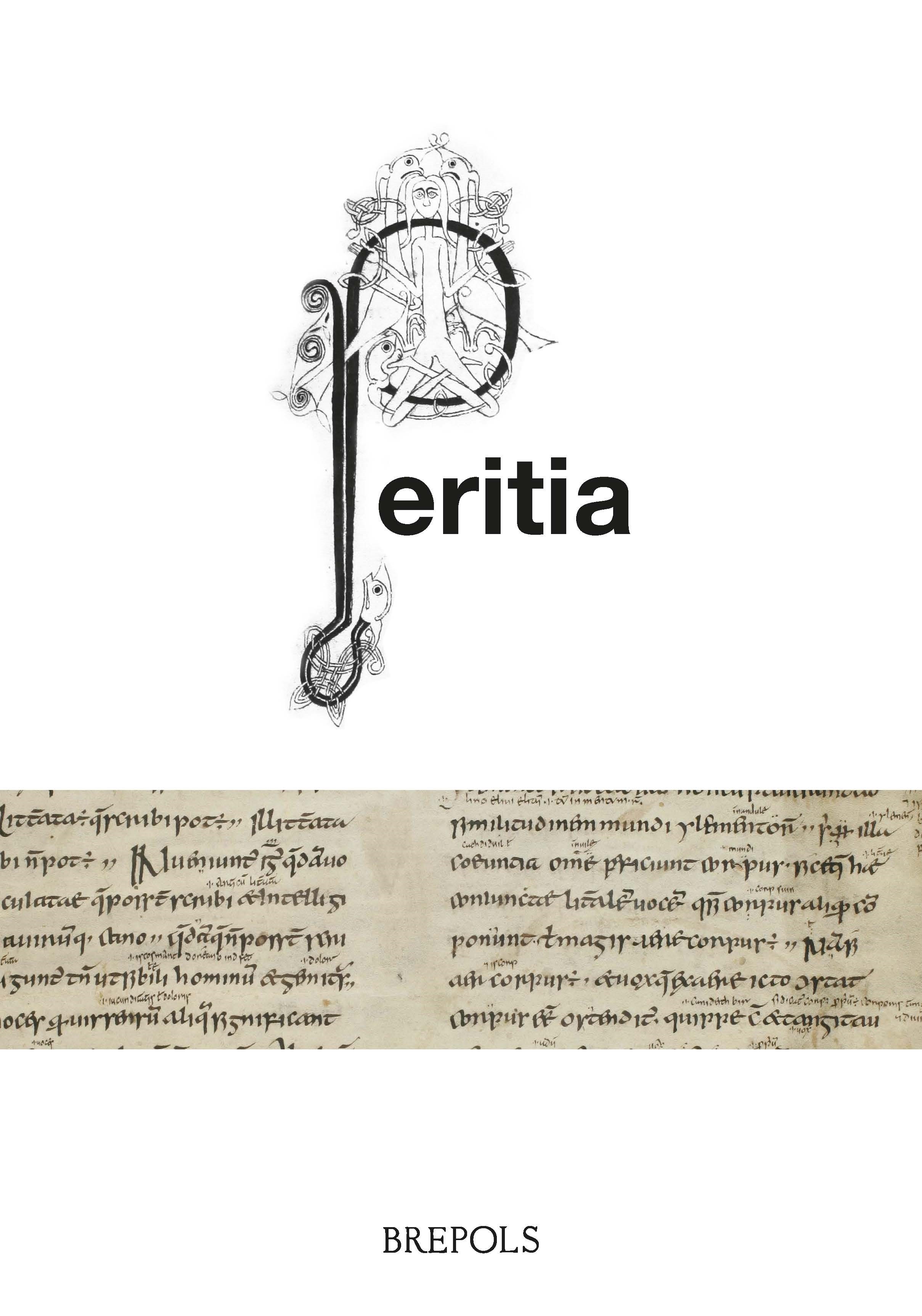
Volume 35, Issue 1, 2024
-
-
Front Matter ("Contents", "Abbreviations", "Expanded Acknowledgement for ‘Tracing the Sons of Brión. The R1b-A259 Y-DNA Subclade and the Uí Briúin Dynasty of Connacht’, Peritia 34 (2023) 9–45")
show More to view fulltext, buy and share links for:Front Matter ("Contents", "Abbreviations", "Expanded Acknowledgement for ‘Tracing the Sons of Brión. The R1b-A259 Y-DNA Subclade and the Uí Briúin Dynasty of Connacht’, Peritia 34 (2023) 9–45") show Less to hide fulltext, buy and share links for: Front Matter ("Contents", "Abbreviations", "Expanded Acknowledgement for ‘Tracing the Sons of Brión. The R1b-A259 Y-DNA Subclade and the Uí Briúin Dynasty of Connacht’, Peritia 34 (2023) 9–45")
-
-
-
De enigmatibus (Das Bibelwerk) on Genesis: A Few Problems Concerning Enigmas from Codicological Fragments
show More to view fulltext, buy and share links for:De enigmatibus (Das Bibelwerk) on Genesis: A Few Problems Concerning Enigmas from Codicological Fragments show Less to hide fulltext, buy and share links for: De enigmatibus (Das Bibelwerk) on Genesis: A Few Problems Concerning Enigmas from Codicological FragmentsAuthors: Lukas J. Dorfbauer and Charles D. WrightAbstractIn his groundbreaking ‘Wendepunkte’ article of 1954, Bernhard Bischoff listed some manuscript fragments at the BSB Munich that contain parts of the Hiberno-Latin biblical commentary De enigmatibus. The shelfmarks he indicated (‘Clm 29051 + 29162 + 29167’) have long been obsolete and cannot readily be identified in the usual concordances. After investigation in Bischoff’s ‘Nachlass’ at the BSB, we can demonstrate that the fragments correspond to the current signatures Clm 29280/4 and 29410/5. Our paleographical analysis confirms that these pieces originally belonged to the same manuscript book, written around the middle of the ninth century, probably in the Regensburg area. Since the fragments (all from the commentary on Genesis) were not consulted by Gerard MacGinty for his edition of the Pentateuch section of De enigmatibus, we transcribe their texts and also clarify their stemmatic relationship to the main manuscripts of the commentary: they were copied from the same lost exemplar as was Clm 14276 (s. ix1/4, Regensburg).
-
-
-
Fosterage in the Annals of the Four Masters: The Case of Diarmait mac Máel na mBó and Tairdelbach Ua Briain
show More to view fulltext, buy and share links for:Fosterage in the Annals of the Four Masters: The Case of Diarmait mac Máel na mBó and Tairdelbach Ua Briain show Less to hide fulltext, buy and share links for: Fosterage in the Annals of the Four Masters: The Case of Diarmait mac Máel na mBó and Tairdelbach Ua BriainBy: Caitlin EllisAbstractThis article examines the evidence for a specific instance of fosterage in the eleventh century: an item in the Annals of the Four Masters which claims that Tairdelbach Ua Briain, king of Munster, was the foster-son of Diarmait mac Máel na mBó, king of Leinster. The timing and possible circumstances for this arrangement will be considered. It is argued that the later association between Tairdelbach and Diarmait has made scholars more accepting of a potential fosterage relationship. This discussion has wider implications for the study of fosterage in medieval Ireland, particularly in a political and dynastic context.
-
-
-
Patterns of Commemoration in Medieval Irish Martyrologies
show More to view fulltext, buy and share links for:Patterns of Commemoration in Medieval Irish Martyrologies show Less to hide fulltext, buy and share links for: Patterns of Commemoration in Medieval Irish MartyrologiesBy: Elva JohnstonAbstractThis paper analyses the inter-relationships between three martyrologies, the Martyrology of Tallaght, Félire Óengusso and the Martyrology of Gorman. The two latter use the former as their major primary source, shaping its contents for their own purposes. They constitute a coherent body of material that can be analysed as a corpus. Together these texts highlight the vibrant nature of Irish saints’ cults, how they were interpreted, re-interpreted and re-imagined over time.
-
-
-
The Alexandrian Paschal Table Brought to Ireland by Saint Patrick, c. ad 458
show More to view fulltext, buy and share links for:The Alexandrian Paschal Table Brought to Ireland by Saint Patrick, c. ad 458 show Less to hide fulltext, buy and share links for: The Alexandrian Paschal Table Brought to Ireland by Saint Patrick, c. ad 458By: Daniel Mc CarthyAbstractCummian’s Paschal letter of c. ad 632 provides a unique account of a Christian community changing their Paschal tradition. However, while scholars have disagreed upon the tradition adopted by Cummian’s community most have accepted that it related in some way to the 532-year Paschal table compiled by Victorius of Aquitaine in ad 457, but they have been unable to explain the relationship. This article identifies that all the published editions of Victorius’s table preserve substantial redactions transmitted by the manuscripts of the table. When these redactions are corrected Cummian’s account of the table that saint Patrick ‘brought and made’, always observing Paschal luna 14 after 21 March, corresponds to Victorius’s tabulated Paschal criteria when the saltus of each 19-year cycle is retarded by thirteen years. It thus emerges that in c. ad 458 Patrick brought to Ireland a 532-year table that he had adapted so that its Paschal dates and lunae were identical with those of the Alexandrian Paschal table compiled by Annianus in c. ad 412. This was the Alexandrian table endorsed by Cyril, bishop of Alexandria in ad 418, excerpts of which were transmitted subsequently by the Prologus S. Cyrilli of c. ad 456, Dionysius Exiguus in ad 525, Isidore in c. ad 636, and Bede in ad 725. Consequently, in Ireland the disciples of Patrick since c. ad 458, and the southern Irish churches that adopted the decision of Mag Léne in c. ad 632, were celebrating the Paschal criteria that would be declared as canonical for the Roman church by pope Honorius (ad 625–638). Subsequently, in ad 716, Iona and its familia adopted these same Paschal criteria as transmitted by the continuation of Dionysius’s Paschal table.
-
-
-
New Light on the Turin Gospels (Torino, Biblioteca Nazionale Universitaria, MS O. IV. 20) and Related Manuscripts
show More to view fulltext, buy and share links for:New Light on the Turin Gospels (Torino, Biblioteca Nazionale Universitaria, MS O. IV. 20) and Related Manuscripts show Less to hide fulltext, buy and share links for: New Light on the Turin Gospels (Torino, Biblioteca Nazionale Universitaria, MS O. IV. 20) and Related ManuscriptsBy: Bernard MeehanAbstractThe primary purpose of this article is to publish new images of the somewhat neglected Turin Gospels (Torino, Biblioteca Nazionale Universitaria, MS O. IV. 20), and to discuss whether the scribe of the Gospels text is identical to that of the Book of Durrow (TCD, MS 57).
-
-
-
Máel Sechnaill, Munster and the Vikings: 853–862
show More to view fulltext, buy and share links for:Máel Sechnaill, Munster and the Vikings: 853–862 show Less to hide fulltext, buy and share links for: Máel Sechnaill, Munster and the Vikings: 853–862By: Brendan MeighanAbstractHistorians have long seen the mid-ninth century as a turning-point in Irish history. However, to date no detailed analysis has been undertaken of the political interactions between Máel Sechnaill (king of Tara) and the Vikings between the coming of Amlaíb of Laithlind (fl. 853–871) in 853 and the death of Máel Sechnaill in 862, a crucial period that witnessed both the emergence of the Viking kingdom based at Dublin as a significant force in Irish politics and Máel Sechnaill’s attempts to assert himself as king of Ireland. The present article aims to fill this important gap in the historiography.
-
-
-
The Liber de ordine creaturarum and Early Irish Scholarship
show More to view fulltext, buy and share links for:The Liber de ordine creaturarum and Early Irish Scholarship show Less to hide fulltext, buy and share links for: The Liber de ordine creaturarum and Early Irish ScholarshipBy: Eoghan AhernAbstractDescribed by C. W. Jones as ‘a work of magnificent conception’, the Liber de ordine creaturarum is one of the most admired texts in the entire canon of Hiberno-Latin literature. Publication of a revised edition and accompanying English translation provides an opportunity to reexamine its importance.
-
-
-
Words Between Spaces
show More to view fulltext, buy and share links for:Words Between Spaces show Less to hide fulltext, buy and share links for: Words Between SpacesBy: Dáibhí Ó CróinínAbstractIlluminating the Word sets out to date and locate the starting-point of manuscript decoration (or illumination) in the Early Medieval West. In so doing it attempts to establish a linear and historical sequence for the history of the decorated book.
-
-
-
Elizabeth Boyle, History and Salvation in Medieval Ireland
show More to view fulltext, buy and share links for:Elizabeth Boyle, History and Salvation in Medieval Ireland show Less to hide fulltext, buy and share links for: Elizabeth Boyle, History and Salvation in Medieval IrelandBy: Elizabeth Dawson
-
-
-
Martin Browne OSB, Tracy Collins, Bronagh Ann McShane & Colmán Ó Clabaigh OSB (eds), Brides of Christ: Women and monasticism in medieval and early modern Ireland
show More to view fulltext, buy and share links for:Martin Browne OSB, Tracy Collins, Bronagh Ann McShane & Colmán Ó Clabaigh OSB (eds), Brides of Christ: Women and monasticism in medieval and early modern Ireland show Less to hide fulltext, buy and share links for: Martin Browne OSB, Tracy Collins, Bronagh Ann McShane & Colmán Ó Clabaigh OSB (eds), Brides of Christ: Women and monasticism in medieval and early modern Ireland
-
-
-
Elizabeth Dawson, Lives and Afterlives. The Hiberno-Latin Patrician Tradition 650–1100
show More to view fulltext, buy and share links for:Elizabeth Dawson, Lives and Afterlives. The Hiberno-Latin Patrician Tradition 650–1100 show Less to hide fulltext, buy and share links for: Elizabeth Dawson, Lives and Afterlives. The Hiberno-Latin Patrician Tradition 650–1100
-
-
-
Donncha MacGabhann, The Book of Kells. A masterwork revealed: creators, collaboration, and campaigns
show More to view fulltext, buy and share links for:Donncha MacGabhann, The Book of Kells. A masterwork revealed: creators, collaboration, and campaigns show Less to hide fulltext, buy and share links for: Donncha MacGabhann, The Book of Kells. A masterwork revealed: creators, collaboration, and campaigns
-
-
-
Richard Oram ( ed), ‘With our backs to the ocean’: land, lordship, climate change, and environment in the north-west European past. Essays in memory of Alasdair Ross
show More to view fulltext, buy and share links for:Richard Oram ( ed), ‘With our backs to the ocean’: land, lordship, climate change, and environment in the north-west European past. Essays in memory of Alasdair Ross show Less to hide fulltext, buy and share links for: Richard Oram ( ed), ‘With our backs to the ocean’: land, lordship, climate change, and environment in the north-west European past. Essays in memory of Alasdair RossBy: Eugene Costello
-
-
-
Sinéad O’Sullivan & Ciaran Arthur (eds), Crafting knowledge in the early medieval book. Practices of collecting and concealing in the Latin West. Journal of Medieval Latin
show More to view fulltext, buy and share links for:Sinéad O’Sullivan & Ciaran Arthur (eds), Crafting knowledge in the early medieval book. Practices of collecting and concealing in the Latin West. Journal of Medieval Latin show Less to hide fulltext, buy and share links for: Sinéad O’Sullivan & Ciaran Arthur (eds), Crafting knowledge in the early medieval book. Practices of collecting and concealing in the Latin West. Journal of Medieval Latin
-
-
-
Huw Pryce, Writing Welsh history. From the early Middle Ages to the twenty-first century
show More to view fulltext, buy and share links for:Huw Pryce, Writing Welsh history. From the early Middle Ages to the twenty-first century show Less to hide fulltext, buy and share links for: Huw Pryce, Writing Welsh history. From the early Middle Ages to the twenty-first centuryBy: Wendy Davies
-
-
-
Romedio Schmitz–Esser, The corpse in the Middle Ages: embalming, cremating, and the cultural construction of the dead body
show More to view fulltext, buy and share links for:Romedio Schmitz–Esser, The corpse in the Middle Ages: embalming, cremating, and the cultural construction of the dead body show Less to hide fulltext, buy and share links for: Romedio Schmitz–Esser, The corpse in the Middle Ages: embalming, cremating, and the cultural construction of the dead bodyBy: Niamh Wycherley
-
Volumes & issues
-
Volume 35 (2024)
-
Volume 34 (2023)
-
Volume 33 (2022)
-
Volume 32 (2021)
-
Volume 31 (2020)
-
Volume 30 (2019)
-
Volume 29 (2018)
-
Volume 28 (2017)
-
Volume 27 (2016)
-
Volume 26 (2015)
-
Volume 24-25 (2014)
-
Volume 22-23 (2011)
-
Volume 21 (2010)
-
Volume 20 (2008)
-
Volume 19 (2005)
-
Volume 17-18 (2003)
-
Volume 16 (2002)
-
Volume 15 (2001)
-
Volume 14 (2000)
-
Volume 13 (1999)
-
Volume 12 (1998)
-
Volume 11 (1997)
-
Volume 10 (1996)
-
Volume 9 (1995)
-
Volume 8 (1994)
-
Volume 6-7 (1987)
-
Volume 5 (1986)
-
Volume 4 (1985)
-
Volume 3 (1984)
-
Volume 2 (1983)
-
Volume 1 (1982)
Most Read This Month Most Read RSS feed
