


Brepols Online Books Medieval Monographs Collection 2012 - bob2012mome

Collection Contents
2 results
-
-
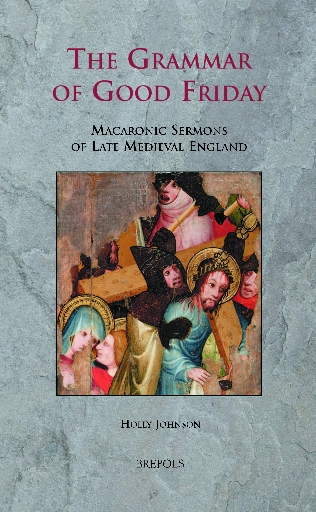
The Grammar of Good Friday
show More to view fulltext, buy and share links for:The Grammar of Good Friday show Less to hide fulltext, buy and share links for: The Grammar of Good FridayThis volume offers a study of Good Friday preaching and an edition (with modern translation) of five highly imaginative, rhetorically sophisticated macaronic (mixed Latin and Middle English) Good Friday sermons preached in late medieval England (c. 1350-1450). The study investigates the way medieval preachers made use of popular topoi and popular categorizations, reworking and recombining well-known material to create new sets of associations and images. The features that these sermons share with other genres, such as Passion plays, meditative treatises, and Middle English lyrics, reveal the rich cross-fertilization of this material and the cultural pervasiveness of topoi and images we often associate with literary works such as Piers Plowman. The sermons in this edition, all but one previously unavailable, increase our understanding of the medieval art of memory, the relationship between verbal and visual images, affective piety, and medieval rhetoric. Finally, all five of the sermons edited are macaronic, two of them switching between Latin and Middle English within almost every sentence; they thus offer a significant witness to this curious linguistic phenomenon. This volume presents new and rich source material and places this material into its wider cultural contexts with a detailed investigation of the rhetorical dimensions and intended effects of late medieval Good Friday preaching.
-
-
-
Glosa Victorina super partem Prisciani De Constructione (ms. Paris, Bibliothèque de l'Arsenal 910)
show More to view fulltext, buy and share links for:Glosa Victorina super partem Prisciani De Constructione (ms. Paris, Bibliothèque de l'Arsenal 910) show Less to hide fulltext, buy and share links for: Glosa Victorina super partem Prisciani De Constructione (ms. Paris, Bibliothèque de l'Arsenal 910)From the twelfth century onwards, notable advances in the theoretical development occur in independent treatises on syntax, which on their side are intimately linked with medieval commentaries on the last two books, the so-called Priscian Minor, of the Institutiones Grammaticae I-XVIII, where Priscian deals with syntax. A number of the independent treatises on syntax are now available. But of the many commentaries on Priscian Minor known, only a few have been edited, so let me start by editing an interesting 12th c. gloss on Priscian Minor, called the Glosa Victorina. Priscian Minor itself begins with introducing the notion of what is a perfect sentence, what is a well-formed utterance and which parts of speech are indispensable or the most important, stating their order of importance : noun, verb, participle, pronoun, and the indeclinable word classes. As the argumentation unfolds, comparisons between letters, syllables and words are introduced providing a continuity and refinement on what was taught earlier in the so-called Priscian Maior, and how this concerns grammar on the level of syntax. Very quickly, this leads to an interdisciplinary discussion of what constitutes a perfect sentence (according to the grammarians and the dialecticians), involving the commentators in redefinitions of the principal parts of speech and explaining their distinguishing features. In this process, notions of substance, of person, of deixis, of reference - signification, and many other important grammatical issues are discussed. So in principle, the beginning of any commentary on Priscian Minor provides its author with scope for developing his particular doctrines and ideas of prime importance in linguistics.
Here the Glosa Victorina deserves a closer look, because it provides us with insights into discussions normally only hinted at by Abelard, or a use of terminology which then becomes refined and partially rejected by William of Conches and Petrus Helias.
-